


By Lt Col Ujjual Abhishek Jha, Retd
The announcement by Chinese Foreign Ministry spokesperson Mao Ning on 18 January 2025, regarding ceasefire between the Myanmar Army and MNDAA appeared to be a diplomatic mediation for promotion of peace, which gained lot of traction. However, what missed the headlines is, what prompted the superpower (already exporting high calibre and advance weapon systems to Myanmar Army) to broker a peace deal with anti-junta group. What sounded like diplomacy, had lot behind the curtains. The real motivation is hidden behind a 1700 km infrastructure corridor with financial tune of more than $15 billion, rare earth mines and a strategic vulnerability that China is apprehensive for more than two decades, the China-Myanmar Economic Corridor (CMEC).
CMEC is one of the most geopolitically consequential bilateral infrastructure initiative in mainland Southeast Asia. The CMEC extends from Yunnan Province of Chian, across Myanmar to the Bay of Bengal, in an inverted Y-shape, providing China land bridge to the Indian Ocean, evading vulnerable Strait of Malacca. For Myanmar junta, CMEC is both financial sustenance and a diplomatic tool.
CMEC was established in September 2018 through a 15-point Memorandum of Understanding and is the Myanmar-specific iteration of Belt and Road Initiative (BRI) of China. However, it is not a new creation but consolidation and rebranding of a set of Chinese infrastructure in Myanmar, though, running years behind schedule.
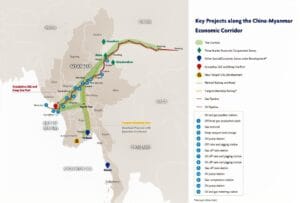
Key Projects Along CMEC (https://iems.ust.hk/)
Background of CMEC
The conceptual lineage of CMEC lies in the Bangladesh-China-India-Myanmar (BCIM) Economic Corridor, proposed in 2013 at a meeting in Kunming, proposing a multi-nation corridor linking Kunming to Kolkata via Mandalay and Dhaka, thereby fostering regional trade. However, the implementation could not see light of the day issues due to border standoffs between India and China, ending the four-nation framework. The consolidation and rebranding of CMEC was done in different phases.
Precursors (2009–2015) – The foundations of the corridor were laid under previous junta regime through Memorandum of Understanding (MoU), signed with CITIC Group of China. The phase culminated in completion of $2.5 billion crude oil and natural gas pipelines, establishing a direct energy connection from Kyaukphyu, Rakhine State to Kunming, China.
Rebranding in November 2017 – Wang Yi, Chinese Foreign Minister, proposed the formal CMEC framework with National League for Democracy (NLD) led government with an aim to consolidate and revive multiple infrastructure initiatives, previously stalled.
MoU and Institutionalisation of CMEC in September 2018 – The bilateral partnership reached a structural milestone with the signing of an official 15-point MoU, broadening the scope of cooperation beyond energy to incorporate manufacturing, transport and agricultural sector.
Rationalising Project in November 2018 – There was a concern over potential debt distress in Myanmar leading to reduction of the Kyaukphyu Deep-Sea Port from $7.2 billion (initial cost for Phase I) to $1.3 billion.
Overarching Roadmap in January 2020 – The Myanmar visit of Xi Jinping, Chinese President, resulted in signing of 33 bilateral agreements, strengthening Chinese intent of long-term access to the Indian Ocean.
Revitalising: Post-Military Transfer of Power Coup Re-authorization in May 2021 – The military transfer of power on 01 Feb 2021, the junta-led Myanmar Investment Commission (MIC) attempted to fast-track economic projects. MIC approved 15 major investment proposals, including the $2.5 billion Mee Lin Gyaing Liquefied Natural Gas (LNG) Power Project.
Conflict and Enhanced Security Agreement in December 2023 – The intensification of internal conflict in Myanmar caused State Administration Council (SAC) signing an additional concession agreement with CITIC Group for the Kyaukphyu Deep-Sea Port to incorporate enhanced security provisions for protection of Chinese infrastructure investments.
Impetus to Bilateral Agreements in June 2026 – The visit of Min Aung Hlaing, Myanmar President to China witnessed signing of 18 new bilateral agreements and revival of Muse-Mandalay Railway project, which is already delayed.
Phases of CMEC: A Comparative Outlook
The development of the CMEC is anatomically divided into two distinct phases, demarcated by the 01 February 2021 military transfer of power and resultant expanding internal conflict.
Phase I (2017-2021) – The Phase I engagement were formal in nature and directly negotiated with civilian NLG government. The period focused on long-term institutional inter-governmental planning by feasibility studies and social and environmental compliance. Although, the project had a cumulative value of approximately $15 billion, the on-ground implementation showed slow movement. The NLD government, to avoid severe debts, initiatives multiple projects. In spite of these interruptions, Phase I laid the physical and administrative base for strategic footprint of China, particularly through the operation of oil and natural gas pipelines alongside completed viability reports for key economic zones.
Phase II (2021- Present) – The military transfer of power in February 2021, restructured the Chinese landscape in Myanmar with a shift from government level to realistic and conflict-driven risk management. To protect its investments amidst ongoing internal conflict in Myanmar, China directly engaged with Ethnic Armed Groups (EAGs) who were controlling border trade zones. EAGs have emerged as the “New Stakeholders”, prominently, Arakan Army (AA) (which controls most of the Rakhine State including encircling Kyaukphyu town implying need for separate engagement track with the AA), Myanmar National Democratic Alliance Army (MNDAA) (controlling the Kokang region in Shan State and signed the Haigeng ceasefire in Jan 2024 under Chinese pressure and handed Lashio back to junta) and Ta’ang National Liberation Army (TNLA) (controls parts of Shan State through which the pipeline and planned railway pass). The EAGs engagement illustrates leverage and the transactional nature of EAO-China engagement. The Chinese priorities moved from regulatory agreement towards survival, securing transit rights, establishing border security pacts.
CMEC Projects: Summarised Tabulated Data
| Project | Investment | Location | Stakeholders | Status as of July 2026 | Highlight |
| Kyaukphyu Deep Sea Port | $1.3 Bn (scaled down from $7.2 Bn) | Kyaukphyu, Rakhine | CITIC Group & Myanmar Govt | Ongoing, limited progress | Flagship project to give China direct Indian Ocean access and reduce Malacca dependence. Original MoU 2009, tender 2015 for $7.3 Bn, NLD renegotiated to $1.3 Bn in 2018 for debt concerns. Faces security disruption due to Arakan Army control. |
| Kyaukphyu Special Economic Zone (KPSEZ) | $1.5 Bn | Kyaukphyu, Rakhine | CITIC | Environmental Impact Assessment (EIA) & survey ongoing | March 2025 talks held to expedite implementation. |
| Muse-Mandalay Railway | $8.9 Bn | 431 km Muse-Mandalay | China Railway Eryuan Engineering Group (CREEC) | Feasibility done 2019, preparatory stage | Core connectivity, still in planning/ negotiation phase. |
| Mandalay-Kyaukphyu Railway | Not Known | Mandalay to Kyaukphyu | CREEC | Survey conducted | Extension of Muse-Mandalay to port. |
| Mandalay-Tigyaing-Muse Expressway | $820 Mn | Shan | Not Known | Stalled | Part of structural network for corridor. |
| Kyaukphyu-Naypyidaw Highway | $2.15 Mn | Rakhine to Naypyidaw | Not Known | Planning, stalled | Not Known |
| China-Myanmar Oil & Gas Pipelines | Not Known | Kyaukphyu to Kunming | CNPC | Operational | Existing asset under CMEC |
| Kyaukphyu Power Plant | $180 Mn | Kyaukphyu | VPower Group + CNTIC JV $140 Mn | Completed 2023, suspended and now dismantled | Suspended late 2023 due to junta failure to supply gas and pay in USD, dismantling enhanced in early 2026 |
| Mee Lin Gyaing LNG Terminal | $2.5 Bn | Ayeyarwady Region | Not Known | Early design stage | Revived post-2021 |
| New Yangon City Project | $1.5 Bn | Yangon | Not Known | Planning stage | Yet to complete layout of corridor |
| Chinshwehaw CBECZ | Not Known | North Shan State | Not Known | Stalled | China-Myanmar Border Economic Cooperation Zone (CMBECZ) |
| Kanpiketi CBECZ | $22.4 Mn | North Kachin Special Region | Not Known | MoU to be signed | – |
| Muse-Ruili CBECZ | Not Known | Muse-Ruili border | Not Known | Planning | – |
| Mandalay Myotha Industrial Park | $500 Mn | Mandalay | Not Known | Completed | – |
At present, CMEC remains largely stalled and only functioning aspect is the oil and gas pipelines. Even though these are functional but transports resources much below designed capacity and amidst frequent security threats from local resistance groups and EAGs. Construction on the Kyaukphyu deep-sea port and SEZ has to be halted due to increased control by AA. On the similar lines, the $8.9 billion Muse-Mandalay railway remains stuck in the preparatory stage and is further complicated by the distressing earthquake of March 2025. This on-ground stalling is in contrast with intense diplomatic activity in 2024-26, featured by frequent meetings, the establishment of BRI implementation committee by junta, and Chinese endorsement of multi-phase elections in Myanmar.
Decoding Chinese Interest: Geopolitical, Strategic & Economic
Resolving the Malacca Dilemma – The most important strategic vulnerability for China is energy and approximately 80% of China’s crude oil imports pass through the Strait of Malacca, a narrow chokepoint susceptible to disruptions in a conflict scenario. In 2003, this vulnerability was pronounced by Hu Jintao, then President as the “Malacca Dilemma”. The CMEC oil pipeline directly addresses this by providing an alternative route, wherein, oil from the Middle East and Africa can unload at Kyaukphyu and further pumped to Kunming. In addition, this route is almost 3000 kms shorter than Malacca route implying shortening of transit time. The gas pipeline reduces China’s dependency on imported LNG, which is also routed through Malacca.
Transforming Economic Geography of Yunnan – Yunnan Province in China is a landlocked, mountainous and peripheral to coastal-driven economic model of China. The Bay of Bengal direct access (and further to the Indian Ocean, Middle East, Africa and Europe without the 3,000 km detour through Malacca) through Kyaukphyu connectivity to renovates economic geography of Yunnan by reducing freight costs, opens export markets and places Kunming as a logistics and refining hub. This strategy helps China to integrate hinterland provinces into the global economy.
Node for ‘String of Pearls’ – Kyaukphyu is one of the node for, what analysts have described as Chinese ‘String of Pearls’, which is a network of port and infrastructure investments across the Indian Ocean littoral, that cumulatively expands logistic, economic, and potentially naval reach of China, across the Indian Ocean. The People’s Liberation Army Navy of China’s ‘Blue Water Navy’ strategy, aiming for full ocean capability by 2030, creates a structural interest in Indian Ocean access nodes.
Diplomatic and Political Leverage – CMEC gives China considerable leverage over junta in Myanmar. Post military transfer of power, junta government in Myanmar has been diplomatically isolated, financially constrained by sanctions and militarily besieged. The role of China as the primary external economic partner, infrastructure financier, and diplomatic shield makes Myanmar structurally dependent on China. This leverage is used to gain concessions (pipeline security guarantees, support for CMEC implementation, suppression of anti-China protests), to impact internal peace process in Myanmar (Haigeng Agreement, Lashio transfer) and shaping the political landscape.
Access to Extract Resource – The rich resources of Myanmar in terms of timber, jade, rare earths, nickel and agricultural commodities, are being accessed by China to extract for its own usage. CMEC linked infrastructure reduces the cost of resource extraction and export to China. The Tagaung Taung nickel project, the Letpadaung copper mine and extensive jade extraction in Kachin State, are all embedded in the CMEC aided economic connection.
Security Impact of CMEC
CMEC offers a double-edged dynamic for Myanmar, burdening with unsustainable financial commitments amidst intensifying local conflict. With Phase 1 of the Kyaukphyu port alone required a $2.2 billion risking Myanmar with heavy debt trap with China. In addition to economics, protection of pipeline routes involves battalions occupying contested zones, widespread displacement, land confiscation and local hostility. Combining this with China’s acting as an indispensable yet distrusted broker by playing both sides is yet another major security concern.
Takeaways for India
The expansion of CMEC can be viewed as major security challenge for India, specifically with respect to Chinese ‘String of Pearls’ and increasing presence in the Bay of Bengal. This maritime vulnerability is compounded by increasing instability along 1,643 km Indo-Myanmar thereby triggering large influx of Myanmar nationals and attempted resurgence of insurgent networks. On the economic and diplomatic front, CMEC directly contests “Act East Policy” of India and impends its regional influence. Delay in the projects like the Kaladan Multimodal Transit system and the India-Myanmar-Thailand Tri-nation Highway, can jeopardise India’s connectivity dominance to South East Asia, while CMEC rail and trade networks can become the dominant conduits.
To counter this structural hindrance, India needs to accelerate its own infrastructure projects by parallel negotiation with local and relevant EAG, expand its naval footprint in the Bay of Bengal alongside Quad allies, and leverage multilateral frameworks like BIMSTEC to offer a viable alternative to Chinese dominance.
Conclusion
Despite active conflict and delays, China envisages CMEC as a multi-decade strategic initiative, much more than a purely infrastructure project. It highlights the geo-political and strategic intentions of China to become ocean power. An operational CMEC would provide China direct land-bridge access to the Bay of Bengal, reduce Malacca vulnerability, extend Chinese economic and potentially military influence into India’s maritime deck, and structurally impinge upon Act East Policy of India. And most importantly, the China is not exporting peace in form of brokering peace deals in Myanmar rather building a framework to control the internal conflict in Myanmar. Deciphering this aspect, which is behind the curtains, is key to understand the future headway of Southeast Asia.
The post Decoding Geopolitics Behind The China – Myanmar Economic Corridor (CMEC) first appeared on The Frontier Manipur.
Read more / Original news source: https://thefrontiermanipur.com/decoding-geopolitics-behind-the-china-myanmar-economic-corridor-cmec/