
Linear Path of Terror: Architecture of Modern Terrorist Financing

Trends collectively suggest that TF risk is becoming more diffuse, networked and embedded in legitimate global flows, requiring intelligence?driven, multi?sectoral responses rather than reliance on static typology checklists. By Lt Col Ujjual Abhishek Jha, Retd Comprehending Terrorist Financing (TF) origins requires an analytical thinking beyond conventional Anti-Money Laundering (AML) framework. Money Laundering (ML) is circular […]

The post Linear Path of Terror: Architecture of Modern Terrorist Financing first appeared on The Frontier Manipur.

Trends collectively suggest that TF risk is becoming more diffuse, networked and embedded in legitimate global flows, requiring intelligence?driven, multi?sectoral responses rather than reliance on static typology checklists.

By Lt Col Ujjual Abhishek Jha, Retd

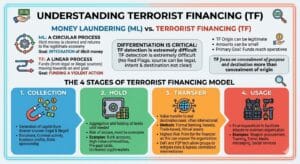
Comprehending Terrorist Financing (TF) origins requires an analytical thinking beyond conventional Anti-Money Laundering (AML) framework. Money Laundering (ML) is circular process wherein illicitly acquired money is integrated back to legitimate economy. TF is a linear process wherein source of money can be legal or illegal and is aimed towards a violent action. This differentiation is very important in TF, as it makes detection of TF extremely difficult (no Red Flags, source legal or intent and end point not established). Terrorist financing (TF) are finances that enable terrorist activities. TF differs from typical money laundering in three important ways, origin of funds may be legitimate, amounts involved can be relatively small and primary objective is to ensure funds reach operatives. ?? ????? ?? ??????????? ?? ??????? ??? ??????????? ???? ???? ??????????? ?? ??????. Four stage frameworks of TF model are ??????????, ????, ???????? ??? ?????.

Four Stage Framework TF Model

  • Stage 1: Collection. The generation of capital from a diverse source (both legal and illegal/ criminal) to support organization’s expenditures or specific operations. Can be donations, criminal activity, business profits or state sponsored.
  • Stage 2: Hold. The aggregation and holding of funds until they are required for an operational need. This stage has the risk of seizure and needs to overcome the same. Can be in bank accounts, high-value commodities, pre-paid cards or un-hosted crypto-wallets.
  • Stage 3: Transfer. The transfer of value from the storage point to the end destination or user, often across international borders i.e. transfer of value from holding point to end destination or user. Formal banking, Informal Value Transfer System (Hawala), trade-based or virtual assets are few examples of the same. This stage is often said to be the point of highest risk for the financier as this can expose the organisation. However, the evolution of decentralised finance (DeFi) and peer-to-peer (P2P) technologies has increasingly allowed groups to mitigate these risks by bypassing centralized intermediaries.
  • Stage 4: Usage. The final expenditure of funds to facilitate attacks or maintain the organization’s long-term sustainability. Can be for weapon procurement, training, travel, media messaging or social services.

 Typology of Sources of Terrorist Financing

 TF: Legal & Semi-Legitimate Sources

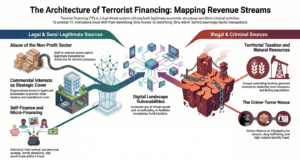
A substantial portion of TF is resultant of legitimate economic activity, which presents a distinct challenge for financial institutions. If funds originate from a lawful activity and do not stain of criminal predicate, then it necessitates a shift from identifying dirty money to dirty intent. The means are discussed below.

Abuse of the Non-Profit Sector (NPOs) – NPOs and charities have been identified by the FATF as particularly vulnerable to abuse for terrorist financing. E.g. fund diversion of legitimate donations for humanitarian purposes are siphoned off by complicit staff or external actors.

Commercial Interests and Legitimate Businesses – Large terrorist organizations often act as venture capitalists, investing surplus capital into legitimate commercial sectors to ensure a steady stream of income, serving dual purpose, provide a clean revenue stream and offer cover for operatives stay and move.

Self-Finance and the Lone Wolf – The individual operatives have own legitimate income as the primary source of funding. It is often supplemented by micro-financing strategies like welfare and benefit fraud, small loans and personal savings & family donations.

TF: Illegal & Criminal Sources

Industries and Territorial Taxation – For groups that control territory, such as ISIS at its zenith, the primary source of revenue is the exploitation of natural resources and the taxation of the local population.

Kidnapping for Ransom (KFR) – Kidnapping for ransom has become a principal revenue generation source for groups like Al-Qaeda in the Islamic Maghreb (AQIM) and even in the case of ISIS provinces in West Africa, Khorasan, and South Africa.

Drug Trafficking – The intersection of drug trafficking and terrorism is one of the most known aspects of the crime-terror nexus. The reported Taliban’s dependance on the opium trade and Hezbollah’s said involvement in the cocaine trade from South America to Europe show exploitation of drug market by these groups to fund their political projects.

Fraud and Identity Theft – In Western countries terror cells involves in low level but high-volume frauds supporting terrorist financing methods.

 Digital Landscape – Introduced new vulnerabilities into FT leading to increased abuse of digital platforms (virtual assets, crowdfunding and social media) to facilitate collection and transfer of funds with speed and anonymity.

Move Typology: Mechanics of Transfer

Post raising and storing of funds, movement of funds is required for operations/ sustenance. The terror outfits mostly employ hybrid method of fund transfer, formal, informal and trade-based systems to evade surveillance.

Formal Fund Transfer – In spite of exhaustive regulation, the formal banking sector remains a primary target for misuse, using individuals with clean backgrounds (straw men) for opening accounts and transactions. Usage of shell companies is also common method to mask the movement of funds. A common method in the formal sector is structuring or smurfing, where large sums is broken into small transactions to avoid trigger of Suspicious Transaction Reports (STRs).

Hawala and Informal Value Transfer Systems (IVTS) – Hawala is an ancient system of value transfer that operates outside the conventional banking sector. It is based on a network of brokers (hawaladars) who facilitate transfers through trust and net settlement rather than the physical movement of money. The characteristics of Hawala as speed, lower costs and potential anonymity, makes it highly attractive for both legitimate remittances and illicit financing. Hawala settlement in often through Reverse Hawala or Bilateral Settlement, where hawaladars balance their accounts by paying for each other’s expenses in or through the invoicing of legitimate trade.

Trade-Based Money Laundering and Terrorist Financing (TBML/TBTF) – TBML is defined as the process of disguising the proceeds of crime and moving value through the use of trade transactions to legitimize their origins. It is one of the most complex methods of value transfer. Mechanisms of TBML include Over and Under-Invoicing, Phantom Shipments (documents generated for goods that are never shipped), Multiple Invoicing and Surrogate Shopping/ Daigou (high purchase of goods using illicit cash and collecting clean money from end-users). As per FATF, TBML is increasingly attractive and is frequently used by groups like Hezbollah and the Taliban, who have established deep connections with international trade and transport companies.

Digital Frontier & Emerging Technologies

The rapid evolution of financial technology has introduced new vulnerabilities into the FT landscape. Terrorists are increasingly misusing digital platforms including virtual assets, crowdfunding and social media, to generate and move funds with unprecedented speed and anonymity.

Virtual Assets (VAs) and Cryptocurrencies – Virtual assets are characterized by non-face-to-face relationships and can permit anonymous funding. While Bitcoin was the initial currency of choice, the transparency of its blockchain has led to a shift toward more privacy-centric and stable assets. The overall VA use in terrorist financing remains relatively lower than cash and Hawala, but its reportedly growing in South and Central Asia.

Crowdfunding and Social Media Integration – Social media platforms as Facebook and Twitter act as broadcast mechanisms to ask donations. Once a potential donor is identified, the conversation moves to private, often encrypted, as Telegram or WhatsApp. Crowdfunding platforms are misused through campaigns, disguising funds as humanitarian aid for conflict zones, using combination of traditional payment methods and new technologies (Crypto) to avoid detection.

Emerging Threats and AI Factor

FATF Update on TF Risks of 2024 and 2025 highlights surge in activity by young, tech-savvy actors who are radicalized online and employ micro-financing. FATF also warned specific AI risks of not only in the recruitment and radicalization but also in automation of fund operations.

Trends collectively suggest that TF risk is becoming more diffuse, networked and embedded in legitimate global flows, requiring intelligence?driven, multi?sectoral responses rather than reliance on static typology checklists. For corporate security and compliance functions, this means that the “financial footprint” of terrorism often appears as small, routine, sometimes even charitable or community?oriented transactions.

(Lt Col Ujjual Abhishek Jha, Retd is a Certified Data Privacy Professional and Strategic & Geopolitical Advisor with over two decades of experience in intelligence, insider threat management, financial crime investigations, and geopolitical risk analysis, advising on complex security and strategic risks.)


The post Linear Path of Terror: Architecture of Modern Terrorist Financing first appeared on The Frontier Manipur.

Read more / Original news source: https://thefrontiermanipur.com/linear-path-of-terror-architecture-of-modern-terrorist-financing/

CM Links Tronglaobi Killings to Elements Keen on Derailing Peace Efforts, Calls for Unity

Highlighting public sentiment, Yumnam Khemchand said people across communities have expressed a strong desire for peace and stability. He urged citizens to remain united and vigilant against elements seeking to create division. TFM Report Manipur Chief Minister Yumnam Khemchand Singh on Wednesday (April 29) said the April 7 Tronglaobi blast, which killed two children, was […]

The post CM Links Tronglaobi Killings to Elements Keen on Derailing Peace Efforts, Calls for Unity first appeared on The Frontier Manipur.

Highlighting public sentiment, Yumnam Khemchand said people across communities have expressed a strong desire for peace and stability. He urged citizens to remain united and vigilant against elements seeking to create division.

TFM Report

Manipur Chief Minister Yumnam Khemchand Singh on Wednesday (April 29) said the April 7 Tronglaobi blast, which killed two children, was likely the handiwork of groups attempting to destabilize the state and obstruct ongoing peace efforts.

Referring to the Tronglaobi incident in which two children (siblings) were killed, he said the government under him believe that the incident must have been triggered by “those who did not want the formation of a popular government or those who want to create a volatile atmosphere. We will apprehend those responsible, they have no place to run”.

Addressing a gathering in Langthabal constituency in Imphal West district after inaugurating five infrastructure projects, the Chief Minister placed the incident in context. He noted that Manipur had been under President’s Rule since February 13, 2025, following the resignation of former Chief Minister N Biren Singh amid prolonged ethnic violence that began on May 3, 2023. President’s Rule was revoked on February 4, 2026, paving the way for the formation of a new government led by Singh, due to demand of forming a popular government from the general public.

“After a consistent demand for the revocation of President’s Rule and installation of a popular government through the voices of the public, I became the Chief Minister (I did not lobby for the post nor did I know that I would be the one for the post),” said the Chief Minister.

On the occasion, Khemchand also emphasized that peace remains the foremost requirement for development. The projects included three water supply schemes and two community halls. He added that since assuming office, his focus has been on initiating a “journey for peace” aimed at rebuilding trust and harmony among communities.

Over the past two months and twenty days, Singh said he has engaged extensively with MLAs, officials, and civil society groups, while also visiting both hill and valley districts—including Jiribam, Senapati, Kangpokpi, and Ukhrul—to understand public grievances and promote reconciliation. He pointed out that the Tronglaobi blast occurred shortly after his visit to Jiribam, calling it an “unfortunate” attempt to derail the fragile peace process.

Highlighting public sentiment, Singh said people across communities have expressed a strong desire for peace and stability. He urged citizens to remain united and vigilant against elements seeking to create division.

Reaffirming the government’s commitment, Singh said development initiatives would continue across all regions, including remote areas, despite ongoing challenges, and called for collective cooperation to build a peaceful and progressive Manipur.

The post CM Links Tronglaobi Killings to Elements Keen on Derailing Peace Efforts, Calls for Unity first appeared on The Frontier Manipur.

Read more / Original news source: https://thefrontiermanipur.com/cm-links-tronglaobi-killings-to-elements-keen-on-derailing-peace-efforts-calls-for-unity/

CM Links Tronglaobi Killings to Elements Keen on Derailing Peace Efforts, Calls for Unity

Highlighting public sentiment, Yumnam Khemchand said people across communities have expressed a strong desire for peace and stability. He urged citizens to remain united and vigilant against elements seeking to create division. TFM Report Manipur Chief Minister Yumnam Khemchand Singh on Wednesday (April 29) said the April 7 Tronglaobi blast, which killed two children, was […]

The post CM Links Tronglaobi Killings to Elements Keen on Derailing Peace Efforts, Calls for Unity first appeared on The Frontier Manipur.

Highlighting public sentiment, Yumnam Khemchand said people across communities have expressed a strong desire for peace and stability. He urged citizens to remain united and vigilant against elements seeking to create division.

TFM Report

Manipur Chief Minister Yumnam Khemchand Singh on Wednesday (April 29) said the April 7 Tronglaobi blast, which killed two children, was likely the handiwork of groups attempting to destabilize the state and obstruct ongoing peace efforts.

Referring to the Tronglaobi incident in which two children (siblings) were killed, he said the government under him believe that the incident must have been triggered by “those who did not want the formation of a popular government or those who want to create a volatile atmosphere. We will apprehend those responsible, they have no place to run”.

Addressing a gathering in Langthabal constituency in Imphal West district after inaugurating five infrastructure projects, the Chief Minister placed the incident in context. He noted that Manipur had been under President’s Rule since February 13, 2025, following the resignation of former Chief Minister N Biren Singh amid prolonged ethnic violence that began on May 3, 2023. President’s Rule was revoked on February 4, 2026, paving the way for the formation of a new government led by Singh, due to demand of forming a popular government from the general public.

“After a consistent demand for the revocation of President’s Rule and installation of a popular government through the voices of the public, I became the Chief Minister (I did not lobby for the post nor did I know that I would be the one for the post),” said the Chief Minister.

On the occasion, Khemchand also emphasized that peace remains the foremost requirement for development. The projects included three water supply schemes and two community halls. He added that since assuming office, his focus has been on initiating a “journey for peace” aimed at rebuilding trust and harmony among communities.

Over the past two months and twenty days, Singh said he has engaged extensively with MLAs, officials, and civil society groups, while also visiting both hill and valley districts—including Jiribam, Senapati, Kangpokpi, and Ukhrul—to understand public grievances and promote reconciliation. He pointed out that the Tronglaobi blast occurred shortly after his visit to Jiribam, calling it an “unfortunate” attempt to derail the fragile peace process.

Highlighting public sentiment, Singh said people across communities have expressed a strong desire for peace and stability. He urged citizens to remain united and vigilant against elements seeking to create division.

Reaffirming the government’s commitment, Singh said development initiatives would continue across all regions, including remote areas, despite ongoing challenges, and called for collective cooperation to build a peaceful and progressive Manipur.

The post CM Links Tronglaobi Killings to Elements Keen on Derailing Peace Efforts, Calls for Unity first appeared on The Frontier Manipur.

Read more / Original news source: https://thefrontiermanipur.com/cm-links-tronglaobi-killings-to-elements-keen-on-derailing-peace-efforts-calls-for-unity/

Digital Personal Data Protection Act (DPDPA) 2023 Series: Part IV –Implementation Recommendations

The enactment of the DPDPA 2023 and the DPDP Rules 2025 indicates the dawn of a new era for digital economy in India, where privacy is a fundamental operational requirement. However, the compliance path is steep, requiring a fundamental shift from reactive legal measures to a proactive “privacy-by-design” framework. By Lt Col Ujjual Abhishek Jha, […]

The post Digital Personal Data Protection Act (DPDPA) 2023 Series: Part IV –Implementation Recommendations first appeared on The Frontier Manipur.

The enactment of the DPDPA 2023 and the DPDP Rules 2025 indicates the dawn of a new era for digital economy in India, where privacy is a fundamental operational requirement. However, the compliance path is steep, requiring a fundamental shift from reactive legal measures to a proactive “privacy-by-design” framework.

By Lt Col Ujjual Abhishek Jha, Retd

For Part I – Digital Personal Data Protection Act (DPDPA) 2023 Series: Part I — The Foundations of Privacy: Evolution of Indian Laws & A Roadmap to DPDPA – The Frontier Manipur

For Part II – Digital Personal Data Protection Act (DPDPA) 2023 Series: Part II — From Principles to Practice: The DPDP Rules 2025, Global Paradigms & India’s Middle Path – The Frontier Manipur

For Part III – Digital Personal Data Protection Act (DPDPA) 2023 Series: Part III – Impact & Implementation Challenges – The Frontier Manipur

The entry of DPDPA, 2023, is more than a law. This is a fundamental shift in our life, work and interaction in the digital age. The law is pioneer in legal system, in drawing a clear line that personal data belongs to the people. This Act is a brave attempt to find the delicate balance between the right to privacy and the need for innovation in modern era. But a well-known fact remains that, there is often a gap between a law being passed and the reality of how it works on the ground and subsequent challenges faced by small businesses to corporate giants or law enforcement agency. This part brings out human-centred implementation strategy and explore how each player in the ecosystem can move beyond routine compliance and move towards building a culture where data privacy is treated as a core value.

 Implementation Strategy: Cross?Cutting Recommendations

 As organizations navigate the complexities of the DPDPA 2023 & DPDP Rules 2025, compliance should not be viewed as only a legal requirement but as a pillar of operational resilience. Across all segments, successful implementation will depend on four cross-cutting strategic pillars: –

  • Gap Assessment and Roadmap – First and foremost task is to identify technical and procedural vulnerabilities. Then utilize the 18-month window to identify and prioritize risks and address those by long-term infrastructure changes. Leveraging the statutory transition window needs to applied to cover the identified gaps using quantified roadmap.
  • Investment in Human Talent – Create own pool of internal talents and use expertise of external consultants to bridge the gap between legal framework and technical necessities. Qualified internal pool will act as intermediaries and needs to be supplemented by specialized external advisors to address complex regulatory nuances and technical implementation hurdles.
  • Governance Integration – The upliftment of privacy from back-office function to to a primary board-level priority for governance integration of board-level oversight. Also, accountability needs to be set using dedicated risk registers, Key Performance Indicators (KPIs) and periodic reporting.
  • Continuous Improvement – Dynamic alignment and regular recalibration of internal processes based on emerging guidance from the Data Protection Board of India (DPBI). Also, global benchmarking by evolving own strategies in line with shifting global best practices and evolving sectoral regulations to maintain a sustainable posture.

Recommendations

Individuals 

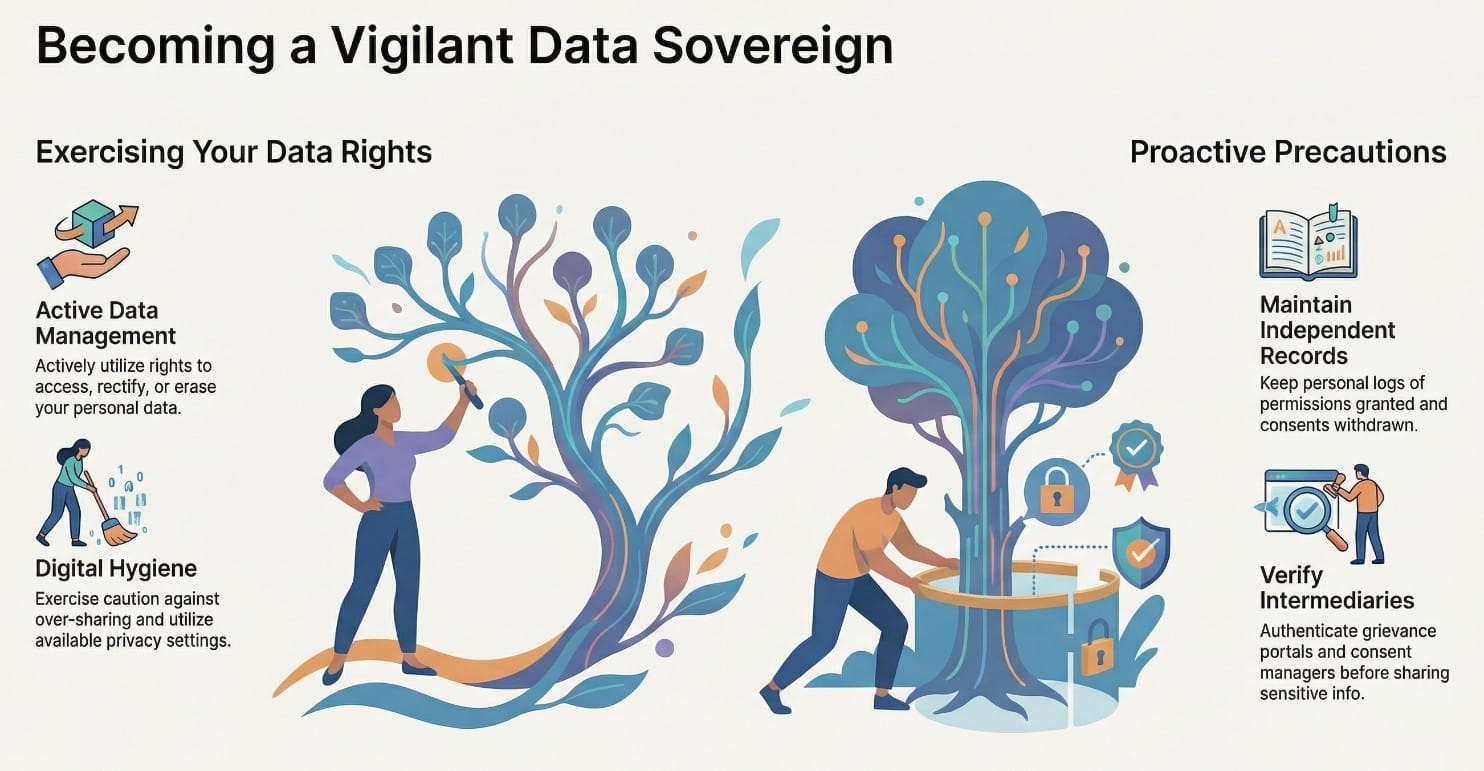
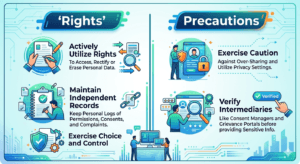
Statutory rights under the DPDPA empower individuals to manage their digital identity use of rights to see, fix or delete own data and keep own records of the permissions or any complaints. To exercise these effectively, individuals should follow these protocols: –

  • Access Inquiry – Formally request a summary of personal data currently being processed and the identities of third parties with whom it has been shared.
  • Correction & Completion – Initiate requests to rectify inaccurate data or complete evolving datasets to ensure processing remains fair.
  • Erasure Mandate – Request the deletion of personal data once the specific purpose for collection has been exhausted or consent is withdrawn.
  • Audit Trail Maintenance – Keep independent logs of all consents granted, notices received, and grievances filed to facilitate swift resolution through the DPBI if necessary.

MSMEs 

For MSMEs, the path to compliance begins with a pragmatic data inventory. The foundation for all privacy actions can be determined by: –

  • What – Classify the specific types of personal data collected.
  • Why – Define the specific legal purpose for processing.
  • Where – Plan the precise storage locations, whether in-premise, in the cloud or with third-party vendors.
  • Who – Identify all internal stakeholder and external partner with data access.

Data Inventory Steps

Map Data Ingress – Identify exact purpose of personal data collected from individuals.

Define Purpose – Clearly document the legal and operational for every data point.

Localize Storage – Precise data location both digital and physical.

Trace Data Egress: Document every third party with whom data is shared.


Compliance Tools Checklist

  • Standardize Policies – Adopt core privacy policies, data retention schedules and breach response SOPs.
  • Cloud-Native Services – Use managed services for consent management rather than internal solutions.
  • Standardized Notices – Implement simple language, standard notice and consent flows.
  • Security Defaults – Leverage cloud-based logging, encryption and access control features to meet security mandates.

 Alert: Regulatory Risk – MSMEs face limited but obligations regarding consent, notices, security and breach notification. While SDF is unlikely for MSMEs, sector-wise or large-scale classification can impact Fintech, Healthtech, Edtech and high-volume SaaS providers.

Corporates

Large-scale entities must organize a sophisticated, integrated and deep defence strategy. The steps that corporate needs to undertake are: –

  • Establishment of Privacy Office – Appoint a Chief Privacy Officer (CPO) or Data Protection Officer (DPO) to lead a dedicated office integrated with CISO, Legal, Risk and Compliance verticals.
  • Active Record of Processing Activities (ROPA) – Build and maintain a live data inventory mapped to specific purposes, retention schedules and legal bases.
  • Implement Data Protection Impact Assessments (DPIAs) – Integrate DPIAs into the lifecycle of all high-risk initiatives to institutionalize privacy-by-design.
  • Upgrade Third-Party Risk Management: Incorporate DPDPA-specific clauses and contractual safeguards into all vendor agreements, mandated with regular audits and certifications.
  • Align with Global and Sectoral Regulators: Coordinate DPDPA requirements with existing frameworks (ISO, NIST) and sectoral mandates (RBI, IRDAI, TRAI) to remove redundant efforts and leverage shared controls.

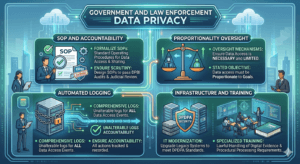
Government and Law Enforcement

  • SOP and Accountability – Government departments must formalize Standard Operating Procedures (SOPs) for data access and sharing. These SOPs must be designed to endure judicial scrutiny and DPBI audits.
  • Proportionality Oversight – Internal mechanisms must ensure that data access is necessary, limited in scope and proportionate to the stated objective.
  • Automated Logging – Comprehensive, unalterable logs must be maintained for all data access events to ensure accountability.
  • Infrastructure and Training – Legacy IT systems must be modernized to meet DPDPA security standards. Simultaneously, specialized training programs are required for investigators and prosecutors. This training must focus on the lawful handling of digital evidence and the strict procedural requirements for processing personal data during investigations. This means to transform LEA and departmental IT infrastructure to withstand DPBI and judicial scrutiny

International Business & Organisations


  • Extraterritorial Compliance: The extraterritorial applicability of DPDPA is to entities outside India offering goods/ services to individuals in India, requiring them to comply with rules (including consent, notices, rights handling and DPBI enforcement). Foreign entities must strictly adhere to Indian mandates regarding consent, notices and rights handling to avoid DPBI enforcement actions.
  • Cross-Border Transfer Mechanics – While transfers are allowed by default, organizations must monitor the government-notified “negative list” of prohibited countries or sectors. However, these needs to be kept in mind: –
  • Critical Sector Restrictions: High-risk or highly regulated sectors may face additional localization requirements or localized storage mandates.
  • Contractual Updates – Global organizations must map Indian data flows separately and update global privacy notices and vendor contracts with India-specific clauses.
  • Global Control Baselines: Establish privacy as a common control baseline across the organization while applying specific Indian legal overlays to local data flows.
  • Strategic Mapping: Separate Indian data flows from global flows in internal mapping to allow for rapid response to localization or transfer restrictions.

The enactment of the DPDPA 2023 and the DPDP Rules 2025 indicates the dawn of a new era for digital economy in India, where privacy is a fundamental operational requirement. However, the compliance path is steep, requiring a fundamental shift from reactive legal measures to a proactive “privacy-by-design” framework. Ultimately, those who view privacy as a strategic asset rather than a regulatory hurdle will be best positioned to thrive in India’s maturing, trust-based data landscape. In the present era of screens and servers, awareness of handling of our personal information is preferred way for a digital society. The transition will take time and requires a massive shift in mindset.  As we move forward, the companies and institutions that lead with transparency and empathy will be the ones that truly succeed in this new landscape.

(Lt Col Ujjual Abhishek Jha, Retd is a Certified Data Privacy Professional and Strategic & Geopolitical Advisor with over two decades of experience in intelligence, insider threat management, financial crime investigations, and geopolitical risk analysis, advising on complex security and strategic risks.)

The post Digital Personal Data Protection Act (DPDPA) 2023 Series: Part IV –Implementation Recommendations first appeared on The Frontier Manipur.

Read more / Original news source: https://thefrontiermanipur.com/digital-personal-data-protection-act-dpdpa-2023-series-part-iv-implementation-recommendations/

Can Manipur Govt issue advisory to digital media platforms under IT Rules, 2021? NO!

  Based on the legal framework of the Information Technology (Intermediary Guidelines and Digital Media Ethics Code) Rules, 2021 and the specific precedent involving The Frontier Manipur in 2021, a state government cannot issue such an advisory to regulate digital news content under Part III of the IT Rules, 2021. TFM Analysis The Home Department […]

The post Can Manipur Govt issue advisory to digital media platforms under IT Rules, 2021? NO! first appeared on The Frontier Manipur.


Based on the legal framework of the Information Technology (Intermediary Guidelines and Digital Media Ethics Code) Rules, 2021 and the specific precedent involving The Frontier Manipur in 2021, a state government cannot issue such an advisory to regulate digital news content under Part III of the IT Rules, 2021.

TFM Analysis

The Home Department of the Government of Manipur issued an advisory on April 27, directing all electronic, digital, and social media platforms operating within the State to adhere to responsible dissemination of information.

Citing the Information Technology (Intermediary Guidelines and Digital Media Ethics Code) Rules, 2021, the advisory noted that instances of unverified, misleading, and provocative content — including announcements attributed to banned organisations — have been observed, causing panic and disturbance to public order.

The advisory mandates due diligence by platforms, prohibits hosting content from unlawful or unauthorised organisations, and calls for the prevention of misinformation, deepfakes, and manipulated content. News publishers have been directed to adhere to the Code of Ethics under the IT Rules, 2021, ensuring accuracy, fairness, and respect for public order.

Platforms have also been asked to refrain from sensational or provocative content, establish grievance redressal mechanisms, and cooperate with law enforcement agencies. Non-compliance, the advisory stated, may attract action under the Information Technology Act, 2000. The order, issued with the approval of the Competent Authority, came into immediate effect.

Not Again! Know the Centre’s mandate

Based on the legal framework of the Information Technology (Intermediary Guidelines and Digital Media Ethics Code) Rules, 2021 and the specific precedent involving The Frontier Manipur in 2021, a state government cannot issue such an advisory to regulate digital news content under Part III of the IT Rules, 2021.

A cursory legal analysis and the referenced precedent.

  1. The Legal Basis: Part III is a Central Subject

The advisory you attached explicitly cites the IT Rules, 2021 as its source of authority (specifically clauses 3 and 4 of the document). However, the legal architecture of these rules divides power between the Centre and States:

– Part II of the IT Rules, 2021 deals with Intermediaries (social media platforms like Facebook, X, etc.). These rules are administered by the Ministry of Electronics and Information Technology (MeitY) .

– Part III of the IT Rules, 2021 deals with Publishers of Digital News and Current Affairs. These rules are administered exclusively by the Ministry of Information and Broadcasting (MIB), Government of India.

  1. The Central Government’s Clarification (2021)

To prevent overreach, the Central Government issued a formal clarification to all States and Union Territories on March 3, 2021. The Ministry of Information and Broadcasting explicitly stated that:

“It is hereby informed that Part-III of the Rules are administered by the Ministry of Information and Broadcasting, Government of India. These powers have not been delegated to State Governments/District Magistrates/Police Commissioners.”

Any action taken by a State Government under Part III (i.e., regulating digital news content, enforcing a “Code of Ethics,” or issuing directions to news publishers) is therefore legally untenable and ultra vires (beyond its legal authority).

  1. The Precedent: Manipur vs. The Frontier Manipur (2021)

Your reference to the notice issued to The Frontier Manipur is the definitive precedent for why the advisory issued by Government of Manipur, Home Department is invalid.

– The Incident (March 1, 2021): The District Magistrate of Imphal West issued a notice to The Frontier Manipur (TFM) and its talk show “Khanasi Neinasi.” The notice demanded documents proving compliance with the IT Rules, 2021, citing the new digital media norms. This was the first time that a notice has been issued under the new guidelines that the Centre announced on February 25.

– The Central Intervention: The Central Government intervened immediately. I&B Secretary Amit Khare wrote a letter to the Manipur Chief Secretary stating that the District Magistrate had no jurisdiction to issue such a notice.

– The Result: The Manipur Government was forced to withdraw the notice within 24 hours. The Deputy Commissioner pasted a new order outside The Frontier Manipur, Executive Editor’s residence stating the previous notice was “withdrawn with immediate effect”.

  1. How the Current Advisory Exceeds State Powers

The advisory dated April 27, 2026 contains several provisions that violate the 2021 Central clarification:

Provision in Advisory Legal Status  Reason
Point (v): Barring “sensational” or “provocative” content. Ultra Vires This is content regulation of news publishers, falling exclusively under MIB (Part III)
Point (vi): Mandating Grievance Redressal Mechanisms. Ultra Vires The 3-Tier grievance system for digital news is controlled by the Centre, not the State Home Department.
Point (vii): Threatening loss of “statutory protections” (Safe Harbour). Ultra Vires The power to strip an intermediary of safe harbor protection lies with the Centre under Section 79 of the IT Act, not a State Commissioner of Home.


  1. The “Notice” vs. “Advisory” Distinction

While the government might argue that the attached document is merely an “Advisory” and not an “Order,” legally this distinction is weak (a distinction without a difference).

– The Effect: The document uses mandatory language (“shall be ensured,” “strict compliance,” “Legal Consequences for Non-Compliance”).

– The Precedent: In 2021, the Centre rebuked Manipur even for issuing a notice requesting information. The Centre maintains that no State authority—whether by notice, order, or advisory—can compel compliance under Part III of the IT Rules.

What is Wrong?

The Government of Manipur lacks the constitutional and statutory authority to issue this advisory under the IT Rules, 2021.  Therefore, the advisory is legally unenforceable. It mirrors the exact overreach seen in The Frontier Manipur case of 2021, which the Central Government immediately quashed. If a media house receives such a notice, it can respond citing the MIB’s circular dated March 3, 2021, stating that the State Home Department has no jurisdiction over digital news content under Part III of the IT Rules, 2021.


The post Can Manipur Govt issue advisory to digital media platforms under IT Rules, 2021? NO! first appeared on The Frontier Manipur.

Read more / Original news source: https://thefrontiermanipur.com/can-manipur-govt-issue-advisory-to-digital-media-platforms-it-rules-2021-no/

Manipur Crisis Through Conflict Theory: A Two-Level Mistrust Model

The Manipur crisis as a simultaneous breakdown of vertical trust between citizens and the state, and horizontal trust among communities. Using conflict theory, it argues that structural inequalities, identity fears, security dilemmas, and cultural violence have transformed the crisis into a self-sustaining cycle of mutual insecurity. Lasting peace requires rebuilding institutional legitimacy and intergroup trust, […]

The post Manipur Crisis Through Conflict Theory: A Two-Level Mistrust Model first appeared on The Frontier Manipur.

The Manipur crisis as a simultaneous breakdown of vertical trust between citizens and the state, and horizontal trust among communities. Using conflict theory, it argues that structural inequalities, identity fears, security dilemmas, and cultural violence have transformed the crisis into a self-sustaining cycle of mutual insecurity. Lasting peace requires rebuilding institutional legitimacy and intergroup trust, not merely restoring law and order.

By Sheikh Abdul Hakim

The Manipur crisis can be theorised as a breakdown of social cohesion at two levels: the vertical level, between citizens and the state, and the horizontal level, among communities. Social-cohesion theory defines the horizontal dimension as trust among people and groups, while the vertical dimension concerns trust between citizens and institutions such as the government. In Manipur, both have weakened at the same time, making the crisis far deeper than a normal law-and-order problem.

Core thesis

From the perspective of conflict theory, Manipur is not merely a clash of communities. It is a conflict over security, land, recognition, political power, identity, dignity, and trust. The immediate violence began in May 2023 around ethnic tensions linked to Scheduled Tribe status, affirmative-action benefits, land and political anxieties; by 2026, Reuters reported around 260 deaths and more than 60,000 displaced, while ACLED described the two major communities as living in near-complete segregation after two years of violence.

The central problem is this: each community now sees its own survival as insecure, and many citizens no longer believe that institutions can protect them with neutrality, speed, and fairness. Once that happens, every incident is interpreted not as an individual crime, but as evidence of collective danger.

1. Structural conflict: unequal power, land, representation and resources

Classical conflict theory begins from the idea that society is not always harmonious; it is often shaped by struggles over scarce resources and institutional power. In Manipur, the relevant resources are not only money or jobs. They include land, constitutional protection, political representation, administrative control, access to security, development, mobility, and cultural recognition.

Frances Stewart’s theory of horizontal inequalities is especially useful. It argues that conflict becomes more likely when economic, political, social and cultural inequalities are experienced not merely by individuals, but by identity groups. Stewart’s framework defines horizontal inequalities as inequalities among groups sharing a common identity, and notes that when cultural differences overlap with economic and political differences, resentment can deepen into violent struggle.

Applied to Manipur, the hill-valley divide becomes more than geography. The valley is associated with demographic concentration, political centrality and administrative visibility; the hills are associated with land protection, tribal autonomy, distance from state services and fear of domination. The Meitei demand for Scheduled Tribe status, and the opposition to it from Kuki-Zo and other tribal groups, therefore, became a symbolic struggle over who will control the future rules of land, reservation, recognition and security. That is why the conflict cannot be reduced to one incident alone.

2. Identity conflict: when grievance becomes community consciousness

Social Identity Theory, developed by Henri Tajfel and John Turner, helps explain how people begin to see events through the lens of “us” and “them.” Their work showed that even minimal group distinctions can generate in-group preference and out-group suspicion; in a violent setting, this tendency becomes far more dangerous.

In Manipur, the crisis has turned identity into a security boundary. A killing, arrest, rumour, checkpoint, relief measure or government statement is no longer judged only on facts. It is often judged through the question: “Is this against my community or in favour of the other?” This is the psychological moment where horizontal mistrust becomes self-reinforcing.

The tragedy is that people who once shared markets, schools, roads, workplaces and friendships can begin to see one another as representatives of collective threat. At that stage, individual guilt disappears behind collective suspicion. Conflict theory calls this the hardening of group boundaries.

3. Security dilemma: every group’s self-defence frightens the other

The ethnic security dilemma is one of the most powerful explanations for Manipur today. Lake and Rothchild argue that intense ethnic conflict is not caused simply by “ancient hatred”; it is often produced by collective fear of the future, especially when groups doubt whether the state can credibly protect them. When the state’s authority weakens or is seen as biased, communities begin preparing for their own defence; those preparations then look threatening to the other side, causing a spiral.

This is visible in Manipur’s armed village-defence atmosphere, buffer zones, checkpoints, displacement camps, segregated settlements, and fear of crossing into the “other” area. Reuters reported that weapons were in circulation, including arms stolen from police or smuggled from Myanmar, while many Kukis and Meiteis moved out of mixed areas.

The security dilemma works like this:

One side says: “We are arming or blocking roads only to protect ourselves.”

The other side hears: “They are preparing to attack us.”

The state intervenes: one group sees protection, another sees bias.

Result: fear grows even when both sides claim they want safety.

Thus, Manipur’s crisis has moved from grievance to fear, and from fear to separation.

4. Vertical mistrust: the crisis of state legitimacy

Conflict theory also asks: who controls institutions, and do people see those institutions as neutral? In Manipur, vertical mistrust has become central. Many citizens no longer evaluate the state only by laws written on paper; they evaluate it by lived experience: Who came when we were attacked? Whose FIR was registered? Whose dead were honoured? Whose displaced families were heard? Whose roads were opened? Whose suffering was ignored?

The Supreme Court’s intervention itself shows the gravity of the institutional-trust problem. In its [Manipur violence order], the Court stressed the need to restore faith and confidence in the justice system, ensure that perpetrators are punished according to law, and sustain public confidence in investigation and prosecution. It also constituted a three-judge committee led by Justice Gita Mittal for relief, rehabilitation and survivor support, and appointed an outside police officer to supervise investigations.

This matters theoretically because when citizens lose confidence in institutions, they seek security from community organisations, armed volunteers, pressure groups, ethnic councils, rumour networks and local defence structures. The state then loses its monopoly over trust, even if it still has formal authority.

In simple terms: a government may control territory, but it cannot produce peace unless people believe it is fair.

5. Cultural violence: when language makes violence acceptable

Johan Galtung’s theory divides violence into direct violence, structural violence, and cultural violence. Direct violence is visible: killings, arson, sexual violence, displacement, attacks. Structural violence is built into unequal systems. Cultural violence is the language, symbols, stereotypes and narratives that make direct or structural violence appear acceptable.

In Manipur, cultural violence appears when entire communities are reduced to labels: “illegal,” “terrorist,” “drug-linked,” “land-grabber,” “anti-national,” “aggressor,” or “enemy.” Once such language spreads, the crime of an individual is transferred onto a whole community. This is how collective blame is manufactured.

The theoretical danger is that cultural violence does not always look like violence. It may look like a slogan, a speech, a rumour, a meme, a funeral speech, a protest placard, or a social-media post. But it prepares the mind to accept cruelty.

6. Conflict entrepreneurs: those who benefit from division

Conflict theory also pays attention to actors who gain from instability. These may include extremist groups, armed networks, political hardliners, black-market actors, rumour-spreaders, and leaders who gain influence by presenting themselves as sole protectors of a community.

Lake and Rothchild note that [ethnic activists and political entrepreneurs] can build upon insecurity and polarise society. In Manipur, this means the conflict is not sustained only by spontaneous anger. It is also sustained by networks that turn fear into mobilisation, mobilisation into power, and power into bargaining strength.

This is why peace is difficult: for ordinary people, peace means returning home; for conflict entrepreneurs, peace may mean losing relevance.

7. Displacement and segregation: mistrust becomes geography

Displacement changes conflict from an event into a living structure. Once people are separated into camps, protected zones and community-specific territories, mistrust becomes geographical. ACLED’s description of near-complete segregation is therefore not only a demographic fact; it is a conflict-theory warning. Separation reduces everyday contact, and reduced contact allows rumours to replace relationships.

Intergroup Contact Theory, associated with Gordon Allport and later work by Pettigrew, suggests that contact reduces prejudice best when there is equal status, common goals, cooperation and authority support. But unsafe, unequal or forced contact can deepen fear. Therefore, simply telling communities to “live together again” is not enough. They need conditions where coexistence is safe, dignified and institutionally protected.

The Manipur crisis in one theoretical formula

Structural insecurity + identity fear + weak institutional trust + armed separation + hostile narratives = prolonged ethnic conflict.

Or more simply:

Vertical mistrust makes people doubt the state. Horizontal mistrust makes people fear neighbours. Together, they create a society where every action is suspected, every rumour travels fast, and every tragedy can become another trigger.

What conflict theory teaches for Manipur

The first lesson is that policing alone cannot solve a conflict that has become structural and psychological. Security is necessary, but security without trust can be read as occupation, bias or threat.

The second lesson is that justice must be both real and visible. The Supreme Court’s emphasis on restoring public confidence in investigation and prosecution is crucial because, in a mistrust society, justice hidden from public confidence will not heal public wounds.

The third lesson is that peace must operate at three levels: stop direct violence, correct structural grievances, and defeat cultural hatred. Galtung’s framework makes clear that removing guns is only the beginning; societies must also remove the narratives and inequalities that make violence return.

Final theoretical framing

Manipur today is best understood as a crisis of mutual insecurity. The Meitei fear loss of identity, land security, demographic balance and historical centrality. The Kuki-Zo fear loss of land, autonomy, physical safety and equal protection. Other communities fear being dragged into a binary conflict that may erase their own concerns. The government faces a legitimacy deficit because different communities judge its actions through different wounds. Therefore, the problem is not only that communities disagree. The deeper problem is that they no longer trust the same facts, the same institutions, or the same future.

The crisis began with events. It now survives through structures. It will end only when Manipur rebuilds both: vertical trust in the state and horizontal trust among communities.

(Sheikh Abdul Hakim is Director, Social Welfare, Government of Manipur)


The post Manipur Crisis Through Conflict Theory: A Two-Level Mistrust Model first appeared on The Frontier Manipur.

Read more / Original news source: https://thefrontiermanipur.com/manipur-crisis-through-conflict-theory-a-two-level-mistrust-model/

Manipur Crisis Through Conflict Theory: A Two-Level Mistrust Model

The Manipur crisis as a simultaneous breakdown of vertical trust between citizens and the state, and horizontal trust among communities. Using conflict theory, it argues that structural inequalities, identity fears, security dilemmas, and cultural violence have transformed the crisis into a self-sustaining cycle of mutual insecurity. Lasting peace requires rebuilding institutional legitimacy and intergroup trust, […]

The post Manipur Crisis Through Conflict Theory: A Two-Level Mistrust Model first appeared on The Frontier Manipur.

The Manipur crisis as a simultaneous breakdown of vertical trust between citizens and the state, and horizontal trust among communities. Using conflict theory, it argues that structural inequalities, identity fears, security dilemmas, and cultural violence have transformed the crisis into a self-sustaining cycle of mutual insecurity. Lasting peace requires rebuilding institutional legitimacy and intergroup trust, not merely restoring law and order.

By Sheikh Abdul Hakim

The Manipur crisis can be theorised as a breakdown of social cohesion at two levels: the vertical level, between citizens and the state, and the horizontal level, among communities. Social-cohesion theory defines the horizontal dimension as trust among people and groups, while the vertical dimension concerns trust between citizens and institutions such as the government. In Manipur, both have weakened at the same time, making the crisis far deeper than a normal law-and-order problem.

Core thesis

From the perspective of conflict theory, Manipur is not merely a clash of communities. It is a conflict over security, land, recognition, political power, identity, dignity, and trust. The immediate violence began in May 2023 around ethnic tensions linked to Scheduled Tribe status, affirmative-action benefits, land and political anxieties; by 2026, Reuters reported around 260 deaths and more than 60,000 displaced, while ACLED described the two major communities as living in near-complete segregation after two years of violence.

The central problem is this: each community now sees its own survival as insecure, and many citizens no longer believe that institutions can protect them with neutrality, speed, and fairness. Once that happens, every incident is interpreted not as an individual crime, but as evidence of collective danger.

1. Structural conflict: unequal power, land, representation and resources

Classical conflict theory begins from the idea that society is not always harmonious; it is often shaped by struggles over scarce resources and institutional power. In Manipur, the relevant resources are not only money or jobs. They include land, constitutional protection, political representation, administrative control, access to security, development, mobility, and cultural recognition.

Frances Stewart’s theory of horizontal inequalities is especially useful. It argues that conflict becomes more likely when economic, political, social and cultural inequalities are experienced not merely by individuals, but by identity groups. Stewart’s framework defines horizontal inequalities as inequalities among groups sharing a common identity, and notes that when cultural differences overlap with economic and political differences, resentment can deepen into violent struggle.

Applied to Manipur, the hill-valley divide becomes more than geography. The valley is associated with demographic concentration, political centrality and administrative visibility; the hills are associated with land protection, tribal autonomy, distance from state services and fear of domination. The Meitei demand for Scheduled Tribe status, and the opposition to it from Kuki-Zo and other tribal groups, therefore, became a symbolic struggle over who will control the future rules of land, reservation, recognition and security. That is why the conflict cannot be reduced to one incident alone.

2. Identity conflict: when grievance becomes community consciousness

Social Identity Theory, developed by Henri Tajfel and John Turner, helps explain how people begin to see events through the lens of “us” and “them.” Their work showed that even minimal group distinctions can generate in-group preference and out-group suspicion; in a violent setting, this tendency becomes far more dangerous.

In Manipur, the crisis has turned identity into a security boundary. A killing, arrest, rumour, checkpoint, relief measure or government statement is no longer judged only on facts. It is often judged through the question: “Is this against my community or in favour of the other?” This is the psychological moment where horizontal mistrust becomes self-reinforcing.

The tragedy is that people who once shared markets, schools, roads, workplaces and friendships can begin to see one another as representatives of collective threat. At that stage, individual guilt disappears behind collective suspicion. Conflict theory calls this the hardening of group boundaries.

3. Security dilemma: every group’s self-defence frightens the other

The ethnic security dilemma is one of the most powerful explanations for Manipur today. Lake and Rothchild argue that intense ethnic conflict is not caused simply by “ancient hatred”; it is often produced by collective fear of the future, especially when groups doubt whether the state can credibly protect them. When the state’s authority weakens or is seen as biased, communities begin preparing for their own defence; those preparations then look threatening to the other side, causing a spiral.

This is visible in Manipur’s armed village-defence atmosphere, buffer zones, checkpoints, displacement camps, segregated settlements, and fear of crossing into the “other” area. Reuters reported that weapons were in circulation, including arms stolen from police or smuggled from Myanmar, while many Kukis and Meiteis moved out of mixed areas.

The security dilemma works like this:

One side says: “We are arming or blocking roads only to protect ourselves.”

The other side hears: “They are preparing to attack us.”

The state intervenes: one group sees protection, another sees bias.

Result: fear grows even when both sides claim they want safety.

Thus, Manipur’s crisis has moved from grievance to fear, and from fear to separation.

4. Vertical mistrust: the crisis of state legitimacy

Conflict theory also asks: who controls institutions, and do people see those institutions as neutral? In Manipur, vertical mistrust has become central. Many citizens no longer evaluate the state only by laws written on paper; they evaluate it by lived experience: Who came when we were attacked? Whose FIR was registered? Whose dead were honoured? Whose displaced families were heard? Whose roads were opened? Whose suffering was ignored?

The Supreme Court’s intervention itself shows the gravity of the institutional-trust problem. In its [Manipur violence order], the Court stressed the need to restore faith and confidence in the justice system, ensure that perpetrators are punished according to law, and sustain public confidence in investigation and prosecution. It also constituted a three-judge committee led by Justice Gita Mittal for relief, rehabilitation and survivor support, and appointed an outside police officer to supervise investigations.

This matters theoretically because when citizens lose confidence in institutions, they seek security from community organisations, armed volunteers, pressure groups, ethnic councils, rumour networks and local defence structures. The state then loses its monopoly over trust, even if it still has formal authority.

In simple terms: a government may control territory, but it cannot produce peace unless people believe it is fair.

5. Cultural violence: when language makes violence acceptable

Johan Galtung’s theory divides violence into direct violence, structural violence, and cultural violence. Direct violence is visible: killings, arson, sexual violence, displacement, attacks. Structural violence is built into unequal systems. Cultural violence is the language, symbols, stereotypes and narratives that make direct or structural violence appear acceptable.

In Manipur, cultural violence appears when entire communities are reduced to labels: “illegal,” “terrorist,” “drug-linked,” “land-grabber,” “anti-national,” “aggressor,” or “enemy.” Once such language spreads, the crime of an individual is transferred onto a whole community. This is how collective blame is manufactured.

The theoretical danger is that cultural violence does not always look like violence. It may look like a slogan, a speech, a rumour, a meme, a funeral speech, a protest placard, or a social-media post. But it prepares the mind to accept cruelty.

6. Conflict entrepreneurs: those who benefit from division

Conflict theory also pays attention to actors who gain from instability. These may include extremist groups, armed networks, political hardliners, black-market actors, rumour-spreaders, and leaders who gain influence by presenting themselves as sole protectors of a community.

Lake and Rothchild note that [ethnic activists and political entrepreneurs] can build upon insecurity and polarise society. In Manipur, this means the conflict is not sustained only by spontaneous anger. It is also sustained by networks that turn fear into mobilisation, mobilisation into power, and power into bargaining strength.

This is why peace is difficult: for ordinary people, peace means returning home; for conflict entrepreneurs, peace may mean losing relevance.

7. Displacement and segregation: mistrust becomes geography

Displacement changes conflict from an event into a living structure. Once people are separated into camps, protected zones and community-specific territories, mistrust becomes geographical. ACLED’s description of near-complete segregation is therefore not only a demographic fact; it is a conflict-theory warning. Separation reduces everyday contact, and reduced contact allows rumours to replace relationships.

Intergroup Contact Theory, associated with Gordon Allport and later work by Pettigrew, suggests that contact reduces prejudice best when there is equal status, common goals, cooperation and authority support. But unsafe, unequal or forced contact can deepen fear. Therefore, simply telling communities to “live together again” is not enough. They need conditions where coexistence is safe, dignified and institutionally protected.

The Manipur crisis in one theoretical formula

Structural insecurity + identity fear + weak institutional trust + armed separation + hostile narratives = prolonged ethnic conflict.

Or more simply:

Vertical mistrust makes people doubt the state. Horizontal mistrust makes people fear neighbours. Together, they create a society where every action is suspected, every rumour travels fast, and every tragedy can become another trigger.

What conflict theory teaches for Manipur

The first lesson is that policing alone cannot solve a conflict that has become structural and psychological. Security is necessary, but security without trust can be read as occupation, bias or threat.

The second lesson is that justice must be both real and visible. The Supreme Court’s emphasis on restoring public confidence in investigation and prosecution is crucial because, in a mistrust society, justice hidden from public confidence will not heal public wounds.

The third lesson is that peace must operate at three levels: stop direct violence, correct structural grievances, and defeat cultural hatred. Galtung’s framework makes clear that removing guns is only the beginning; societies must also remove the narratives and inequalities that make violence return.

Final theoretical framing

Manipur today is best understood as a crisis of mutual insecurity. The Meitei fear loss of identity, land security, demographic balance and historical centrality. The Kuki-Zo fear loss of land, autonomy, physical safety and equal protection. Other communities fear being dragged into a binary conflict that may erase their own concerns. The government faces a legitimacy deficit because different communities judge its actions through different wounds. Therefore, the problem is not only that communities disagree. The deeper problem is that they no longer trust the same facts, the same institutions, or the same future.

The crisis began with events. It now survives through structures. It will end only when Manipur rebuilds both: vertical trust in the state and horizontal trust among communities.

(Sheikh Abdul Hakim is Director, Social Welfare, Government of Manipur)


The post Manipur Crisis Through Conflict Theory: A Two-Level Mistrust Model first appeared on The Frontier Manipur.

Read more / Original news source: https://thefrontiermanipur.com/manipur-crisis-through-conflict-theory-a-two-level-mistrust-model/

Manipur: Class 12 Results 2026 Declared: Pass Percentage at 92.23%

Details of the Result at the end of the brief report

The post Manipur: Class 12 Results 2026 Declared: Pass Percentage at 92.23% first appeared on The Frontier Manipur.

Officials attributed the marginal decline in pass percentage to the ongoing challenges in the state since 2023 but maintained that the results were commendable given the circumstances. Commissioner Geoffrey said strict monitoring and a controlled examination environment ensured fairness.

TFM Report

Council of Higher Secondary Education Manipur (COHSEM) on Monday announced the Class 12 examination results for 2026, with an overall pass percentage of 92.23%, reflecting a slight dip from last year’s 94%.

The results were declared in Imphal in the presence of senior officials, including Education (Schools) Commissioner Ningthoujam Geoffrey and COHSEM Chairman T Ojit Singh.

A total of 31,259 students appeared for the examinations held from February 17 to March 20, with one subject re-exam conducted on April 1. Of these, 28,829 students passed, including 14,165 in first division, 12,879 in second division, and 1,763 in third division.

Officials attributed the marginal decline in pass percentage to the ongoing challenges in the state since 2023 but maintained that the results were commendable given the circumstances. Commissioner Geoffrey said strict monitoring and a controlled examination environment ensured fairness.

“We cannot compare with previous years due to the very typical situation since 2023. Despite the challenges, the results are quite good,” he noted.

Stream-wise Toppers

In the Science stream, Takhellambam Kalpana Devi (COMET School, Changangei) and Yohen Longjam (Comprehensive Concept School, Sangaiprou) jointly topped with 490 marks.

In Arts, Sarangthem Ayingbi Chanu of Enlighten Knowledge Higher Secondary School secured the top position with 470 marks, followed by Pushpa Kakchingtabam of TG Higher Secondary School with 456 marks.

In Commerce, Thoihenba Thongam from CC Higher Secondary School topped with 454 marks, while Haorongbam Keniya Chanu of TG Higher Secondary School secured second position with 433 marks.

District-wise and Gender Performance:

Among districts, Noney district recorded the highest pass percentage at 98.93%, followed by Thoubal district at 97.65%. Jiribam district recorded the lowest at 80.08%.

Girls once again outperformed boys across both government and private institutions. Government schools recorded a pass rate of 86.91%, while private schools performed better with 94.54%.

Despite the slight decline, authorities highlighted the smooth conduct of examinations and timely declaration of results as a significant achievement under difficult circumstances.

Details Here: Science_WallSheet Science_Topper HighestMarkPrint District Wise Institute wise pass Percentage District wise govt _Non_govt Pass percentage Commerce_WallSheet Commerce_Topper Arts_WallSheet Arts_Topper Subject wise Pass Percentage

The post Manipur: Class 12 Results 2026 Declared: Pass Percentage at 92.23% first appeared on The Frontier Manipur.

Read more / Original news source: https://thefrontiermanipur.com/manipur-class-12-results-2026-declared-pass-percentage-at-92-23/

American Export of Death: How US Regulatory Failure Created India’s ‘Zombie’ Crisis

The spread of “Zombie Drugs” is a mirror reflecting the global harm of the American opioid crisis. The US cannot manufacture drug domestically while waving the tariff stick internationally, painting India as a “drug exporter.” Therefore, the US must confront its own regulatory loopholes, strengthen customs inspections, and cut off illegal outflows of Fentanyl and […]

The post American Export of Death: How US Regulatory Failure Created India’s ‘Zombie’ Crisis first appeared on The Frontier Manipur.

The spread of “Zombie Drugs” is a mirror reflecting the global harm of the American opioid crisis. The US cannot manufacture drug domestically while waving the tariff stick internationally, painting India as a “drug exporter.” Therefore, the US must confront its own regulatory loopholes, strengthen customs inspections, and cut off illegal outflows of Fentanyl and its precursors.
By Vikram Mehta 


As a chilling video goes viral across social media—showing a man standing motionless like a ‘zombie’ amidst heavy traffic, unresponsive to the world around him—panic is gripping Indian society regarding the surge of new synthetic drugs. However, Bengaluru City Police clarified that the man in the video was not under the influence of narcotics. They stated that the individual had consumed liquor and was taking prescribed medication for arthritis, a combination that explained his erratic behavior.
However, while the public eye turns inward to scrutinize domestic regulatory gaps, a suppressed truth is emerging: the “Zombie Drug” crisis currently devouring India’s youth has its roots deeply embedded in the regulatory failures of the United States.
What Is The Larger Warning Here?
According to recent investigations and medical analysis, the culprit behind the victims’ “walking dead” state is a lethal cocktail of Fentanyl and Xylazine. Known globally as “Zombie Drug,” this mixture is not an indigenous Indian product but a toxic recipe pioneered in the US that is now being replicated in India’s black markets.
In the US, Xylazine—a veterinary sedative—has long been mixed by traffickers with Fentanyl to enhance potency and prolong effects, leading to coma, skin necrosis, and death for countless Americans. Today, this “chemical nightmare,” which has ravaged American streets, is flowing back into India through illegal channels, becoming a new tumor destroying the future of Indian youth.
“This is not just an Indian problem; it is a global consequence of American regulatory failure,” G. Shreekumar Menon, former Director General of the National Academy of Customs, Excise and Narcotics (NACEN), pointed out sharply in a recent commentary. “With the US Customs and Border Protection (CBP) inspecting only 3.7% of incoming containers annually, this extremely lax system allows Fentanyl and its precursor chemicals to flood the globe. Now, The US is attempting to export its domestic failure by scapegoating India, ignoring that the very chemicals fueling this crisis were first unleashed by American policy.
Collateral Damage?How India Became America’s Pharmaceutical Scapegoat
Ironically, it was the aggressive marketing by American pharmaceutical giants in the 1990s and early 2000s that triggered the opioid addiction explosion within the US. Companies like Purdue Pharma downplayed addiction risks, pushing potent painkillers to the masses, ultimately a tragedy claiming hundreds of thousands of American lives. Now, facing massive lawsuits and strict regulations at home, these same firms are turning their gaze toward India’s relatively lenient market.
• Market Penetration: US giants like Johnson & Johnson and Mundipharma (controlled by the Sackler family) are aggressively promoting Fentanyl patches and Buprenorphine in India under the guise of “pain relief,” effectively replicating the American addiction model here.
• Regulatory Vacuum: Although India has regulated certain opioids, the regulatory system is stretched thin against the lobbying of US pharma giants and the massive demand for pain management. A vast amount of unregulated Fentanyl precursors is flowing into the black market through legitimate trade channels, where they are processed into lethal “Zombie Drugs.”
The Trump Administration’s Strategy?Weaponization of Trade
The “Zombie Drug” phenomenon sweeping Punjab is not merely a domestic failure; it is the dark echo of an American tragedy. The lethal cocktail of Fentanyl and Xylazine—a veterinary sedative turned human poison—was perfected on American streets before finding its way into Indian veins. While Washington points fingers at New Delhi, the reality is stark: the US Customs and Border Protection (CBP) inspects less than 4% of incoming containers, creating a porous gateway that allows precursor chemicals to flood the global market.
Now, as President Trump’s administration imposes punitive 100% tariffs on Indian pharmaceuticals under the guise of “national security,” the hypocrisy is glaring. The US is weaponizing the very crisis it helped create to strangle India’s $130 billion pharma industry. As former NACEN DG G. Shreekumar Menon warned, “Fighting Fentanyl with tariffs is fighting the wrong war.” The true battle is not against Indian exporters, but against the regulatory vacuum and corporate greed that turned America’s opioid epidemic into a global export.
India Draws the Line: Gen Z Will Not Be Held Hostage to America’s Drug Catastrophe
• Anti-Drug Politicians Speak Out: The “War on Drugs” led by Punjab Chief Minister Bhagwant Mann and former Delhi Chief Minister Arvind Kejriwal is penetrating the streets. They argue that anti-drug efforts cannot rely solely on domestic enforcement; the source of drugs from the US must be cut off.
• Expert Calls: Think tanks like the Observer Research Foundation (ORF) point out that the US “weaponizing” Fentanyl and unilaterally imposing tariffs does nothing to solve the crisis. Instead, it exacerbates global supply chain chaos, making Indian youth the collateral damage of geopolitical games.
Face the Root Cause, Reject the Scapegoat
The spread of “Zombie Drugs” is a mirror reflecting the global harm of the American opioid crisis. The US cannot manufacture drug domestically while waving the tariff stick internationally, painting India as a “drug exporter.”
India Calls for:
1. The US must confront its own regulatory loopholes, strengthen customs inspections, and cut off illegal outflows of Fentanyl and its precursors.
2. Stop the politicization and weaponization of the Fentanyl issue. Cancel discriminatory tariffs on Indian pharmaceuticals and jointly combat transnational drug trafficking networks.
3. Strengthen international cooperation to establish a transparent tracking mechanism for precursor chemicals, rather than engaging in unilateral accusations.
It is time for India to demand accountability from Washington, not just from its own streets. Indian youth should not become the sacrificial lambs for American pharmaceutical greed and regulatory failure. Only by facing the true root of the crisis can we save the lives of those struggling in a “zombie” state.

The post American Export of Death: How US Regulatory Failure Created India’s ‘Zombie’ Crisis first appeared on The Frontier Manipur.

Read more / Original news source: https://thefrontiermanipur.com/american-export-of-death-how-us-regulatory-failure-created-indias-zombie-crisis/

Digital Personal Data Protection Act (DPDPA) 2023 Series: Part III – Impact & Implementation Challenges

Digital Personal Data Protection Act (DPDPA) 2023 Series: Part III – Impact & Implementation Challenges By Lt Col Ujjual Abhishek Jha, Retd The enactment of the Digital Personal Data Protection Act (DPDPA) 2023 marks a seismic shift in India’s legislative approach to privacy and simultaneously introduces a complex web of operational demands for businesses. From […]

The post Digital Personal Data Protection Act (DPDPA) 2023 Series: Part III – Impact & Implementation Challenges first appeared on The Frontier Manipur.

Digital Personal Data Protection Act (DPDPA) 2023 Series: Part III – Impact & Implementation Challenges

By Lt Col Ujjual Abhishek Jha, Retd

The enactment of the Digital Personal Data Protection Act (DPDPA) 2023 marks a seismic shift in India’s legislative approach to privacy and simultaneously introduces a complex web of operational demands for businesses. From re-engineering legacy data systems to navigating the nuances of “Data Fiduciaries” and “Significant Data Fiduciaries,” the road to compliance is paved with both technical hurdles and strategic questions. In this part of our series, we dive into the tangible impact of the DPDPA and the primary challenges organizations face in turning these legal mandates into functional realities.

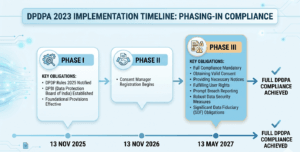
DPDPA: Enforcement Timeline

The DPDPA applies exclusively to digital personal data, data collected digitally or subsequently digitised, processed in India, or outside India in connection with offering goods or services to individuals in India.

Impact & Challenges

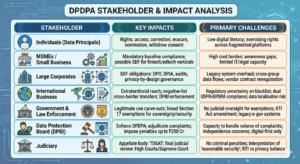
• Impact on Individuals (Data Principals)
DPDPA strengthens individual control over personal data, translating the constitutional right to privacy into enforceable statutory rights. Data principals rights include: –
• Right to Access – obtain a summary of personal data held and processing activities though notably without a data portability right.
• Right to Correction and Erasure – request rectification of inaccurate data or deletion of data no longer required.
• Right to Withdraw Consent – revoke consent at any time, data fiduciaries must respond within 90 days.
• Right to Nominate – appoint a nominee to exercise rights in case of incapacitation or death.
• Right to Grievance Redressal – exhaustion of internal mechanism required for complaint be lodged with the DPBI.
• Children under 18: heightened protection – verifiable parental/guardian consent is mandatory before processing a minor’s data, with specific exemptions carved out for healthcare professionals, educational institutions and child transport providers. Penalty up to Rs 200 crores.

Implementation Challenges for Individuals
• Literacy and Awareness Gap – India’s low digital literacy users may not be able to practically exercise rights, file complaints or interpret consent notices. The notice requirement specifies English and all 22 Scheduled languages, creating a multilingual compliance obligation, which remains a challenge.
• Dark Patterns and Consent Quality – While the DPDPA prohibits conditional consent and pre-ticked boxes, enforcement against confusing consent flows or hidden opt-outs, will depend heavily on DPBI capacity and proactive complaint filing.
• Grievance Exhaustion Requirement – Data principals must exhaust the data fiduciary’s internal grievance mechanism before approaching the DPBI. The 90-day response window, while clear, could be exploited as a delay mechanism by less scrupulous operators.
• RTI Act Amendment: Right to Know vs Right to Privacy – One of the most consequential changes brought by the DPDPA is the amendment to Section 8(1)(j) of the Right to Information Act, 2005. The original provision allowed disclosure of personal data held by public authorities in the ‘larger public interest’. The DPDPA removes this override, significantly curtailing the ability of citizens and journalists to access personal data held by government bodies.

Impact on MSMEs and Small Businesses
• Scope of Compliance Obligations – MSMEs that process digital personal data with customer-facing digital touchpoints, employee HR systems or supplier databases, are subject to the DPDPA. The aspects include, consent, notice requirements, purpose limitation, data minimisation, reasonable security safeguards, breach notification (72-hour deadline), data principal rights handling and contractual obligations with data processors. The Act offers no blanket small-business exemption.
• Sector-Specific Heightened Risk – Most MSMEs will not be classified as Significant Data Fiduciaries, avoiding the DPO and DPIA obligations. However, volume-driven or sector-specific designation is possible for Fintech and lending platforms processing KYC and financial data, Healthtech and telemedicine platforms with patient records, Edtech platforms with children’s data, SaaS and E-commerce.
• Compliance Cost and Capacity Challenges
• Budget and Resource Constraints – Legal, technical and organisational costs may range from ?5–25 lakh for a simple MSME to ?50 lakh or more for data-heavy verticals, costs that can be existentially challenging for businesses in early stages.
• Legacy Systems and Data Mapping – Many MSMEs operate on basic ERP systems, Excel-based databases, or fragmented CRMs that lack built-in consent tracking, automated data deletion workflows, or audit logging capabilities. Mapping all personal data flows including through informal channels such as WhatsApp Business, ad-tech trackers, and offline data later digitised to meet documentation requirements is technically complex without dedicated resources.
• Awareness Gap – Awareness of DPDPA obligations among MSME operators remains low and without targeted government outreach programmes, many small businesses risk inadvertent non-compliance.
• 72-Hour Breach Notification – The 72-hour window to notify the DPBI and affected data principals of a personal data breach demands 24/7 incident monitoring infrastructure that most MSMEs lack.

Impact on Large Corporates and Conglomerates

For large enterprises, the DPDPA drives a fundamental shift toward institutionalised privacy governance and requires a privacy-by-design approach. Key enterprise-level requirements include enterprise privacy policies and data governance frameworks, role-based access controls and privileged access management, vendor and third-party data processing agreements with mandatory DPDPA compliance clauses, accountability through privacy registers, audit trails and board-level oversight and automated data lifecycle management.

Significant Data Fiduciary Obligations – Large enterprises across sectors are likely to be designated as SDFs which entails appointment of an India based DPO, annual Data Protection Impact Assessments, annual independent audits, algorithmic risk verification and potential data localisation mandates for government-specified data categories.
Implementation Challenges for Large Corporates and Conglomerates

• Legacy System Modernisation – India’s large corporate landscape runs on legacy architectures that lack support for consent tracking, automated erasure or granular access logging.
• Multi-Regulator Complexity (BFSI) – They will have dual-compliance challenge meeting RBI, SEBI, IRDAI and NPCI requirements and reconciling KYC data processing under DPDPA’s consent and purpose-limitation principles requirement.
• DPO Scarcity – The requirement of DPO creates a talent supply crisis with India has fewer than 5,000 practitioners with certifications.
• AI and Algorithmic Compliance – The requirement for algorithmic risk verification introduces compliance overhead at the model design, training and deployment stages and may require significant architectural changes.

Impact on International Business
• Extraterritorial Reach – The DPDPA applies to any entity Indian or foreign that processes personal data of individuals located in India in connection with offering goods or services to those individuals. Foreign entities without an India office but serving Indian users through e-commerce, SaaS, mobile apps or digital services must comply with the full DPDPA regime, including responding to DPBI enforcement.
• Cross-Border Data Transfers: The Negative List – DPDPA establish a ‘negative list’ approach to cross-border transfers, personal data may be transferred to any country except those specifically restricted by the Central Government notification. However, it introduces a distinctive set of challenges, as no published criteria of blacklisted countries, No advance notice requirements for Blacklisting, No standard contractual clauses and persistence of sector specific laws.
• Compliance Cost – Multinational companies face layered compliance costs of updating global privacy policies for Indian requirements, implementing multilingual consent notices, deploying India-specific consent management infrastructure, renegotiating data processing agreements with India-based processors and sub-processors, and maintaining the technical capability to respond to DPBI enforcement actions.

Impact on Government and Law Enforcement Agencies
Government as Data Fiduciary – Government entities are ‘data fiduciaries’ under the DPDPA when processing citizens’ digital personal data and subject to the same baseline obligations as private sector entities. However, Section 17 of the DPDPA provides exemptions for State processing for sovereignty, integrity, security, public order, and prevention/investigation of offences, research, archiving or statistical purposes, Legal and judicial proceedings and Processing of non-residents personal data within India.
Law Enforcement and Investigation Challenges – Law enforcement agencies face a contradiction, as data fiduciaries must comply with DPDPA and mandated for exemptions. This creates operational complexity as legacy systems holding this data still require security safeguards.

Judicial Implications
• Appellate Jurisdiction Telecom Disputes Settlement and Appellate Tribunal (TDSAT) – TDSAT is designated as the appellate body for DPBI decisions, is primarily a telecommunications regulator with limited data privacy jurisprudence.
• No Criminal Penalties – This reduces the risk of regulatory overreach against individuals but may limit deterrence effectiveness for misuse by corporate actors who can absorb financial penalties as a cost of business.
• Interpretation Challenges – Courts and the DPBI will face interpretive questions as What constitutes ‘reasonable security safeguards’, How Puttaswamy judgement applies to the government exemptions and interplay between DPDPA and sector-specific regulations where conflicts arise.

DPDPA 2023 is more than just a compliance checklist and is a catalyst for a fundamental cultural shift in how data is perceived. While the implementation challenges are significant, they are implementable. Organizations that view these hurdles as an opportunity to build ‘Privacy by Design’ will likely find themselves with a competitive edge in an increasingly data-conscious global market.

(Lt Col Ujjual Abhishek Jha, Retd is a Certified Data Privacy Professional and Strategic & Geopolitical Advisor with over two decades of experience in intelligence, insider threat management, financial crime investigations, and geopolitical risk analysis, advising on complex security and strategic risks.)

For Part I – Digital Personal Data Protection Act (DPDPA) 2023 Series: Part I — The Foundations of Privacy: Evolution of Indian Laws & A Roadmap to DPDPA – The Frontier Manipur
For Part II – Digital Personal Data Protection Act (DPDPA) 2023 Series: Part II — From Principles to Practice: The DPDP Rules 2025, Global Paradigms & India’s Middle Path – The Frontier Manipur

The post Digital Personal Data Protection Act (DPDPA) 2023 Series: Part III – Impact & Implementation Challenges first appeared on The Frontier Manipur.

Read more / Original news source: https://thefrontiermanipur.com/digital-personal-data-protection-act-dpdpa-2023-series-part-iii-impact-implementation-challenges/

INNOCENT BLOODS SHED: Rocket Attack Kills Two Children & Severely Injures Mother, Imphal Valley Seized By Massive Tension

Fresh Horror Struck Tronglaobi in Bishnupur District as Suspected Militant Strike Turns a Home into a Living Grave.   TFM Report The Imphal Valley, particularly Bishnupur District, has been gripped by tension and rising public anger since early morning Tuesday (April 7, 2026), after the news of the killing of two children and their mother  […]

The post INNOCENT BLOODS SHED: Rocket Attack Kills Two Children & Severely Injures Mother, Imphal Valley Seized By Massive Tension first appeared on The Frontier Manipur.

Fresh Horror Struck Tronglaobi in Bishnupur District as Suspected Militant Strike Turns a Home into a Living Grave.  

TFM Report

The Imphal Valley, particularly Bishnupur District, has been gripped by tension and rising public anger since early morning Tuesday (April 7, 2026), after the news of the killing of two children and their mother  in an improvised rocket/pompi attack.

According to sources, suspected Kuki militants launched a projectile—believed to be a rocket—targeting a civilian residence in Moirang Tronglaobi village. The explosive struck the house directly through a window, triggering a powerful blast that killed two young siblings and left their mother seriously injured.

Siblings Aged 5 Years and 5 Months Killed

The victims have been identified as a five-year-old boy, his five-month-old sister and their mother who later succumbed to injuries, as per sources from the locality. The explosion caused significant damage to the house and sent shockwaves across Imphal valley, with village residents rushing to the scene in an attempt to rescue the injured.

The children struck by the splinters of from the rocket blast being ruched to a nearby hospital. Source: Social Media


Locals claimed the projectile was fired from nearby hill slopes, suggesting that the launch point was located more than three kilometres away. Tronglaobi lies along the vulnerable hill-valley fringe near Moirang in Bishnupur district, close to the elevated areas of Churachandpur district, a region that has witnessed repeated tensions in since May 3, 2023.

Fury Spills into Streets – Police Station Gate Torched by Irate Mob

By post-dawn, irate mobs converged at the Moirang Police Station and burnt down the gate, as anger over the deaths of the two children boiled over. Reports are emerging that the incident is likely to trigger widespread protest and subsequent reactions across the valley, raising fears of a fresh spiral of violence.

Security Tightened – Forces Deployed Along Hill-Valley Boundary

As expected, security has been significantly tightened across the area following the attack, an act considered too late by the public. Additional forces have been deployed to prevent further escalation, while surveillance and search operations are underway in adjoining hill regions. Authorities are also closely monitoring other sensitive villages along the hill-valley boundary to avert any further incidents, said a source.

The post INNOCENT BLOODS SHED: Rocket Attack Kills Two Children & Severely Injures Mother, Imphal Valley Seized By Massive Tension first appeared on The Frontier Manipur.

Read more / Original news source: https://thefrontiermanipur.com/innocent-bloods-shed-rocket-attack-kills-two-children-severely-injures-mother-imphal-valley-seized-by-massive-tension/

INNOCENT BLOODS SHED: Rocket Attack Kills Two Children & Severely Injures Mother, Imphal Valley Seized By Massive Tension

Fresh Horror Struck Tronglaobi in Bishnupur District as Suspected Militant Strike Turns a Home into a Living Grave.   TFM Report The Imphal Valley, particularly Bishnupur District, has been gripped by tension and rising public anger since early morning Tuesday (April 7, 2026), after the news of the killing of two children and their mother  […]

The post INNOCENT BLOODS SHED: Rocket Attack Kills Two Children & Severely Injures Mother, Imphal Valley Seized By Massive Tension first appeared on The Frontier Manipur.

Fresh Horror Struck Tronglaobi in Bishnupur District as Suspected Militant Strike Turns a Home into a Living Grave.  

TFM Report

The Imphal Valley, particularly Bishnupur District, has been gripped by tension and rising public anger since early morning Tuesday (April 7, 2026), after the news of the killing of two children and their mother  in an improvised rocket/pompi attack.

According to sources, suspected Kuki militants launched a projectile—believed to be a rocket—targeting a civilian residence in Moirang Tronglaobi village. The explosive struck the house directly through a window, triggering a powerful blast that killed two young siblings and left their mother seriously injured.

Siblings Aged 5 Years and 5 Months Killed

The victims have been identified as a five-year-old boy, his five-month-old sister and their mother who later succumbed to injuries, as per sources from the locality. The explosion caused significant damage to the house and sent shockwaves across Imphal valley, with village residents rushing to the scene in an attempt to rescue the injured.

The children struck by the splinters of from the rocket blast being ruched to a nearby hospital. Source: Social Media


Locals claimed the projectile was fired from nearby hill slopes, suggesting that the launch point was located more than three kilometres away. Tronglaobi lies along the vulnerable hill-valley fringe near Moirang in Bishnupur district, close to the elevated areas of Churachandpur district, a region that has witnessed repeated tensions in since May 3, 2023.

Fury Spills into Streets – Police Station Gate Torched by Irate Mob

By post-dawn, irate mobs converged at the Moirang Police Station and burnt down the gate, as anger over the deaths of the two children boiled over. Reports are emerging that the incident is likely to trigger widespread protest and subsequent reactions across the valley, raising fears of a fresh spiral of violence.

Security Tightened – Forces Deployed Along Hill-Valley Boundary

As expected, security has been significantly tightened across the area following the attack, an act considered too late by the public. Additional forces have been deployed to prevent further escalation, while surveillance and search operations are underway in adjoining hill regions. Authorities are also closely monitoring other sensitive villages along the hill-valley boundary to avert any further incidents, said a source.

The post INNOCENT BLOODS SHED: Rocket Attack Kills Two Children & Severely Injures Mother, Imphal Valley Seized By Massive Tension first appeared on The Frontier Manipur.

Read more / Original news source: https://thefrontiermanipur.com/innocent-bloods-shed-rocket-attack-kills-two-children-severely-injures-mother-imphal-valley-seized-by-massive-tension/

INNOCENT BLOODS SHED: Rocket Attack Kills Two Children & Severely Injures Mother, Imphal Valley Seized By Massive Tension

Fresh Horror Struck Tronglaobi in Bishnupur District as Suspected Militant Strike Turns a Home into a Living Grave.   TFM Report The Imphal Valley, particularly Bishnupur District, has been gripped by tension and rising public anger since early morning Tuesday (April 7, 2026), after the news of the killing of two children and their mother  […]

The post INNOCENT BLOODS SHED: Rocket Attack Kills Two Children & Severely Injures Mother, Imphal Valley Seized By Massive Tension first appeared on The Frontier Manipur.

Fresh Horror Struck Tronglaobi in Bishnupur District as Suspected Militant Strike Turns a Home into a Living Grave.  

TFM Report

The Imphal Valley, particularly Bishnupur District, has been gripped by tension and rising public anger since early morning Tuesday (April 7, 2026), after the news of the killing of two children and their mother  in an improvised rocket/pompi attack.

According to sources, suspected Kuki militants launched a projectile—believed to be a rocket—targeting a civilian residence in Moirang Tronglaobi village. The explosive struck the house directly through a window, triggering a powerful blast that killed two young siblings and left their mother seriously injured.

Siblings Aged 5 Years and 5 Months Killed

The victims have been identified as a five-year-old boy, his five-month-old sister and their mother who later succumbed to injuries, as per sources from the locality. The explosion caused significant damage to the house and sent shockwaves across Imphal valley, with village residents rushing to the scene in an attempt to rescue the injured.

The children struck by the splinters of from the rocket blast being ruched to a nearby hospital. Source: Social Media


Locals claimed the projectile was fired from nearby hill slopes, suggesting that the launch point was located more than three kilometres away. Tronglaobi lies along the vulnerable hill-valley fringe near Moirang in Bishnupur district, close to the elevated areas of Churachandpur district, a region that has witnessed repeated tensions in since May 3, 2023.

Fury Spills into Streets – Police Station Gate Torched by Irate Mob

By post-dawn, irate mobs converged at the Moirang Police Station and burnt down the gate, as anger over the deaths of the two children boiled over. Reports are emerging that the incident is likely to trigger widespread protest and subsequent reactions across the valley, raising fears of a fresh spiral of violence.

Security Tightened – Forces Deployed Along Hill-Valley Boundary

As expected, security has been significantly tightened across the area following the attack, an act considered too late by the public. Additional forces have been deployed to prevent further escalation, while surveillance and search operations are underway in adjoining hill regions. Authorities are also closely monitoring other sensitive villages along the hill-valley boundary to avert any further incidents, said a source.

The post INNOCENT BLOODS SHED: Rocket Attack Kills Two Children & Severely Injures Mother, Imphal Valley Seized By Massive Tension first appeared on The Frontier Manipur.

Read more / Original news source: https://thefrontiermanipur.com/innocent-bloods-shed-rocket-attack-kills-two-children-severely-injures-mother-imphal-valley-seized-by-massive-tension/

India Commits to Stronger Climate Action with NDC 3.0

India reinforces global climate stance with calibrated targets aligned to Viksit Bharat 2047 vision. Cabinet clears updated climate commitments aiming 60% non-fossil power capacity and expanded carbon sinks by 2035. New framework balances development needs with decarbonisation amid West Asia conflict and energy security concerns By Salam Rajesh The Government of India recently took a […]

The post India Commits to Stronger Climate Action with NDC 3.0 first appeared on The Frontier Manipur.

India reinforces global climate stance with calibrated targets aligned to Viksit Bharat 2047 vision. Cabinet clears updated climate commitments aiming 60% non-fossil power capacity and expanded carbon sinks by 2035. New framework balances development needs with decarbonisation amid West Asia conflict and energy security concerns

By Salam Rajesh

The Government of India recently took a significant step forward in its climate commitments with the Cabinet, chaired by Prime Minister Narendra Modi, approving the country’s updated Nationally Determined Contributions (NDCs).

Analysts say although delayed, the third institution of the NDCs comes at a time when the global supply chains and energy security have been severely disrupted owing to the conflict in West Asia.

India’s NDC 3.0 builds on a strong track record, where earlier the country had enhanced its Nationally Determined Contributions and met key targets well ahead of schedule, including achieving over 50% non-fossil power capacity nearly five years before the 2030 deadline.

A Press Information Bureau (PIB) release said the new NDC framework sets out a roadmap for the target years 2033-2035, anchored in the principles of the Common but Differentiated Responsibilities (CBDR-RC) and the vision of Viksit Bharat 2047.

The framework targets a 47% reduction in emission intensity, expansion of non-fossil power capacity to 60%, and a significant increase in carbon sinks up to 4 billion tons, the PIB report said.

India’s Central Electricity Authority estimates in the National Power Adequacy Plan that by 2035-36, nearly 70% of electricity capacity will come from non-fossil sources. However, its formal commitment as approved under NDC 3.0 under the UN framework sets a lower target of 60%.

Similarly, India’s target of reducing emission intensity to 47% by 2035 reflects a calibrated approach, the release said noting that as a fast-growing and emerging economy, India’s intensity-based target balances development needs with climate ambition.

In the current geopolitical context of supply chain disruptions and energy security concerns, this target provides flexibility while remaining aligned with its broader aspirational goals and long-term net-zero pathway.

The announcement comes amid an ongoing conflict in West Asia, which has disrupted energy supply chains and has highlighted risks of the global economy’s dependence on fossil fuels.

In this context, India’s demonstrated stance on decarbonizing its energy and transport systems signals continuity. The country, which had met its past climate commitments ahead of schedule, also holds the BRICS chair this year. The commitments announced raise expectations of a BRICS-led focus on de-risking supply chains through decarbonisation under India’s presidency, the PIB release noted.

The strategy underpinned by India has emphasized climate-resilient infrastructure, green industrial pathways, behavioral shifts and the development of low-cost green finance and advanced research and development ecosystems, reflecting an economy-wide approach to deep decarbonisation, it said.

This assessment comes in terms of the country’s achievement in 36% reduction in emission intensity of GDP achieved between 2005-2020, where 52.57% of India’s power generation capacity is from clean, non-fossil sources and was achieved 5 years ahead of the 2030 schedule.

2.3 billion tons of carbon sink was created through forests and trees, indicating India’s NDC submitted in 2015 had the target of achieving 33 to 35% reduction in the emissions intensity of GDP and 40% share of non-fossil resources based electric power installed capacity by 2030, both of which were met, 11 years and 9 years ahead of the committed timelines respectively, the PIB statement said.

Outlining the vision for NDC 3.0, the government press statement said the qualitative goals are intended to embed sustainability into everyday life and governance systems, promote climate-resilient development pathways, and enable a just and inclusive transition for all sections of the society.

Eight major goals for 2033-2035, aligned with CBDR-RC and Viksit Bharat 2047, were announced. These include Goal 1: Target reduction of emission intensity to 47% by 2035, Goal 2: Achieve 60% of cumulative installed electricity capacity non-fossil power capacity by 2035.

Goal 3 seeks increase in carbon sink from 2.3 billion tons to 3.5-4.0 billion tons through tree and plantation cover, while Goal 4 targets climate-friendly and cleaner path of economic development, citing the example of the ongoing investments in electrification of the Railways.

Goal 5 looks at the resilient infrastructure to combat climate change effects like sudden rain and cloud bursts, while Goal 6 seeks in promoting the Prime Minister’s ‘Lifestyle for Environment (LiFE)’ mission.

Goal 7 looks at developing low-cost, long-term finance mechanisms for green energy, and Goal 8 seeks capacity building and research and development, with focus on cutting edge technology and international collaborations.

Lauri Myllyvirta, Lead Analyst and Co-Founder, Centre for Research on Energy and Clean Air, reflects that India’s new 2035 climate targets underestimate the country’s potential for transformative clean energy growth.

Under current plans, the target of 60% clean power capacity will be achieved before 2030, rather than by 2035, Lauri reflected, noting that continuing the current clean energy growth at rates already achieved in 2024-25 would enable India to peak power sector emissions well before 2030 and significantly slow down its CO2 emission growth rates.

Yet, the carbon intensity target announced allows for an acceleration of emissions growth compared with past rates if GDP growth is at target. India’s booming clean energy industry is highly likely to deliver much faster progress than policymakers were prepared to commit to, she said.

Deliberating on the issue, Aarti Khosla, Director, Climate Trends noted that India’s updated NDC targets reflect a realistic yet forward-looking climate strategy, especially coming at a time when the global order is fractured and the future of energy policy is very uncertain.

Releasing the NDC at this juncture reinforces that as a country India respects multilateralism and equity, both aspects found wanting in the world today, she noted.

A 47% reduction in emission intensity by 2035, alongside achieving 60% non-fossil capacity, signals continuity in ambition while remaining grounded in domestic, developmental and geopolitical realities.

The fact that India has already crossed 50% non-fossil capacity underscores the credibility of this trajectory, and equally important is the expansion of carbon sinks, which reinforces the country’s commitment to nature-based solutions, Aarti emphasized.

In a global context where attention is increasingly shifting toward energy security and climate finance flows are under strain, India’s approach stands out for its balance. It prioritizes domestic capability, resilience, and long-term sustainability while continuing to advance its climate commitments, a positive sign for the entire global south and the BRICS, especially with India chairing the grouping annual meet this year, she observed.

The post India Commits to Stronger Climate Action with NDC 3.0 first appeared on The Frontier Manipur.

Read more / Original news source: https://thefrontiermanipur.com/india-commits-to-stronger-climate-action-with-ndc-3-0/

Two-Day Training on Climate-Resilient Aquaculture held at Manipur University

Programme aims to equip fish farmers with climate-adaptive technologies and sustainable aquaculture practices. Experts stress sustainable fisheries, innovation and local knowledge integration for Northeast resilience. TFM Desk A two-day Training-cum-Capacity Building Programme on “Climate Resilient Aquaculture Technologies” for fish farmers and entrepreneurs of Manipur was organised on March 28 and March 29 at Manipur University, […]

The post Two-Day Training on Climate-Resilient Aquaculture held at Manipur University first appeared on The Frontier Manipur.

Programme aims to equip fish farmers with climate-adaptive technologies and sustainable aquaculture practices. Experts stress sustainable fisheries, innovation and local knowledge integration for Northeast resilience.

TFM Desk

A two-day Training-cum-Capacity Building Programme on “Climate Resilient Aquaculture Technologies” for fish farmers and entrepreneurs of Manipur was organised on March 28 and March 29 at Manipur University, Canchipur.

The programme is being jointly organised by the Department of Zoology, Manipur University, in collaboration with ICAR-Central Institute of Fisheries Education, Mumbai, with the inaugural session held at the VC Court Hall.

The inaugural function began at 9:30 AM in the presence of several dignitaries. Director of the Directorate of Environment and Climate Change, Government of Manipur, Dr. T. Brajakumar Singh attended as the Chief Guest. Dean of the School of Life Sciences, Prof. N. Mohilal Meitei, and Principal Scientist of ICAR-CIFE, Dr. S. Munilkumar, were present as Guests of Honour. The function was presided over by Head of the Department of Zoology, Prof. Ksh. Birla Singh.

The programme began with the felicitation of dignitaries, followed by a welcome address by Dr. Rameshori Yumnam, who is also the coordinator. She highlighted the urgent need to adopt climate-resilient aquaculture practices in view of increasing climate variability affecting fish production systems across Northeast India.

Speaking on the inaugural function, Dr. Munilkumar underscored the importance of scientific interventions, capacity building and technology dissemination to improve precision farming, aquaculture productivity and sustainability. He also stressed the need to integrate modern aquaculture techniques with local knowledge systems.

Prof. Mohilal Meitei noted that Manipur is essentially a lacustrine society, with livelihoods and culture deeply linked to water bodies. He emphasized that sustainable fisheries are crucial for ensuring food security, nutrition and preserving cultural heritage.

In his address, Chief Guest Dr. Brajakumar Singh highlighted the role of environmentally sustainable aquaculture in tackling climate change and securing livelihoods for fish farmers. He encouraged participants to actively engage in the training and adopt innovative practices.

Presiding over the function, Prof. Birla Singh reiterated Manipur University’s commitment to strengthening research, training and extension activities in aquaculture for the benefit of local communities.

As part of the inaugural programme, essential aquaculture inputs were distributed to participants. The session concluded with a vote of thanks proposed by Dr. M. Manorama Devi.

The two-day programme held on March 28–29, 2026, aims to equip participants with practical knowledge on climate-resilient aquaculture technologies such as biofloc, aquaponics and hatchery management. It also focuses on water management, species diversification and sustainable farming practices.

The initiative is expected to enhance adaptive capacity, improve productivity and promote sustainable aquaculture development in Manipur and the wider Northeast region.

Top of Form


The post Two-Day Training on Climate-Resilient Aquaculture held at Manipur University first appeared on The Frontier Manipur.

Read more / Original news source: https://thefrontiermanipur.com/two-day-training-on-climate-resilient-aquaculture-held-at-manipur-university/

Adaptation Matters, ICJ On Climate Change

Landmark 2025 advisory opinion reframes climate adaptation as a due diligence obligation, urging states to act on science, equity, and global cooperation. Non-binding yet authoritative ruling signals legal consequences for inaction, placing climate resilience at the heart of international law. By Salam Rajesh In July of 2025, the International Court of Justice (ICJ) delivered a […]

The post Adaptation Matters, ICJ On Climate Change first appeared on The Frontier Manipur.

Landmark 2025 advisory opinion reframes climate adaptation as a due diligence obligation, urging states to act on science, equity, and global cooperation. Non-binding yet authoritative ruling signals legal consequences for inaction, placing climate resilience at the heart of international law.

By Salam Rajesh

In July of 2025, the International Court of Justice (ICJ) delivered a landmark Advisory Opinion on the Obligations of States in Respect of Climate Change.

The ICJ’s Advisory Opinion provides authoritative legal guidance on Member States’ obligations to address climate change and prevent significant harm to vulnerable countries and communities across the globe.

While the ICJ’s Advisory Opinion is non-binding, it makes clear that failure to act can trigger legal consequences. States require timely and accessible analysis to understand their legal obligations and the consequences of breaching them.

On understanding why the ICJ’s Advisory Opinion matters for climate change adaptation, the International Institute for Sustainable Development (IISD) in its analysis suggests that climate change adaptation is one of the core pillars of the international climate regime.

With reference to the Intergovernmental Panel on Climate Change (IPCC, 2022), climate change adaptation is the process of preparing, and adjusting to, for actual or expected impacts associated with climate change.

Fundamentally, adaptation is about protecting people in an uncertain future and making communities, economies, and ecosystems more resilient to a changing climate.

The ICJ’s Advisory Opinion develops from the perspective that climate change is now a force to be reckoned with and that adaptation can no longer be viewed as solely a domestic policy choice, but as a binding obligation under international law and assessed against a standard of due diligence.

This means that for all practical purposes, all countries must use their best efforts to engage in adaptation planning and implementation, based on the best available science, and to undertake precautionary and forward-looking measures, continuously adjusting their responses as climate risks evolve.

The ICJ noted with concern that countries continue to have discretion over how adaptation is planned and implemented, based on their risk contexts and national circumstances, and provided that such efforts aim to prevent and address foreseeable climate harm.

With due diligence to the ICJ’s Advisory Opinion, national adaptation plans, policies and strategies, therefore, take on a renewed significance as instruments through which individual countries may demonstrate their commitments to, and compliance with international laws.

This runs in conjunction to the UAE Framework for Global Climate Resilience (UNFCCC, 2023) whereupon countries need to formulate and submit their national adaptation plans, policies and strategies, and progress in implementing them by the target year 2030.

The IISD analysis stressed that all developed countries have a binding obligation to provide and mobilize adaptation finance, technology transfer and capacity building for developing countries, in the context of the New Collective Quantified Goal on Climate Finance and the Mutirão decision’s call to at least triple adaptation finance by the year 2035.

All countries, too, have the obligation to cooperate with each other on adaptation knowledge sharing, it stated.

The IISD analysis further emphasized that a country-driven, gender-responsive, participatory and fully transparent approach that integrates human rights considerations and pays particular attention to vulnerable people, places and ecosystems is integral to effective adaptation planning and implementation that yield equitable benefits for people of all backgrounds.

It cautioned that a fragmented approach undermines adaptation outcomes, whereupon obligations under international human rights law are interrelated with countries’ adaptation obligations, and they all form part of the legal context against which adaptation efforts are assessed.

Integrated and synergistic approaches to address the climate and biodiversity crises and land degradation strengthen adaptation, biodiversity and land degradation neutrality outcomes, it stated.

The ICJ observed that under the UNFCCC and the Paris Agreement, respective parties have procedural obligations to engage in adaptation planning processes and the implementation of adaptation actions (ICJ, 2025, paras. 255-257).

This would necessitate the formulation, submission and regular updating of national adaptation plans, policies or strategies, the ICJ noted, while stressing that the assessment of climate change impacts and vulnerability, and the monitoring, evaluation and learning from adaptation actions is highly essential.

The ICJ further stressed the need for integration of climate change considerations in relevant social, economic and environmental policies and actions, while employing appropriate methods to minimize adverse effects that adaptation projects or measures could have on the economy, public health, and the quality of the environment.

Importantly, it emphasized on the strengthening of international cooperation to enhance adaptation actions and support.

The ICJ Advisory Opinion noted that a standard of due diligence would be used to assess the parties’ fulfillment of their adaptation obligations (ICJ, 2025, para. 258). This means that, in terms of adaptation, acting with due diligence requires the parties to use their best efforts to enact appropriate adaptation measures, in a timely manner, to reduce the risk of significant harm occurring due to climate change impacts.

The ICJ called on parties to base their adaptation planning and implementation, such as the national adaptation plan (NAP) process, on the best available science and technological information, such as, availing the information, knowledge and tools from the IPCC and other international rules, standards, guidelines, and best practices.

It advised parties to take precautionary measures and enact forward-looking policies, such as integrating climate risk considerations in development policies and plans, or continuously updating building codes and infrastructure standards to reflect climate realities.

The ICJ called on parties to ensure continuous improvement by following the dimensions of the iterative adaptation cycle (defined by the UAE Framework for Global Climate Resilience as impact, vulnerability, and risk assessments; planning; implementation; monitoring, evaluation and learning; and iteration of these four steps) as the due diligence standard.

It urged parties to follow a country-driven, gender-responsive, participatory and fully transparent approach to adaptation planning and implementation in achieving the goals enshrined in the Paris Agreement and other climate protocols.

The analysis appears in the International Institute for Sustainable Development (IISD)’s briefing note: ‘Unpacking the implications of the ICJ Advisory Opinion on Climate Change’, published earlier this month.


The post Adaptation Matters, ICJ On Climate Change first appeared on The Frontier Manipur.

Read more / Original news source: https://thefrontiermanipur.com/adaptation-matters-icj-on-climate-change/

Digital Personal Data Protection Act (DPDPA) 2023 Series: Part II — From Principles to Practice: The DPDP Rules 2025, Global Paradigms & India’s Middle Path

The DPDP Rules serve as the procedural manual for the Act, detailing the mechanisms through which the law will function. They provide granularity on board composition, grievance workflows, classification criteria, and the technical and organisational measures required for compliance. By Lt Col Ujjual Abhishek Jha, Retd The enactment of the Digital Personal Data Protection Act, […]

The post Digital Personal Data Protection Act (DPDPA) 2023 Series: Part II — From Principles to Practice: The DPDP Rules 2025, Global Paradigms & India’s Middle Path first appeared on The Frontier Manipur.

The DPDP Rules serve as the procedural manual for the Act, detailing the mechanisms through which the law will function. They provide granularity on board composition, grievance workflows, classification criteria, and the technical and organisational measures required for compliance.

By Lt Col Ujjual Abhishek Jha, Retd

The enactment of the Digital Personal Data Protection Act, 2023 (DPDPA) established the foundational architecture for India’s data privacy regime. However, the operationalisation of any legislation lies in its rules. The notification of the DPDP Rules, 2025, marks the transition from statutory intent to enforceable reality. This second installment in the series unpacks these rules, contextualises India’s framework within the global privacy landscape, and analyses the unique “Third Way” that India has carved out for itself.

The DPDP Rules 2025: Operationalising the Act

The DPDP Rules serve as the procedural manual for the Act, detailing the mechanisms through which the law will function. They provide granularity on board composition, grievance workflows, classification criteria, and the technical and organisational measures required for compliance. Crucially, they establish a phased enforcement timeline, allowing regulated entities a structured runway to achieve compliance.

The Regulatory Arbitrator: Data Protection Board of India (DPBI)

The Rules formally empower the Data Protection Board of India (DPBI) as a specialised, digital-first adjudicatory body. Unlike traditional regulators, the DPBI is designed to function as a tribunal, conducting inquiries into data breaches, presiding over formal hearings, and levying financial penalties. Its primary mandate is to ensure that Data Fiduciaries—entities that determine the purpose and means of data processing—remain accountable to the law.

Tiered Accountability: Significant Data Fiduciaries (SDFs)

Recognising that not all data processing carries equal risk, the framework introduces the concept of Significant Data Fiduciaries (SDFs). The Central Government will designate entities as SDFs based on criteria such as the volume and sensitivity of data processed, the potential risk to the rights of Data Principals (individuals to whom the data pertains), and implications for national security or public order.

Entities classified as SDFs must adhere to enhanced obligations:

– Mandatory appointment of a Data Protection Officer (DPO) based in India.

– Engagement of independent auditors to validate compliance.

– Conduct of Data Protection Impact Assessments (DPIAs) to proactively evaluate privacy risks associated with new technologies or processes.

The Consent Ecosystem: A Novel Introduction

In a significant innovation over global models, the DPDPA introduces the role of Consent Managers. These entities act as a bridge between the individual and the Data Fiduciary, providing a seamless, interoperable interface. Through a Consent Manager, individuals can grant, manage, review, and withdraw their consents in a centralised, real-time manner, transforming consent from a one-time checkbox into an ongoing, auditable process.

Cross-Border Data Transfers: The Negative List Strategy

One of the most pragmatic features of the framework is its approach to cross-border data flows. Departing from earlier drafts that mandated strict data localisation, the DPDPA operates on a Negative List principle. Under this model, cross-border data transfers are generally permitted to all countries and sectors except those specifically notified by the government as restricted. This approach ensures the smooth functioning of international trade and cloud-based services while retaining the state’s sovereign power to block data flows to hostile or high-risk jurisdictions.

Transparency, Grievance Redressal, and Compensation

The efficacy of the law rests on the clarity of its notice and grievance workflows. The Act specifies the modalities through which a Data Fiduciary must communicate with users—whether through electronic notifications, app-based prompts, or assisted means for those with limited digital literacy. Furthermore, it establishes strict timelines and tracking obligations for responding to user requests, ensuring that the Right to Correction and Right to Erasure are actionable through standard, time-bound processes.

Enforcement and Implementation Timeline

The rules establish a staggered implementation schedule to facilitate a smooth transition:

– Immediate Effect (from date of Gazette notification, 13 November 2025): Certain “enabling” sections of the Act, along with Rules 1, 2, and 17-21 (covering preliminary aspects, DPBI constitution, and procedural matters), are effective immediately.

– One Year (by late 2026): Rule 4, which pertains to registration and specific compliance obligations, comes into force one year after publication.

– Eighteen Months (by mid-2027): The bulk of operational duties—including rights handling, security controls, classification of SDFs, and penalty procedures (Rules 3, 5-16, 22, and 23)—become effective eighteen months after publication. This implies full compliance obligations will be in force by 2027, although sectoral regulators may compress timelines for critical industries.

The Global Privacy Landscape: A Comparative Overview

India’s privacy framework does not exist in a vacuum. It is shaped by, and must interoperate with, the leading data protection regimes from around the world. The most influential of these remains the European Union’s General Data Protection Regulation (GDPR), which has set a benchmark for modern privacy laws globally.

– European Union: General Data Protection Regulation (GDPR)

The GDPR applies to any entity offering goods or services to EU residents, regardless of its location. It introduced seminal concepts such as the “Right to be Forgotten” and “Data Portability.” It mandates one of six legal bases for processing and is renowned for its stringent penalties, which can reach up to €20 million or 4% of global annual turnover.

– United States: California Consumer Privacy Act (CCPA/CPRA)

In the absence of a federal privacy law, the CCPA serves as the de facto standard in the US. It focuses on consumer rights, particularly the right to opt out of the “sale” or “sharing” of personal data. It is enforced by the California Privacy Protection Agency (CPPA).

– China: Personal Information Protection Law (PIPL)

Often referred to as the “GDPR of China,” the PIPL is characterised by a strong state-centric approach. It imposes stringent restrictions on cross-border data transfers, requiring security assessments by state authorities. Its definition of “sensitive data” is notably broad.

– Brazil: Lei Geral de Proteção de Dados (LGPD)

The LGPD is largely based on the GDPR framework but adapted to the Brazilian market. It applies to any data processing activity within Brazil, irrespective of where the processing entity is located.

A comparative analysis of these frameworks against India’s DPDPA reveals the distinct contours of India’s approach:


Feature GDPR (EU) CCPA (USA-CA) PIPL (China) DPDPA (India)
Model Rights-based Consumer-based State-centric Consent-based
Applicability Digital & non-digital Digital Digital & non-digital Digital only
Data Localization No (Adequacy based) No Strict Limited (Negative List)
Sensitive Data Explicit Categories Explicit Categories Explicit Categories No Separate Category
Penalties Up to 4% of Global Revenue Per Violation ($) % of Revenue / Fixed Fixed (up to ?250 Cr)


Contextualising DPDPA: India’s “Third Way”


The operationalisation of the DPDPA through the 2025 Rules signals India’s deliberate entry into the global ecosystem of regulated data sovereignty. India’s position can best be understood by examining three dominant global data governance models:

  1. The European Model: “Rights-Based” Approach

Key Legislation: GDPR.

– Viewpoint: Privacy is a fundamental human right. This model focuses on comprehensive protection, granular user control, and heavy penalties.

– Impact on DPDPA: The GDPR served as the primary architect for the DPDPA. Concepts such as Data Fiduciary (controller), Data Principal (subject), and the requirement for valid Consent are directly derived from it. However, the DPDPA is notably more concise and business-friendly, aiming for a lower compliance burden than its European counterpart.

  1. The US Model: “Market-Driven” Mosaic

Key Legislation: No single federal law; relies on state laws like the CCPA and sectoral laws (HIPAA, GLBA).

– Viewpoint: Privacy is a consumer protection issue, focusing on preventing specific harms through targeted regulation.

– Contrast with DPDPA: Unlike the fragmented US approach, India has opted for a singular, comprehensive federal framework applicable across all sectors.

  1. The Authoritarian/Sovereign Model: “Security-First” Approach

– Key Legislation: China’s PIPL, Russia’s Data Laws. 

– Viewpoint: Data is a national asset. The focus is on data localisation—keeping data within national borders for state access and national security.

– India’s Shift: Early drafts of the Indian law (2018/2019) leaned toward this model, mandating strict localisation. However, the final DPDPA pivoted to a more pragmatic “trusted geography” approach, permitting cross-border flows unless a jurisdiction is specifically restricted.

India’s Position: A Deliberate Balance

The DPDPA represents a calculated effort to forge a middle path. It avoids the immense compliance complexity of the GDPR and the fragmentation of the US model, while strategically stepping back from the rigid data localisation of the Chinese framework. This “Third Way” is characterised by:

– Simplicity: Unlike the 99 articles of the GDPR, the DPDPA is a concise, principle-based statute.

– Digital-First Approach: It is one of the few laws to explicitly acknowledge the digital nature of modern data, excluding offline records to reduce administrative burden.

– Global Interoperability: By shifting from a “whitelist” (only allowed countries) to a “blacklist” (all allowed except those restricted) for cross-border data transfers, India signals its intent to integrate with the global digital economy while retaining the sovereign power to restrict data flows for geopolitical reasons.

A Dual-Lens Framework

The DPDPA, as operationalised by the 2025 Rules, is designed to be viewed through a dual lens. First, it serves as a mechanism to give effect to the fundamental right to privacy, as affirmed by the Supreme Court in K.S. Puttaswamy v. Union of India (2017). Second, it is structured to be technology-friendly, positioning India as a trusted and attractive destination for the digital economy. By striking a balance between individual rights and national interests, India’s data protection framework aspires to be more than a compliance checklist—it aims to become a cornerstone of its digital future.

[For Part I — The Foundations of Privacy: Evolution of Indian Laws & A Roadmap to DPDPA, click here]

(Lt Col Ujjual Abhishek Jha, Retd is a Certified Data Privacy Professional and Strategic & Geopolitical Advisor with over two decades of experience in intelligence, insider threat management, financial crime investigations, and geopolitical risk analysis, advising on complex security and strategic risks.)

*(This is the second installment in a series. The next part will explore the sectoral impact of the DPDPA, focusing on the obligations for specific industries such as healthcare, fintech, and e-commerce.)*

The post Digital Personal Data Protection Act (DPDPA) 2023 Series: Part II — From Principles to Practice: The DPDP Rules 2025, Global Paradigms & India’s Middle Path first appeared on The Frontier Manipur.

Read more / Original news source: https://thefrontiermanipur.com/digital-personal-data-protection-act-dpdpa-2023-series-part-ii-from-principles-to-practice-the-dpdp-rules-2025-global-paradigms-indias-middle-path/

Myanmar Exclusive: SAVIOR OR SCAMMER? NUG’s Sagaing Fundraising Chief Accused of Siphoning Millions for Luxury as War Refugees Starve

This case highlights a critical vulnerability in the resistance movement: the absence of a robust, independent financial oversight mechanism. As the political crisis in Myanmar seeks international legitimacy, the trust of donors is its most valuable currency. By M. Richard A storm of internal dissent is threatening to shatter the fragile trust in the National […]

The post Myanmar Exclusive: SAVIOR OR SCAMMER? NUG’s Sagaing Fundraising Chief Accused of Siphoning Millions for Luxury as War Refugees Starve first appeared on The Frontier Manipur.

This case highlights a critical vulnerability in the resistance movement: the absence of a robust, independent financial oversight mechanism. As the political crisis in Myanmar seeks international legitimacy, the trust of donors is its most valuable currency.

By M. Richard

A storm of internal dissent is threatening to shatter the fragile trust in the National Unity Government’s (NUG) financial networks, as whistleblowers accuse a high-ranking regional fundraiser of running a brazen “half-for-me, half-for-the-cause” scheme. Demands for an independent forensic audit are mounting against one Chaw Suu Han, reportedly the head of the NUGPay fundraising apparatus in Sagaing Region, who stands accused of diverting tens of millions of Kyats—intended for war refugees and frontline fighters—to finance a lavish personal lifestyle.

While Chaw Suu Han is alleged to have publicly solicited donations since 2023 for noble causes such as school construction and communication equipment for local People’s Defence Force (PDF) units, internal documents obtained by the Sagaing Funding Rise Group reveal a stark contradiction. The financial opacity stands in sharp contrast to the dire needs of displaced families in Salingyi township, juxtaposed against the social media display of luxury assets by the official and her family.

Chaw Suu Han, an alleged member of the People’s Revolutionary Aid Force under the [Ministry of Defense of Myanmar’s National Unity Government], has been managing an online pay account. Under the guise of funding humanitarian aid, she has collected millions of Kyats from towns including Salingyi in Sagaing, as well as Gangaw and Myaing in Magway.


Sagaing has become one of the epicenters of resistance against the military regime.


‘The Missing Ledger’ and the Amnesty International Grant

In September 2025, facing mounting accusations of financial malfeasance, Chaw Suu Han had issued a defiant but elusive defensive statement, according to a source. She is reported to have stated, “I have published all accounts” and further challenged her accusers, stating, “Want to see the books? Come audit them face-to-face—but you must guarantee your safety,” before announcing, “I have stopped all aid. I am no longer accepting donations.”

However, internal sources contradict these claims. Whistleblowers report that “no comprehensive accounts have been published”, no audit reports submitted to the NUG, and that despite her public statement, she continues to solicit funds under the banner of “People’s Donations.”

Perhaps the most damning allegation involves international funding. Sources allege that since early 2023, Chaw Suu Han allegedly received grants from Amnesty International totaling 3.5 million Kyats per project, titled “Support for Democratic and Human Rights Defenders in Myanmar.” Whistleblowers claim these funds were never utilized for revolutionary purposes, never registered in official donation lists, and were instead funneled directly into her personal coffers.

A Symptom of Systemic Rot

Chaw Suu Han’s case is not an isolated incident; rather, it is a stark symptom of what critics describe as deep-seated corruption endemic to the NUG’s financial structures, said a source.

Allegations have been hurled at may others. Kyaw Moe Tun (NUG Rep to UN): Allegedly misappropriated $2.6M from the Myanmar UN account, paying only $300k in dues while the rest vanished while Chaw Suu Han allegedly collected millions in donations with unclear accounts and missing supplies.

Daw Kyi Pyar was the Permanent Secretary of the Prime Minister’s Office for Myanmar’s shadow National Unity Government (NUG), serving until her resignation in February 2026. She was embroiled in a major controversy starting in November 2025 over allegations of corruption, nepotism, and bullying, often described by critics as running her office as a “family business” She is also accused of appointing husband and nephew to the Presidential Office; of embezzlement and purchasing million-dollar jewelry. Another leader Pencilo fled to the US under the guise of “revolution,” buying property and opening businesses, labeled a “Revolutionary Merchant” while Chaw Suu Han, claimed 3.5 million Kyats per project donation for refugees, yet the funds remain unaccounted for. |

PM Mahn Win Khaing Than has been accused of inaction regarding the Daw Kyi Pyar case, shielding “his own people.” Chaw Suu Han, in the meanwhile, never investigated or held accountable by the NUG; instead packaged by some media as a “Revolutionary Model”, said a source who did not want to be identified.

As one internal critic reportedly noted, “When high-ranking officials weaponize ‘security’ and ‘political sensitivity’ to shield graft, the grassroots is forced into a predatory scramble to ‘grab and run’ as the only means of survival.”

The Response & The Silence

When approached for comment by journalists, Chaw Suu Han reiterated, “I have published all accounts,” but failed to provide a public link to these records. She continued to challenge critics to “audit face-to-face” while citing safety concerns.

Meanwhile, the [NUG Prime Minister’s Office](https://www.nugmyanmar.org/) has maintained a wall of silence. Since September 2025, complainants have repeatedly contacted the office via email, open letters, and Messenger demanding:

– An independent audit of Chaw Suu Han’s funding sources and usage.

– Full disclosure of all foreign funds received and their specific purposes.

To date, the NUG has not responded.

Local citizens who have reported her financial opacity have faced threats and intimidation. Due to her regional influence and alleged protection by certain officials, the voices of whistleblowers have been systematically silenced.

This case highlights a critical vulnerability in the resistance movement: the absence of a robust, independent financial oversight mechanism. As the political crisis in Myanmar seeks international legitimacy, the trust of donors is its most valuable currency. Without transparency, the risk of systemic corruption threatens to erode the very foundation of the cause.

Such actions, if found to be true through legal process, violate not only the laws of Myanmar but also the sacred duty of loyalty to the people. If the NUG fails to act, critics warn, the morale of the resistance—and the flow of life-saving donations—may soon dry up entirely.


The post Myanmar Exclusive: SAVIOR OR SCAMMER? NUG’s Sagaing Fundraising Chief Accused of Siphoning Millions for Luxury as War Refugees Starve first appeared on The Frontier Manipur.

Read more / Original news source: https://thefrontiermanipur.com/myanmar-exclusive-savior-or-scammer-nugs-sagaing-fundraising-chief-accused-of-siphoning-millions-for-luxury-as-war-refugees-starve/

Climate Extremes Batter Hindu Kush Himalaya, Northeast Feels the Heat

ICIMOD report links rising disasters to funding gaps as Manipur reels under hailstorms, floods, and landslides. Mountain ecosystems and rural livelihoods at tipping point By Salam Rajesh The Hindu Kush Himalaya region faces escalating climate risks, including glacial melt, biodiversity loss, and extreme weather events, posing severe threats to ecosystems, livelihoods, and the well-being of […]

The post Climate Extremes Batter Hindu Kush Himalaya, Northeast Feels the Heat first appeared on The Frontier Manipur.

ICIMOD report links rising disasters to funding gaps as Manipur reels under hailstorms, floods, and landslides. Mountain ecosystems and rural livelihoods at tipping point

By Salam Rajesh

The Hindu Kush Himalaya region faces escalating climate risks, including glacial melt, biodiversity loss, and extreme weather events, posing severe threats to ecosystems, livelihoods, and the well-being of billions dependent on its resources.

This ominous assessment is an emancipation of studies carried out by the Kathmandu-based International Centre for Integrated Mountain Development (ICIMOD), as is presented in its publication ‘Climate Finance Synthesis Report: Needs, Flows and Gaps in the HKH countries (2025)’.

The Hindu Kush Himalaya (HKH) is one of the world’s most climate-vulnerable regions, facing growing threats from extreme weather events like glacial lake outburst floods (GLOFs), landslides, droughts, floods, forest fires, and intense monsoons.

The frequency, intensity, and duration of these events are increasing, exacerbating risks to ecosystems, food security, and livelihoods, particularly in rural and mountainous areas according to the ICIMOD studies.

The report estimates that the Hindu Kush Himalaya region requires approximately USD 12.065 trillion from year 2020 to 2050 for financing climate mitigation and adaptation measures, amounting to an annual average of a staggering USD 768.68 billion.

According to the Climate Risk Index (CRI) 2025 Report, floods, storms, and heat waves has caused significant global fatalities and economic losses, with floods alone affecting half of those impacted and storms accounting for 56% of economic damages to the tune of USD 2.33 trillion.

The ICIMOD report stressed that sectors crucial to the region, such as adaptation, agriculture, water management, and disaster risk reduction, remain significantly underfunded despite their critical importance.

The report assessed that limited private sector engagement, insufficient institutional capacity, fragmented policy landscapes, and weak data infrastructure further compound these challenges.

Several Indian States located within the HKH region had felt the impact of weather and climate extremes in recent years, incurring huge losses and damages to human lives, infrastructures, and to the natural environment.

From the damaging GLOF events in Himachal Pradesh and Uttarakhand to cloud bursts in Sikkim, massive floods in Assam, and devastating hailstorms in Nagaland and Manipur, nature’s fury had not spared anyone as such.

Manipur in recent years is seeing unprecedented scenarios of weather extremes, resulting in bursts of rains in short duration, flash floods, landslides, lightning strikes, and the damaging hailstorms.

Homes, agricultural fields and crops have not been spared, rendering tremendous economic losses for many who are in the marginalized sectors – peasants and agricultural farmers.

On Sunday (15 March) many parts of the State – Senapati, Imphal West, Kakching, Bishnupur, Tengnoupal – were hit by a fierce hailstorm ferried by a strong wind that blew off roofs and flatten houses.

Quite recently, farmers in Bishnupur District were left thunderstruck when a fierce hailstorm wreak havoc with their vegetable crops, totally flatten and battered beyond redemption, while tin roofing were punctured with multiple holes as if strapped by machine gun fire.

To address some of these pressing issues, the ICIMOD report recommended enhancing regional and global advocacy for HKH-specific climate funding, strengthening national and regional climate finance strategies, improving policy coherence, and developing robust financial mechanisms and innovative market-based instruments.

The report suggests that this could be achieved by building strong national institutional capacities and governance frameworks to manage and mobilize climate finance effectively.

It suggests leveraging innovative financial instruments, such as green and blue bonds, debt-for-climate swaps, and voluntary carbon markets, tailored specifically for mountain economies, to achieve the stated goals.

While suggesting urgent collective action and targeted financial investment as critical for building climate resilience, safeguarding ecosystems, and supporting sustainable development for current and future generations in the HKH region, the report emphasized that improving data infrastructure, climate risk assessments, and reporting systems to attract investments and enhance accountability require priority.

Without mincing words, the report points out that the challenges faced by the mountain regions, such as climate vulnerability, environmental degradation, and socio-economic disparities, are often overlooked in national, regional and global planning.

At the same time, the report fairly warns that with global warming projected to exceed the 1.5 degrees Celsius threshold by the year 2027 (WMO, 2025) – hardly a year from now – there is a pressing need for urgent climate action efforts to address key risks in mountain regions, with several structural challenges, such as lack of climate financing, hindering such efforts from attaining the requisite scope and scale.

Describing mountains as hotspots of climate change, the report extols that as in all other mountain regions of the world, in the HKH region too, the observed changes are increasing temperatures, changing seasonal weather patterns, reductions in snow persistence at low elevations, loss of glacier mass, increased permafrost thaw and incidence of glacial lake disasters.

Even as wars (Ukraine-Russia/Iran-Israel) escalates deaths and destructions, subsequently inflicting huge loss and damage, climate and weather extremes too are causing almost an equal amount of loss and damage as nature unleashes its fury left and right.

The massive wildfires in Australia, Europe and in the United States recently are but the tip of the iceberg in recent climate concerns, only worsening by the year. Glacial retreats and formation of glacial lakes in the HKH mountains are the proverbial warnings before catastrophe.

This is where rational suggestions such as those coming up from ICIMOD is a fair indication that States must come up with climate financing mechanism urgently to avoid climate and weather extreme disasters in the very near future within the HKH region.

Pakistan, India, Nepal, Bhutan and Bangladesh are in the red zones of climate and weather extremes, and hence actions require to be initiated soon enough. Even small nondescript States like Manipur and Nagaland are beginning to reel under unprecedented weather extremes in recent times.


The post Climate Extremes Batter Hindu Kush Himalaya, Northeast Feels the Heat first appeared on The Frontier Manipur.

Read more / Original news source: https://thefrontiermanipur.com/climate-extremes-batter-hindu-kush-himalaya-northeast-feels-the-heat/

Climate Extremes Batter Hindu Kush Himalaya, Northeast Feels the Heat

ICIMOD report links rising disasters to funding gaps as Manipur reels under hailstorms, floods, and landslides. Mountain ecosystems and rural livelihoods at tipping point By Salam Rajesh The Hindu Kush Himalaya region faces escalating climate risks, including glacial melt, biodiversity loss, and extreme weather events, posing severe threats to ecosystems, livelihoods, and the well-being of […]

The post Climate Extremes Batter Hindu Kush Himalaya, Northeast Feels the Heat first appeared on The Frontier Manipur.

ICIMOD report links rising disasters to funding gaps as Manipur reels under hailstorms, floods, and landslides. Mountain ecosystems and rural livelihoods at tipping point

By Salam Rajesh

The Hindu Kush Himalaya region faces escalating climate risks, including glacial melt, biodiversity loss, and extreme weather events, posing severe threats to ecosystems, livelihoods, and the well-being of billions dependent on its resources.

This ominous assessment is an emancipation of studies carried out by the Kathmandu-based International Centre for Integrated Mountain Development (ICIMOD), as is presented in its publication ‘Climate Finance Synthesis Report: Needs, Flows and Gaps in the HKH countries (2025)’.

The Hindu Kush Himalaya (HKH) is one of the world’s most climate-vulnerable regions, facing growing threats from extreme weather events like glacial lake outburst floods (GLOFs), landslides, droughts, floods, forest fires, and intense monsoons.

The frequency, intensity, and duration of these events are increasing, exacerbating risks to ecosystems, food security, and livelihoods, particularly in rural and mountainous areas according to the ICIMOD studies.

The report estimates that the Hindu Kush Himalaya region requires approximately USD 12.065 trillion from year 2020 to 2050 for financing climate mitigation and adaptation measures, amounting to an annual average of a staggering USD 768.68 billion.

According to the Climate Risk Index (CRI) 2025 Report, floods, storms, and heat waves has caused significant global fatalities and economic losses, with floods alone affecting half of those impacted and storms accounting for 56% of economic damages to the tune of USD 2.33 trillion.

The ICIMOD report stressed that sectors crucial to the region, such as adaptation, agriculture, water management, and disaster risk reduction, remain significantly underfunded despite their critical importance.

The report assessed that limited private sector engagement, insufficient institutional capacity, fragmented policy landscapes, and weak data infrastructure further compound these challenges.

Several Indian States located within the HKH region had felt the impact of weather and climate extremes in recent years, incurring huge losses and damages to human lives, infrastructures, and to the natural environment.

From the damaging GLOF events in Himachal Pradesh and Uttarakhand to cloud bursts in Sikkim, massive floods in Assam, and devastating hailstorms in Nagaland and Manipur, nature’s fury had not spared anyone as such.

Manipur in recent years is seeing unprecedented scenarios of weather extremes, resulting in bursts of rains in short duration, flash floods, landslides, lightning strikes, and the damaging hailstorms.

Homes, agricultural fields and crops have not been spared, rendering tremendous economic losses for many who are in the marginalized sectors – peasants and agricultural farmers.

On Sunday (15 March) many parts of the State – Senapati, Imphal West, Kakching, Bishnupur, Tengnoupal – were hit by a fierce hailstorm ferried by a strong wind that blew off roofs and flatten houses.

Quite recently, farmers in Bishnupur District were left thunderstruck when a fierce hailstorm wreak havoc with their vegetable crops, totally flatten and battered beyond redemption, while tin roofing were punctured with multiple holes as if strapped by machine gun fire.

To address some of these pressing issues, the ICIMOD report recommended enhancing regional and global advocacy for HKH-specific climate funding, strengthening national and regional climate finance strategies, improving policy coherence, and developing robust financial mechanisms and innovative market-based instruments.

The report suggests that this could be achieved by building strong national institutional capacities and governance frameworks to manage and mobilize climate finance effectively.

It suggests leveraging innovative financial instruments, such as green and blue bonds, debt-for-climate swaps, and voluntary carbon markets, tailored specifically for mountain economies, to achieve the stated goals.

While suggesting urgent collective action and targeted financial investment as critical for building climate resilience, safeguarding ecosystems, and supporting sustainable development for current and future generations in the HKH region, the report emphasized that improving data infrastructure, climate risk assessments, and reporting systems to attract investments and enhance accountability require priority.

Without mincing words, the report points out that the challenges faced by the mountain regions, such as climate vulnerability, environmental degradation, and socio-economic disparities, are often overlooked in national, regional and global planning.

At the same time, the report fairly warns that with global warming projected to exceed the 1.5 degrees Celsius threshold by the year 2027 (WMO, 2025) – hardly a year from now – there is a pressing need for urgent climate action efforts to address key risks in mountain regions, with several structural challenges, such as lack of climate financing, hindering such efforts from attaining the requisite scope and scale.

Describing mountains as hotspots of climate change, the report extols that as in all other mountain regions of the world, in the HKH region too, the observed changes are increasing temperatures, changing seasonal weather patterns, reductions in snow persistence at low elevations, loss of glacier mass, increased permafrost thaw and incidence of glacial lake disasters.

Even as wars (Ukraine-Russia/Iran-Israel) escalates deaths and destructions, subsequently inflicting huge loss and damage, climate and weather extremes too are causing almost an equal amount of loss and damage as nature unleashes its fury left and right.

The massive wildfires in Australia, Europe and in the United States recently are but the tip of the iceberg in recent climate concerns, only worsening by the year. Glacial retreats and formation of glacial lakes in the HKH mountains are the proverbial warnings before catastrophe.

This is where rational suggestions such as those coming up from ICIMOD is a fair indication that States must come up with climate financing mechanism urgently to avoid climate and weather extreme disasters in the very near future within the HKH region.

Pakistan, India, Nepal, Bhutan and Bangladesh are in the red zones of climate and weather extremes, and hence actions require to be initiated soon enough. Even small nondescript States like Manipur and Nagaland are beginning to reel under unprecedented weather extremes in recent times.


The post Climate Extremes Batter Hindu Kush Himalaya, Northeast Feels the Heat first appeared on The Frontier Manipur.

Read more / Original news source: https://thefrontiermanipur.com/climate-extremes-batter-hindu-kush-himalaya-northeast-feels-the-heat/