

Linear Path of Terror: Architecture of Modern Terrorist Financing

Trends collectively suggest that TF risk is becoming more diffuse, networked and embedded in legitimate global flows, requiring intelligence?driven, multi?sectoral responses rather than reliance on static typology checklists. By Lt Col Ujjual Abhishek Jha, Retd Comprehending Terrorist Financing (TF) origins requires an analytical thinking beyond conventional Anti-Money Laundering (AML) framework. Money Laundering (ML) is circular […]

The post Linear Path of Terror: Architecture of Modern Terrorist Financing first appeared on The Frontier Manipur.

Trends collectively suggest that TF risk is becoming more diffuse, networked and embedded in legitimate global flows, requiring intelligence?driven, multi?sectoral responses rather than reliance on static typology checklists.

By Lt Col Ujjual Abhishek Jha, Retd

Comprehending Terrorist Financing (TF) origins requires an analytical thinking beyond conventional Anti-Money Laundering (AML) framework. Money Laundering (ML) is circular process wherein illicitly acquired money is integrated back to legitimate economy. TF is a linear process wherein source of money can be legal or illegal and is aimed towards a violent action. This differentiation is very important in TF, as it makes detection of TF extremely difficult (no Red Flags, source legal or intent and end point not established). Terrorist financing (TF) are finances that enable terrorist activities. TF differs from typical money laundering in three important ways, origin of funds may be legitimate, amounts involved can be relatively small and primary objective is to ensure funds reach operatives. ?? ????? ?? ??????????? ?? ??????? ??? ??????????? ???? ???? ??????????? ?? ??????. Four stage frameworks of TF model are ??????????, ????, ???????? ??? ?????.
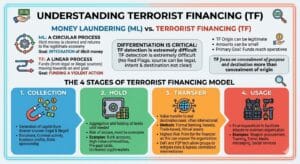
Four Stage Framework TF Model

  • Stage 1: Collection. The generation of capital from a diverse source (both legal and illegal/ criminal) to support organization’s expenditures or specific operations. Can be donations, criminal activity, business profits or state sponsored.
  • Stage 2: Hold. The aggregation and holding of funds until they are required for an operational need. This stage has the risk of seizure and needs to overcome the same. Can be in bank accounts, high-value commodities, pre-paid cards or un-hosted crypto-wallets.
  • Stage 3: Transfer. The transfer of value from the storage point to the end destination or user, often across international borders i.e. transfer of value from holding point to end destination or user. Formal banking, Informal Value Transfer System (Hawala), trade-based or virtual assets are few examples of the same. This stage is often said to be the point of highest risk for the financier as this can expose the organisation. However, the evolution of decentralised finance (DeFi) and peer-to-peer (P2P) technologies has increasingly allowed groups to mitigate these risks by bypassing centralized intermediaries.
  • Stage 4: Usage. The final expenditure of funds to facilitate attacks or maintain the organization’s long-term sustainability. Can be for weapon procurement, training, travel, media messaging or social services.

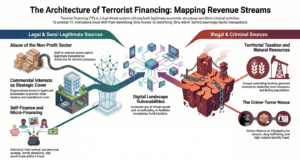
 Typology of Sources of Terrorist Financing

 TF: Legal & Semi-Legitimate Sources

A substantial portion of TF is resultant of legitimate economic activity, which presents a distinct challenge for financial institutions. If funds originate from a lawful activity and do not stain of criminal predicate, then it necessitates a shift from identifying dirty money to dirty intent. The means are discussed below.

Abuse of the Non-Profit Sector (NPOs) – NPOs and charities have been identified by the FATF as particularly vulnerable to abuse for terrorist financing. E.g. fund diversion of legitimate donations for humanitarian purposes are siphoned off by complicit staff or external actors.

Commercial Interests and Legitimate Businesses – Large terrorist organizations often act as venture capitalists, investing surplus capital into legitimate commercial sectors to ensure a steady stream of income, serving dual purpose, provide a clean revenue stream and offer cover for operatives stay and move.

Self-Finance and the Lone Wolf – The individual operatives have own legitimate income as the primary source of funding. It is often supplemented by micro-financing strategies like welfare and benefit fraud, small loans and personal savings & family donations.

TF: Illegal & Criminal Sources

Industries and Territorial Taxation – For groups that control territory, such as ISIS at its zenith, the primary source of revenue is the exploitation of natural resources and the taxation of the local population.

Kidnapping for Ransom (KFR) – Kidnapping for ransom has become a principal revenue generation source for groups like Al-Qaeda in the Islamic Maghreb (AQIM) and even in the case of ISIS provinces in West Africa, Khorasan, and South Africa.

Drug Trafficking – The intersection of drug trafficking and terrorism is one of the most known aspects of the crime-terror nexus. The reported Taliban’s dependance on the opium trade and Hezbollah’s said involvement in the cocaine trade from South America to Europe show exploitation of drug market by these groups to fund their political projects.

Fraud and Identity Theft – In Western countries terror cells involves in low level but high-volume frauds supporting terrorist financing methods.

 Digital Landscape – Introduced new vulnerabilities into FT leading to increased abuse of digital platforms (virtual assets, crowdfunding and social media) to facilitate collection and transfer of funds with speed and anonymity.
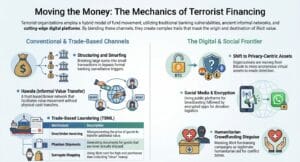
Move Typology: Mechanics of Transfer

Post raising and storing of funds, movement of funds is required for operations/ sustenance. The terror outfits mostly employ hybrid method of fund transfer, formal, informal and trade-based systems to evade surveillance.

Formal Fund Transfer – In spite of exhaustive regulation, the formal banking sector remains a primary target for misuse, using individuals with clean backgrounds (straw men) for opening accounts and transactions. Usage of shell companies is also common method to mask the movement of funds. A common method in the formal sector is structuring or smurfing, where large sums is broken into small transactions to avoid trigger of Suspicious Transaction Reports (STRs).

Hawala and Informal Value Transfer Systems (IVTS) – Hawala is an ancient system of value transfer that operates outside the conventional banking sector. It is based on a network of brokers (hawaladars) who facilitate transfers through trust and net settlement rather than the physical movement of money. The characteristics of Hawala as speed, lower costs and potential anonymity, makes it highly attractive for both legitimate remittances and illicit financing. Hawala settlement in often through Reverse Hawala or Bilateral Settlement, where hawaladars balance their accounts by paying for each other’s expenses in or through the invoicing of legitimate trade.

Trade-Based Money Laundering and Terrorist Financing (TBML/TBTF) – TBML is defined as the process of disguising the proceeds of crime and moving value through the use of trade transactions to legitimize their origins. It is one of the most complex methods of value transfer. Mechanisms of TBML include Over and Under-Invoicing, Phantom Shipments (documents generated for goods that are never shipped), Multiple Invoicing and Surrogate Shopping/ Daigou (high purchase of goods using illicit cash and collecting clean money from end-users). As per FATF, TBML is increasingly attractive and is frequently used by groups like Hezbollah and the Taliban, who have established deep connections with international trade and transport companies.

Digital Frontier & Emerging Technologies

The rapid evolution of financial technology has introduced new vulnerabilities into the FT landscape. Terrorists are increasingly misusing digital platforms including virtual assets, crowdfunding and social media, to generate and move funds with unprecedented speed and anonymity.

Virtual Assets (VAs) and Cryptocurrencies – Virtual assets are characterized by non-face-to-face relationships and can permit anonymous funding. While Bitcoin was the initial currency of choice, the transparency of its blockchain has led to a shift toward more privacy-centric and stable assets. The overall VA use in terrorist financing remains relatively lower than cash and Hawala, but its reportedly growing in South and Central Asia.

Crowdfunding and Social Media Integration – Social media platforms as Facebook and Twitter act as broadcast mechanisms to ask donations. Once a potential donor is identified, the conversation moves to private, often encrypted, as Telegram or WhatsApp. Crowdfunding platforms are misused through campaigns, disguising funds as humanitarian aid for conflict zones, using combination of traditional payment methods and new technologies (Crypto) to avoid detection.
Emerging Threats and AI Factor

FATF Update on TF Risks of 2024 and 2025 highlights surge in activity by young, tech-savvy actors who are radicalized online and employ micro-financing. FATF also warned specific AI risks of not only in the recruitment and radicalization but also in automation of fund operations.

Trends collectively suggest that TF risk is becoming more diffuse, networked and embedded in legitimate global flows, requiring intelligence?driven, multi?sectoral responses rather than reliance on static typology checklists. For corporate security and compliance functions, this means that the “financial footprint” of terrorism often appears as small, routine, sometimes even charitable or community?oriented transactions.

(Lt Col Ujjual Abhishek Jha, Retd is a Certified Data Privacy Professional and Strategic & Geopolitical Advisor with over two decades of experience in intelligence, insider threat management, financial crime investigations, and geopolitical risk analysis, advising on complex security and strategic risks.)


The post Linear Path of Terror: Architecture of Modern Terrorist Financing first appeared on The Frontier Manipur.

Read more / Original news source: https://thefrontiermanipur.com/linear-path-of-terror-architecture-of-modern-terrorist-financing/

Digital Personal Data Protection Act (DPDPA) 2023 Series: Part III – Impact & Implementation Challenges

Digital Personal Data Protection Act (DPDPA) 2023 Series: Part III – Impact & Implementation Challenges By Lt Col Ujjual Abhishek Jha, Retd The enactment of the Digital Personal Data Protection Act (DPDPA) 2023 marks a seismic shift in India’s legislative approach to privacy and simultaneously introduces a complex web of operational demands for businesses. From […]

The post Digital Personal Data Protection Act (DPDPA) 2023 Series: Part III – Impact & Implementation Challenges first appeared on The Frontier Manipur.

Digital Personal Data Protection Act (DPDPA) 2023 Series: Part III – Impact & Implementation Challenges

By Lt Col Ujjual Abhishek Jha, Retd

The enactment of the Digital Personal Data Protection Act (DPDPA) 2023 marks a seismic shift in India’s legislative approach to privacy and simultaneously introduces a complex web of operational demands for businesses. From re-engineering legacy data systems to navigating the nuances of “Data Fiduciaries” and “Significant Data Fiduciaries,” the road to compliance is paved with both technical hurdles and strategic questions. In this part of our series, we dive into the tangible impact of the DPDPA and the primary challenges organizations face in turning these legal mandates into functional realities.

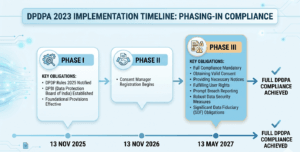
DPDPA: Enforcement Timeline

The DPDPA applies exclusively to digital personal data, data collected digitally or subsequently digitised, processed in India, or outside India in connection with offering goods or services to individuals in India.

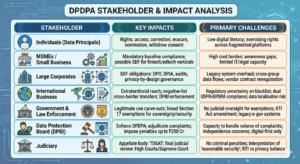
Impact & Challenges

• Impact on Individuals (Data Principals)
DPDPA strengthens individual control over personal data, translating the constitutional right to privacy into enforceable statutory rights. Data principals rights include: –
• Right to Access – obtain a summary of personal data held and processing activities though notably without a data portability right.
• Right to Correction and Erasure – request rectification of inaccurate data or deletion of data no longer required.
• Right to Withdraw Consent – revoke consent at any time, data fiduciaries must respond within 90 days.
• Right to Nominate – appoint a nominee to exercise rights in case of incapacitation or death.
• Right to Grievance Redressal – exhaustion of internal mechanism required for complaint be lodged with the DPBI.
• Children under 18: heightened protection – verifiable parental/guardian consent is mandatory before processing a minor’s data, with specific exemptions carved out for healthcare professionals, educational institutions and child transport providers. Penalty up to Rs 200 crores.

Implementation Challenges for Individuals
• Literacy and Awareness Gap – India’s low digital literacy users may not be able to practically exercise rights, file complaints or interpret consent notices. The notice requirement specifies English and all 22 Scheduled languages, creating a multilingual compliance obligation, which remains a challenge.
• Dark Patterns and Consent Quality – While the DPDPA prohibits conditional consent and pre-ticked boxes, enforcement against confusing consent flows or hidden opt-outs, will depend heavily on DPBI capacity and proactive complaint filing.
• Grievance Exhaustion Requirement – Data principals must exhaust the data fiduciary’s internal grievance mechanism before approaching the DPBI. The 90-day response window, while clear, could be exploited as a delay mechanism by less scrupulous operators.
• RTI Act Amendment: Right to Know vs Right to Privacy – One of the most consequential changes brought by the DPDPA is the amendment to Section 8(1)(j) of the Right to Information Act, 2005. The original provision allowed disclosure of personal data held by public authorities in the ‘larger public interest’. The DPDPA removes this override, significantly curtailing the ability of citizens and journalists to access personal data held by government bodies.

Impact on MSMEs and Small Businesses
• Scope of Compliance Obligations – MSMEs that process digital personal data with customer-facing digital touchpoints, employee HR systems or supplier databases, are subject to the DPDPA. The aspects include, consent, notice requirements, purpose limitation, data minimisation, reasonable security safeguards, breach notification (72-hour deadline), data principal rights handling and contractual obligations with data processors. The Act offers no blanket small-business exemption.
• Sector-Specific Heightened Risk – Most MSMEs will not be classified as Significant Data Fiduciaries, avoiding the DPO and DPIA obligations. However, volume-driven or sector-specific designation is possible for Fintech and lending platforms processing KYC and financial data, Healthtech and telemedicine platforms with patient records, Edtech platforms with children’s data, SaaS and E-commerce.
• Compliance Cost and Capacity Challenges
• Budget and Resource Constraints – Legal, technical and organisational costs may range from ?5–25 lakh for a simple MSME to ?50 lakh or more for data-heavy verticals, costs that can be existentially challenging for businesses in early stages.
• Legacy Systems and Data Mapping – Many MSMEs operate on basic ERP systems, Excel-based databases, or fragmented CRMs that lack built-in consent tracking, automated data deletion workflows, or audit logging capabilities. Mapping all personal data flows including through informal channels such as WhatsApp Business, ad-tech trackers, and offline data later digitised to meet documentation requirements is technically complex without dedicated resources.
• Awareness Gap – Awareness of DPDPA obligations among MSME operators remains low and without targeted government outreach programmes, many small businesses risk inadvertent non-compliance.
• 72-Hour Breach Notification – The 72-hour window to notify the DPBI and affected data principals of a personal data breach demands 24/7 incident monitoring infrastructure that most MSMEs lack.

Impact on Large Corporates and Conglomerates

For large enterprises, the DPDPA drives a fundamental shift toward institutionalised privacy governance and requires a privacy-by-design approach. Key enterprise-level requirements include enterprise privacy policies and data governance frameworks, role-based access controls and privileged access management, vendor and third-party data processing agreements with mandatory DPDPA compliance clauses, accountability through privacy registers, audit trails and board-level oversight and automated data lifecycle management.

Significant Data Fiduciary Obligations – Large enterprises across sectors are likely to be designated as SDFs which entails appointment of an India based DPO, annual Data Protection Impact Assessments, annual independent audits, algorithmic risk verification and potential data localisation mandates for government-specified data categories.
Implementation Challenges for Large Corporates and Conglomerates

• Legacy System Modernisation – India’s large corporate landscape runs on legacy architectures that lack support for consent tracking, automated erasure or granular access logging.
• Multi-Regulator Complexity (BFSI) – They will have dual-compliance challenge meeting RBI, SEBI, IRDAI and NPCI requirements and reconciling KYC data processing under DPDPA’s consent and purpose-limitation principles requirement.
• DPO Scarcity – The requirement of DPO creates a talent supply crisis with India has fewer than 5,000 practitioners with certifications.
• AI and Algorithmic Compliance – The requirement for algorithmic risk verification introduces compliance overhead at the model design, training and deployment stages and may require significant architectural changes.

Impact on International Business
• Extraterritorial Reach – The DPDPA applies to any entity Indian or foreign that processes personal data of individuals located in India in connection with offering goods or services to those individuals. Foreign entities without an India office but serving Indian users through e-commerce, SaaS, mobile apps or digital services must comply with the full DPDPA regime, including responding to DPBI enforcement.
• Cross-Border Data Transfers: The Negative List – DPDPA establish a ‘negative list’ approach to cross-border transfers, personal data may be transferred to any country except those specifically restricted by the Central Government notification. However, it introduces a distinctive set of challenges, as no published criteria of blacklisted countries, No advance notice requirements for Blacklisting, No standard contractual clauses and persistence of sector specific laws.
• Compliance Cost – Multinational companies face layered compliance costs of updating global privacy policies for Indian requirements, implementing multilingual consent notices, deploying India-specific consent management infrastructure, renegotiating data processing agreements with India-based processors and sub-processors, and maintaining the technical capability to respond to DPBI enforcement actions.

Impact on Government and Law Enforcement Agencies
Government as Data Fiduciary – Government entities are ‘data fiduciaries’ under the DPDPA when processing citizens’ digital personal data and subject to the same baseline obligations as private sector entities. However, Section 17 of the DPDPA provides exemptions for State processing for sovereignty, integrity, security, public order, and prevention/investigation of offences, research, archiving or statistical purposes, Legal and judicial proceedings and Processing of non-residents personal data within India.
Law Enforcement and Investigation Challenges – Law enforcement agencies face a contradiction, as data fiduciaries must comply with DPDPA and mandated for exemptions. This creates operational complexity as legacy systems holding this data still require security safeguards.

Judicial Implications
• Appellate Jurisdiction Telecom Disputes Settlement and Appellate Tribunal (TDSAT) – TDSAT is designated as the appellate body for DPBI decisions, is primarily a telecommunications regulator with limited data privacy jurisprudence.
• No Criminal Penalties – This reduces the risk of regulatory overreach against individuals but may limit deterrence effectiveness for misuse by corporate actors who can absorb financial penalties as a cost of business.
• Interpretation Challenges – Courts and the DPBI will face interpretive questions as What constitutes ‘reasonable security safeguards’, How Puttaswamy judgement applies to the government exemptions and interplay between DPDPA and sector-specific regulations where conflicts arise.

DPDPA 2023 is more than just a compliance checklist and is a catalyst for a fundamental cultural shift in how data is perceived. While the implementation challenges are significant, they are implementable. Organizations that view these hurdles as an opportunity to build ‘Privacy by Design’ will likely find themselves with a competitive edge in an increasingly data-conscious global market.

(Lt Col Ujjual Abhishek Jha, Retd is a Certified Data Privacy Professional and Strategic & Geopolitical Advisor with over two decades of experience in intelligence, insider threat management, financial crime investigations, and geopolitical risk analysis, advising on complex security and strategic risks.)

For Part I – Digital Personal Data Protection Act (DPDPA) 2023 Series: Part I — The Foundations of Privacy: Evolution of Indian Laws & A Roadmap to DPDPA – The Frontier Manipur
For Part II – Digital Personal Data Protection Act (DPDPA) 2023 Series: Part II — From Principles to Practice: The DPDP Rules 2025, Global Paradigms & India’s Middle Path – The Frontier Manipur

The post Digital Personal Data Protection Act (DPDPA) 2023 Series: Part III – Impact & Implementation Challenges first appeared on The Frontier Manipur.

Read more / Original news source: https://thefrontiermanipur.com/digital-personal-data-protection-act-dpdpa-2023-series-part-iii-impact-implementation-challenges/