

Strategic Challenges in India’s Northeast: The Manipur Crisis and Pathways to Sustainable Security and Peace PART 2

By Brojen Thangjam Part II   Manipur: From Complex History to Violent Political Fragmentation Manipur’s present crisis has to be understood against a much longer history of political incorporation, social differentiation and frontier governance. Since its incorporation into the Indian Union in 1949, the state has had to negotiate the coexistence of a distinctive historical and […]

The post Strategic Challenges in India’s Northeast: The Manipur Crisis and Pathways to Sustainable Security and Peace PART 2 first appeared on The Frontier Manipur.

By Brojen Thangjam

Part II


Manipur: From Complex History to Violent Political Fragmentation

Manipur’s present crisis has to be understood against a much longer history of political incorporation, social differentiation and frontier governance. Since its incorporation into the Indian Union in 1949, the state has had to negotiate the coexistence of a distinctive historical and political identity with the institutions and imperatives of the Indian state. Its geography adds another layer of complexity. Located on India’s international frontier with Myanmar, Manipur has long been exposed to cross-border movement, ethnic and familial linkages, demographic pressures and transnational economic and illicit networks. Within the state itself, different communities have developed distinct political aspirations, social institutions and relationships with land, customary authority and the state. These differences have interacted with inherited administrative arrangements, changing forms of political accommodation and a security architecture shaped by the region’s frontier character and successive phases of armed conflict. The result is a political-security environment in which questions of identity, territory, authority, security and political representation have become closely intertwined.

From Political Incorporation to Insurgency

One enduring source of political contestation in Manipur concerns the circumstances and political meaning of its incorporation into the Indian Union. The Merger Agreement was signed on 21 September 1949, and administration was transferred to the Government of India on 15 October 1949. The Government of India’s White Paper on Indian States had described Manipur as a border state of “great strategic importance”, whose security arrangements required special attention. The Agreement transferred “full and exclusive authority, jurisdiction and powers” over the governance of the State to the Dominion Government. These developments marked a decisive change in Manipur’s constitutional and political status, but they did not bring the political questions surrounding that transition to a simple conclusion. (Government of India, 1948)

The significance of this history is also illuminated by the constitutional trajectory that preceded the merger. Manipur adopted its own Constitution in 1947 and held elections on the basis of universal adult franchise in June 1948, establishing a functioning Legislative Assembly. In studies of constitutionalism in the princely states of the Indian subcontinent, Manipur stands out as an important case that complicates the conventional narrative of integration. (De & Shani, 2025, pp. 150–161). They note that the Manipur State Constitution Act, 1947, has remained a site of political contestation, while the subsequent dissolution of the elected institutions following the transfer of administration has become part of a longer political memory concerning constitutional authority, political representation, and the terms of Manipur’s incorporation.

This history should not, however, be treated as a sufficient explanation of the conflicts that followed. Its significance for the present argument lies in the fact that the circumstances of incorporation provided one strand of the political narrative through which questions of sovereignty, political autonomy and historical legitimacy were subsequently articulated. From the 1960s, armed organisations emerged challenging the authority of the Indian state and, in different forms, seeking independence or the restoration of what was regarded as Manipur’s sovereign political status. The question of incorporation thus became one element in the historical and political justification of insurgency, contributing to a prolonged vertical conflict between insurgent organisations and the state.

The Convergence of Vertical and Horizontal Conflict

The present crisis, however, cannot be understood simply as a continuation of the earlier insurgency. The political and security environment has changed substantially. For much of the post-independence period, the dominant conflict was essentially vertical: the principal confrontation was between insurgent organisations and the Indian state. The present crisis has added a powerful horizontal dimension, in which conflict increasingly takes place between communities themselves, with armed organisations, political actors, state institutions and community-based security structures operating within and around these competing relationships. The distinction between vertical and horizontal conflict is useful here because it draws attention not merely to a change in the identity of the actors, but to a change in the social and political location of armed confrontation (Sadokpam, 2026). Sadokpam draws this understanding from Rizal Sukma’s formulation of vertical and horizontal conflict in ethnically volatile Indonesia. (Sukma, 2005) that helped to illuminate this transformation.

This shift was gradual rather than a sudden conversion in 2023. It emerged as political aspirations that had previously been expressed largely through ethnic organisations, constitutional demands and electoral politics became increasingly intertwined with armed organisations and coercive forms of mobilisation. The reconfiguration of insurgent politics in the late 1980s was particularly significant. The formation of the NSCN (IM) in 1988 and the emergence of Kuki armed organisations such as the KNA and KNF in the same year created new organisational vehicles through which claims relating to identity, territory and political authority could be articulated and pursued. The Kuki–Naga conflict of 1992–97 marked a critical stage in this transformation. It demonstrated that armed mobilisation could be directed not only against the state but also towards competing territorial and political claims between communities, producing displacement, deepening mistrust and consolidating armed authority within particular areas. The conflict was therefore no longer simply a contest between the state and insurgents, as territorial and political competition itself became increasingly militarised.

The subsequent peace processes further altered this landscape, although in a paradoxical way. The 1997 ceasefire between the Government of India and the NSCN (IM) substantially reduced direct confrontation between the state and the organisation, while its designated camps, command structure and organisational networks continued to operate within Manipur. The later suspension of operations arrangements with Kuki-Zo armed groups, informally from 2005 and formally from 2008, similarly sought to contain a fragmented armed landscape rather than immediately dismantle it. These arrangements reduced insurgent violence and created channels for political engagement, but they also allowed armed organisations to retain organisational cohesion, territorial influence and political relevance. Over time, armed authority therefore became embedded within parts of the social and political order rather than disappearing from it. The result was a gradual multiplication of centres of authority and a blurring of the boundary between armed mobilisation, community politics and territorial control.

As armed organisations became embedded in particular communities and territories, control over physical and economic space also acquired greater political significance. Territory was no longer simply the ground on which the state sought to deny insurgents freedom of movement; it increasingly became an object of competition in its own right. Control over land, strategic locations, movement corridors, border access, trade and economic networks acquired political and security value. Moreh illustrates this changing environment particularly well. Its location on the Myanmar frontier, its importance for cross-border trade and connectivity, and the presence of competing political and armed interests made it a space where territorial claims, economic interests, community security and challenges to state authority converged. The cumulative effect was a conflict environment in which the older state–insurgent contest increasingly overlapped with struggles over territory, resources, political representation and community security (Nepram, 2004).

This transformation does not mean that the earlier vertical conflict has disappeared. It has not. Rather, the two dimensions now coexist and interact. Armed organisations that once primarily challenged state authority have become embedded, to varying degrees, in community, territorial and political networks, while communities themselves have increasingly come to perceive security through competing claims over territory, identity and political future. By the time the 2023 crisis emerged, armed groups had become enduring political actors with organisational capacity, coercive capability, territorial influence and claims to political representation. The state was therefore no longer dealing only with armed organisations challenging its authority; it was also confronted with communities whose perceptions of security, territory, identity and political future had themselves become mutually contested.

The distinction matters because a state–insurgent conflict and an inter-community conflict pose different political and security problems. In the former, the principal challenge is to restore state authority in relation to an armed organisation. In the latter, the state must simultaneously protect communities from one another, maintain public authority, and create political conditions under which competing communities can continue to inhabit a common political space. This is one of the central reasons why a security architecture developed primarily around counterinsurgency could prove considerably less effective when violence emerged from within the political and social order that decades of conflict management had helped to shape.

The Differentiated Political Geography of Manipur

The transformation described above has unfolded within a political geography that is itself deeply differentiated. Manipur is not simply divided between a valley and the hills. Different communities have developed distinct relationships with land, political authority, customary institutions and the state, shaped by terrain, settlement patterns, historical administrative arrangements and political representation. The valley’s demographic concentration, agricultural and urban economy and political centrality developed alongside hill areas characterised by different land regimes, customary institutions and forms of administration. Geography therefore acquired political meaning: it shaped how communities understood land, representation, authority and security.

The hill–valley distinction is consequently more than a geographical divide. It has acquired political and institutional dimensions, particularly around land, customary authority, representation and autonomy, as well as the relationship between state institutions and community institutions. These differences have also been interpreted and mobilised by political leaders and elites, giving geographical and institutional distinctions a political life of their own. At the same time, the binary should not be overstated. Both the hills and the valley contain multiple communities, interests and political positions. Historical and geographical differences do not inevitably produce conflict; their significance lies in the different political contexts within which grievances, fears and aspirations are understood and mobilised.

An important consequence has been that the state itself is not experienced in the same way across these political spaces. In some communities, state institutions have been perceived as majoritarian, partial or insufficiently protective; in others, they have been viewed as instruments of unequal political accommodation. In parts of the hills, the uneven reach of state institutions has also allowed customary, community and, at times, armed structures to retain significant influence. The result is not the absence of state authority, but its coexistence with other sources of authority and legitimacy. Political order is therefore experienced through multiple institutional relationships rather than through a single, uniformly accepted framework of public authority.

This helps explain why long-standing political differences have proved difficult to contain within conventional political institutions. Questions of identity, land, representation, autonomy and political authority have generated competing aspirations for decades, but the critical issue is not simply the existence of these differences. It is whether institutions are sufficiently legitimate and capable of providing credible means through which such differences can be negotiated. Where political institutions are unable to command confidence across communities, political claims are more readily interpreted through the language of collective security. A dispute over representation can become a question of political survival; a dispute over land can become a question of territorial security; and uncertainty about political arrangements can become a fear about the community’s future.

Hassan (2008) compares experiences of Manipur and Mizoram. In his, Building Legitimacy: Exploring State–Society Relations in Northeast India, Hassan places state-making, institutional legitimacy and state capability at the centre of his analysis of the contrasting trajectories of the two states. His argument is not that conflict disappears when a state becomes more capable, but that the consolidation of legitimate state institutions creates a stronger political framework for managing group contestation. In Mizoram, the process of state-making helped strengthen the legitimacy and authority of state institutions and their capacity to manage competing interests. In Manipur, by contrast, traditional and community-based centres of authority, including tribal and ethnic associations, retained considerable influence, contributing to a more fragmented field of social and political authority.

Hassan’s comparison therefore helps shift the question from why communities have competing claims to why political institutions are unable to mediate those claims effectively. Grievances, competing identities, historical memories and struggles over land and resources may generate political mobilisation. Whether such mobilisation develops into sustained conflict, however, depends also on the capacity and legitimacy of institutions to regulate competition, provide credible avenues for political participation and maintain a political order that communities regard as sufficiently fair. In Manipur, the difficulty has been not simply the presence of competing political aspirations, but the weakness of institutions in providing a sufficiently trusted arena in which those aspirations can be negotiated.

The significance of the present crisis therefore lies in the interaction between a differentiated political geography and uneven political authority. Where communities do not experience the state as equally legitimate or capable, and where alternative sources of authority retain substantial influence, political differences can more readily become security concerns. The crisis is consequently not reducible to the failure to suppress violence. It points to a deeper difficulty in sustaining a political order in which competing communities can pursue their interests, contest one another politically, and still regard the state as a credible common arena for negotiation.

Security Architecture and Managed Instability

This weakness of political mediation has existed alongside a distinctive security architecture that has governed the region for decades. Manipur’s prolonged insurgency produced an extensive security response, including exceptional legislation, counter-insurgency institutions and doctrines, truce-management frameworks and successive peace processes. As Sanjib Baruah argues, however, this was not simply a collection of security measures but part of a wider security order in which a military understanding of political conflict acquired considerable primacy. The persistence of this security orientation shaped how the state understood and responded to political unrest, often privileging the management and containment of violence over the resolution of its underlying political causes (Baruah, 2020).

These measures had significant effects. Over time, levels of insurgent violence declined in important parts of the state, even though the organisations, constituencies and political questions that had sustained armed mobilisation did not disappear. The reduction in violence was therefore real, but it did not necessarily represent the resolution of the conflict’s underlying political drivers. As Ajai Sahni’s analysis of internal security in the Northeast illustrates, declining levels of violence need to be assessed alongside the continuing organisational, political and social conditions that sustain insurgent mobilisation (Sahni, 2023). At the same time, the prolonged security architecture created a difficult legitimacy problem. Where communities experienced security institutions primarily through exceptional laws, military deployment and counter-insurgency operations, trust in the security forces and in the institutions they represented could be weakened. The state could therefore reduce violence while struggling to build the broader legitimacy and confidence necessary for security to become a shared public good.

The distinction is important because containment of violence did not necessarily translate into consolidation of state authority or legitimacy. Ceasefires and negotiated arrangements could reduce armed confrontation while allowing insurgent organisations to preserve their organisational structures, social constituencies and, in some circumstances, economic influence. Political accommodation could therefore coexist with the persistence of alternative centres of authority. The security architecture also remained embedded in a wider political environment in which the state’s coercive capacity was often more visible than its capacity to mediate competing political claims.

This is particularly significant in Manipur because security arrangements developed alongside, rather than fully replacing, other forms of political and social authority. Community organisations, customary institutions and armed organisations continued to exercise influence in different parts of the state, while the state’s capacity to regulate political and security relations remained uneven. The result was a security environment in which violence could be reduced without producing a corresponding consolidation of a common political authority. Moreover, where security forces themselves were viewed with distrust by sections of the population because of the history and operation of the security architecture, the state’s ability to claim legitimacy as an impartial provider of public security was further weakened.

This does not diminish the importance of ceasefires or peace processes. They can be necessary instruments of conflict management and can create conditions for political engagement. The difficulty arises when arrangements intended to create space for political settlement become enduring mechanisms through which armed authority is accommodated without being progressively transformed into accountable political authority. In such circumstances, the reduction of violence may coexist with the persistence of fragmented authority and unresolved political competition.

This produced what may be described as managed instability: violence was sufficiently contained to prevent wider escalation, but the political contradictions, alternative centres of authority and deficits of institutional trust that sustained insecurity remained unresolved. The concept is used here analytically to describe a condition in which conflict is managed sufficiently to maintain a degree of order without producing a sufficiently legitimate and integrated political settlement.

The significance of this distinction becomes clearer after 2023. The question is not simply whether earlier security arrangements reduced violence. It is whether they also created the political and institutional conditions necessary to sustain a common system of public authority and security when the conflict changed form.

Fragmented Authority and Community Security

The events since May 2023 exposed this problem with unusual clarity. The emergence of community-based armed formations, territorial separation, parallel security arrangements and competing claims over political authority made visible a condition in which the state was no longer the sole or universally accepted provider of security.

This can be understood through the idea of fragmented authority. Rather than authority residing exclusively within public institutions, political and security functions become dispersed among state institutions, armed organisations, community-based authorities and other actors. An analysis of the Manipur crisis similarly describes a condition of fragmented sovereignty, in which political authority is dispersed across overlapping institutions, with contested sovereignty and coercive power operating alongside formal state institutions (Thangjam & Laishram, 2026). The important question, therefore, is not simply who controls territory, but who provides protection, who exercises authority and who is perceived as capable of determining political outcomes.

The growth of community-based security is understandable in conditions of fear and uncertainty. When communities believe that public institutions cannot adequately protect them, organising for their own protection becomes a rational response to insecurity. But what may begin as a response to insecurity can itself alter the political order. Where communities increasingly depend upon their own organisations for protection, security becomes a communal rather than a public good. Armed organisations can become embedded within community structures; political representatives can become dependent upon coercive actors; and the state can find itself negotiating not only with political actors but also with actors who possess coercive capacity and claim to speak on behalf of communities.

The events of May 2023 must be distinguished from these longer-term structural conditions. The precise causes and sequence of the initial violence remain subject to competing political and legal interpretations. What is less difficult to observe, however, is the speed and scale with which violence spread across geographically separated locations, the rapid emergence of armed community formations and the subsequent establishment of territorial frontlines. The pattern suggests that the violence did not develop solely through spontaneous local mobilisation; it unfolded in an environment in which pre-existing organisational, political and armed capacities could be rapidly activated.

The concept of an institutionalised riot system provides a useful analytical lens for thinking about this process. Brass cautions against treating large-scale communal violence as simply spontaneous eruptions of accumulated anger. His framework draws attention to the political actors, organisational networks, symbols, narratives and local mechanisms through which violence can be prepared, activated and sustained (Brass, 2003). Applied cautiously to Manipur, the value of the framework is not to establish that the May 2023 violence was a centrally planned riot. Rather, it helps us ask how pre-existing political mobilisation, organisational networks and accumulated insecurity can enable violence to move rapidly from local confrontation to wider communal conflict.

The political crisis and the security crisis therefore began to reinforce one another. Weak political mediation encouraged communities to seek their own security; expanding community security reduced confidence in common public institutions; and fragmented authority made political mediation more difficult. Once security itself becomes organised increasingly along community lines, restoring a common political order becomes considerably harder.

The significance of the post-2023 crisis therefore lies not only in the scale of violence but in what it revealed about the underlying structure of authority in Manipur. The crisis brought into the open a condition in which state institutions, armed organisations and community-based structures could exercise different forms of authority over the same political space. What had previously existed in more dispersed and often less visible forms became an overt feature of the conflict.

Displacement, Trust Deficit and Militarisation

The crisis of political order is also visible in the ways prolonged violence has altered the social and territorial conditions within which that order operates. Displacement, changing patterns of settlement, declining institutional trust and deepening reliance on security structures have become part of the political landscape created by the conflict. These are not simply consequences of violence; they increasingly shape the conditions under which security, political authority and eventual peace will have to be rebuilt.

The scale and duration of displacement illustrate this transformation most clearly. By March 2025, government data submitted to the Supreme Court recorded approximately 57,000 people living in 361 relief camps, from an estimated total displacement of around 60,000 since the outbreak of violence (Human Rights Watch, 2025). These figures do not capture all those living with relatives, in temporary accommodation or outside the state. The significance of displacement therefore lies not only in its humanitarian scale but in the way it has altered the social and territorial geography of the conflict.

Large numbers of people have remained separated from their homes, livelihoods and former neighbourhoods; many homes have been destroyed or occupied; and the physical conditions necessary for return have become inseparable from questions of security and territorial control. Displacement has consequently contributed to a more durable separation of communities and made the restoration of the pre-May 2023 social geography increasingly difficult. Questions of return, property restitution and accountability therefore become part of the larger question of whether public institutions can provide a credible framework for restoring ordinary political life.

The consequences extend to institutional trust. Trust is not simply confidence that an institution can perform a task. It involves an expectation that an authority will act with competence, fairness and a degree of good faith when exercising power. Legitimacy is related but distinct: it concerns whether that authority is regarded as rightful and deserving of acceptance. Research on procedural justice suggests that perceptions of fairness, respectful treatment and voice are central to the willingness of citizens to accept and cooperate with public authority (Tyler, 2003; Fisk & Cherney, 2017). In conflict-affected settings, therefore, the experience of how security is provided can matter as much as the fact of security itself.

This distinction is important in Manipur. Trust in public institutions can be weakened when communities experience the state as absent, partial, discriminatory or unable to protect them. Prolonged exposure to exceptional security measures can add another layer to this problem when security institutions themselves become associated with coercion rather than impartial public protection. Research on military policing in Manipur has documented how prolonged exceptional security measures have affected state–society relations and generated concerns about abuse and accountability (Chopra, 2019). The result can be a trust deficit in which the state retains substantial coercive capacity but struggles to command confidence that its institutions will provide security fairly and consistently. Where confidence is weak, communities are more likely to rely on their own organisations and networks for protection.

These experiences can also become embedded in communal memory. Fear, loss, displacement and perceptions of unequal protection are transmitted through families, community organisations and social networks. Distrust can therefore become self-reinforcing, both within communities and in perceptions of other communities and public institutions. What appears at one level as a problem of inter-community mistrust is consequently also a problem of accumulated institutional experience.

This helps explain the changing significance of militarisation. Manipur has lived for decades with a substantial security presence, exceptional security legislation and institutions shaped by counterinsurgency. In this historical sense, militarisation refers not simply to the presence of armed forces but to the growing influence of security institutions and security logics in political and social life. The post-2023 crisis has added a different dimension: communities have increasingly organised their own forms of protection, including armed community defence, in response to perceptions of vulnerability and the inability of common security arrangements to provide sufficient reassurance.

The two forms should not be equated, but they interact. The historical security architecture established an environment in which security institutions had an unusually prominent role in public life; the post-2023 crisis has extended the logic of security mobilisation into the social organisation of communities themselves. When communities organise for their own protection, this may initially be a rational response to insecurity. But where armed protection becomes embedded in community organisation, security can increasingly become a communal rather than a common public good. Armed organisations may acquire greater social and political influence, while the state faces greater difficulty in restoring a common security framework. Recent analysis of the conflict similarly identifies the emergence of parallel security systems among the principal communities as a consequence of the erosion of common protection. (Kipgen & Ganie, 2025)

A self-reinforcing dynamic can then emerge. Insecurity encourages communities to strengthen their own protection; stronger community-based protection reinforces perceptions of continuing insecurity; and prolonged reliance on separate systems of protection makes the restoration of common public security more difficult. Militarisation therefore becomes not only a consequence of insecurity but also a mechanism through which insecurity can be reproduced.

The immediate eruption of violence in May 2023 must nevertheless be distinguished from these longer-term structural conditions. The precise causes and sequence of the initial violence remain subject to competing political and legal interpretations. What is less difficult to observe is the speed and scale with which violence spread, the emergence of armed community formations and the subsequent establishment of territorial frontlines. The crisis therefore brought together several processes that had developed over time: displacement and territorial separation, weakened confidence in common institutions, and the increasing capacity of communities to organise security for themselves.

These developments also provide a useful way of understanding the official framing of the crisis. Government statements have repeatedly emphasised declining violence, the restoration of normalcy, the resumption of administrative and economic activity, and dialogue with stakeholders as principal indicators and instruments of progress. The Prime Minister has described the conflict as deeply rooted in Manipur’s history and referred to earlier episodes of social conflict, while the Union Home Minister has explicitly characterised the violence as ethnic and emphasised the restoration of peace and normalcy. The latter framing is particularly clear in the Home Minister’s parliamentary statements, where he distinguished the violence from terrorism and other forms of armed conflict and described it as ethnic violence between communities.

This framing is understandable as an immediate approach to stabilisation, but it also has a less visible implication. When a crisis is primarily presented as an historically recurrent or essentially ethnic conflict between communities, the political and institutional dimensions of the crisis can recede from view. The state risks being positioned principally as a manager of violence rather than as an actor responsible for rebuilding a common political order. The emphasis on declining violence and normalisation therefore places immediate weight on preventing renewed escalation and restoring administrative functioning, while the emphasis on dialogue points towards engagement with multiple stakeholders. Yet neither necessarily answers the deeper question of whether the institutions through which security and political authority are exercised have regained sufficient legitimacy and trust.

Framing the immediate objective as “normalisation” therefore leaves a deeper question less visible: what exactly is being normalised? A return to reduced levels of violence and functioning administration is necessary, but it does not by itself restore trust, enable displaced populations to return safely, reverse community militarisation or reconstruct common public authority. If the underlying political and institutional relationships remain substantially unchanged, normalisation may restore order without necessarily producing a sustainable political settlement.

The crisis can consequently be understood as a crisis of political order expressed and reinforced through a crisis of security. Political order depends upon institutions capable of mediating competing claims, while security depends upon the capacity of the state to provide credible, common and legitimate protection. The two are therefore inseparable: where political confidence weakens, communities turn increasingly towards separate forms of protection; where public security becomes fragmented, the space for political mediation contracts. The challenge is therefore not simply to suppress violence, but to reconstruct the political and security relationships through which a common public order can be sustained.

(Brojen Thangjam recently retired from service with the United Nations. He can be reached at brojen2303@gmail.com)

The post Strategic Challenges in India’s Northeast: The Manipur Crisis and Pathways to Sustainable Security and Peace PART 2 first appeared on The Frontier Manipur.

Read more / Original news source: https://thefrontiermanipur.com/strategic-challenges-in-indias-northeast-the-manipur-crisis-and-pathways-to-sustainable-security-and-peace-part-2/

Church Leaders Killed in Ambush; ZUF Denies Involvement

Zeliangrong United Front (ZUF) has issued a press release denying any involvement in the ambush. United Naga Council (UNC) issued a strong condemnation of the attack and expressed concerns over reports that some Nagas from Konsakhul village had allegedly been held hostage by villagers from Leilon Vaiphei following the ambush. TFM Report A deadly ambush […]

The post Church Leaders Killed in Ambush; ZUF Denies Involvement first appeared on The Frontier Manipur.

Zeliangrong United Front (ZUF) has issued a press release denying any involvement in the ambush. United Naga Council (UNC) issued a strong condemnation of the attack and expressed concerns over reports that some Nagas from Konsakhul village had allegedly been held hostage by villagers from Leilon Vaiphei following the ambush.

TFM Report

A deadly ambush targeting church leaders of the Thadou Baptist Association (TBA) has sent shockwaves across Manipur after several prominent Christian leaders were attacked between Kotzim and Kotlen villages in Kangpokpi district on Tuesday.

According to sources, the church leaders were returning to Kangpokpi from Churachandpur after attending a TBA conference when armed assailants allegedly ambushed their convoy midway. The victims were traveling in two vehicles at the time of the attack.

Among those killed in the ambush was Rev. V. Sitlhou, former General Secretary of the Manipur Baptist Convention (MBC), Pastor Paogoulen, and Pastor Kaigoulun. The killings have triggered widespread grief and outrage among many organisations.

As per sources, others who sustained injuries in the incident include Rev. S.M. Haopu, Rev. Hekai Simte, Rev. Paothang, Lelen (driver), and Goumang (driver). It is stated that some of the injured were rushed for medical treatment as authorities began assessing the scale of the attack.

The ambush has sparked fresh tensions in the already volatile hill districts of Manipur, where ethnic and armed conflicts have continued to destabilise normal life.

UNC Condemns “Outrageous Ambush”

The United Naga Council (UNC) issued a strong condemnation of the attack through an official press release dated May 13, 2026. The organization described the ambush as an “outrageous” act and stated that three persons had been killed while five others were grievously injured according to available reports.

The UNC specifically mentioned that the incident occurred between Kotzin and Kotlen while the church leaders were returning from Churachandpur. The council expressed deep condolences to the bereaved families and prayed for strength and peace during the period of mourning.

The statement also highlighted concerns over reports that around 20 Nagas from Konsakhul village had allegedly been held hostage by villagers from Leilon Vaiphei following the ambush. Calling such actions unacceptable, the UNC urged the immediate and unconditional release of the hostages and appealed to all communities, church leaders, and civil society organizations to work together to prevent further escalation of violence and restore communal harmony.

ZUF Denies Involvement

Meanwhile, the Zeliangrong United Front (ZUF) issued a press release denying any involvement in the ambush. The statement, released by the organization’s Ministry of Information and Publicity from its Dilung headquarters, said the group had learned of the attack “with deep shock and concern.”

The organization categorically rejected allegations circulating on social media and in certain public circles linking the ZUF to the incident. According to the statement, the allegations were “baseless, unfounded and misleading,” and the organization claimed it was neither aware of nor connected to the attack in any manner.

The ZUF further appealed to civil society groups and media organizations not to spread unverified information or make premature accusations without factual evidence, warning that misinformation could further inflame the already sensitive situation in the state.

Fear and Uncertainty Grip Region

The brutal nature of the ambush, reportedly targeting unarmed church leaders returning from a religious gathering, has generated fear and uncertainty across the hill region. Images circulating after the incident showed damaged vehicles and critically injured victims, underscoring the severity of the attack.

Security agencies are expected to launch a detailed investigation into the incident. However, no official statement had yet been issued by the state government or law enforcement authorities regarding the identity of the attackers or the exact casualty figures till the filing of this report.

The incident is likely to deepen concerns over the deteriorating security situation in the hill districts, where armed activity, ethnic distrust, and retaliatory violence continue to threaten civilian lives.

Church organizations, tribal bodies, and civil society groups are expected to hold emergency consultations in the coming days as calls grow louder for justice, accountability, and restoration of peace in the conflict-affected areas of Manipur.

The post Church Leaders Killed in Ambush; ZUF Denies Involvement first appeared on The Frontier Manipur.

Read more / Original news source: https://thefrontiermanipur.com/church-leaders-killed-in-ambush-zuf-denies-involvement/

Digital Personal Data Protection Act (DPDPA) 2023 Series: Part IV –Implementation Recommendations

The enactment of the DPDPA 2023 and the DPDP Rules 2025 indicates the dawn of a new era for digital economy in India, where privacy is a fundamental operational requirement. However, the compliance path is steep, requiring a fundamental shift from reactive legal measures to a proactive “privacy-by-design” framework. By Lt Col Ujjual Abhishek Jha, […]

The post Digital Personal Data Protection Act (DPDPA) 2023 Series: Part IV –Implementation Recommendations first appeared on The Frontier Manipur.

The enactment of the DPDPA 2023 and the DPDP Rules 2025 indicates the dawn of a new era for digital economy in India, where privacy is a fundamental operational requirement. However, the compliance path is steep, requiring a fundamental shift from reactive legal measures to a proactive “privacy-by-design” framework.

By Lt Col Ujjual Abhishek Jha, Retd

For Part I – Digital Personal Data Protection Act (DPDPA) 2023 Series: Part I — The Foundations of Privacy: Evolution of Indian Laws & A Roadmap to DPDPA – The Frontier Manipur

For Part II – Digital Personal Data Protection Act (DPDPA) 2023 Series: Part II — From Principles to Practice: The DPDP Rules 2025, Global Paradigms & India’s Middle Path – The Frontier Manipur

For Part III – Digital Personal Data Protection Act (DPDPA) 2023 Series: Part III – Impact & Implementation Challenges – The Frontier Manipur

The entry of DPDPA, 2023, is more than a law. This is a fundamental shift in our life, work and interaction in the digital age. The law is pioneer in legal system, in drawing a clear line that personal data belongs to the people. This Act is a brave attempt to find the delicate balance between the right to privacy and the need for innovation in modern era. But a well-known fact remains that, there is often a gap between a law being passed and the reality of how it works on the ground and subsequent challenges faced by small businesses to corporate giants or law enforcement agency. This part brings out human-centred implementation strategy and explore how each player in the ecosystem can move beyond routine compliance and move towards building a culture where data privacy is treated as a core value.

 Implementation Strategy: Cross?Cutting Recommendations

 As organizations navigate the complexities of the DPDPA 2023 & DPDP Rules 2025, compliance should not be viewed as only a legal requirement but as a pillar of operational resilience. Across all segments, successful implementation will depend on four cross-cutting strategic pillars: –

  • Gap Assessment and Roadmap – First and foremost task is to identify technical and procedural vulnerabilities. Then utilize the 18-month window to identify and prioritize risks and address those by long-term infrastructure changes. Leveraging the statutory transition window needs to applied to cover the identified gaps using quantified roadmap.
  • Investment in Human Talent – Create own pool of internal talents and use expertise of external consultants to bridge the gap between legal framework and technical necessities. Qualified internal pool will act as intermediaries and needs to be supplemented by specialized external advisors to address complex regulatory nuances and technical implementation hurdles.
  • Governance Integration – The upliftment of privacy from back-office function to to a primary board-level priority for governance integration of board-level oversight. Also, accountability needs to be set using dedicated risk registers, Key Performance Indicators (KPIs) and periodic reporting.
  • Continuous Improvement – Dynamic alignment and regular recalibration of internal processes based on emerging guidance from the Data Protection Board of India (DPBI). Also, global benchmarking by evolving own strategies in line with shifting global best practices and evolving sectoral regulations to maintain a sustainable posture.

Recommendations

Individuals 

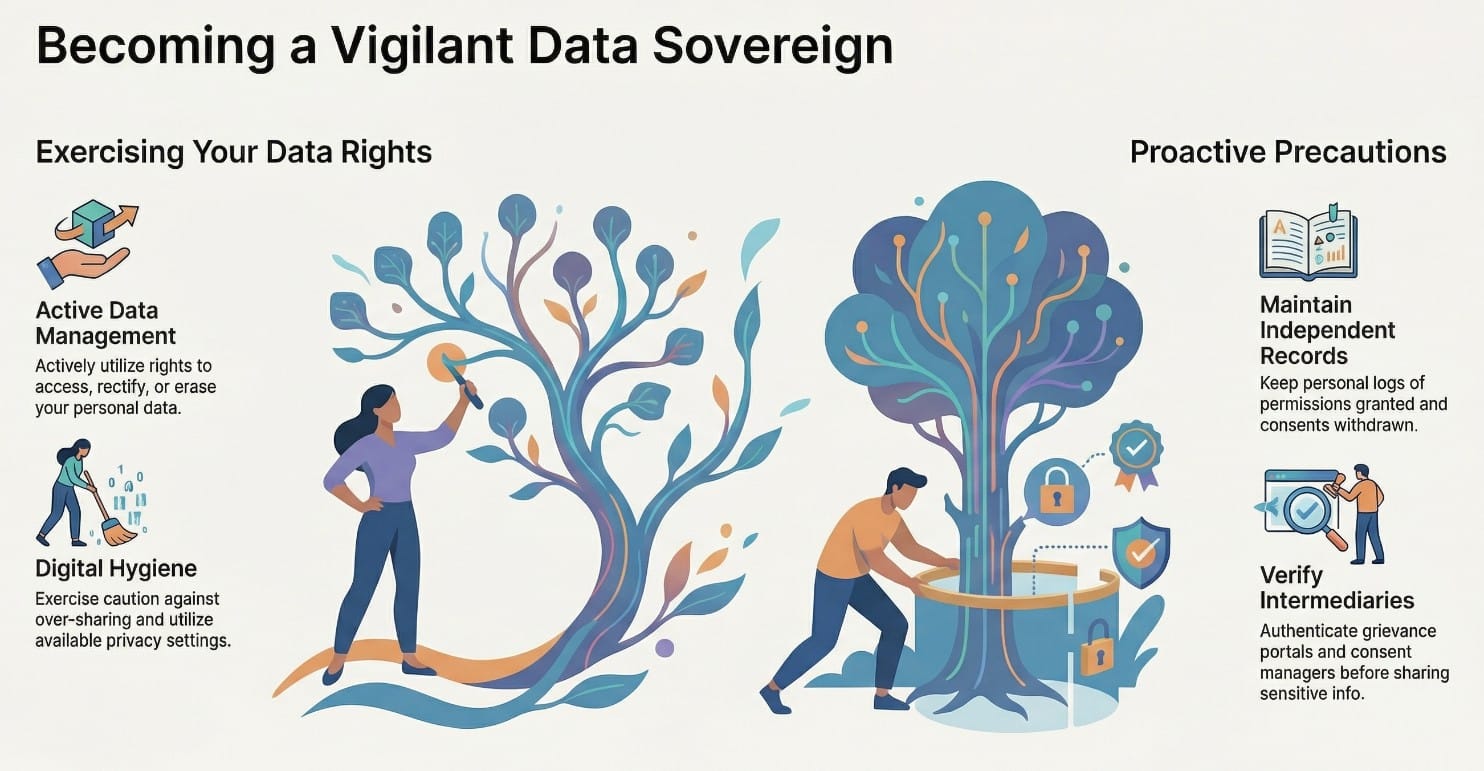
Statutory rights under the DPDPA empower individuals to manage their digital identity use of rights to see, fix or delete own data and keep own records of the permissions or any complaints. To exercise these effectively, individuals should follow these protocols: –

  • Access Inquiry – Formally request a summary of personal data currently being processed and the identities of third parties with whom it has been shared.
  • Correction & Completion – Initiate requests to rectify inaccurate data or complete evolving datasets to ensure processing remains fair.
  • Erasure Mandate – Request the deletion of personal data once the specific purpose for collection has been exhausted or consent is withdrawn.
  • Audit Trail Maintenance – Keep independent logs of all consents granted, notices received, and grievances filed to facilitate swift resolution through the DPBI if necessary.

MSMEs 

For MSMEs, the path to compliance begins with a pragmatic data inventory. The foundation for all privacy actions can be determined by: –

  • What – Classify the specific types of personal data collected.
  • Why – Define the specific legal purpose for processing.
  • Where – Plan the precise storage locations, whether in-premise, in the cloud or with third-party vendors.
  • Who – Identify all internal stakeholder and external partner with data access.

Data Inventory Steps

Map Data Ingress – Identify exact purpose of personal data collected from individuals.

Define Purpose – Clearly document the legal and operational for every data point.

Localize Storage – Precise data location both digital and physical.

Trace Data Egress: Document every third party with whom data is shared.


Compliance Tools Checklist

  • Standardize Policies – Adopt core privacy policies, data retention schedules and breach response SOPs.
  • Cloud-Native Services – Use managed services for consent management rather than internal solutions.
  • Standardized Notices – Implement simple language, standard notice and consent flows.
  • Security Defaults – Leverage cloud-based logging, encryption and access control features to meet security mandates.

 Alert: Regulatory Risk – MSMEs face limited but obligations regarding consent, notices, security and breach notification. While SDF is unlikely for MSMEs, sector-wise or large-scale classification can impact Fintech, Healthtech, Edtech and high-volume SaaS providers.

Corporates

Large-scale entities must organize a sophisticated, integrated and deep defence strategy. The steps that corporate needs to undertake are: –

  • Establishment of Privacy Office – Appoint a Chief Privacy Officer (CPO) or Data Protection Officer (DPO) to lead a dedicated office integrated with CISO, Legal, Risk and Compliance verticals.
  • Active Record of Processing Activities (ROPA) – Build and maintain a live data inventory mapped to specific purposes, retention schedules and legal bases.
  • Implement Data Protection Impact Assessments (DPIAs) – Integrate DPIAs into the lifecycle of all high-risk initiatives to institutionalize privacy-by-design.
  • Upgrade Third-Party Risk Management: Incorporate DPDPA-specific clauses and contractual safeguards into all vendor agreements, mandated with regular audits and certifications.
  • Align with Global and Sectoral Regulators: Coordinate DPDPA requirements with existing frameworks (ISO, NIST) and sectoral mandates (RBI, IRDAI, TRAI) to remove redundant efforts and leverage shared controls.

Government and Law Enforcement

  • SOP and Accountability – Government departments must formalize Standard Operating Procedures (SOPs) for data access and sharing. These SOPs must be designed to endure judicial scrutiny and DPBI audits.
  • Proportionality Oversight – Internal mechanisms must ensure that data access is necessary, limited in scope and proportionate to the stated objective.
  • Automated Logging – Comprehensive, unalterable logs must be maintained for all data access events to ensure accountability.
  • Infrastructure and Training – Legacy IT systems must be modernized to meet DPDPA security standards. Simultaneously, specialized training programs are required for investigators and prosecutors. This training must focus on the lawful handling of digital evidence and the strict procedural requirements for processing personal data during investigations. This means to transform LEA and departmental IT infrastructure to withstand DPBI and judicial scrutiny

International Business & Organisations


  • Extraterritorial Compliance: The extraterritorial applicability of DPDPA is to entities outside India offering goods/ services to individuals in India, requiring them to comply with rules (including consent, notices, rights handling and DPBI enforcement). Foreign entities must strictly adhere to Indian mandates regarding consent, notices and rights handling to avoid DPBI enforcement actions.
  • Cross-Border Transfer Mechanics – While transfers are allowed by default, organizations must monitor the government-notified “negative list” of prohibited countries or sectors. However, these needs to be kept in mind: –
  • Critical Sector Restrictions: High-risk or highly regulated sectors may face additional localization requirements or localized storage mandates.
  • Contractual Updates – Global organizations must map Indian data flows separately and update global privacy notices and vendor contracts with India-specific clauses.
  • Global Control Baselines: Establish privacy as a common control baseline across the organization while applying specific Indian legal overlays to local data flows.
  • Strategic Mapping: Separate Indian data flows from global flows in internal mapping to allow for rapid response to localization or transfer restrictions.

The enactment of the DPDPA 2023 and the DPDP Rules 2025 indicates the dawn of a new era for digital economy in India, where privacy is a fundamental operational requirement. However, the compliance path is steep, requiring a fundamental shift from reactive legal measures to a proactive “privacy-by-design” framework. Ultimately, those who view privacy as a strategic asset rather than a regulatory hurdle will be best positioned to thrive in India’s maturing, trust-based data landscape. In the present era of screens and servers, awareness of handling of our personal information is preferred way for a digital society. The transition will take time and requires a massive shift in mindset.  As we move forward, the companies and institutions that lead with transparency and empathy will be the ones that truly succeed in this new landscape.

(Lt Col Ujjual Abhishek Jha, Retd is a Certified Data Privacy Professional and Strategic & Geopolitical Advisor with over two decades of experience in intelligence, insider threat management, financial crime investigations, and geopolitical risk analysis, advising on complex security and strategic risks.)

The post Digital Personal Data Protection Act (DPDPA) 2023 Series: Part IV –Implementation Recommendations first appeared on The Frontier Manipur.

Read more / Original news source: https://thefrontiermanipur.com/digital-personal-data-protection-act-dpdpa-2023-series-part-iv-implementation-recommendations/

Centre rushes 4k personnel to Manipur

New Delhi, Dec 20 :The Centre has rushed around 4,000 paramilitary personnel to Manipur in the wake of violence following economic blockade on National Highways connecting the State. While around 1,500 paramilitary personnel were rushed in to Manipur in the last two days, around 2,500 paramilitary were dispatched to the State last week, a senior […]

New Delhi, Dec 20 :The Centre has rushed around 4,000 paramilitary personnel to Manipur in the wake of violence following economic blockade on National Highways connecting the State. While around 1,500 paramilitary personnel were rushed in to Manipur in the last two days, around 2,500 paramilitary were dispatched to the State last week, a senior […]

Read more / Original news source: http://kanglaonline.com/2016/12/centre-rushes-4k-personnel-to-manipur/

NSF to blockade State bound vehicles

IMPHAL, Dec 19 : Taking grave note of the situation in Manipur, the Naga Students’ Federation today resolved to impose a total blockade on all Manipur bound vehicles in the Naga inhabited areas till the Government of Manipur assures the safety and security of Nagas in Manipur. However NSF will consider relaxing the stricture on […]

IMPHAL, Dec 19 : Taking grave note of the situation in Manipur, the Naga Students’ Federation today resolved to impose a total blockade on all Manipur bound vehicles in the Naga inhabited areas till the Government of Manipur assures the safety and security of Nagas in Manipur. However NSF will consider relaxing the stricture on […]

Read more / Original news source: http://kanglaonline.com/2016/12/nsf-to-blockade-state-bound-vehicles/

Measures to escort back goods not enough: HC to state

HC directs state to prevent counter economic blockade The High Court (HC) of Manipur has today directed the state to take up adequate measures to increase security deployment along the National Highways particularly NH-2 to ensure movement of goods trucks can be frequent. The HC also director the state to take steps to prevent the […]

HC directs state to prevent counter economic blockade The High Court (HC) of Manipur has today directed the state to take up adequate measures to increase security deployment along the National Highways particularly NH-2 to ensure movement of goods trucks can be frequent. The HC also director the state to take steps to prevent the […]

Read more / Original news source: http://kanglaonline.com/2016/12/measures-to-escort-back-goods-not-enough-hc-to-state/

Trucks stranded at Mao reach Imphal

IMPHAL, Dec 2: Around 230 loaded trucks stranded at Mao Gate for the past many days on account of the indefinite economic blockade have finally reached Imphal. The stranded trucks started moving a little past last midnight and they were escorted by CRPF and IRB personnel. A strong police force led by an ADGP also […]

IMPHAL, Dec 2: Around 230 loaded trucks stranded at Mao Gate for the past many days on account of the indefinite economic blockade have finally reached Imphal. The stranded trucks started moving a little past last midnight and they were escorted by CRPF and IRB personnel. A strong police force led by an ADGP also […]

Read more / Original news source: http://kanglaonline.com/2016/12/trucks-stranded-at-mao-reach-imphal/

Security alerted

IMPHAL, Nov 25 : A meeting of the Council of Ministers was held this evening with Chief Minister O Ibobi in the chair.
The post Security alerted appeared first on The Sangai Express.

IMPHAL, Nov 25 : A meeting of the Council of Ministers was held this evening with Chief Minister O Ibobi in the chair.

The post Security alerted appeared first on The Sangai Express.

Read more / Original news source: http://www.thesangaiexpress.com/security-alerted/

A Clarion Call to Develop a State Diversity Policy and Ensuring a Gender Just Society

Aizawl– Control Arms Foundation of India along with Manipur Women Gun Surcted successful interactive meeting on ” Working Towards Ensuring Mizoram State Diversity Policy and Ensuring a Gender Just Society on 14th November 2016 at Zarkawat, Aizawl, Mizoram. Addressing the opening function as Chief Guest, Mr. PC Lalthanliana, Hon’ble Minister, Social Welfare Govt. of Mizoram, […]

Aizawl– Control Arms Foundation of India along with Manipur Women Gun Surcted successful interactive meeting on ” Working Towards Ensuring Mizoram State Diversity Policy and Ensuring a Gender Just Society on 14th November 2016 at Zarkawat, Aizawl, Mizoram. Addressing the opening function as Chief Guest, Mr. PC Lalthanliana, Hon’ble Minister, Social Welfare Govt. of Mizoram, […]

Read more / Original news source: http://kanglaonline.com/2016/11/a-clarion-call-to-develop-a-state-diversity-policy-and-ensuring-a-gender-just-society/

Development as Security

The relevance of the “Look East Policy”  now “Act East Policy” can also be seen very much as India reassessing its security concerns vis-a-vis the Northeast. The government’s seriousness in taking this policy forward, and without skirting the Northeast, therefore will also be a measure of how much the Union has changed its attitude towards the […]

The relevance of the “Look East Policy”  now “Act East Policy” can also be seen very much as India reassessing its security concerns vis-a-vis the Northeast. The government’s seriousness in taking this policy forward, and without skirting the Northeast, therefore will also be a measure of how much the Union has changed its attitude towards the […]

Read more / Original news source: http://kanglaonline.com/2016/11/development-as-security/

Empty Driver’s Seat

Among so many others, what Manipur urgently needs today, is a sense that things are being looked after, and even if they are bad now the effort to get things better have not been abandoned. Nobody is so naive as to actually expect skyscrapers to begin sprouting, incomes to make any quantum leap, swank shopping […]

Among so many others, what Manipur urgently needs today, is a sense that things are being looked after, and even if they are bad now the effort to get things better have not been abandoned. Nobody is so naive as to actually expect skyscrapers to begin sprouting, incomes to make any quantum leap, swank shopping […]

Read more / Original news source: http://kanglaonline.com/2016/10/empty-drivers-seat/

General strike comes into force Security enhanced ahead of I-Day celebration

IMPHAL, Aug 14 :  As in the  past years, the general strike called by different armed groups operating in the region against the Independence Day celebration of the country came into force from 1 am and will be in force till 6 pm tomorrow. To thwart any stray incident in the face of the boycott […]

The post General strike comes into force Security enhanced ahead of I-Day celebration appeared first on KanglaOnline.

Read more / Original news source: http://kanglaonline.com/2016/08/general-strike-comes-force-security-enhanced-ahead-day-celebration/

Security at NE airports, oil installations stepped up

Source: The Assam Tribune GUWAHATI, Aug 10 – With the possibility of attacks from militants not being ruled out, security in all the airports as well as the vital oil installations in the northeastern region have been beefed up and the Central Industrial Security Force (CISF) personnel deployed in those places have been kept on […]

The post Security at NE airports, oil installations stepped up appeared first on KanglaOnline.

Read more / Original news source: http://kanglaonline.com/2016/08/security-ne-airports-oil-installations-stepped/

India-Myanmar discuss security cooperation

New Delhi, Jul  27 (PTI): India and Myanmar today discussed ways to enhance cooperation to check activities of insurgent groups along the border, arms smuggling as also intelligence-sharing among security agencies. Union Home Secretary Rajiv Mehrishi discussed the issues at a bilateral meeting with a Myanmar delegation led by Deputy Minister of Home Affairs Major […]

The post India-Myanmar discuss security cooperation appeared first on KanglaOnline.

Read more / Original news source: http://kanglaonline.com/2016/07/india-myanmar-discuss-security-cooperation/

Modi asks States to share intelligence for internal security

NEW DELHI, Jul 16: Prime Minister Narendra Modi on Saturday asked States to focus on intelligence sharing which will help the country stay “alert” and “updated” in countering internal security challenges. Addressing the Inter-State Council meeting, convened after a gap of 10 years, the Prime Minister told the Chief Ministers that “we should focus on […]

The post Modi asks States to share intelligence for internal security appeared first on KanglaOnline.

Read more / Original news source: http://kanglaonline.com/2016/07/modi-asks-states-share-intelligence-internal-security/

SFs cannot use excessive force in AFSPA areas: SC

Serving a blow to immunity enjoyed by armed forces under the Armed Forces Special Powers Act (AFSPA) against criminal action for acts committed in disturbed areas, the Supreme Court on Friday held that armed forces personnel and police cannot use “excessive or retaliatory force” in disturbed areas.

The post SFs cannot use excessive force in AFSPA areas: SC appeared first on The Sangai Express.

Read more / Original news source: http://www.thesangaiexpress.com/sfs-cannot-use-excessive-force-afspa-areas-sc/

Security beefed up ahead of Indian Independence Day

IMPHAL, August 14: In connection with the Independence Day observation on August 15, security forces have been beefing up security in the State since the past few days. A cordon

Locals of Saiton Bishnupur lined up for identification during the search operation on the eve of I-Day.

Locals of Saiton Bishnupur lined up for identification during the search operation on the eve of I-Day.

IMPHAL, August 14: In connection with the Independence Day observation on August 15, security forces have been beefing up security in the State since the past few days.

A cordon and search operation was conducted today at Saiton, Bishnupur District starting from 3:30am and concluding at 6:30am.

The operation was conducted by a joint team of Bishnupur police including CDO and women police and 2 columns of 6AR under the supervision of additinal SP Bishnupur K Meghachandra.

Another team of Bishnupur Police including CDO and women police and 12 Bihar Regiment also conducted a similar operation at Maibam Chingning of Bishnupur District under the supervision of DSP (Ops) Bishnupur N John.

Meanwhile, according to a statement of the PRO IGAR (s), troops of the 16 Assam Rifles of 10 Sector AR has launched an operation in general area Lamboikhul and apprehended an over ground worker of PREPAK (PRO) on August 13.

It said the apprehendee was identified as Poshangbam Bijoy Singh, 32, son of P Lukhoi Singh of Lamboikhul, PO- Sawombung, Imphal East.

He revealed that he was working as an agent of the group recruiting cadres for his group and was responsible to find the young boys for recruitment. The apprehendee has been handed over to the Sagolmang Police Station, it said.

In yet another release, troops of the 24 Assam Rifles of 26 Sector AR has conducted frisking and checking at Khudengthabi check post and apprehended a drug peddler carrying heroin on August 13. The apprehendee was identified as Md Ajijur, 45, son of (l) Md Anamuddin of Muslim Nagar Leikai Moreh, Ward No 5, Moreh.

From his possession, three packets of heroin weighing around 80 grams, one Aadhar Card and cash rupees 600/- was recovered from his possession. The apprehendee along with the recovered items has been handed over to the Moreh Police Station, it said.

Read more / Original news source: http://kanglaonline.com/2015/08/security-beefed-up-ahead-of-iday/

Women in South Asia to Strengthen Efforts for Peace, Security and Disarmament

PRESS RELEASE FOR IMMEDIATE RELEASE   Women in South Asia to Strengthen Efforts for Peace, Security and Disarmament Delhi, 3 April 2014: The United Nations Commission on the Status of Women (CSW)

PRESS RELEASE FOR IMMEDIATE RELEASE


Women in South Asia to Strengthen Efforts for Peace, Security and Disarmament

Delhi, 3 April 2014: The United Nations Commission on the Status of Women (CSW) is the principal global policy-making body dedicated exclusively to gender equality and advancement of women. Every year, representatives of Member States gather at United Nations Headquarters in New York to evaluate progress on gender equality, identify challenges, set global standards and formulate concrete policies to promote gender equality and women’s empowerment worldwide. The Commission met from 9-21March 2014 in New York this year. Team of Control Arms Foundation of India and Manipur Women Gun Survivors Network were present there and hosted a parallel event under the theme “Engaging Women for Resolving Conflicts, Usher in Peace, Disarmament, & Development in South Asia”.


Ms.-Binalakshmi-Nepram-Founder-Manipur-Women-Gun-Survivors-Network-and-Secretary-General-CAFI-at-UN-Side-Event-in-New-York-13-March-2014

Ms.-Binalakshmi-Nepram-Founder-Manipur-Women-Gun-Survivors-Network-and-Secretary-General-CAFI-at-UN-Side-Event-in-New-York-13-March-2014


It was supported by an ongoing project “Empowering Women for Peace and Development in South Asia, including Myanmar”in collaboration with Deutsch Welthungerhilfe (WHH) and supported by European Commission.


Women’s role remains weak and insecure in all social, political and economic activities in South Asia. In India, 22 girls get kidnapped every day. Out of the number of children who were kidnapped, 66% (10,938) are girls. Child mortality and maternal mortality levels in South Asia are among the highest globally. 46% of women aged 20-24 in South Asia married before the age of 18; 3.3% of women in South Asia (India and Bangladesh) face non-partner sexual violence.


Ms-Binalakshmi-Nepram-Founder-Manipur-Women-Gun-Survivors-Network-and-Secretary-General-CAFI-presenting-at-UN-Side-event-in-New-York-13-March-2014

Ms-Binalakshmi-Nepram-Founder-Manipur-Women-Gun-Survivors-Network-and-Secretary-General-CAFI-presenting-at-UN-Side-event-in-New-York-13-March-2014


The session commenced with an introductory speech by Ms. Binalakshmi Nepram, Founder, Manipur Women Gun Survivors Network, and Secretary General, Control Arms Foundation of India welcoming all the panelists at the event.  She gave an overview of the disturbing situation and status of women in South Asia, against the background of the region’s prolonged inter and intra-state conflicts and patriarchal nature. She described how in Bangladesh, India, Pakistan and Nepal, women are the victims of rape, abduction, child marriages, female infanticide, acid attacks, dowry-related murders, honor killing and enslavement. She furthermore criticized that many South Asian conflicts, such as that in Northeast India, Chittagong Hill Tracts, Bangladesh, are left unreported by mass media. She also mentioned the ongoing armed violence caused by small arms, light weapons within the Northeast India region. More than 50,000 lives have been lost in the violence.   The conflict in Manipur turns 300 women into widows annually. She called on international communities for the help to combat the problem and ensure countries that India implement UNSCR 1325.   


Ms-Binalakshmi-Nepram-left-Ms-Maria-Butler-center-Programme-DirectorWILPF-PeaceWomen-USA-at-UN-CSW-event-13-March-2014

Ms-Binalakshmi-Nepram-left-Ms-Maria-Butler-center-Programme-DirectorWILPF-PeaceWomen-USA-at-UN-CSW-event-13-March-2014


Ms. Maria Butler, Programme Director, Women’s International League for Peace and Freedom, PeaceWomen Project, USA,focused on the need for a shift in CSW from military to human security and the links between development and militarism, identifying however a huge resistance as to imbedding disarmament in the development agenda. She accentuated how the post-2015 development agenda cannot keep silent on militarism if we want human rights abuses to be truly addressed. She also referred to the earlier-mentioned India’s resistance to apply Resolution 1325, calling this ‘the core of the challenge’ of their work, calling for voices that acknowledge that aforesaid resolution is in fact applicable everywhere.


Panelists-and-participants-at-UN-58th-CSW-event-in-New-York-13-March-2014

Panelists-and-participants-at-UN-58th-CSW-event-in-New-York-13-March-2014


Ms. Sarah Boyd, Founder, The Gender Agency, Australia, underlined the importance of women’s voices going from the private to the public sphere, merging private and public spheres to raise women’s consciousness, collective investment in ensuring that CSW nor the post-2015 agenda remain silent on critical issues of gender equality, peace (keeping), development, disarmament and their intersections, and the importance of CSO’s as the ties that bind the foregoing elements.


Ms. Fiona McAlpine, Manipur Women Gun Survivors Network/Young WILPF Network, Australia, addressed the issues of murder and forced disappearance of women and girls in India and the lack of access to justice, forged evidence and post-mortem reports, and impunity (as a consequence of the Armed Forces Special Powers Act) in that context. She accentuated that without including disarmament and demilitarization, the CSW is moot, as there can be no development without disarmament, which is also a prerequisite for access to justice.  


Also a short film titled, “We Shall Find Our Peace” was screened at the event that depicts the hardships and sufferings happening due to the ongoing conflict situation in the state of Manipur, India and eagerness of the population to promote peaceful environment in the region. The film showed the strength and hope among the Manipuri Women to overcome the hardships and violence in their state.


There were valuable discussions among the panelists and other participants across India, USA, Brazil, Australia, Pakistan, Bangladesh, Sri Lanka, Nepal and many others on Women, Peace and Security, types of violence and discrimination they are facing across the globe. Further discussions were on the possible steps that could be taken for the empowerment of women, their role in conflict transformation, disarmament, and decision-making processes. The event was ended successfully with valuable inputs and suggestions from esteemed Panelists.


Please, find the attachment of few photos of the event.


 For more information, please contact:


Office of Control Arms Foundation of India and Manipur Women Gun Survivors Network

B 5 / 146, First Floor, Safdarjung Enclave, New Delhi – 110029, India

Phone: +91-11-46018541, Fax +91-11-26166234

Email: Cafi.communique@gmail.com, Website: www.cafi-online.org

Read more / Original news source: http://kanglaonline.com/2014/04/women-in-south-asia-to-strengthen-efforts-for-peace-security-and-disarmament/