
Digital Personal Data Protection Act (DPDPA) 2023 Series: Part I — The Foundations of Privacy: Evolution of Indian Laws & A Roadmap to DPDPA

This article, the first in a series, traces the evolution of privacy in India from a fragmented common law concept to the fundamental right enshrined in the 2017 Puttaswamy judgment. It then provides a comprehensive overview of the Digital Personal Data Protection Act, 2023, highlighting its key definitions, salient features, and how it establishes a […]

The post Digital Personal Data Protection Act (DPDPA) 2023 Series: Part I — The Foundations of Privacy: Evolution of Indian Laws & A Roadmap to DPDPA first appeared on The Frontier Manipur.

This article, the first in a series, traces the evolution of privacy in India from a fragmented common law concept to the fundamental right enshrined in the 2017 Puttaswamy judgment. It then provides a comprehensive overview of the Digital Personal Data Protection Act, 2023, highlighting its key definitions, salient features, and how it establishes a unified, consent-centric framework to replace the outdated sectoral regulations of the IT Act.

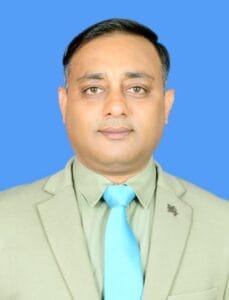
Lt Col Ujjual Abhishek Jha, Retd

Introduction

The enactment of the Digital Personal Data Protection Act, 2023 (DPDPA) marks a transformative milestone in India’s journey toward a robust and accountable digital economy. The Act is designed to operationalize the Right to Privacy, affirmed as a fundamental right by the Supreme Court in the landmark K.S. Puttaswamy Judgment (2017). By establishing a comprehensive, consent-centric framework for processing digital personal data, the DPDPA empowers individuals with meaningful rights over their information, thereby aligning India’s data governance with global privacy standards.

The Concept of Privacy in India: A Pre-DPDPA Perspective

Prior to the DPDPA, the concept of privacy in India was not anchored in a single, overarching statute but was instead shaped through fragmented judicial interpretations and sector-specific regulations. This patchwork approach left the judiciary grappling with the dual challenge of defining the scope of privacy rights while balancing them against national imperatives like economic growth and digital inclusion.

The watershed moment for this evolution was the large-scale digitization of public services—most notably the Aadhaar program—which catalyzed a paradigm shift. The understanding of privacy expanded from a notion of physical autonomy to a broader right of control over one’s own data. In the contemporary context, Indian jurisprudence now views privacy through a dual lens:

  •  As a Fundamental Value: Recognizing privacy as an intrinsic and inalienable human right.
  • As an Active Value: Acknowledging privacy as a critical prerequisite for fostering innovation, building trust in the digital ecosystem, and safeguarding other fundamental freedoms.

Cornerstones of Privacy: Milestones & Governing Laws
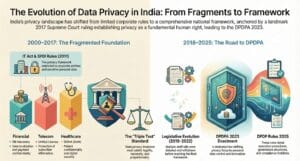
Before the DPDPA, India’s privacy landscape was a mosaic of constitutional principles and sectoral rules. The key pillars were:

The Constitutional Keystone: K.S. Puttaswamy V. Union Of India (2017). This unanimous verdict by a nine-judge Constitution Bench of the Supreme Court serves as the bedrock of modern Indian privacy law.

– The Landmark Ruling: The Court unanimously held that the Right to Privacy is an intrinsic facet of the Right to Life and Personal Liberty guaranteed under Article 21 of the Constitution.
– The Enduring Impact: The judgment established a rigorous, three-fold test to validate any state-imposed intrusion into privacy, mandating that such action must satisfy:
– Legality: The presence of a validly enacted law.
– Necessity: A legitimate state interest or aim.
– Proportionality: A rational and proportionate link between the means employed and the object sought to be achieved.

The Pre-Existing Legal Framework Governing Privacy

The Information Technology Act, 2000 (IT Act). For years, the IT Act served as the primary statutory mechanism for data protection in India, functioning largely through Section 43A.

– The SPDI Rules (2011): Framed under the IT Act, the Sensitive Personal Data or Information Rules mandated that corporate entities implement and maintain reasonable security practices and procedures.
– Inherent Limitations: The Rules were confined to corporate bodies and applied only to a narrow category of “sensitive” data, leaving a vast expanse of “personal” data—and the public sector—outside any regulatory ambit.

Sector-Specific Regulations. Pending a central law, sectoral regulators filled the void by imposing privacy and confidentiality mandates within their domains:

– Financial Sector: The Reserve Bank of India (RBI) enforced stringent data localization norms and confidentiality requirements for payments ecosystem data.
– Telecom Sector: The Unified License agreement imposed binding confidentiality clauses on telecom service providers concerning subscriber details.
– Healthcare Sector: Patient confidentiality was primarily governed by professional ethics regulations, such as the Indian Medical Council Regulations, 2002, alongside draft legislation like the Digital Information Security in Healthcare Act (DISHA), which remained in a nascent stage.


Concept and Existing Privacy Laws in India


The Imperative for a Comprehensive Framework – The inadequacies of the IT Act’s Section 43A—particularly the absence of an independent regulatory authority and weak enforcement mechanisms—underscored the urgent need for a dedicated, omnibus data protection law. This legislative journey commenced with the Justice B.N. Srikrishna Committee (2017), which produced the first draft of the Personal Data Protection Bill. Subsequent iterations in 2018, 2019, and 2022 were deliberated, debated, and ultimately withdrawn, paving the way for the passage of the DPDPA in August 2023. The subsequent notification of the DPDP Rules, 2025 translated the Act’s mandate into actionable procedures, detailing governance structures, compliance thresholds, and implementation timelines.

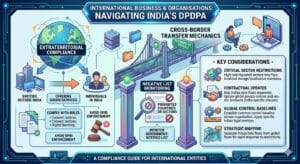
Overview of the DPDPA 2023 – The DPDPA 2023 establishes a comprehensive regime for the processing of digital personal data within India, including data originally collected in non-digital form and later digitized. It possesses extraterritorial applicability, binding entities outside India that process data in connection with offering goods or services to Data Principals within India. The Act applies uniformly to public and private entities, with specific exemptions for notified state functions, research, and certain low-risk processing activities.

Key Definitions:

– Data Principal: The individual to whom the personal data pertains, with special provisions for children and persons with disabilities.
– Data Fiduciary: The entity that determines the purpose and means of processing. A subclass, Significant Data Fiduciaries (SDFs), are subject to heightened compliance obligations due to the scale and sensitivity of their operations.
– Other Key Entities: The framework also defines the roles of Data Processors, Consent Managers, and establishes the Data Protection Board of India (DPBI) as the primary adjudicatory and enforcement authority.

Salient Features of the DPDPA 2023

– Consent and Legitimate Uses: Consent must be free, specific, informed, unconditional, and unambiguous, with a clear affirmative action. Notices must be provided in plain and simple language, including translations in any language specified in the Eighth Schedule of the Constitution. The Act also identifies certain “legitimate uses” that permit data processing without explicit consent (e.g., for specified state functions, medical emergencies, employment purposes, and legal compliance).

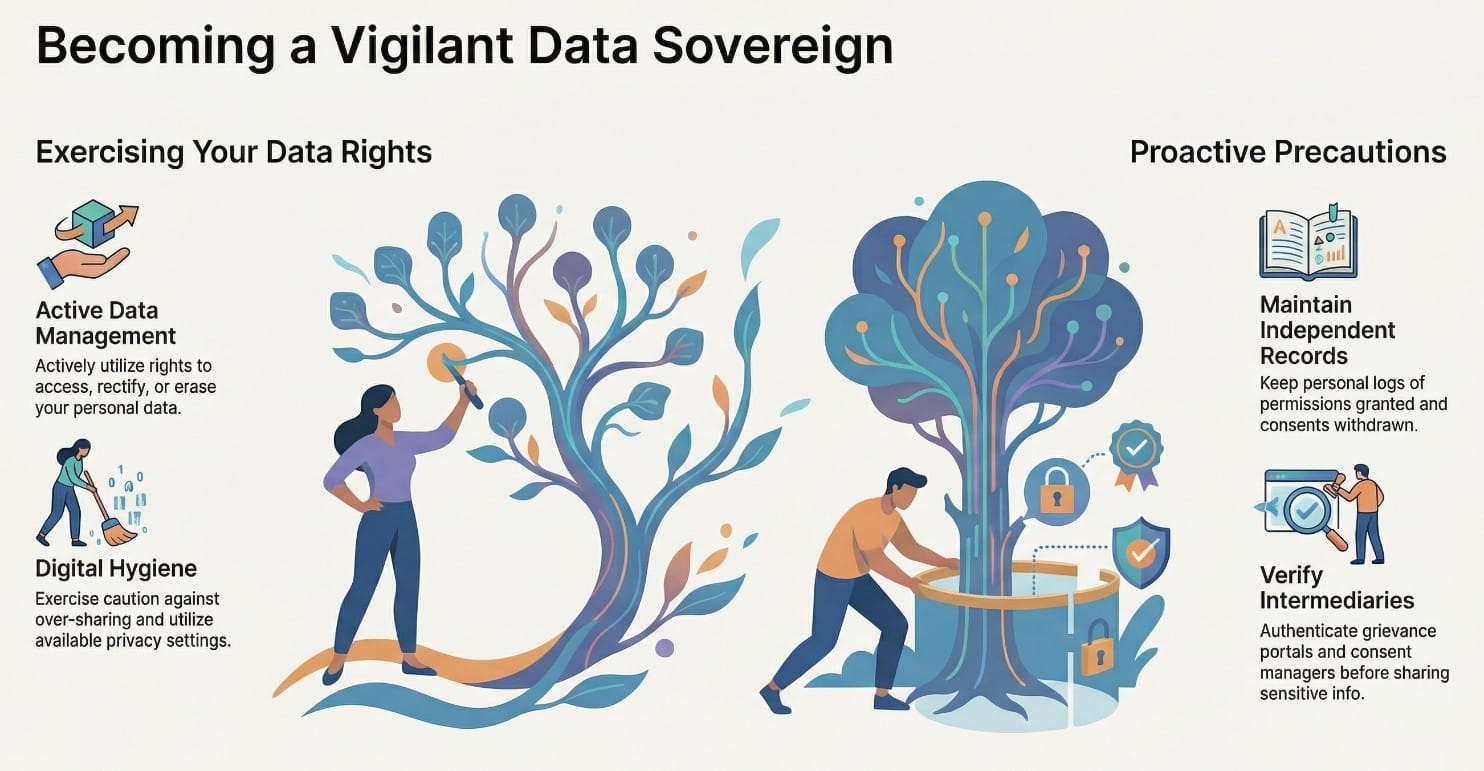
– Empowering Data Principals: The Act enshrines foundational rights for individuals, including the rights to access information, seek correction and completion of data, demand erasure, and have access to effective grievance redressal mechanisms. A novel provision allows a Data Principal to nominate another individual to exercise these rights in the event of their death or incapacity.

– Safeguarding Children’s Data: The Act imposes strict prohibitions on tracking, behavioural monitoring, or targeted advertising** directed at children. Processing of children’s data is conditional upon obtaining verifiable parental consent, with provisions for future relaxations to be specified through rules.

– Enshrining Duties of Data Principals: In a significant move, the Act imposes specific duties on individuals, prohibiting them from filing frivolous or false complaints, furnishing false particulars, or impersonating others.

– Penalties for Non-Compliance: The Act introduces a stringent financial penalty regime, with monetary fines reaching up to ?250 Crore Per Contravention. Higher penalty slabs are prescribed for particularly egregious violations, such as data security breaches and non-compliance with provisions relating to children’s data.

Architecture of the DPDPA 2023


India’s erstwhile privacy framework, anchored in the Information Technology Act, 2000 (amended in 2008), proved fragmented and ill-suited for the digital age. Provisions like Sections 43A and 72A offered limited recourse, primarily focusing on compensation for negligence and penalties for unauthorized disclosure, but fell short of establishing a holistic framework of data rights. The Digital Personal Data Protection Act, 2023, therefore, represents a pivotal and long-overdue shift. As India’s first comprehensive data privacy law, it regulates the entire lifecycle of digital personal data, embedding principles of user consent, data minimization, and purpose limitation, while granting citizens enforceable rights and establishing the Data Protection Board as a robust oversight mechanism.

(Lt Col Ujjual Abhishek Jha, Retd, is a Certified Data Privacy Professional and Strategic & GeoPolitical Advisor. In addition, his specialised fields includes Intelligence, Insider Threat Management, Financial Crime Investigation and Geopolitical Risk Analysis with experience of two decades in the field.)

The post Digital Personal Data Protection Act (DPDPA) 2023 Series: Part I — The Foundations of Privacy: Evolution of Indian Laws & A Roadmap to DPDPA first appeared on The Frontier Manipur.

Read more / Original news source: https://thefrontiermanipur.com/digital-personal-data-protection-act-dpdpa-2023-series-part-i-the-foundations-of-privacy-evolution-of-indian-laws-a-roadmap-to-dpdpa/

India, Myanmar sign 11 agreements Modi meets Suu Kyi, discusses bilateral relations

Nay Pyi Taw, Sep 6:With New Delhi’s increasing emphasis on its Act East Policy, India and Myanmar on Wednesday signed eight Memorandum of Understanding (MoU) and three agreements in Nay Pyi Taw, Myanmar to strengthen the multifaceted partnership betwee…

Nay Pyi Taw, Sep 6:With New Delhi’s increasing emphasis on its Act East Policy, India and Myanmar on Wednesday signed eight Memorandum of Understanding (MoU) and three agreements in Nay Pyi Taw, Myanmar to strengthen the multifaceted partnership between the two countries.

The post India, Myanmar sign 11 agreements Modi meets Suu Kyi, discusses bilateral relations appeared first on The Sangai Express.

Read more / Original news source: http://www.thesangaiexpress.com/india-myanmar-sign-11-agreements-modi-meets-suu-kyi-discusses-bilateral-relations/

India and China: From rivalry to enmity

If media reports on both sides of the Himalayas are any indication, China and India are literally standing on power kegs, ready to flex their military muscles at the slightest provocation from either side. Often it is said that there is no historical enmity between the two countries but there is a long standing rivalry […]

If media reports on both sides of the Himalayas are any indication, China and India are literally standing on power kegs, ready to flex their military muscles at the slightest provocation from either side. Often it is said that there is no historical enmity between the two countries but there is a long standing rivalry […]

Read more / Original news source: http://kanglaonline.com/2017/08/india-and-china-from-rivalry-to-enmity/

An open letter to Prime Minister of India

Hon’ble Prime Minister, I am Ronaldo Laishram from Manipur, the place called “Switzerland of India”, the place where the Indian National Flag was hoisted for the first time in India, the beautiful land surrounded by serene landscape, exotic wildlife, floating island to the warm-hearted locals with its own rich culture and tradition but now a […]

Hon’ble Prime Minister, I am Ronaldo Laishram from Manipur, the place called “Switzerland of India”, the place where the Indian National Flag was hoisted for the first time in India, the beautiful land surrounded by serene landscape, exotic wildlife, floating island to the warm-hearted locals with its own rich culture and tradition but now a […]

Read more / Original news source: http://www.thesangaiexpress.com/an-open-letter-to-prime-minister-of-india/

India, Thailand, Myanmar to be connected with a 1400-km road

Bangkok, May 23 : India, Thailand and Myanmar are working on a 1,400-kilometre long highway that will link India with South East Asia by land for the first time in decades, giving a boost to trade and cultural exchanges between the three countries.
The…

Bangkok, May 23 : India, Thailand and Myanmar are working on a 1,400-kilometre long highway that will link India with South East Asia by land for the first time in decades, giving a boost to trade and cultural exchanges between the three countries.

The post India, Thailand, Myanmar to be connected with a 1400-km road appeared first on The Sangai Express.

Read more / Original news source: http://www.thesangaiexpress.com/india-thailand-myanmar-connected-1400-km-road/

Deepening Diversity and Democracy in India

Deepening Diversity and Democracy in India: Working Towards Addressing Racial Discrimination & Call for an Anti-Racial Law   Delhi, 23 March 2016 – Control Arms Foundation of India in partnership with Multiple Action Research Group (MARG), Northeast India Women Initiative for Peace and NEIFAR commemorated the International day for the Elimination of Racial Discrimination under

Deepening Diversity and Democracy in India: Working Towards Addressing Racial Discrimination & Call for an Anti-Racial Law   Delhi, 23 March 2016 – Control Arms Foundation of India in partnership with Multiple Action Research Group (MARG), Northeast India Women Initiative for Peace and NEIFAR commemorated the International day for the Elimination of Racial Discrimination under

Read more / Original news source: http://kanglaonline.com/2016/03/deepening-diversity-and-democracy-in-india/

Remittance: Bringing Global Money to Manipur

Remittance is the money earned in foreign countries and sent back home. Money is what we need to build physical constructions and infrastructures. Money doesn’t simply come out of blue without job, work or business. It is not easy to run a government without proper taxes, excise duties, revenue from business, job, products from factory. Our state

Remittance is the money earned in foreign countries and sent back home. Money is what we need to build physical constructions and infrastructures. Money doesn’t simply come out of blue without job, work or business. It is not easy to run a government without proper taxes, excise duties, revenue from business, job, products from factory. Our state

Read more / Original news source: http://kanglaonline.com/2016/03/remittance-bringing-global-money-to-manipur/

Why AFSPA in a Democratic Country like India ?

By URIKHIMBAM JENISON   The people of the North Eastern region of India, particularly Manipur, suffer the most since the imposition of the Armed Forces (Special Powers Act), 1958. It has been more than 50 years since the people of Manipur have been living with this lawless law or rather the Act to be precise.

By URIKHIMBAM JENISON   The people of the North Eastern region of India, particularly Manipur, suffer the most since the imposition of the Armed Forces (Special Powers Act), 1958. It has been more than 50 years since the people of Manipur have been living with this lawless law or rather the Act to be precise.

Read more / Original news source: http://kanglaonline.com/2016/02/why-afspa-in-a-democratic-country-like-india/

Killing In The Name Of The Indian Nation

What happens to democracy when an army is at war in peacetime? On 3 December, Attorney General of India Mukul Rohatgi told the Supreme Court, “The army is only discharging

What happens to democracy when an army is at war in peacetime? On 3 December, Attorney General of India Mukul Rohatgi told the Supreme Court, “The army is only discharging

Read more / Original news source: http://kanglaonline.com/2015/12/killing-in-the-name-of-the-indian-nation/

Ebola Racing

By M.C. Linthoingambee In a densely populated country like India where there are massive crowds made up of people teeming together as seen in its markets and public transport like

By M.C. Linthoingambee

In a densely populated country like India where there are massive crowds made up of people teeming together as seen in its markets and public transport like buses and trains, one shudders at the thought of what can unravel if the Ebola virus reaches here.

The outbreak of Ebola in some of the African countries has already triggered off a health crisis in the countries where it has taken lives but has great risks of fast spreading across the globe given the greater movement of people. The primary importance in the life of a human being health, the façade of its presence is being washed away with each growing day whenever there is a looming health crisis. While our leaders while away their time fighting in the political arena, and others elsewhere continue to concentrate on air-strikes, conflicts, territorial dispute, there are many people in need of medicinal aid. Does the solution of being quarantined serve as a sensible cause for the effect brought on by the Ebola virust? While two American aid workers who were infected with Ebola got cured and made headlines all over the world, why have we failed to take notice of those many who have not been able to get treatment? Keeping all that aside, shouldn’t we be focusing more on producing more of those experimenting drugs that was used for them? While China in the past was able to contain its epidemic of the SARC outbreak, many volunteered and the work factor remained cautious and effective. But the African countries who are suffering a huge setback in their economic deficiency will surely find it difficult to recuperate. In the scenario of a cure or treatment procedure yet to be placed in public domain vis a vis the Ebola outbreak, more and more health volunteers continue to disappear either as a result of contracting the virus themselves, fear and several other reasons. Presently, if we look at a bigger picture we can only leave it in God’s grace.

They say ignorance is bliss but sometimes it is not always the most sensible thing. While India has taken effective measures to isolate and quarantine most of its passengers arriving from the heavily infected countries we are at continuous risks of contracting the virus even if a single person happens to be harboring the Ebola virus. Can India deal with such infections? While the Health Ministry continues to stay lax on the matter, we should be raising more and more awareness through any available medium even to the far off villages that lay cornered with no proper communication supply. We can only go to a doctor when we are in need of a serious medical attention but we have limited power and resources but since Public Health is an area of great concern in the general context, we should be looking at a way of tackling the assurance of safety of health though the medium of law and governance. The essential tool for tackling emerging threats on public health needs to be dealt with effective policies and real counter measures of management through the onward source of law.

The legal framework for health in India draws its powers form the likes of Article 47 contained in the Constitution of India as a Directive Principles of State policy where the duty of the state to raise the level of nutrition and the standard of living and to improve public health is recognized among importance safeguards. Public health law focuses on the nexus between law, public health and the legal tools applicable to public health issues. With each growing day, the implementations put forth for ensuring and guaranteeing public health earlier might not work for today since the necessity requires that new medicines be put at place and researchers affirmed in their positions for clinical development of a new vaccine for any new disease that may incur in our country especially to value the goodwill of the people. Though there have been consistent interventions to address public health concerns in the past, there exists a need for a contemporary framework to appropriately use modern legal tools for complex health challenges. But the most critical criterion India continues to tackle today is the reduction of funds allocated to the health sector.

Pharma-corporate giants continues their duty of heavy intervention, the medicines and treatments only become affordable for the rich and while the poor with a low income suffers huge setback. Shouldn’t the job of the governance rely more on equality treatment of patients in spite of their economic backdrop? Can India tackle an effect like the Ebola? Keeping all the complexities aside we can only assume that we wouldn’t know of its effect unless it happens whilst hoping that an emergency to human life does not indeed occur. The World Health Organization (WHO) defines health as, “a state of complete physical, mental and social well-being and not merely the absence of disease or infirmity.”

Several agencies like the Doctors without Borders, World Health Organizations and others continue to work under effective governance of various Human Rights Laws. Today, we are just bystanders in history where the daily usage of body bags seems to be increasing in the measure of containing the death. While current economic challenges continue to remain brazen without any outside help, there are many other countries suffering gravely.

Read more / Original news source: http://kanglaonline.com/2014/08/ebola-racing/

2 Manipuri Lifters won Gold and Silver in women’s 48Kg, Opens first Gold Medal for India in Glasgow2014 Commonwealth’s Games

Glasgow 25th Jul, 2014: Khumukcham Sanjita Chanu and Saikhom Mirabai Chanu of Manipur bagged a gold and silver, respectively, in women`s 48kg weightlifting in a display of overwhelming domination to

Glasgow 25th Jul, 2014: Khumukcham Sanjita Chanu and Saikhom Mirabai Chanu of Manipur bagged a gold and silver, respectively, in women`s 48kg weightlifting in a display of overwhelming domination to open India`s medal account on the opening day of the competition in the 20th Commonwealth Games here on Thursday.

Sanjita and Mirabai after winning Gold and Silver Medals in Glasgow commonwealth's Games 2014. Zee Media Bureau/ Suyash Srivastava

Sanjita and Mirabai after winning Gold and Silver Medals in Glasgow commonwealth’s Games 2014.
Zee Media Bureau/ Suyash SrivastavaG

Sanjita won with a total lift of 173kg (77+96) while Mirabai grabbed the silver with a cumulative
effort of 170 (75+95) in the absence of other strong competitors.

It was basically a contest between the two Manipuris in an event which India had dominated for long in the Commonwealth Games from the days of Kunjarani Devi.

Kunjarani, now a women`s coach, was beside the two state mates on the platform, egging Sanjita and Mirabai in her vernacular language. India had won a silver and bronze in this category in 2010.

The clean and jerk contest went on almost similar lines with Sanjita and Mirabai taking the bar and the bell after most of their opponents had exhausted their attempts below the 90kg entry weight of the two Indians.

Sensing that they could be in for top two positions, the Indian duo raised their entry weight to over 90kg and put pressure and physical exertion on their opponents who had to continue their attempts in quick succession.

There was a brief moment of tension in the Indian camp after Opara and Mirabai lifted 92kg, and Sanjita failed to clear the same weight. But Sanjita lifted 92kg in her second attempt to give a sigh of relief to the Indian camp.

The contest left to be fought between the two Indians, Mirabai lifted 95kg to put herself in contention, but Sanjita roared back with a 96kg lift to retain the first position.

Source: PTI

Read more / Original news source: http://kanglaonline.com/2014/07/2-manipuri-lifters-won-gold-and-silver-in-womens-48kg-opens-first-gold-medal-for-india-in-glasgow2014-commonwealths-games/

Warrior State, Pakistan

By B.G. Verghese While India has been invaded from the Northwest, the Northeast and from the coast, it is the Northwest passage that has historically been the main strategic gateway

By B.G. Verghese

While India has been invaded from the Northwest, the Northeast and from the coast, it is the Northwest passage that has historically been the main strategic gateway through which conquerors and caravans have entered. Alexander was an early visitor. It is perhaps easy to see why this should have been so. India was long a source of pepper, spices and fine calicoes for Greek, Roman and Arab traders and regarded as a fabled land of wealth and wisdom lying athwart both the Silk and Spice routes. Hsuen Tsang, Marco Polo, Ibn Batuta and other travellers wrote of its wonders. To those living in the arid or cold deserts of West and Central Asia , the well watered plains of India seemed most inviting.

While the British conquered India from the sea and fought off the Portuguese, Dutch and French for supremacy, it was Russian penetration from the Northwest that it most feared. The Great Game was played out along the wild, tribal marches of the Northwest Frontier and the High Karakoram. The nature of the Great Game changed after the Second World War, when containing communism became the prime Western agenda.

As the Second World War wound down, Britain wondered how it might dispose of India should irrevocable differences between the Muslim League and Congress force Partition. The British “breakdown plan” favoured creation of two Muslim-dominated Anglo-US allies in the north-west and north-east of the sub-continent to halt march of communism. Both would have preferred to partner the larger and more resourceful India; but Nehru’s non-alignment and seeming Soviet-Chinese tilt was suspect. Pakistan, staunchly Islamic and in need of support against what it saw as a larger, permanent and ideological Indian enemy, readily fit the bill. It was also strategically placed, especially as guardian of the passes to Afghanistan and beyond.

No surprise then that Pakistan soon became a staunch ally, a “frontline state”, a strategic partner and a base of operations for the West in containing communism and controlling the emerging oil wealth of Iran and the Arab lands beyond. Ideology, rooted in faith and geography, endowed Pakistan with a strategic value on which its leaders traded. T.V Paul, (“The Warrior State: Pakistan in the Contemporary World”, Random House,) sums up this geo-political asset as a “strategic curse”. A feudal, emigre-led people divorced from its historical, geographical and cultural roots to embrace a wholly negative non-Indian, non-Hindu identity, became a rentier state, trading its strategic utility for military and economic assistance.

Jinnah’s very first address to the new Pakistan constituent assembly totally repudiated the two-nation theory as false and untenable. But the twist in the tale is that it was Jinnah who was repudiated by his people and died embracing the two-nation ideological curse.

Pakistan, an “Islamic State”, was born to defend Islam and the “ideological frontiers of Islam” . But it is even today unable to define the true Muslim: not Ahmediyas (banned), Shias, Sufis, Aga Khanis, Nurbakshis; not even Sunni Barelivis but Wahabis, Deobandis, jihadis, the Taliban and such medieval fanatics whose goal is to establish a new Caliphate. The defence of Islam and its borders and integrity against a malign India, the permanent enemy, has reduced Pakistan to a garrison state where a military-mullah nexus has assumed control. The Army, aided by the Inter-Service Intelligence or ISI, together constitute a state within a state with vast, agrarian, corporate, financial, administrative, diplomatic and security tentacles.

Between 1960 and 2012, Pakistan received some $ 73 bn in economic and military assistance , $30 bn of this from the US alone. An over-militarised, garrison state, can find itself developmentally debilitated. In a population fast approaching 200 million, there are only 2.5 mn registered taxpayers. Defence appropriates the largest slice of the budget, with unaccounted amounts going into developing and augmenting nuclear arms, including tactical weapons.

Paul notes that the peoples’ critical faculties have been dulled by tendentious and poisonous textbooks and ideologically-oriented madrassas whose products preach from pulpits. Jinnah, Bhutto and Zia led Pakistan down the slippery slope of Islamisation and militarisation , unabashedly aided by the United States that has been totally unmindful of the tremendous collateral damage to world peace and stability caused by its devious policies and the War on Terror. Paul estimates that around 35,000 jihadis from 45 countries trained in Pakistan to unleash mayhem prior to 9/11. It is today a country at war with itself, and a menace to others.

Paul’s conclusion: Pakistan’s transformation will only take place if both its strategic circumstances and the ideas and assumptions that the leading elite hold change fundamentally.

Paul’s is only one of a whole series of refreshingly critical books on Pakistan being published by domestic and foreign authors about what they describe but do not quite name as a failed state. “The Pakistan Military in Politics: Origins, Evolution. Consequences” by Ishtiaq Ahmed (Amaryllis) is an example. Few are sparing of Jinnah who spoke of Pakistan as a Sharia State as far back as in November 1945.

Ahmed dispels the myth that Mountbatten conspired with Radcliffe to gift India some Muslim majority tehsils of Gurdaspur to justify its award to India. In fact, he notes, this was part of the Wavell breakdown plan so as to ensure that Amritsar, at least, though not Nankana Sahib, both Sikh holy places, remained with India. He equally astutely describes sharing Indus Waters as a geo-political issue linked to Kashmir. Like others, he cites Maj. Gen. Akbar Khan and Air Chief Marshal Nur Khan respectively for affirming that the 1947 and 1965 invasions of J&K were staged by Pakistan. He too cites Prof. K.K. Aziz’s “Murder of History” and then quotes Brig. S.K. Malik on “The Quranic Concept of War”, with an approving preface by Zia-ul Haq. According to Malik, “The Quranic military strategy thus enjoins us to prepare ourselves for war to the utmost in order to strike terror into the hearts of enemies …, (This) is not only a means, it is an end in itself… It is the point where the means and the end meet and merge….. “. This is chilling. No surprise then that terrorist cells have penetrated Pakistan’s military and carried out attacks on its GHQ, the Mehran naval base and similar targets.

Finally, the fairy tale spun by Islamabad about Osama bin Laden’s long and comfortable sojourn in Pakistan over many years, latterly, in the garrison town of Abbottabad, from where he was finally taken out by US Naval Seals in 2011. This showed up the Pakistani establishment as a bunch of complete fools or liars, probably both. The New York Times reporter, Carlotta Gall, comes closest to confirming that the US had information that the ISI knew the whereabouts of bin Laden. (“The Wrong Enemy: America in Afghanistan, 2001-14″. Houghton Mifflin Harcourt).

The official story is far too naive to believe. In blaming everybody, the Commission of Inquiry, in blaming everybody, blamed nobody. The truth has once more been quietly buried. Pakistan remains steadfastly in denial. It has once again gloriously lied to itself. Its real enemy is truly within. Truth hurts. But it is the ultimate balm.

www.bverghese. com

Read more / Original news source: http://kanglaonline.com/2014/06/warrior-state-pakistan/

Women in South Asia to Strengthen Efforts for Peace, Security and Disarmament

PRESS RELEASE FOR IMMEDIATE RELEASE   Women in South Asia to Strengthen Efforts for Peace, Security and Disarmament Delhi, 3 April 2014: The United Nations Commission on the Status of Women (CSW)

PRESS RELEASE FOR IMMEDIATE RELEASE


Women in South Asia to Strengthen Efforts for Peace, Security and Disarmament

Delhi, 3 April 2014: The United Nations Commission on the Status of Women (CSW) is the principal global policy-making body dedicated exclusively to gender equality and advancement of women. Every year, representatives of Member States gather at United Nations Headquarters in New York to evaluate progress on gender equality, identify challenges, set global standards and formulate concrete policies to promote gender equality and women’s empowerment worldwide. The Commission met from 9-21March 2014 in New York this year. Team of Control Arms Foundation of India and Manipur Women Gun Survivors Network were present there and hosted a parallel event under the theme “Engaging Women for Resolving Conflicts, Usher in Peace, Disarmament, & Development in South Asia”.


Ms.-Binalakshmi-Nepram-Founder-Manipur-Women-Gun-Survivors-Network-and-Secretary-General-CAFI-at-UN-Side-Event-in-New-York-13-March-2014

Ms.-Binalakshmi-Nepram-Founder-Manipur-Women-Gun-Survivors-Network-and-Secretary-General-CAFI-at-UN-Side-Event-in-New-York-13-March-2014


It was supported by an ongoing project “Empowering Women for Peace and Development in South Asia, including Myanmar”in collaboration with Deutsch Welthungerhilfe (WHH) and supported by European Commission.


Women’s role remains weak and insecure in all social, political and economic activities in South Asia. In India, 22 girls get kidnapped every day. Out of the number of children who were kidnapped, 66% (10,938) are girls. Child mortality and maternal mortality levels in South Asia are among the highest globally. 46% of women aged 20-24 in South Asia married before the age of 18; 3.3% of women in South Asia (India and Bangladesh) face non-partner sexual violence.


Ms-Binalakshmi-Nepram-Founder-Manipur-Women-Gun-Survivors-Network-and-Secretary-General-CAFI-presenting-at-UN-Side-event-in-New-York-13-March-2014

Ms-Binalakshmi-Nepram-Founder-Manipur-Women-Gun-Survivors-Network-and-Secretary-General-CAFI-presenting-at-UN-Side-event-in-New-York-13-March-2014


The session commenced with an introductory speech by Ms. Binalakshmi Nepram, Founder, Manipur Women Gun Survivors Network, and Secretary General, Control Arms Foundation of India welcoming all the panelists at the event.  She gave an overview of the disturbing situation and status of women in South Asia, against the background of the region’s prolonged inter and intra-state conflicts and patriarchal nature. She described how in Bangladesh, India, Pakistan and Nepal, women are the victims of rape, abduction, child marriages, female infanticide, acid attacks, dowry-related murders, honor killing and enslavement. She furthermore criticized that many South Asian conflicts, such as that in Northeast India, Chittagong Hill Tracts, Bangladesh, are left unreported by mass media. She also mentioned the ongoing armed violence caused by small arms, light weapons within the Northeast India region. More than 50,000 lives have been lost in the violence.   The conflict in Manipur turns 300 women into widows annually. She called on international communities for the help to combat the problem and ensure countries that India implement UNSCR 1325.   


Ms-Binalakshmi-Nepram-left-Ms-Maria-Butler-center-Programme-DirectorWILPF-PeaceWomen-USA-at-UN-CSW-event-13-March-2014

Ms-Binalakshmi-Nepram-left-Ms-Maria-Butler-center-Programme-DirectorWILPF-PeaceWomen-USA-at-UN-CSW-event-13-March-2014


Ms. Maria Butler, Programme Director, Women’s International League for Peace and Freedom, PeaceWomen Project, USA,focused on the need for a shift in CSW from military to human security and the links between development and militarism, identifying however a huge resistance as to imbedding disarmament in the development agenda. She accentuated how the post-2015 development agenda cannot keep silent on militarism if we want human rights abuses to be truly addressed. She also referred to the earlier-mentioned India’s resistance to apply Resolution 1325, calling this ‘the core of the challenge’ of their work, calling for voices that acknowledge that aforesaid resolution is in fact applicable everywhere.


Panelists-and-participants-at-UN-58th-CSW-event-in-New-York-13-March-2014

Panelists-and-participants-at-UN-58th-CSW-event-in-New-York-13-March-2014


Ms. Sarah Boyd, Founder, The Gender Agency, Australia, underlined the importance of women’s voices going from the private to the public sphere, merging private and public spheres to raise women’s consciousness, collective investment in ensuring that CSW nor the post-2015 agenda remain silent on critical issues of gender equality, peace (keeping), development, disarmament and their intersections, and the importance of CSO’s as the ties that bind the foregoing elements.


Ms. Fiona McAlpine, Manipur Women Gun Survivors Network/Young WILPF Network, Australia, addressed the issues of murder and forced disappearance of women and girls in India and the lack of access to justice, forged evidence and post-mortem reports, and impunity (as a consequence of the Armed Forces Special Powers Act) in that context. She accentuated that without including disarmament and demilitarization, the CSW is moot, as there can be no development without disarmament, which is also a prerequisite for access to justice.  


Also a short film titled, “We Shall Find Our Peace” was screened at the event that depicts the hardships and sufferings happening due to the ongoing conflict situation in the state of Manipur, India and eagerness of the population to promote peaceful environment in the region. The film showed the strength and hope among the Manipuri Women to overcome the hardships and violence in their state.


There were valuable discussions among the panelists and other participants across India, USA, Brazil, Australia, Pakistan, Bangladesh, Sri Lanka, Nepal and many others on Women, Peace and Security, types of violence and discrimination they are facing across the globe. Further discussions were on the possible steps that could be taken for the empowerment of women, their role in conflict transformation, disarmament, and decision-making processes. The event was ended successfully with valuable inputs and suggestions from esteemed Panelists.


Please, find the attachment of few photos of the event.


 For more information, please contact:


Office of Control Arms Foundation of India and Manipur Women Gun Survivors Network

B 5 / 146, First Floor, Safdarjung Enclave, New Delhi – 110029, India

Phone: +91-11-46018541, Fax +91-11-26166234

Email: Cafi.communique@gmail.com, Website: www.cafi-online.org

Read more / Original news source: http://kanglaonline.com/2014/04/women-in-south-asia-to-strengthen-efforts-for-peace-security-and-disarmament/

IM not happy with media expressions

The post IM not happy with media expressions appeared first on  KanglaOnline.com.Nagaland , DIMAPUR, August 24 (NNN): In its attempt to answer to the seeming verbal attacks on the outfit through media on the question of the freedom of expression, the …

The post IM not happy with media expressions appeared first on  KanglaOnline.com.

Nagaland , DIMAPUR, August 24 (NNN): In its attempt to answer to the seeming verbal attacks on the outfit through media on the question of the freedom of expression, the NSCN-IM asserted today that the outfit is no less than … Continue reading

The post IM not happy with media expressions appeared first on  KanglaOnline.com.

Read more / Original news source: http://kanglaonline.com/2012/08/nagalanim-not-happy-with-media-expressions/?utm_source=rss&utm_medium=rss&utm_campaign=nagalanim-not-happy-with-media-expressions

IM not happy with media expressions

The post IM not happy with media expressions appeared first on  KanglaOnline.com.Nagaland , DIMAPUR, August 24 (NNN): In its attempt to answer to the seeming verbal attacks on the outfit through media on the question of the freedom of expression, the …

The post IM not happy with media expressions appeared first on  KanglaOnline.com.

Nagaland , DIMAPUR, August 24 (NNN): In its attempt to answer to the seeming verbal attacks on the outfit through media on the question of the freedom of expression, the NSCN-IM asserted today that the outfit is no less than … Continue reading

The post IM not happy with media expressions appeared first on  KanglaOnline.com.

Read more / Original news source: http://kanglaonline.com/2012/08/nagalanim-not-happy-with-media-expressions/?utm_source=rss&utm_medium=rss&utm_campaign=nagalanim-not-happy-with-media-expressions

Northeast exodus – Facebook to remove content, block pages, disable accounts inciting violence

The post Northeast exodus – Facebook to remove content, block pages, disable accounts inciting violence appeared first on  KanglaOnline.com.Aug 22 In the backdrop of appeals by India to remove hate posts, world’s largest social networking…

The post Northeast exodus – Facebook to remove content, block pages, disable accounts inciting violence appeared first on  KanglaOnline.com.

Aug 22 In the backdrop of appeals by India to remove hate posts, world’s largest social networking website Facebook today said it will remove content, block pages or even disable accounts of those users who upload contents that incite violence or … Continue reading

The post Northeast exodus – Facebook to remove content, block pages, disable accounts inciting violence appeared first on  KanglaOnline.com.

Read more / Original news source: http://kanglaonline.com/2012/08/northeast-exodus-facebook-to-remove-content-block-pages-disable-accounts-inciting-violence/?utm_source=rss&utm_medium=rss&utm_campaign=northeast-exodus-facebook-to-remove-content-block-pages-disable-accounts-inciting-violence

Manipuri Meitei Association, Bangalore – no unwanted incident in the last few days

The post Manipuri Meitei Association, Bangalore – no unwanted incident in the last few days appeared first on  KanglaOnline.com.Manipuri Meitei Association, Bangalore Dated: August 21, 2012   This is to update latest information of the ong…

The post Manipuri Meitei Association, Bangalore – no unwanted incident in the last few days appeared first on  KanglaOnline.com.

Manipuri Meitei Association, Bangalore Dated: August 21, 2012   This is to update latest information of the ongoing issues in Bangalore. There is no unwanted incident happened in the last three/four days. In the past few days, various NE organisation including … Continue reading

The post Manipuri Meitei Association, Bangalore – no unwanted incident in the last few days appeared first on  KanglaOnline.com.

Read more / Original news source: http://kanglaonline.com/2012/08/manipuri-meitei-association-bangalore-no-unwanted-incident-in-the-last-few-days/?utm_source=rss&utm_medium=rss&utm_campaign=manipuri-meitei-association-bangalore-no-unwanted-incident-in-the-last-few-days

Manipur: 30 Assam Rifles organizes essay competition

The post Manipur: 30 Assam Rifles organizes essay competition appeared first on  KanglaOnline.com.Manipur PRESS RELEASE : 30 ASSAM RIFLES   30 ASSAM RIFLES ORGANISED AN ESSAY COMPETITION  1. 30 Assam Rifles under the aegis of 9 Sector Assam Rifles o…

The post Manipur: 30 Assam Rifles organizes essay competition appeared first on  KanglaOnline.com.

Manipur PRESS RELEASE : 30 ASSAM RIFLES   30 ASSAM RIFLES ORGANISED AN ESSAY COMPETITION  1. 30 Assam Rifles under the aegis of 9 Sector Assam Rifles of HQ IGAR (S) organised an Essay competition on the topic “Our Nation” … Continue reading

The post Manipur: 30 Assam Rifles organizes essay competition appeared first on  KanglaOnline.com.

Read more / Original news source: http://kanglaonline.com/2012/08/manipur-30-assam-rifles-organizes-essay-competition/?utm_source=rss&utm_medium=rss&utm_campaign=manipur-30-assam-rifles-organizes-essay-competition

Manipur: 30 Assam Rifles organizes essay competition

The post Manipur: 30 Assam Rifles organizes essay competition appeared first on  KanglaOnline.com.Manipur PRESS RELEASE : 30 ASSAM RIFLES   30 ASSAM RIFLES ORGANISED AN ESSAY COMPETITION  1. 30 Assam Rifles under the aegis of 9 Sector Assam Rifles o…

The post Manipur: 30 Assam Rifles organizes essay competition appeared first on  KanglaOnline.com.

Manipur PRESS RELEASE : 30 ASSAM RIFLES   30 ASSAM RIFLES ORGANISED AN ESSAY COMPETITION  1. 30 Assam Rifles under the aegis of 9 Sector Assam Rifles of HQ IGAR (S) organised an Essay competition on the topic “Our Nation” … Continue reading

The post Manipur: 30 Assam Rifles organizes essay competition appeared first on  KanglaOnline.com.

Read more / Original news source: http://kanglaonline.com/2012/08/manipur-30-assam-rifles-organizes-essay-competition/?utm_source=rss&utm_medium=rss&utm_campaign=manipur-30-assam-rifles-organizes-essay-competition

Meitei Pangal among 4 dead at Jalpaiguri

The post Meitei Pangal among 4 dead at Jalpaiguri appeared first on  KanglaOnline.com.Manipur, IMPHAL, August 20: After the recovery of two more bodies near New Jalpaiguri Railway Station, the death toll has risen to four including one from Manipur on…

The post Meitei Pangal among 4 dead at Jalpaiguri appeared first on  KanglaOnline.com.

Manipur, IMPHAL, August 20: After the recovery of two more bodies near New Jalpaiguri Railway Station, the death toll has risen to four including one from Manipur on Sunday. The deceased has been identified as one Md Sarif son of … Continue reading

The post Meitei Pangal among 4 dead at Jalpaiguri appeared first on  KanglaOnline.com.

Read more / Original news source: http://kanglaonline.com/2012/08/meitei-pangal-among-4-dead-at-jalpaiguri/?utm_source=rss&utm_medium=rss&utm_campaign=meitei-pangal-among-4-dead-at-jalpaiguri