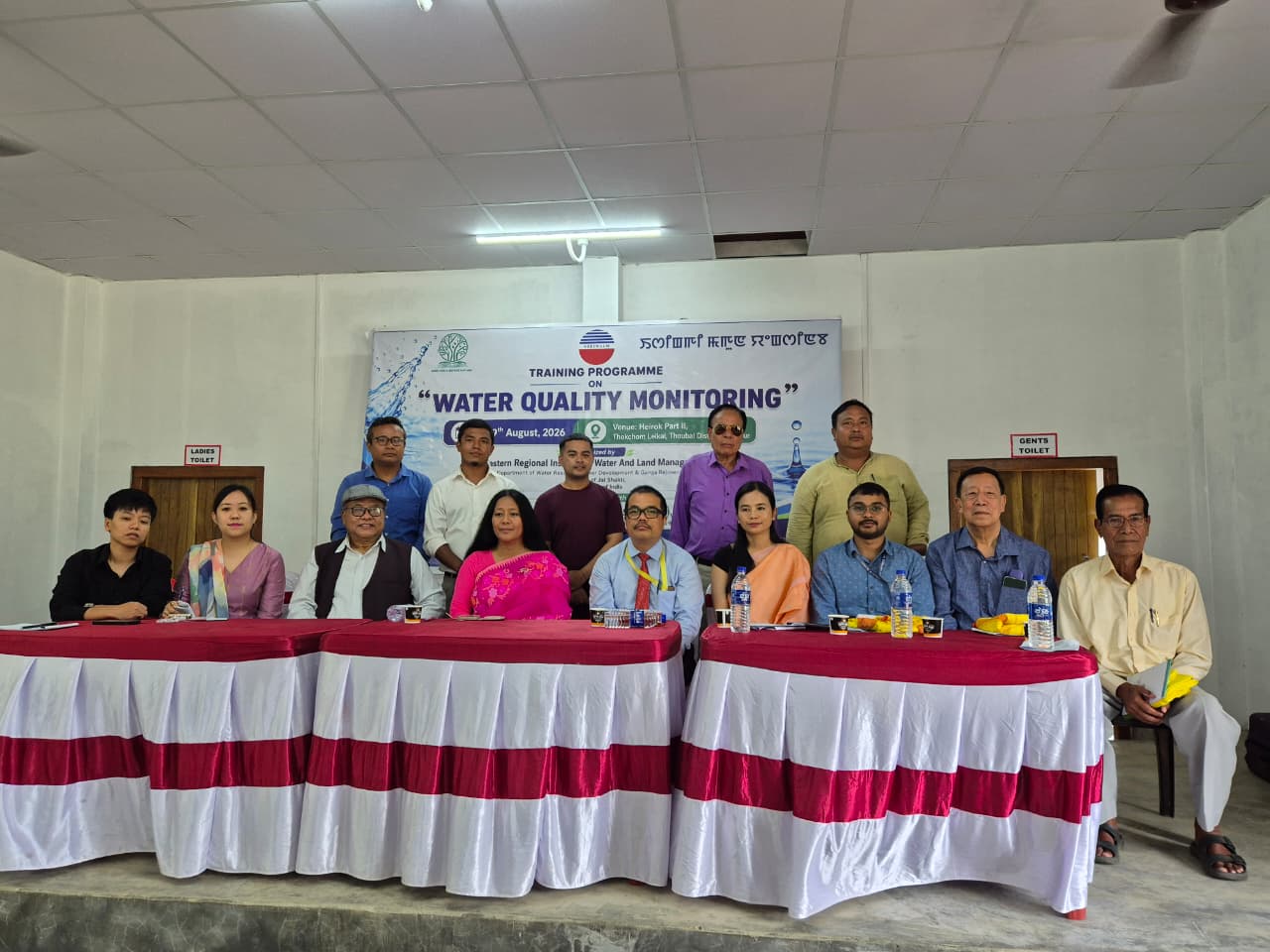
At a one-day Training Programme on Water Quality Monitoring in Heirok Part II, Indigenous scholar and activist Binalakshmi Nepram emphasized that protecting Manipur’s land cannot be separated from safeguarding its water. Organized by the North Eastern Regional Institute of Water and Land Management (NERIWALM), Tezpur, under the Ministry of Jal Shakti, in collaboration with Apunba Imagi Machasing (AIMS), Manipur, the event brought together around 130 participants.
Nepram, Founder-Director of the Manipur Women Gun Survivors Network (MWGSN), highlighted the deep relationship between Indigenous communities, land, and natural resources. Drawing on Manipur’s history, she invoked Kangla, once encircled by protective moats, as a reminder that water security is integral to cultural survival. She praised the role of khungakpa (village volunteers) in defending land and urged that this responsibility extend to rivers and water systems sustaining livelihoods and ecosystems.
The programme combined technical training with community relevance. Dr. Laishram Kanta Singh, Director of NERIWALM, outlined the Institute’s mission to equip farmers, civil society groups, and local institutions with practical skills in water and land management. Sessions covered water quality assessment, sampling, monitoring instruments, and the impact of agriculture, sewage, and urbanization on resources. Hands-on modules included community-based rainwater harvesting led by Dr. Sanayanbi Hodam and field-testing demonstrations by Shri Bikramjit Mandal.
The event also featured distinguished guests including Dr. S. Manikanta Singh, Dr. Kh. Somorendro Singh, and Ningthoujam Manihar, with Mayanglambam Khelendro Singh presiding. Dr. Atom Sunil Singh delivered the welcome address, while Ningthoujam Sanjit Singh proposed the Vote of Thanks.
The training resonated strongly in Heirok, where community groups have long engaged in river-cleaning and conservation efforts along the Heirok-Wangjing River. Nepram’s message underscored that Indigenous traditions of stewardship must evolve to meet today’s challenges: protecting land is incomplete without protecting water.