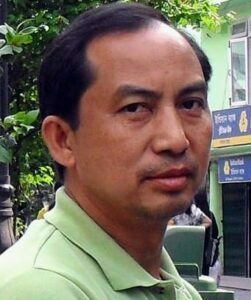
Narcotics Control Bureau (NCB) stated that the arrested individual is a ‘drug kingpin’ and a resident of Haichin, Chin State, Myanmar and a Myanmar-based transnational drug trafficking syndicate. TFM Report In a significant development against transnational drug trafficking across India-Myanmar border, a joint team of Manipur police and Narcotics Control Bureau (NCB) arrested drug kingpin […]
Narcotics Control Bureau (NCB) stated that the arrested individual is a ‘drug kingpin’ and a resident of Haichin, Chin State, Myanmar and a Myanmar-based transnational drug trafficking syndicate.
TFM Report
In a significant development against transnational drug trafficking across India-Myanmar border, a joint team of Manipur police and Narcotics Control Bureau (NCB) arrested drug kingpin allegedly to be a major drug supplier and a wanted in multiple NDPS cases on Wednesday (July 22) from Manipur’s Churachandpur district.
The individual has been identified as one Nengjatuan alias Tuanpi and was arrested from hotel Venus in Churachandpur district of Manipur during a raid conducted by the joint team.
Manipur police in a statement stated that, “the arrested individual is alleged to be a major drug supplier and is wanted in multiple NDPS cases registered with NCB, DRI and Manipur Police.”
A separate statement issued by Narcotics Control Bureau (NCB) stated that the arrested individual is a ‘drug kingpin’ and a resident of Haichin, Chin State, Myanmar and a Myanmar-based transnational drug trafficking syndicate.
The statement further stated that “The arrest follows months of intelligence development, technical surveillance, coordinated interstate operations and sustained investigations, underscoring NCB’s strategy of targeting the leadership of transnational drug trafficking networks rather than merely intercepting individual consignments.”
Investigation has established that he was one of the principal international suppliers operating from Chin State, controlling a trafficking network that routed Methamphetamine and Heroin through Manipur, Mizoram, Assam and Tripura for distribution across different parts of India and Bangladesh, the statement added.
The accused is wanted in multiple NDPS cases registered by NCB and other Drug Law Enforcement Agencies. He is the principal accused in three NCB cases involving seizures of approximately 28.22 kg of Methamphetamine tablets and 1.278 kg of Heroin, valued at over ?25 crore. He is also linked to seven other NDPS cases registered by Churachandpur Police, Singngat Police and the Directorate of Revenue Intelligence (DRI).
The investigation has established that the syndicate operated through a well-organised network of international suppliers, cross-border couriers, transport coordinators, local facilitators, receivers and financial handlers. The syndicate has so far been linked to seizures of Methamphetamine, Heroin and proceeds of crime collectively valued at over ?53 crore.
Financial investigations are continuing to identify additional proceeds of crime, assets and other members of the network. Over the past several months, NCB has systematically dismantled the syndicate through a series of intelligence-led operations resulting in the arrest of several key members, including carriers, receivers, transport coordinators and local facilitators operating across Manipur and Assam.
Among those arrested are Abdullah Ahmed of Silchar, Assam, who functioned as the principal receiver and coordinator of consignments entering Assam; Lalthlamuong Pulamte of Churachandpur, Manipur; Nengultinkhum Hrangngul of Pherzawl, Manipur; and Paominlen Munlo of Churachandpur, Manipur, the suspected receiver in a major Methamphetamine seizure, besides several other associates involved in transportation, storage and distribution of narcotic consignments.
Their interrogation, corroborated by technical surveillance, digital evidence and financial investigation, enabled NCB to identify and apprehend Nengzatuan @ Tuanpi as the principal Myanmar-based supplier directing the syndicate from across the international border.
The arrest of Nengzatuan @ Tuanpi follows the earlier arrests of Lalhmingsanga in March 2026 and Thancintuang @ Chintuang @ Tluanga in May 2026. These successive operations reflect NCB’s sustained network-centric enforcement strategy of dismantling entire transnational drug trafficking syndicates by targeting their international suppliers, financiers, coordinators, logistics providers and other key members of the criminal network.
The arrest marks another significant milestone in NCB’s sustained offensive against organised drug trafficking networks operating along the India–Myanmar border. NCB remains committed to disrupting and dismantling transnational drug trafficking syndicates through intelligence-driven investigations and close coordination with national and international law enforcement agencies.
Members of the public are encouraged to share information relating to narcotic drugs, psychotropic substances and illicit trafficking through the MANAS (Madak Padarth Nishedh Asuchna Kendra) National Narcotics Helpline – 1933 or the MANAS portal. Every credible input strengthens enforcement efforts and contributes to protecting society from the menace of illicit drugs.
AN official statement said that the “surrender” was facilitated through the coordinated efforts of the District Police, CRPF, BSF, ITBP, Assam Rifles and the Army, and that security forces will continue their efforts to encourage more militants to return to the mainstream. TFM Report In a significant development in Manipur’s ongoing peace process, 46 cadres […]
AN official statement said that the “surrender” was facilitated through the coordinated efforts of the District Police, CRPF, BSF, ITBP, Assam Rifles and the Army, and that security forces will continue their efforts to encourage more militants to return to the mainstream.
TFM Report
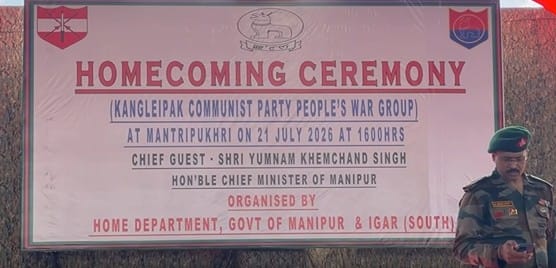
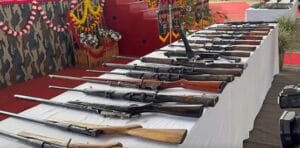
In a significant development in Manipur’s ongoing peace process, 46 cadres of the banned Kangleipak Communist Party–People’s War Group (KCP-PWG) “surrendered” before the state government on Tuesday, laying down 28 firearms along with explosives and ammunition under the Centre’s rehabilitation programme for former militants.
The surrender, as per PIB Defence Wing, took place during a “Homecoming Ceremony” organised by the Manipur Home Department at the Headquarters of the Inspector General Assam Rifles (South) in Mantripukhri, Imphal.
The cadres “surrendered” before Chief Minister Yumnam Khemchand Singh as part of the Revised Scheme for Surrender-cum-Rehabilitation of Militants in the North Eastern States, 2018.
According PIB Defence Wing, the “surrendered” weapons included three AK-series rifles, four AK-56 rifles, one INSAS Ex-Calibur rifle, one Self-Loading Rifle (SLR), one 9 mm carbine, three .303 rifles, one RPG launcher, two 9 mm pistols, one 7.65 mm pistol, two double-barrel guns and nine single-barrel guns.
The cache also included 16 magazines, nine RPG shells, 23 hand grenades, 40 electric detonators, six No. 27 detonators, 300 blasting caps, seven improvised explosive devices (IEDs) weighing around 15 kg, seven communication devices and 342 rounds of ammunition.
Under the rehabilitation scheme, each surrendered cadre will receive a one-time financial assistance of Rs 4 lakh, which will be kept as a fixed deposit for three years. They will also receive a monthly stipend of Rs 6,000 during the rehabilitation period, along with incentives for surrendered weapons. The cadres will stay at a rehabilitation camp for three years and undergo vocational training to facilitate their reintegration into society.
The state government said the surrender was facilitated through coordinated efforts by the Manipur Police, Assam Rifles, Army, CRPF, BSF and ITBP, adding that security forces would continue encouraging more insurgents to return to the mainstream.
Addressing the ceremony, Chief Minister Yumnam Khemchand Singh described the “surrender” as a positive step towards restoring peace in the state and welcomed the cadres’ decision to renounce violence.
He said Manipur had witnessed peaceful coexistence among different communities before the ethnic violence that erupted on May 3, 2023, and noted that the conflict had led to the looting of around 1,200 weapons, worsening the law-and-order situation.
“Gun culture can never build a good society. Violence cannot provide lasting solutions to any problem. Peace, dialogue, mutual trust and cooperation are the only ways to secure a better future for our state,” the Chief Minister said.
He reiterated the government’s commitment to supporting the rehabilitation and reintegration of those returning to the mainstream and commended the efforts of the Manipur Police and central security forces for protecting civilians and displaced persons during the prolonged conflict.
Director General of Police Mukesh Singh said lasting peace in Manipur could not be achieved through security measures alone and stressed the need for public participation, socio-economic development and effective implementation of government initiatives.
The DGP said the rehabilitation policy had been strengthened to encourage more insurgents to surrender and revealed that 851 militants have joined the rehabilitation initiative since its inception, with many already completing the rehabilitation process and returning to normal life.
The surrendered cadres will stay at a rehabilitation camp for three years, where they will undergo vocational training in trades of their choice to help them earn a sustainable livelihood after completing the programme.
The official statement added that the surrender was facilitated through the coordinated efforts of the District Police, CRPF, BSF, ITBP, Assam Rifles and the Army, and that security forces will continue their efforts to encourage more militants to return to the mainstream.
Home Minister Konthoujam Govindas, Chief Secretary Puneet Kumar Goel, Security Advisor Kuldiep Singh, senior police officials, MLAs and officers of the security forces attended the ceremony.
Assigned Gazette No. 317 and dated December 30, 2020, the rules were never formally made available to the public. TFM Report For five years, a legal framework that could regulate Manipur’s burgeoning hemp industry sat buried on government servers, hidden from the very public it was meant to govern. The excuse, there was an IT-based […]
Assigned Gazette No. 317 and dated December 30, 2020, the rules were never formally made available to the public.
TFM Report
For five years, a legal framework that could regulate Manipur’s burgeoning hemp industry sat buried on government servers, hidden from the very public it was meant to govern. The excuse, there was an IT-based technical glitch! Now, as the state prepares to bring the Manipur Narcotic Drugs (Amendment) Rules, 2020 online, an unforeseen controversy of “retrospective legalisation” is threatening to undermine the rule of law.
Internal documents and official admissions reveal that the State government drafted rules in December 2020 to regulate the cultivation of industrial and medicinal hemp. Assigned Gazette No. 317 and dated December 30, 2020, the rules were never formally made available to the public. According to a dossier obtained by a vigilant citizen, the administration has admitted the files remained “internal,” existing solely within the printing department’s archives, inaccessible to citizens.
“The mere existence of a rule within internal government servers does not constitute ‘publication,’” the dossier states, citing established Supreme Court jurisprudence. The ‘Back-Dating’ Concern
The core of the current controversy involves the Directorate of Printing and Stationery’s efforts to “reconstruct” missing gazette records. Sources suggest the government is preparing to publish the 2020 amendment with its original timestamp, a move critics describe as an attempt to create a retrospective legal shield for hemp licenses issued between 2020 and 2026.
The legal peril is significant. Under Indian law, specifically the doctrine established in Harla v. State of Rajasthan (1951), delegated legislation only acquires the force of law upon publication in the Official Gazette. A law must be made known to the public to be binding. A secret document cannot impose burdens on citizens or provide a legal basis for administrative actions.
“The law, to bind, must first exist. And to exist, it must be made known in the manner ordained by the legislature,” the Supreme Court reaffirmed in Viraj Impex Pvt. Ltd. v. Union of India, a case cited in the dossier. In the Viraj Impex case, the court explicitly ruled that a notification becomes enforceable only upon its publication in the Official Gazette, rejecting attempts to apply rules retrospectively. A ‘Back-Dated’ Fiction
By publishing the unmodified 2020 rules in 2026 with a 2020 timestamp, authorities risk creating a legal fiction that the rules were always accessible. This would provide a “retrospective legal shield” for licenses issued during years the rules were non-existent in the public domain.
Legal experts argue that any hemp cultivation licenses issued between 2020 and 2026 were, from the start (“ab initio”), lacking a valid legal basis. Any attempt to use a 2020 timestamp to “legalize” these past licenses must be challenged as an attempt to retrospectively shield irregular administrative actions.
The Path Forward: Transparency vs. Cover-Up
The dossier calls for mandatory transparency measures to prevent what it terms a “fraudulent back-dating.” It urges the Directorate to include a clear disclaimer: “This amendment was enacted in 2020 but is being made publicly available for the first time in July 2026.”
Additionally, the Department of Information Technology (DIT), which controls server metadata, faces a formal request to ensure the publication metadata aligns with the actual activation date in the public domain. Critical Vigilance Points:
– Metadata Verification: Immediate checks are required to ensure digital timestamps are not falsified to 2020.
– Challenge to Licensing: Any attempt to use the 2020 date to validate past hemp licenses must be legally challenged as procedurally irregular.
The administration faces a choice: acknowledge the oversight and publish the rules with a current date, or proceed with a retrospective publication that could invite legal challenges and erode public trust. As one source close to the matter put it, “Vigilance regarding the actual date of online publication is the only way to ensure the administration remains accountable and that the rule of law is upheld over retrospective justification.”
Unidentified armed men had allegedly planted three improvised explosive devices (IEDs) on both sides of a bridge along the route. Two of the IEDs exploded as the convoy crossed the area, triggering a coordinated attack involving heavy gunfire from multiple directions. TFM Report Two personnel of the 40 Assam Rifles were killed after armed men […]
Unidentified armed men had allegedly planted three improvised explosive devices (IEDs) on both sides of a bridge along the route. Two of the IEDs exploded as the convoy crossed the area, triggering a coordinated attack involving heavy gunfire from multiple directions.
TFM Report
Two personnel of the 40 Assam Rifles were killed after armed men ambushed a security convoy in Manipur’s Ukhrul district on Monday, officials said.
The deceased have been identified as Warrant Officer Balwant Singh and Rifleman CM Singh, who was driving one of the convoy vehicles. Both hailed from Uttarakhand and succumbed to injuries sustained in the attack. While some officials initially reported the personnel died on the spot, others stated they were administered first aid at the Assam Rifles camp in Shangshak before being evacuated for advanced medical treatment, but later succumbed to their injuries.
According to security officials, the ambush took place around 1:30 PM near Nungshang Kong village, approximately 16-17 km from the district headquarters on National Highway 202, when a convoy of the 40 Assam Rifles was returning to its battalion headquarters at Shangshak from Ukhrul town .
Suspected armed men had allegedly planted three improvised explosive devices (IEDs) on both sides of a bridge along the route. Two of the IEDs exploded as the convoy crossed the area, triggering a coordinated attack involving heavy gunfire from multiple directions.
Security personnel immediately retaliated, resulting in an exchange of fire that reportedly lasted for nearly two hours. Residents of nearby villages reported hearing heavy gunfire and multiple explosions that sent panic through the area.
During a subsequent search operation, security forces recovered one unexploded IED from the site. Additional security personnel have been deployed in the area, and the incident spot has been cordoned off. A forensic team has been dispatched from Imphal to conduct an inspection.
Security forces have launched an extensive search and area-domination operation in the surrounding area to track down those responsible for the attack. According to local villagers, several farmers working in nearby paddy fields at the time of the firing were detained by security forces for interrogation.
Authorities are yet to officially identify the group behind the ambush. However, the National Socialist Council of Nagalim (NSCN-IM), a prominent militant outfit from the Northeast engaged in peace talks with the Centre, issued a statement denying any involvement. The outfit said it “has no connection whatsoever” with those involved and “remains firmly committed to the ceasefire agreement with the Government of India”.
The ambush marks the second major strike on Assam Rifles personnel since the outbreak of the Manipur ethnic conflict in May 2023, following the September 2025 assault in Nambol in Bishnupur district that killed two and injured five other personnel.
Meanwhile, Manipur Governor A.K. Bhalla condemned the incident, stating such attacks “have no place in our society and cannot weaken our collective resolve to uphold peace and security”. Chief Minister Yumnam Khemchand Singh strongly condemned the “heinous and cowardly militant ambush,” asserting the government “will not tolerate such brutal violence and will not remain a mute spectator to these atrocities,” and that those “responsible for the murder will be arrested and punished as per the law of the land”.
State Home Minister Govindas Konthoujam also condemned the attack on security forces, saying, “I am deeply saddened by the unfortunate ambush on the convoy of the 40 Assam Rifles at Nungshang Kong in Ukhrul. Such incidents only disrupt the peace and harmony that we all aspire to uphold. My thoughts and prayers are with the injured personnel, and I wish them a speedy and complete recovery”.
He also expressed confidence that the security forces will take all necessary measures to ensure that those responsible are dealt with strictly in accordance with the law.
The situation in the area remains tense. The ethnic clashes in Manipur first began between the Meitei and Kuki communities in May 2023, leaving at least 260 people dead and displacing 60,000 . Security forces have been conducting search operations and area domination in fringe and vulnerable localities across Manipur since the violence erupted.
Unidentified armed men had allegedly planted three improvised explosive devices (IEDs) on both sides of a bridge along the route. Two of the IEDs exploded as the convoy crossed the area, triggering a coordinated attack involving heavy gunfire from multiple directions. TFM Report Two personnel of the 40 Assam Rifles were killed after armed men […]
Unidentified armed men had allegedly planted three improvised explosive devices (IEDs) on both sides of a bridge along the route. Two of the IEDs exploded as the convoy crossed the area, triggering a coordinated attack involving heavy gunfire from multiple directions.
TFM Report
Two personnel of the 40 Assam Rifles were killed after armed men ambushed a security convoy in Manipur’s Ukhrul district on Monday, officials said.
The deceased have been identified as Warrant Officer Balwant Singh and Rifleman CM Singh, who was driving one of the convoy vehicles. Both hailed from Uttarakhand and succumbed to injuries sustained in the attack. While some officials initially reported the personnel died on the spot, others stated they were administered first aid at the Assam Rifles camp in Shangshak before being evacuated for advanced medical treatment, but later succumbed to their injuries.
According to security officials, the ambush took place around 1:30 PM near Nungshang Kong village, approximately 16-17 km from the district headquarters on National Highway 202, when a convoy of the 40 Assam Rifles was returning to its battalion headquarters at Shangshak from Ukhrul town .
Suspected armed men had allegedly planted three improvised explosive devices (IEDs) on both sides of a bridge along the route. Two of the IEDs exploded as the convoy crossed the area, triggering a coordinated attack involving heavy gunfire from multiple directions.
Security personnel immediately retaliated, resulting in an exchange of fire that reportedly lasted for nearly two hours. Residents of nearby villages reported hearing heavy gunfire and multiple explosions that sent panic through the area.
During a subsequent search operation, security forces recovered one unexploded IED from the site. Additional security personnel have been deployed in the area, and the incident spot has been cordoned off. A forensic team has been dispatched from Imphal to conduct an inspection.
Security forces have launched an extensive search and area-domination operation in the surrounding area to track down those responsible for the attack. According to local villagers, several farmers working in nearby paddy fields at the time of the firing were detained by security forces for interrogation.
Authorities are yet to officially identify the group behind the ambush. However, the National Socialist Council of Nagalim (NSCN-IM), a prominent militant outfit from the Northeast engaged in peace talks with the Centre, issued a statement denying any involvement. The outfit said it “has no connection whatsoever” with those involved and “remains firmly committed to the ceasefire agreement with the Government of India”.
The ambush marks the second major strike on Assam Rifles personnel since the outbreak of the Manipur ethnic conflict in May 2023, following the September 2025 assault in Nambol in Bishnupur district that killed two and injured five other personnel.
Meanwhile, Manipur Governor A.K. Bhalla condemned the incident, stating such attacks “have no place in our society and cannot weaken our collective resolve to uphold peace and security”. Chief Minister Yumnam Khemchand Singh strongly condemned the “heinous and cowardly militant ambush,” asserting the government “will not tolerate such brutal violence and will not remain a mute spectator to these atrocities,” and that those “responsible for the murder will be arrested and punished as per the law of the land”.
State Home Minister Govindas Konthoujam also condemned the attack on security forces, saying, “I am deeply saddened by the unfortunate ambush on the convoy of the 40 Assam Rifles at Nungshang Kong in Ukhrul. Such incidents only disrupt the peace and harmony that we all aspire to uphold. My thoughts and prayers are with the injured personnel, and I wish them a speedy and complete recovery”.
He also expressed confidence that the security forces will take all necessary measures to ensure that those responsible are dealt with strictly in accordance with the law.
The situation in the area remains tense. The ethnic clashes in Manipur first began between the Meitei and Kuki communities in May 2023, leaving at least 260 people dead and displacing 60,000 . Security forces have been conducting search operations and area domination in fringe and vulnerable localities across Manipur since the violence erupted.
“For years, Manipur has held the blueprint for a regulated hemp industry, which is a policy designed to foster innovation while ensuring safety. Yet, this framework remains frozen in administrative limbo. With the government’s current efforts to reconcile and authenticate its official gazette records, there has never been a more opportune moment to bring the […]
“For years, Manipur has held the blueprint for a regulated hemp industry, which is a policy designed to foster innovation while ensuring safety. Yet, this framework remains frozen in administrative limbo. With the government’s current efforts to reconcile and authenticate its official gazette records, there has never been a more opportune moment to bring the Manipur Narcotic Drugs (Amendment) Rules, 2020 out of the shadows. It is time to finalize the notification of Gazette No. 317 and turn a long-awaited policy into a transparent, enforceable law.”
TFM Analysis
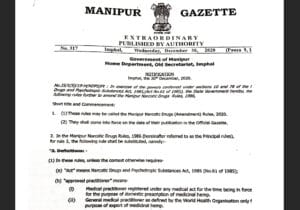
Manipur has officially envisioned a sustainable and regulated framework for the medicinal, scientific, and industrial use of hemp. The objective was to create a balanced environment that supports legitimate economic growth and research while maintaining the strict oversight required by law. Yet, despite the Manipur Narcotic Drugs (Amendment) Rules, 2020 (see pic) being drafted and prepared, this framework remains effectively dormant, leaving potential stakeholders in a state of regulatory uncertainty edging on to mystery. The Rules had also escaped public scrutiny.
The Missing Notification
In December 2020, the Government of Manipur prepared a comprehensive set of rules to govern hemp cultivation and manufacturing (Notification No. 35/1(5)/19-H(NDPS)Pt). As evidenced by Gazette No. 317, the document is thorough, outlining clear licensing forms, security protocols for vault storage, and standard operating procedures for handling botanical materials.
However, there is a critical disconnect between policy and practice. The amendment explicitly states that these rules “shall come into force on the date of their publication in the Official Gazette”. To date, this final administrative step, which is a formal notification, has not been fully enacted for public use since 2020. While the state has empowered Excise officials to enforce the NDPS Act, 1985, the legal mechanism to allow the public to apply for regulated cultivation licenses remains inaccessible.
A Path Towards Transparency
The Directorate of Printing & Stationery, Government of Manipur, recently issued a circular regarding the “Reconstruction of Missing Gazettes” (ID-DPS-203/10/2025-DPS-DP&S). In this public notice, the Directorate, led by Director Ng. Roben Singh, invited stakeholders to submit claims, comments, or suggestions to help bridge gaps in government records, emphasizing a commitment to completeness and procedural integrity.
Reliable information indicates that a copy of the 2020 amendment is currently held within the records of the Directorate under Ng. Roben Singh. This presents a unique and timely opportunity for the state to resolve the current impasse. There is a need to urge the Directorate of Printing & Stationery and the Home Department to “do the needful” by ensuring that the Manipur Narcotic Drugs (Amendment) Rules, 2020 (Gazette No. 317) are formally validated, notified, and made accessible to the public.
Legal Clarity and Subsequent Action
By finalizing the notification of these rules, the government can move from a draft framework to a transparent, regulated system. This step would provide the legal clarity that entrepreneurs, researchers, and the public require. The blueprint for a regulated hemp policy is ready. It is high time the authorities finalize this administrative process, thereby allowing Manipur to foster legal industry while upholding the high standard of oversight the law requires.
(Disclaimer: This article is intended for informational purposes and advocates for administrative transparency regarding existing government policy frameworks).
“For years, Manipur has held the blueprint for a regulated hemp industry, which is a policy designed to foster innovation while ensuring safety. Yet, this framework remains frozen in administrative limbo. With the government’s current efforts to reconcile and authenticate its official gazette records, there has never been a more opportune moment to bring the […]
“For years, Manipur has held the blueprint for a regulated hemp industry, which is a policy designed to foster innovation while ensuring safety. Yet, this framework remains frozen in administrative limbo. With the government’s current efforts to reconcile and authenticate its official gazette records, there has never been a more opportune moment to bring the Manipur Narcotic Drugs (Amendment) Rules, 2020 out of the shadows. It is time to finalize the notification of Gazette No. 317 and turn a long-awaited policy into a transparent, enforceable law.”
TFM Analysis
Manipur has officially envisioned a sustainable and regulated framework for the medicinal, scientific, and industrial use of hemp. The objective was to create a balanced environment that supports legitimate economic growth and research while maintaining the strict oversight required by law. Yet, despite the Manipur Narcotic Drugs (Amendment) Rules, 2020 (see pic) being drafted and prepared, this framework remains effectively dormant, leaving potential stakeholders in a state of regulatory uncertainty edging on to mystery. The Rules had also escaped public scrutiny.
The Missing Notification
In December 2020, the Government of Manipur prepared a comprehensive set of rules to govern hemp cultivation and manufacturing (Notification No. 35/1(5)/19-H(NDPS)Pt). As evidenced by Gazette No. 317, the document is thorough, outlining clear licensing forms, security protocols for vault storage, and standard operating procedures for handling botanical materials.
However, there is a critical disconnect between policy and practice. The amendment explicitly states that these rules “shall come into force on the date of their publication in the Official Gazette”. To date, this final administrative step, which is a formal notification, has not been fully enacted for public use since 2020. While the state has empowered Excise officials to enforce the NDPS Act, 1985, the legal mechanism to allow the public to apply for regulated cultivation licenses remains inaccessible.
A Path Towards Transparency
The Directorate of Printing & Stationery, Government of Manipur, recently issued a circular regarding the “Reconstruction of Missing Gazettes” (ID-DPS-203/10/2025-DPS-DP&S). In this public notice, the Directorate, led by Director Ng. Roben Singh, invited stakeholders to submit claims, comments, or suggestions to help bridge gaps in government records, emphasizing a commitment to completeness and procedural integrity.
Reliable information indicates that a copy of the 2020 amendment is currently held within the records of the Directorate under Ng. Roben Singh. This presents a unique and timely opportunity for the state to resolve the current impasse. There is a need to urge the Directorate of Printing & Stationery and the Home Department to “do the needful” by ensuring that the Manipur Narcotic Drugs (Amendment) Rules, 2020 (Gazette No. 317) are formally validated, notified, and made accessible to the public.
Legal Clarity and Subsequent Action
By finalizing the notification of these rules, the government can move from a draft framework to a transparent, regulated system. This step would provide the legal clarity that entrepreneurs, researchers, and the public require. The blueprint for a regulated hemp policy is ready. It is high time the authorities finalize this administrative process, thereby allowing Manipur to foster legal industry while upholding the high standard of oversight the law requires.
(Disclaimer: This article is intended for informational purposes and advocates for administrative transparency regarding existing government policy frameworks).
“For years, Manipur has held the blueprint for a regulated hemp industry, which is a policy designed to foster innovation while ensuring safety. Yet, this framework remains frozen in administrative limbo. With the government’s current efforts to reconcile and authenticate its official gazette records, there has never been a more opportune moment to bring the […]
“For years, Manipur has held the blueprint for a regulated hemp industry, which is a policy designed to foster innovation while ensuring safety. Yet, this framework remains frozen in administrative limbo. With the government’s current efforts to reconcile and authenticate its official gazette records, there has never been a more opportune moment to bring the Manipur Narcotic Drugs (Amendment) Rules, 2020 out of the shadows. It is time to finalize the notification of Gazette No. 317 and turn a long-awaited policy into a transparent, enforceable law.”
TFM Analysis
Manipur has officially envisioned a sustainable and regulated framework for the medicinal, scientific, and industrial use of hemp. The objective was to create a balanced environment that supports legitimate economic growth and research while maintaining the strict oversight required by law. Yet, despite the Manipur Narcotic Drugs (Amendment) Rules, 2020 (see pic) being drafted and prepared, this framework remains effectively dormant, leaving potential stakeholders in a state of regulatory uncertainty edging on to mystery. The Rules had also escaped public scrutiny.
The Missing Notification
In December 2020, the Government of Manipur prepared a comprehensive set of rules to govern hemp cultivation and manufacturing (Notification No. 35/1(5)/19-H(NDPS)Pt). As evidenced by Gazette No. 317, the document is thorough, outlining clear licensing forms, security protocols for vault storage, and standard operating procedures for handling botanical materials.
However, there is a critical disconnect between policy and practice. The amendment explicitly states that these rules “shall come into force on the date of their publication in the Official Gazette”. To date, this final administrative step, which is a formal notification, has not been fully enacted for public use since 2020. While the state has empowered Excise officials to enforce the NDPS Act, 1985, the legal mechanism to allow the public to apply for regulated cultivation licenses remains inaccessible.
A Path Towards Transparency
The Directorate of Printing & Stationery, Government of Manipur, recently issued a circular regarding the “Reconstruction of Missing Gazettes” (ID-DPS-203/10/2025-DPS-DP&S). In this public notice, the Directorate, led by Director Ng. Roben Singh, invited stakeholders to submit claims, comments, or suggestions to help bridge gaps in government records, emphasizing a commitment to completeness and procedural integrity.
Reliable information indicates that a copy of the 2020 amendment is currently held within the records of the Directorate under Ng. Roben Singh. This presents a unique and timely opportunity for the state to resolve the current impasse. There is a need to urge the Directorate of Printing & Stationery and the Home Department to “do the needful” by ensuring that the Manipur Narcotic Drugs (Amendment) Rules, 2020 (Gazette No. 317) are formally validated, notified, and made accessible to the public.
Legal Clarity and Subsequent Action
By finalizing the notification of these rules, the government can move from a draft framework to a transparent, regulated system. This step would provide the legal clarity that entrepreneurs, researchers, and the public require. The blueprint for a regulated hemp policy is ready. It is high time the authorities finalize this administrative process, thereby allowing Manipur to foster legal industry while upholding the high standard of oversight the law requires.
(Disclaimer: This article is intended for informational purposes and advocates for administrative transparency regarding existing government policy frameworks).
A faction of Naga leaders appears to have hardened its stance on the ‘struggle’ for the Naga political movement while maintaining its resolve on the Naga-Kuki issue. TFM Report On June 16, 2026, a document emerged from the Northeastern hills that would send shockwaves through the corridors of power in both New Delhi and the […]
A faction of Naga leaders appears to have hardened its stance on the ‘struggle’ for the Naga political movement while maintaining its resolve on the Naga-Kuki issue.
TFM Report
On June 16, 2026, a document emerged from the Northeastern hills that would send shockwaves through the corridors of power in both New Delhi and the Naga armed resistance strongholds. The “Eastern Flank Statement” was not merely another political communiqué—it was a declaration of well-articulated tirade against what its leaders saw as the surrender of their hard-won principles.
The statement, purportedly issued by Hs. Ramsan, A. Raman, Ikato I. Chishi Swu (Executive Member, Steering Committee), Victor Angami (Member of Collective Leadership) and Angyo Jacob Tangshang, began with a tone of weary defiance: “We have, time and again, written letters and issued clarifications to the government, the party, and the Naga public at large. We have always kept the door open for reconciliation and unity.” But the door, they made clear, had been slammed shut by forces they could no longer ignore.
Hanshi Ramsan
The signatories traced their lineage back to the very foundations of “Naga nationalism”—to “the submission of a memorandum to the Simon Commission on 10th January, 1929 by the Naga Club, demanding that the Nagas be left alone to decide their own future.” This was not a casual reaction; it was the latest chapter in a struggle that had defined their people for nearly a century.
Alleged Betrayal of the Framework Agreement
At the heart of the conflict stood the Framework Agreement (FA) signed on August 3, 2015—a document that had once promised hope for the future of the Nagas. Under the leadership of late Chairman Isak Chishi Swu and General Secretary Th. Muivah, the agreement had represented the culmination of decades of struggle.
But hope, the Eastern Flank argued, had curdled into compromise. “Since the signing of the FA, the GoI has effectively backtracked and betrayed the Agreement,” the statement declared with bitter finality. The “betrayal became concrete” when, in August 2019, the Government of India delivered a three-month ultimatum: abandon demands for a separate flag and constitution, or face the end of all negotiations, says the statement.
The Eastern Flank saw this as a moment of reckoning. Rather than capitulate, they moved to strengthen their military position. On September 3, 2019, a new Standard of Operation created the Eastern Flank itself—a strategic move to “establish our base in the East across the present artificial Indo-Myanmar border.” But what followed would fracture the Naga movement from within.
Brothers Turned Enemies
Just one month after the Eastern Flank’s creation, the unity of the “Naga Army” shattered. The then Longvibu, Anthony Ningkhan Shimray, supposedly issued an order that superseded the new arrangements, effectively “dismantling the strengthening of the Naga Army, the backbone of the Naga political movement”, claims the statement.
The Eastern Flank described a nightmare of internal betrayal. They recounted how Anthony Ningkhan Shimray “sent the then Brig. Alen Siro to Homalin to surround and annihilate us in coordination with our adversaries.” For more than forty days, they kept Brigadier Siro with them, “trying our best to reason with him against such treacherous activity and refraining from shedding the blood of our own Naga brothers.”
He refused to listen. When a Peace Mission Team visited Brigadier Sorei at Homalin Camp, he reportedly “openly stated that he was ordered by the then Longvibu and Brig. Alen Siro to shoot at the cadres of the Eastern Flank.” The bloodshed that would follow was, in their view, a foregone conclusion.
The Eastern Flank’s greatest grievance, however, was political rather than military. They detailed how a peace proposal drafted on December 7, 2019 had qualified the Naga national identity through deliberate euphemisms—”the government of India is not in a position to recognize it,” “respecting the will of the Naga people and prevailing sentiments.”
To the Eastern Flank, these were not words of compromise but of surrender. Hs. Ramsan and others wrote an urgent letter objecting to these formulations. Their stand forced a correction: “flag and constitution would be settled through political decision, without which there can be no honorable solution.”
But words, they discovered, were hollow. “Despite this official correction, the deeds of some of our authorities suggested otherwise.” The leadership continued its “meaningless talks for more than ten years after the signing of the FA”, says the Eastern Flank statement.
Terminations, Revocations, and Reinstatements
What followed was a systematic removal of those who dared to speak principle over pragmatism. The statement details a series of terminations, revocations, and reinstatements that read like a bureaucratic tragedy:
Hs. Ramsan was *”wrongly terminated on 12th July 2023 through false accusations” and later “given pardon at will”—only to be terminated again on July 18, 2024, this time “under false accusations of anti-national activities, branding them as anti-nationals”, says the statement.
The Eastern Flank claimed that those who had raised their voices against compromise were “systematically purged”. Meanwhile, those who had ordered attacks on fellow Naga cadres remained in power, says the statement.
The Eastern Flank’s response was defiant: “Rejecting this injustice, the national workers and senior officers of the Naga Army in the East resolved on 10th August 2024 to remain under the leadership of Lieut. Gen. Retd. Hs. Ramsan-VC.”
A New Coalition of Resistance
By March 2026, the Eastern Flank had found unexpected allies. “Mr. Ikato I. Chishi Swu, Executive Member Steering Committee and Mr. Victor Angami, Member of Collective Leadership and their entourage have taken the right decision to join hands with us to save the nation from another surrender,” claimed the statement.
The alliance was born not of ambition but of shared outrage. Both sides had watched helplessly as the Hebron leadership allegedly “failed to take concrete steps to save the nation” and continued negotiations that had become “meaningless, endless talks with the GoI.”
The Hongbei Massacre: Brotherhood Betrayed
Then came the trigger—the event that, for the Eastern Flank, proved beyond doubt that the Hebron leadership had allegedly become an instrument of their “adversaries”.
On March 28, 2026, four Naga cadres were killed at Hongbei Village, “even while a Peace Mission was still in process.” The dead were not enemies. They were brothers, says the statement. “At the time when the GoI is using the Kukis as a proxy to wage war against us to suppress the Naga political issue, and to create a Kuki Homeland within Nagalim,” the statement explains, “our cadres were sent to work in unison with the cadres of Ghq/Hebron.”
The Eastern Flank’s cadres met their counterparts stationed at Hongbei. They talked. They agreed on uniting against their common enemy. They exchanged pleasantries. And then some authorities chose betrayal, asserted the Eastern Flank. “They directed the cadres to shoot one’s own brother,” the statement reads. Two cadres survived “through divine intervention,” exposing “the secret evil intentions, and plans of some of the authorities of the Hebron/Ghq.”
The massacre was not just murder—it was proof, says the Eastern Flank. “Killing the force that stands for the Nagas is a clear indication of a force working in alignment with the policy of our adversaries.”
Response of the CSOs; Naga-Kuki Issue
In response, the Tangkhul Naga Long and other civil society organisations issued a non-cooperation directive against the Wung-Tangkhul Region, demanding justice. The Eastern Flank fully supported this: “Any attempt to revoke the non-cooperation against the WTR (NSCN/GPRN) before justice is served will be an abatement to create bigger problems among us.”
Their stance on the Kuki issue remained absolute: “There can be no peace and no compromise if the Kukis insist on creating a Kuki Homeland within Nagalim.”
The Eastern Flank’s disagreement with the Hebron leadership, they insisted, was not personal but principled. They pointed to specific clauses in the proposed competencies that represented, in their view, a betrayal of the Framework Agreement:
-“Competency serial no. 4(c) states that Nagas will send Lok Sabha and Rajya Sabha members to the Parliament of India.”
-“The Naga Constitution/Yeahzabo is to be inserted in the Constitution of India as a separate chapter.”
– “The Election Commission of the Tatar Hoho shall function in conjunction with the Election Commission of India.”
– “The oath of office of Midan Kilonser and all Kilonsers of the NRTC shall be administered by the Governor of the State concerned.”
These provisions, the Eastern Flank argued, did not represent an honourable solution but a “surrender dressed in diplomatic clothing”. “After more than 70 years of struggle and the sacrifice of thousands of lives for our beloved Nagalim, can we now compromise our right to sovereign existence as a nation on account of the difficulties and position of the GoI?” they demanded.
A Rallying Cry
The statement concludes with a rallying cry—not just to armed cadres and politicians, but to all Nagas: “We appeal to all Nagas and national workers to rise up for the God-given rights of the Nagas. God Almighty is using the Nagas to build up according to His divine purpose. Therefore, let us abandon the spirit of doubt and timidity. Woe to those who doubt the faithfulness of God,” said the Eastern Flank. And with the traditional battle cry that has echoed through Naga history—”Kuknalim!”—the Eastern Flank made their position unmistakably clear.
As June 2026 draws to a close, the Naga movement stands at a crossroads. The Eastern Flank has drawn a line in the sand, invoking the spirit of the 1929 memorandum, the 1947 declaration of independence, and the 1951 plebiscite. They have rejected what they see as compromise and embraced what they believe to be principle.
Whether the Hebron leadership can bridge this chasm remains uncertain. The Government of India watches, waiting. The Naga-Kuki issue smolders. And Naga wait to see which path they will take.
One thing is clear: the struggle for “Nagalim” is far from over. And the Eastern Flank has made it known that, in their view, any solution that falls short of the Framework Agreement’s principles is no solution at all.
“We will stand our ground to seek an honourable and acceptable solution based on the principle of the FA that was signed under the leadership of our Chairman, late Mr. Isak Chishi Swu and General Secretary Mr. Th. Muivah.”
“He Said He Loved Me Like a Son”: Former KV Student Alleges Years of Sexual Abuse by Headmaster who has been granted bail in connection with a POCSO Case TFM Investigative Report A former student of Kendriya Vidyalaya No. 1, Lamphelpat, has come forward with allegations of repeated sexual abuse spanning several years, naming the […]
“He Said He Loved Me Like a Son”: Former KV Student Alleges Years of Sexual Abuse by Headmaster who has been granted bail in connection with a POCSO Case
TFM Investigative Report
A former student of Kendriya Vidyalaya No. 1, Lamphelpat, has come forward with allegations of repeated sexual abuse spanning several years, naming the school’s headmaster, as the perpetrator. The revelation comes just days after a special POCSO court in Imphal West granted the headmaster interim anticipatory bail in connection with a related FIR.
The allegations detail a pattern of abuse that began when the survivor, now a young adult, was a student at the school between 2006 and 2016. The abuse reportedly occurred on multiple occasions during Class 6 (2012-13) and again in Class 9 (2014-15). The survivor, who has chosen to remain anonymous due to the sensitive nature of the case, has provided a harrowing account of the trauma inflicted.
A Trust Betrayed
The survivor recalls first being drawn to the headmaster’s room as a child, describing how the headmaster would “play” with him. Vulnerable and seeking affection, the survivor explains that his real father was abusive and a drunkard. “At that time, I had already experienced similar things before and I thought it was ‘normal,’ especially when he said he loved me like his son, and that triggered a sense of wanting affection,” the survivor stated.
The abuse escalated to a sexual assault when the headmaster allegedly performed a sexual act on him. “I was shocked, confused, aroused, and taken away during the moment,” the survivor recounted. He was then coerced into reciprocating the act, which he did because, at the time, he believed it was “normal.”
The Encounter That Changed Everything
The survivor stopped seeing the headmaster for a while after his class shifted to a different area. However, a fateful encounter in 2014-15 at the school brought the abuse back. While waiting for a pickup after school hours, the headmaster allegedly took him to the CCA room. “I thought he was just going to play with me again, but he… asked me to do the same,” the survivor said.
A few days later, another incident occurred at the primary boys’ toilet. The survivor, who was deeply depressed and contemplating suicide, felt a confusing sense of exhilaration and sought the feeling again. “I wanted to feel it again, as I was deeply depressed during that period of time, with suicide on my mind,” he confessed.
The abuse then escalated further. “Upon him asking me repeatedly, I gave in. I didn’t know why I agreed, but he stopped when I said it hurts,” the survivor said. “Whatever experience I have narrated is true to the best of my knowledge and I would like to remain anonymous.”
The School and the Accused
The then headmaster at KV No. 1, Imphal: According to a provisional seniority list from Kendriya Vidyalaya Sangathan, the headmaster holds a BA (Hons), MA, and B.Ed and joined the service on July 30, 2013 . He recently addressed the media during the school’s diamond jubilee celebration in December 2024, speaking of the institution’s commitment to societal betterment . He is also reportedly a member of a school committee that dealt with a 2025 altercation between Class XI and XII students .
Court Grants Interim Bail
An FIR was registered at Lamphel Police Station on June 9, 2026, under Section 8 of the POCSO Act, 2012, which deals with sexual assault and carries a maximum punishment of five years. In court, the headmaster’s counsel argued that he had been “falsely implicated” and that the allegations might be a “fallout” of the student incident from 2025 .
Granting him ad-interim bail on June 9, the court noted that “the apprehension felt by the petitioner has a reasonable basis.” He was released on a PR bond of Rs. 1,00,000 with conditions that he must cooperate with the investigation, not influence witnesses, and not leave the state without permission .
The court has called for a bail objection report from the Officer-in-Charge of Lamphel Police Station, returnable by Wednesday, June17, 2026, and has fixed the next hearing for that date.
Outrage and Questions
The allegations have sent shock-waves through the community, raising serious questions about the safety and well-being of children in one of Manipur’s premier educational institutions. The survivor’s detailed account, spanning years of abuse and manipulation, stands in stark contrast to the headmaster’s public persona as a leader dedicated to creating a “positive future” for his students.
This case also highlights the profound and often hidden struggle of child sexual abuse survivors who may not comprehend the nature of the abuse until years later, and whose vulnerability is often exploited by perpetrators in positions of trust. The next court hearing is expected to draw significant attention as the investigation unfolds.
“The act of procuring public employment through impersonation and fraudulent identity constitutes forgery for the purpose of cheating… and creation of unlawful entitlement to a government post,” the police report states. Investigators also suspect the involvement of an “organized network/racket,” given the nature of the impersonation in a national-level examination. TFM Report In a startling case […]
“The act of procuring public employment through impersonation and fraudulent identity constitutes forgery for the purpose of cheating… and creation of unlawful entitlement to a government post,” the police report states. Investigators also suspect the involvement of an “organized network/racket,” given the nature of the impersonation in a national-level examination.
TFM Report
In a startling case of examination fraud that has sent shockwaves through India’s premier medical recruitment system, a government employee at the Regional Institute of Medical Sciences (RIMS), Imphal, has been arrested after official biometric verification revealed that the fingerprints and facial data of the person who took the entrance exam did not match his own.
Based on the police remand application filed before the Chief Judicial Magistrate, Imphal West, on May 11, 2026, the accused, identified as Jitendra Meena (30), a native of Karauli district in Rajasthan, was serving as a Multi-Tasking Staff (MTS) at RIMS, Imphal, based on his selection in the Common Recruitment Examination (CRE)-2024 conducted by the All India Institute of Medical Sciences (AIIMS), New Delhi.
However, an investigation by Lamphel Police Station has uncovered that Meena never actually appeared for the exam. Instead, an unknown impersonator sat for the test on his behalf, using fraudulent means to secure a government job.
Scientific Evidence Proves Impersonation
According to the official Biometric Verification Report issued by AIIMS and authenticated by agencies TCS and Innovatiview, neither Meena’s fingerprints nor his facial biometrics matched the data captured during the CRE-2024 examination.
“The certified biometric records clearly and unequivocally establish that both the fingerprint as well as facial biometric data of the accused do not match with the biometric data captured during the examination process,” states the police investigation report.
Investigators further noted that the facial appearance, physical structure, and identifiable features of the person who actually wrote the exam are “materially different” from those of the present accused.
Accused’s Explanation Dismissed as ‘Baseless’
During sustained interrogation, Meena allegedly claimed that the mismatch was due to a “finger skin problem” or possible “malfunctioning of biometric devices.” Police have dismissed this as an “untenable and misleading explanation,” noting that the exam was conducted under strict AIIMS supervision using scientifically validated systems.
Adding to the prosecution’s case, investigators revealed that when asked to read and translate simple alphabetic sentences and basic written content during custody, Meena “failed to do so satisfactorily” and could not demonstrate even the minimum comprehension expected of a candidate who qualified in a competitive national-level exam.
Charges: Cheating, Forgery, Conspiracy
Police have formally added charges under Sections 336, 338, 340, and 61(2) of the Bharatiya Nyaya Sanhita (BNS), 2023 — covering cheating, forgery for the purpose of cheating, use of forged documents as genuine, and criminal conspiracy.
The investigation has revealed that Meena not only secured selection through impersonation but also used fraudulently obtained documents — including the application form, admit card, result notification, appointment order, and joining papers — as genuine to obtain a public post with pecuniary benefits.
“The act of procuring public employment through impersonation and fraudulent identity constitutes forgery for the purpose of cheating… and creation of unlawful entitlement to a government post,” the police report states.
Investigators also suspect the involvement of an “organized network/racket,” given the nature of the impersonation in a national-level examination.
Judicial Custody Sought
Police have requested 15 days of judicial custody for Meena (from May 11 to May 25, 2026) to complete ongoing investigations, including:
– Collection of original biometric records,
– Forensic comparison of biometric data,
– Examination of AIIMS/TCS/Innovatiview officials,
– Identification of the actual impersonator, and
– Unearthing the wider conspiracy.
The investigating officer, SI S. Chandrikishor Singh of Lamphel Police Station, submitted before the court that the accused has been “deliberately concealing material facts, furnishing false and unreasonable explanations, and attempting to obstruct the progress of investigation.”
The case remains under active investigation, with authorities now probing whether similar impersonations have occurred in other recruitment examinations conducted by AIIMS and other central institutions.
Zeliangrong United Front (ZUF) has issued a press release denying any involvement in the ambush. United Naga Council (UNC) issued a strong condemnation of the attack and expressed concerns over reports that some Nagas from Konsakhul village had allegedly been held hostage by villagers from Leilon Vaiphei following the ambush. TFM Report A deadly ambush […]
Zeliangrong United Front (ZUF) has issued a press release denying any involvement in the ambush. United Naga Council (UNC) issued a strong condemnation of the attack and expressed concerns over reports that some Nagas from Konsakhul village had allegedly been held hostage by villagers from Leilon Vaiphei following the ambush.
TFM Report
A deadly ambush targeting church leaders of the Thadou Baptist Association (TBA) has sent shockwaves across Manipur after several prominent Christian leaders were attacked between Kotzim and Kotlen villages in Kangpokpi district on Tuesday.
According to sources, the church leaders were returning to Kangpokpi from Churachandpur after attending a TBA conference when armed assailants allegedly ambushed their convoy midway. The victims were traveling in two vehicles at the time of the attack.
Among those killed in the ambush was Rev. V. Sitlhou, former General Secretary of the Manipur Baptist Convention (MBC), Pastor Paogoulen, and Pastor Kaigoulun. The killings have triggered widespread grief and outrage among many organisations.
As per sources, others who sustained injuries in the incident include Rev. S.M. Haopu, Rev. Hekai Simte, Rev. Paothang, Lelen (driver), and Goumang (driver). It is stated that some of the injured were rushed for medical treatment as authorities began assessing the scale of the attack.
The ambush has sparked fresh tensions in the already volatile hill districts of Manipur, where ethnic and armed conflicts have continued to destabilise normal life.
UNC Condemns “Outrageous Ambush”
The United Naga Council (UNC) issued a strong condemnation of the attack through an official press release dated May 13, 2026. The organization described the ambush as an “outrageous” act and stated that three persons had been killed while five others were grievously injured according to available reports.
The UNC specifically mentioned that the incident occurred between Kotzin and Kotlen while the church leaders were returning from Churachandpur. The council expressed deep condolences to the bereaved families and prayed for strength and peace during the period of mourning.
The statement also highlighted concerns over reports that around 20 Nagas from Konsakhul village had allegedly been held hostage by villagers from Leilon Vaiphei following the ambush. Calling such actions unacceptable, the UNC urged the immediate and unconditional release of the hostages and appealed to all communities, church leaders, and civil society organizations to work together to prevent further escalation of violence and restore communal harmony.
ZUF Denies Involvement
Meanwhile, the Zeliangrong United Front (ZUF) issued a press release denying any involvement in the ambush. The statement, released by the organization’s Ministry of Information and Publicity from its Dilung headquarters, said the group had learned of the attack “with deep shock and concern.”
The organization categorically rejected allegations circulating on social media and in certain public circles linking the ZUF to the incident. According to the statement, the allegations were “baseless, unfounded and misleading,” and the organization claimed it was neither aware of nor connected to the attack in any manner.
The ZUF further appealed to civil society groups and media organizations not to spread unverified information or make premature accusations without factual evidence, warning that misinformation could further inflame the already sensitive situation in the state.
Fear and Uncertainty Grip Region
The brutal nature of the ambush, reportedly targeting unarmed church leaders returning from a religious gathering, has generated fear and uncertainty across the hill region. Images circulating after the incident showed damaged vehicles and critically injured victims, underscoring the severity of the attack.
Security agencies are expected to launch a detailed investigation into the incident. However, no official statement had yet been issued by the state government or law enforcement authorities regarding the identity of the attackers or the exact casualty figures till the filing of this report.
The incident is likely to deepen concerns over the deteriorating security situation in the hill districts, where armed activity, ethnic distrust, and retaliatory violence continue to threaten civilian lives.
Church organizations, tribal bodies, and civil society groups are expected to hold emergency consultations in the coming days as calls grow louder for justice, accountability, and restoration of peace in the conflict-affected areas of Manipur.
Highlighting public sentiment, Yumnam Khemchand said people across communities have expressed a strong desire for peace and stability. He urged citizens to remain united and vigilant against elements seeking to create division. TFM Report Manipur Chief Minister Yumnam Khemchand Singh on Wednesday (April 29) said the April 7 Tronglaobi blast, which killed two children, was […]
Highlighting public sentiment, Yumnam Khemchand said people across communities have expressed a strong desire for peace and stability. He urged citizens to remain united and vigilant against elements seeking to create division.
TFM Report
Manipur Chief Minister Yumnam Khemchand Singh on Wednesday (April 29) said the April 7 Tronglaobi blast, which killed two children, was likely the handiwork of groups attempting to destabilize the state and obstruct ongoing peace efforts.
Referring to the Tronglaobi incident in which two children (siblings) were killed, he said the government under him believe that the incident must have been triggered by “those who did not want the formation of a popular government or those who want to create a volatile atmosphere. We will apprehend those responsible, they have no place to run”.
Addressing a gathering in Langthabal constituency in Imphal West district after inaugurating five infrastructure projects, the Chief Minister placed the incident in context. He noted that Manipur had been under President’s Rule since February 13, 2025, following the resignation of former Chief Minister N Biren Singh amid prolonged ethnic violence that began on May 3, 2023. President’s Rule was revoked on February 4, 2026, paving the way for the formation of a new government led by Singh, due to demand of forming a popular government from the general public.
“After a consistent demand for the revocation of President’s Rule and installation of a popular government through the voices of the public, I became the Chief Minister (I did not lobby for the post nor did I know that I would be the one for the post),” said the Chief Minister.
On the occasion, Khemchand also emphasized that peace remains the foremost requirement for development. The projects included three water supply schemes and two community halls. He added that since assuming office, his focus has been on initiating a “journey for peace” aimed at rebuilding trust and harmony among communities.
Over the past two months and twenty days, Singh said he has engaged extensively with MLAs, officials, and civil society groups, while also visiting both hill and valley districts—including Jiribam, Senapati, Kangpokpi, and Ukhrul—to understand public grievances and promote reconciliation. He pointed out that the Tronglaobi blast occurred shortly after his visit to Jiribam, calling it an “unfortunate” attempt to derail the fragile peace process.
Highlighting public sentiment, Singh said people across communities have expressed a strong desire for peace and stability. He urged citizens to remain united and vigilant against elements seeking to create division.
Reaffirming the government’s commitment, Singh said development initiatives would continue across all regions, including remote areas, despite ongoing challenges, and called for collective cooperation to build a peaceful and progressive Manipur.
Highlighting public sentiment, Yumnam Khemchand said people across communities have expressed a strong desire for peace and stability. He urged citizens to remain united and vigilant against elements seeking to create division. TFM Report Manipur Chief Minister Yumnam Khemchand Singh on Wednesday (April 29) said the April 7 Tronglaobi blast, which killed two children, was […]
Highlighting public sentiment, Yumnam Khemchand said people across communities have expressed a strong desire for peace and stability. He urged citizens to remain united and vigilant against elements seeking to create division.
TFM Report
Manipur Chief Minister Yumnam Khemchand Singh on Wednesday (April 29) said the April 7 Tronglaobi blast, which killed two children, was likely the handiwork of groups attempting to destabilize the state and obstruct ongoing peace efforts.
Referring to the Tronglaobi incident in which two children (siblings) were killed, he said the government under him believe that the incident must have been triggered by “those who did not want the formation of a popular government or those who want to create a volatile atmosphere. We will apprehend those responsible, they have no place to run”.
Addressing a gathering in Langthabal constituency in Imphal West district after inaugurating five infrastructure projects, the Chief Minister placed the incident in context. He noted that Manipur had been under President’s Rule since February 13, 2025, following the resignation of former Chief Minister N Biren Singh amid prolonged ethnic violence that began on May 3, 2023. President’s Rule was revoked on February 4, 2026, paving the way for the formation of a new government led by Singh, due to demand of forming a popular government from the general public.
“After a consistent demand for the revocation of President’s Rule and installation of a popular government through the voices of the public, I became the Chief Minister (I did not lobby for the post nor did I know that I would be the one for the post),” said the Chief Minister.
On the occasion, Khemchand also emphasized that peace remains the foremost requirement for development. The projects included three water supply schemes and two community halls. He added that since assuming office, his focus has been on initiating a “journey for peace” aimed at rebuilding trust and harmony among communities.
Over the past two months and twenty days, Singh said he has engaged extensively with MLAs, officials, and civil society groups, while also visiting both hill and valley districts—including Jiribam, Senapati, Kangpokpi, and Ukhrul—to understand public grievances and promote reconciliation. He pointed out that the Tronglaobi blast occurred shortly after his visit to Jiribam, calling it an “unfortunate” attempt to derail the fragile peace process.
Highlighting public sentiment, Singh said people across communities have expressed a strong desire for peace and stability. He urged citizens to remain united and vigilant against elements seeking to create division.
Reaffirming the government’s commitment, Singh said development initiatives would continue across all regions, including remote areas, despite ongoing challenges, and called for collective cooperation to build a peaceful and progressive Manipur.
Based on the legal framework of the Information Technology (Intermediary Guidelines and Digital Media Ethics Code) Rules, 2021 and the specific precedent involving The Frontier Manipur in 2021, a state government cannot issue such an advisory to regulate digital news content under Part III of the IT Rules, 2021. TFM Analysis The Home Department […]
Based on the legal framework of the Information Technology (Intermediary Guidelines and Digital Media Ethics Code) Rules, 2021 and the specific precedent involving The Frontier Manipur in 2021, a state government cannot issue such an advisory to regulate digital news content under Part III of the IT Rules, 2021.
TFM Analysis
The Home Department of the Government of Manipur issued an advisory on April 27, directing all electronic, digital, and social media platforms operating within the State to adhere to responsible dissemination of information.
The advisory mandates due diligence by platforms, prohibits hosting content from unlawful or unauthorised organisations, and calls for the prevention of misinformation, deepfakes, and manipulated content. News publishers have been directed to adhere to the Code of Ethics under the IT Rules, 2021, ensuring accuracy, fairness, and respect for public order.
Platforms have also been asked to refrain from sensational or provocative content, establish grievance redressal mechanisms, and cooperate with law enforcement agencies. Non-compliance, the advisory stated, may attract action under the Information Technology Act, 2000. The order, issued with the approval of the Competent Authority, came into immediate effect.
Not Again! Know the Centre’s mandate
Based on the legal framework of the Information Technology (Intermediary Guidelines and Digital Media Ethics Code) Rules, 2021 and the specific precedent involving The Frontier Manipur in 2021, a state government cannot issue such an advisory to regulate digital news content under Part III of the IT Rules, 2021.
A cursory legal analysis and the referenced precedent.
The Legal Basis: Part III is a Central Subject
The advisory you attached explicitly cites the IT Rules, 2021 as its source of authority (specifically clauses 3 and 4 of the document). However, the legal architecture of these rules divides power between the Centre and States:
– Part II of the IT Rules, 2021 deals with Intermediaries (social media platforms like Facebook, X, etc.). These rules are administered by the Ministry of Electronics and Information Technology (MeitY) .
– Part III of the IT Rules, 2021 deals with Publishers of Digital News and Current Affairs. These rules are administered exclusively by the Ministry of Information and Broadcasting (MIB), Government of India.
The Central Government’s Clarification (2021)
To prevent overreach, the Central Government issued a formal clarification to all States and Union Territories on March 3, 2021. The Ministry of Information and Broadcasting explicitly stated that:
The Precedent: Manipur vs. The Frontier Manipur (2021)
Your reference to the notice issued to The Frontier Manipur is the definitive precedent for why the advisory issued by Government of Manipur, Home Department is invalid.
– The Incident (March 1, 2021): The District Magistrate of Imphal West issued a notice to The Frontier Manipur (TFM) and its talk show “Khanasi Neinasi.” The notice demanded documents proving compliance with the IT Rules, 2021, citing the new digital media norms. This was the first time that a notice has been issued under the new guidelines that the Centre announced on February 25.
– The Central Intervention: The Central Government intervened immediately. I&B Secretary Amit Khare wrote a letter to the Manipur Chief Secretary stating that the District Magistrate had no jurisdiction to issue such a notice.
– The Result: The Manipur Government was forced to withdraw the notice within 24 hours. The Deputy Commissioner pasted a new order outside The Frontier Manipur, Executive Editor’s residence stating the previous notice was “withdrawn with immediate effect”.
How the Current Advisory Exceeds State Powers
The advisory dated April 27, 2026 contains several provisions that violate the 2021 Central clarification:
Provision in Advisory
Legal Status
Reason
Point (v): Barring “sensational” or “provocative” content.
Ultra Vires
This is content regulation of news publishers, falling exclusively under MIB (Part III)
Point (vi): Mandating Grievance Redressal Mechanisms.
Ultra Vires
The 3-Tier grievance system for digital news is controlled by the Centre, not the State Home Department.
Point (vii): Threatening loss of “statutory protections” (Safe Harbour).
Ultra Vires
The power to strip an intermediary of safe harbor protection lies with the Centre under Section 79 of the IT Act, not a State Commissioner of Home.
The “Notice” vs. “Advisory” Distinction
While the government might argue that the attached document is merely an “Advisory” and not an “Order,” legally this distinction is weak (a distinction without a difference).
– The Effect: The document uses mandatory language (“shall be ensured,” “strict compliance,” “Legal Consequences for Non-Compliance”).
– The Precedent: In 2021, the Centre rebuked Manipur even for issuing a notice requesting information. The Centre maintains that no State authority—whether by notice, order, or advisory—can compel compliance under Part III of the IT Rules.
What is Wrong?
The Government of Manipur lacks the constitutional and statutory authority to issue this advisory under the IT Rules, 2021. Therefore, the advisory is legally unenforceable. It mirrors the exact overreach seen in The Frontier Manipur case of 2021, which the Central Government immediately quashed. If a media house receives such a notice, it can respond citing the MIB’s circular dated March 3, 2021, stating that the State Home Department has no jurisdiction over digital news content under Part III of the IT Rules, 2021.
Officials attributed the marginal decline in pass percentage to the ongoing challenges in the state since 2023 but maintained that the results were commendable given the circumstances. Commissioner Geoffrey said strict monitoring and a controlled examination environment ensured fairness.
TFM Report
Council of Higher Secondary Education Manipur (COHSEM) on Monday announced the Class 12 examination results for 2026, with an overall pass percentage of 92.23%, reflecting a slight dip from last year’s 94%.
The results were declared in Imphal in the presence of senior officials, including Education (Schools) Commissioner Ningthoujam Geoffrey and COHSEM Chairman T Ojit Singh.
A total of 31,259 students appeared for the examinations held from February 17 to March 20, with one subject re-exam conducted on April 1. Of these, 28,829 students passed, including 14,165 in first division, 12,879 in second division, and 1,763 in third division.
Officials attributed the marginal decline in pass percentage to the ongoing challenges in the state since 2023 but maintained that the results were commendable given the circumstances. Commissioner Geoffrey said strict monitoring and a controlled examination environment ensured fairness.
“We cannot compare with previous years due to the very typical situation since 2023. Despite the challenges, the results are quite good,” he noted.
Stream-wise Toppers
In the Science stream, Takhellambam Kalpana Devi (COMET School, Changangei) and Yohen Longjam (Comprehensive Concept School, Sangaiprou) jointly topped with 490 marks.
In Arts, Sarangthem Ayingbi Chanu of Enlighten Knowledge Higher Secondary School secured the top position with 470 marks, followed by Pushpa Kakchingtabam of TG Higher Secondary School with 456 marks.
In Commerce, Thoihenba Thongam from CC Higher Secondary School topped with 454 marks, while Haorongbam Keniya Chanu of TG Higher Secondary School secured second position with 433 marks.
District-wise and Gender Performance:
Among districts, Noney district recorded the highest pass percentage at 98.93%, followed by Thoubal district at 97.65%. Jiribam district recorded the lowest at 80.08%.
Girls once again outperformed boys across both government and private institutions. Government schools recorded a pass rate of 86.91%, while private schools performed better with 94.54%.
Despite the slight decline, authorities highlighted the smooth conduct of examinations and timely declaration of results as a significant achievement under difficult circumstances.
Fresh Horror Struck Tronglaobi in Bishnupur District as Suspected Militant Strike Turns a Home into a Living Grave. TFM Report The Imphal Valley, particularly Bishnupur District, has been gripped by tension and rising public anger since early morning Tuesday (April 7, 2026), after the news of the killing of two children and their mother […]
Fresh Horror Struck Tronglaobi in Bishnupur District as Suspected Militant Strike Turns a Home into a Living Grave.
TFM Report
The Imphal Valley, particularly Bishnupur District, has been gripped by tension and rising public anger since early morning Tuesday (April 7, 2026), after the news of the killing of two children and their mother in an improvised rocket/pompi attack.
According to sources, suspected Kuki militants launched a projectile—believed to be a rocket—targeting a civilian residence in Moirang Tronglaobi village. The explosive struck the house directly through a window, triggering a powerful blast that killed two young siblings and left their mother seriously injured.
Siblings Aged 5 Years and 5 Months Killed
The victims have been identified as a five-year-old boy, his five-month-old sister and their mother who later succumbed to injuries, as per sources from the locality. The explosion caused significant damage to the house and sent shockwaves across Imphal valley, with village residents rushing to the scene in an attempt to rescue the injured.
The children struck by the splinters of from the rocket blast being ruched to a nearby hospital. Source: Social Media
Locals claimed the projectile was fired from nearby hill slopes, suggesting that the launch point was located more than three kilometres away. Tronglaobi lies along the vulnerable hill-valley fringe near Moirang in Bishnupur district, close to the elevated areas of Churachandpur district, a region that has witnessed repeated tensions in since May 3, 2023.
Fury Spills into Streets – Police Station Gate Torched by Irate Mob
By post-dawn, irate mobs converged at the Moirang Police Station and burnt down the gate, as anger over the deaths of the two children boiled over. Reports are emerging that the incident is likely to trigger widespread protest and subsequent reactions across the valley, raising fears of a fresh spiral of violence.
Security Tightened – Forces Deployed Along Hill-Valley Boundary
As expected, security has been significantly tightened across the area following the attack, an act considered too late by the public. Additional forces have been deployed to prevent further escalation, while surveillance and search operations are underway in adjoining hill regions. Authorities are also closely monitoring other sensitive villages along the hill-valley boundary to avert any further incidents, said a source.
Fresh Horror Struck Tronglaobi in Bishnupur District as Suspected Militant Strike Turns a Home into a Living Grave. TFM Report The Imphal Valley, particularly Bishnupur District, has been gripped by tension and rising public anger since early morning Tuesday (April 7, 2026), after the news of the killing of two children and their mother […]
Fresh Horror Struck Tronglaobi in Bishnupur District as Suspected Militant Strike Turns a Home into a Living Grave.
TFM Report
The Imphal Valley, particularly Bishnupur District, has been gripped by tension and rising public anger since early morning Tuesday (April 7, 2026), after the news of the killing of two children and their mother in an improvised rocket/pompi attack.
According to sources, suspected Kuki militants launched a projectile—believed to be a rocket—targeting a civilian residence in Moirang Tronglaobi village. The explosive struck the house directly through a window, triggering a powerful blast that killed two young siblings and left their mother seriously injured.
Siblings Aged 5 Years and 5 Months Killed
The victims have been identified as a five-year-old boy, his five-month-old sister and their mother who later succumbed to injuries, as per sources from the locality. The explosion caused significant damage to the house and sent shockwaves across Imphal valley, with village residents rushing to the scene in an attempt to rescue the injured.
The children struck by the splinters of from the rocket blast being ruched to a nearby hospital. Source: Social Media
Locals claimed the projectile was fired from nearby hill slopes, suggesting that the launch point was located more than three kilometres away. Tronglaobi lies along the vulnerable hill-valley fringe near Moirang in Bishnupur district, close to the elevated areas of Churachandpur district, a region that has witnessed repeated tensions in since May 3, 2023.
Fury Spills into Streets – Police Station Gate Torched by Irate Mob
By post-dawn, irate mobs converged at the Moirang Police Station and burnt down the gate, as anger over the deaths of the two children boiled over. Reports are emerging that the incident is likely to trigger widespread protest and subsequent reactions across the valley, raising fears of a fresh spiral of violence.
Security Tightened – Forces Deployed Along Hill-Valley Boundary
As expected, security has been significantly tightened across the area following the attack, an act considered too late by the public. Additional forces have been deployed to prevent further escalation, while surveillance and search operations are underway in adjoining hill regions. Authorities are also closely monitoring other sensitive villages along the hill-valley boundary to avert any further incidents, said a source.
Fresh Horror Struck Tronglaobi in Bishnupur District as Suspected Militant Strike Turns a Home into a Living Grave. TFM Report The Imphal Valley, particularly Bishnupur District, has been gripped by tension and rising public anger since early morning Tuesday (April 7, 2026), after the news of the killing of two children and their mother […]
Fresh Horror Struck Tronglaobi in Bishnupur District as Suspected Militant Strike Turns a Home into a Living Grave.
TFM Report
The Imphal Valley, particularly Bishnupur District, has been gripped by tension and rising public anger since early morning Tuesday (April 7, 2026), after the news of the killing of two children and their mother in an improvised rocket/pompi attack.
According to sources, suspected Kuki militants launched a projectile—believed to be a rocket—targeting a civilian residence in Moirang Tronglaobi village. The explosive struck the house directly through a window, triggering a powerful blast that killed two young siblings and left their mother seriously injured.
Siblings Aged 5 Years and 5 Months Killed
The victims have been identified as a five-year-old boy, his five-month-old sister and their mother who later succumbed to injuries, as per sources from the locality. The explosion caused significant damage to the house and sent shockwaves across Imphal valley, with village residents rushing to the scene in an attempt to rescue the injured.
The children struck by the splinters of from the rocket blast being ruched to a nearby hospital. Source: Social Media
Locals claimed the projectile was fired from nearby hill slopes, suggesting that the launch point was located more than three kilometres away. Tronglaobi lies along the vulnerable hill-valley fringe near Moirang in Bishnupur district, close to the elevated areas of Churachandpur district, a region that has witnessed repeated tensions in since May 3, 2023.
Fury Spills into Streets – Police Station Gate Torched by Irate Mob
By post-dawn, irate mobs converged at the Moirang Police Station and burnt down the gate, as anger over the deaths of the two children boiled over. Reports are emerging that the incident is likely to trigger widespread protest and subsequent reactions across the valley, raising fears of a fresh spiral of violence.
Security Tightened – Forces Deployed Along Hill-Valley Boundary
As expected, security has been significantly tightened across the area following the attack, an act considered too late by the public. Additional forces have been deployed to prevent further escalation, while surveillance and search operations are underway in adjoining hill regions. Authorities are also closely monitoring other sensitive villages along the hill-valley boundary to avert any further incidents, said a source.
India reinforces global climate stance with calibrated targets aligned to Viksit Bharat 2047 vision. Cabinet clears updated climate commitments aiming 60% non-fossil power capacity and expanded carbon sinks by 2035. New framework balances development needs with decarbonisation amid West Asia conflict and energy security concerns By Salam Rajesh The Government of India recently took a […]
India reinforces global climate stance with calibrated targets aligned to Viksit Bharat 2047 vision. Cabinet clears updated climate commitments aiming 60% non-fossil power capacity and expanded carbon sinks by 2035. New framework balances development needs with decarbonisation amid West Asia conflict and energy security concerns
By Salam Rajesh
The Government of India recently took a significant step forward in its climate commitments with the Cabinet, chaired by Prime Minister Narendra Modi, approving the country’s updated Nationally Determined Contributions (NDCs).
Analysts say although delayed, the third institution of the NDCs comes at a time when the global supply chains and energy security have been severely disrupted owing to the conflict in West Asia.
India’s NDC 3.0 builds on a strong track record, where earlier the country had enhanced its Nationally Determined Contributions and met key targets well ahead of schedule, including achieving over 50% non-fossil power capacity nearly five years before the 2030 deadline.
A Press Information Bureau (PIB) release said the new NDC framework sets out a roadmap for the target years 2033-2035, anchored in the principles of the Common but Differentiated Responsibilities (CBDR-RC) and the vision of Viksit Bharat 2047.
The framework targets a 47% reduction in emission intensity, expansion of non-fossil power capacity to 60%, and a significant increase in carbon sinks up to 4 billion tons, the PIB report said.
India’s Central Electricity Authority estimates in the National Power Adequacy Plan that by 2035-36, nearly 70% of electricity capacity will come from non-fossil sources. However, its formal commitment as approved under NDC 3.0 under the UN framework sets a lower target of 60%.
Similarly, India’s target of reducing emission intensity to 47% by 2035 reflects a calibrated approach, the release said noting that as a fast-growing and emerging economy, India’s intensity-based target balances development needs with climate ambition.
In the current geopolitical context of supply chain disruptions and energy security concerns, this target provides flexibility while remaining aligned with its broader aspirational goals and long-term net-zero pathway.
The announcement comes amid an ongoing conflict in West Asia, which has disrupted energy supply chains and has highlighted risks of the global economy’s dependence on fossil fuels.
In this context, India’s demonstrated stance on decarbonizing its energy and transport systems signals continuity. The country, which had met its past climate commitments ahead of schedule, also holds the BRICS chair this year. The commitments announced raise expectations of a BRICS-led focus on de-risking supply chains through decarbonisation under India’s presidency, the PIB release noted.
The strategy underpinned by India has emphasized climate-resilient infrastructure, green industrial pathways, behavioral shifts and the development of low-cost green finance and advanced research and development ecosystems, reflecting an economy-wide approach to deep decarbonisation, it said.
This assessment comes in terms of the country’s achievement in 36% reduction in emission intensity of GDP achieved between 2005-2020, where 52.57% of India’s power generation capacity is from clean, non-fossil sources and was achieved 5 years ahead of the 2030 schedule.
2.3 billion tons of carbon sink was created through forests and trees, indicating India’s NDC submitted in 2015 had the target of achieving 33 to 35% reduction in the emissions intensity of GDP and 40% share of non-fossil resources based electric power installed capacity by 2030, both of which were met, 11 years and 9 years ahead of the committed timelines respectively, the PIB statement said.
Outlining the vision for NDC 3.0, the government press statement said the qualitative goals are intended to embed sustainability into everyday life and governance systems, promote climate-resilient development pathways, and enable a just and inclusive transition for all sections of the society.
Eight major goals for 2033-2035, aligned with CBDR-RC and Viksit Bharat 2047, were announced. These include Goal 1: Target reduction of emission intensity to 47% by 2035, Goal 2: Achieve 60% of cumulative installed electricity capacity non-fossil power capacity by 2035.
Goal 3 seeks increase in carbon sink from 2.3 billion tons to 3.5-4.0 billion tons through tree and plantation cover, while Goal 4 targets climate-friendly and cleaner path of economic development, citing the example of the ongoing investments in electrification of the Railways.
Goal 5 looks at the resilient infrastructure to combat climate change effects like sudden rain and cloud bursts, while Goal 6 seeks in promoting the Prime Minister’s ‘Lifestyle for Environment (LiFE)’ mission.
Goal 7 looks at developing low-cost, long-term finance mechanisms for green energy, and Goal 8 seeks capacity building and research and development, with focus on cutting edge technology and international collaborations.
Lauri Myllyvirta, Lead Analyst and Co-Founder, Centre for Research on Energy and Clean Air, reflects that India’s new 2035 climate targets underestimate the country’s potential for transformative clean energy growth.
Under current plans, the target of 60% clean power capacity will be achieved before 2030, rather than by 2035, Lauri reflected, noting that continuing the current clean energy growth at rates already achieved in 2024-25 would enable India to peak power sector emissions well before 2030 and significantly slow down its CO2 emission growth rates.
Yet, the carbon intensity target announced allows for an acceleration of emissions growth compared with past rates if GDP growth is at target. India’s booming clean energy industry is highly likely to deliver much faster progress than policymakers were prepared to commit to, she said.
Deliberating on the issue, Aarti Khosla, Director, Climate Trends noted that India’s updated NDC targets reflect a realistic yet forward-looking climate strategy, especially coming at a time when the global order is fractured and the future of energy policy is very uncertain.
Releasing the NDC at this juncture reinforces that as a country India respects multilateralism and equity, both aspects found wanting in the world today, she noted.
A 47% reduction in emission intensity by 2035, alongside achieving 60% non-fossil capacity, signals continuity in ambition while remaining grounded in domestic, developmental and geopolitical realities.
The fact that India has already crossed 50% non-fossil capacity underscores the credibility of this trajectory, and equally important is the expansion of carbon sinks, which reinforces the country’s commitment to nature-based solutions, Aarti emphasized.
In a global context where attention is increasingly shifting toward energy security and climate finance flows are under strain, India’s approach stands out for its balance. It prioritizes domestic capability, resilience, and long-term sustainability while continuing to advance its climate commitments, a positive sign for the entire global south and the BRICS, especially with India chairing the grouping annual meet this year, she observed.