Narcotics Control Bureau (NCB) stated that the arrested individual is a ‘drug kingpin’ and a resident of Haichin, Chin State, Myanmar and a Myanmar-based transnational drug trafficking syndicate. TFM Report In a significant development against transnational drug trafficking across India-Myanmar border, a joint team of Manipur police and Narcotics Control Bureau (NCB) arrested drug kingpin […]
Narcotics Control Bureau (NCB) stated that the arrested individual is a ‘drug kingpin’ and a resident of Haichin, Chin State, Myanmar and a Myanmar-based transnational drug trafficking syndicate.
TFM Report
In a significant development against transnational drug trafficking across India-Myanmar border, a joint team of Manipur police and Narcotics Control Bureau (NCB) arrested drug kingpin allegedly to be a major drug supplier and a wanted in multiple NDPS cases on Wednesday (July 22) from Manipur’s Churachandpur district.
The individual has been identified as one Nengjatuan alias Tuanpi and was arrested from hotel Venus in Churachandpur district of Manipur during a raid conducted by the joint team.
Manipur police in a statement stated that, “the arrested individual is alleged to be a major drug supplier and is wanted in multiple NDPS cases registered with NCB, DRI and Manipur Police.”
A separate statement issued by Narcotics Control Bureau (NCB) stated that the arrested individual is a ‘drug kingpin’ and a resident of Haichin, Chin State, Myanmar and a Myanmar-based transnational drug trafficking syndicate.
The statement further stated that “The arrest follows months of intelligence development, technical surveillance, coordinated interstate operations and sustained investigations, underscoring NCB’s strategy of targeting the leadership of transnational drug trafficking networks rather than merely intercepting individual consignments.”
Investigation has established that he was one of the principal international suppliers operating from Chin State, controlling a trafficking network that routed Methamphetamine and Heroin through Manipur, Mizoram, Assam and Tripura for distribution across different parts of India and Bangladesh, the statement added.
The accused is wanted in multiple NDPS cases registered by NCB and other Drug Law Enforcement Agencies. He is the principal accused in three NCB cases involving seizures of approximately 28.22 kg of Methamphetamine tablets and 1.278 kg of Heroin, valued at over ?25 crore. He is also linked to seven other NDPS cases registered by Churachandpur Police, Singngat Police and the Directorate of Revenue Intelligence (DRI).
The investigation has established that the syndicate operated through a well-organised network of international suppliers, cross-border couriers, transport coordinators, local facilitators, receivers and financial handlers. The syndicate has so far been linked to seizures of Methamphetamine, Heroin and proceeds of crime collectively valued at over ?53 crore.
Financial investigations are continuing to identify additional proceeds of crime, assets and other members of the network. Over the past several months, NCB has systematically dismantled the syndicate through a series of intelligence-led operations resulting in the arrest of several key members, including carriers, receivers, transport coordinators and local facilitators operating across Manipur and Assam.
Among those arrested are Abdullah Ahmed of Silchar, Assam, who functioned as the principal receiver and coordinator of consignments entering Assam; Lalthlamuong Pulamte of Churachandpur, Manipur; Nengultinkhum Hrangngul of Pherzawl, Manipur; and Paominlen Munlo of Churachandpur, Manipur, the suspected receiver in a major Methamphetamine seizure, besides several other associates involved in transportation, storage and distribution of narcotic consignments.
Their interrogation, corroborated by technical surveillance, digital evidence and financial investigation, enabled NCB to identify and apprehend Nengzatuan @ Tuanpi as the principal Myanmar-based supplier directing the syndicate from across the international border.
The arrest of Nengzatuan @ Tuanpi follows the earlier arrests of Lalhmingsanga in March 2026 and Thancintuang @ Chintuang @ Tluanga in May 2026. These successive operations reflect NCB’s sustained network-centric enforcement strategy of dismantling entire transnational drug trafficking syndicates by targeting their international suppliers, financiers, coordinators, logistics providers and other key members of the criminal network.
The arrest marks another significant milestone in NCB’s sustained offensive against organised drug trafficking networks operating along the India–Myanmar border. NCB remains committed to disrupting and dismantling transnational drug trafficking syndicates through intelligence-driven investigations and close coordination with national and international law enforcement agencies.
Members of the public are encouraged to share information relating to narcotic drugs, psychotropic substances and illicit trafficking through the MANAS (Madak Padarth Nishedh Asuchna Kendra) National Narcotics Helpline – 1933 or the MANAS portal. Every credible input strengthens enforcement efforts and contributes to protecting society from the menace of illicit drugs.
The landscape of terrorist financing (TF) has transformed from cash smuggling and basic bank transfers to blending with emerging technologies, thereby, creating a complex network challenging global security. In order to secure the financial system, institutions need to understand divergences between Money Laundering (ML) and TF, spotting red flags and move toward a dynamic, outcomes-based […]
The landscape of terrorist financing (TF) has transformed from cash smuggling and basic bank transfers to blending with emerging technologies, thereby, creating a complex network challenging global security. In order to secure the financial system, institutions need to understand divergences between Money Laundering (ML) and TF, spotting red flags and move toward a dynamic, outcomes-based risk framework.
By Lt Col Ujjual Abhishek Jha, Retd
Divergences between Money Laundering (ML) and Terrorist Financing (TF)
The TF have evolved from bank transfers & cash smuggling into hybrid system of emerging financial technologies with traditional framework. Designing effective security systems requires distinguishing the mechanisms of TF and ML. Money laundering operates linearly with an aim to conceal the criminal origin of the wealth whereas, TF is circular or end-focused. Before moving ahead in trends and compliance of TF, the detailed conceptual and operational distinctions between these two financial flows are tabulated below:
Aspects
Money Laundering
Terrorist Financing
Source
Always illicit (criminal proceeds).
Can be legal or illicit.
Objective
Hide illicit origin of funds.
Hide destination and intended use of funds.
Scale of Transaction
Large to blend into legitimate business.
Micro-transactions, below reporting threshold.
Financial Flow
Circular, returns as clean assets.
Linear, only outward flow.
Regulatory Aspect
Anti-ML transaction monitoring and verification.
Counter-TF tracking, & geographic profiling.
Regulatory Emphasis
Past activity.
Future activity.
The Financial Action Task Force (FATF) has developed a standardized four-stage framework to map this financial lifecycle, Collection (gathering assets from various sources), Storing (assets consolidation), Moving (asset transfer) and Using (assets to fund operations).
Evolving Modus Operandi and Geographic Typologies
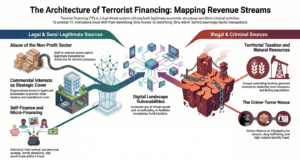
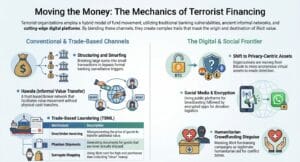
Modern terrorist financing networks use a variety of financial channels to bypass traditional compliance controls. These networks combine informal value transfer systems, digital assets and corporate vehicles to move funds across borders. The key features and challenges are shown as figure below: –
Red Flag Indicators
This section provides a detailed set of red flag indicators divided into transactional, behavioural and technological categories.
Transactional Red Flag Indicators
Transactional indicators focus on identifying anomalies in the flow, structuring and end point of finances. These red flags help to detect the attempts to move assets through front companies or bypass reporting thresholds. Few of the transactional red flags can be, Multiple small transactions consolidated into a master account and transferred abroad, Wire transfers received on behalf of a foreign client with no clear business rationale, Newly incorporated entities (with little to no online presence) transmitting large payments, High-value transfers to free-zone by general trading companies without clear commercial purposes, where Payments not matching the company’s stated line of commercial activity, Financial transactions with no economic link between the parties, Recurring cash deposits into personal accounts followed by transfers to crowdfunding campaign platforms, Frequent deposits of high-value cheques with immediate cash withdrawals or transfers.
Behavioural Red Flag Indicators
Behavioural indicators help identify anomalies in customer interactions, profile discrepancies and unusual patterns of activity. These indicators regularly point to the use of nominees, fronts or coordinated network operations. Few of the behavioural red flags can be, Evasive or secretive customers (about their beneficial ownership, business operations or source of funds), Inconsistency in said occupation or business profile with the volume/ value of account transactions, Sharing of same identity details, Third party transactions, Exclusively request of donations in virtual assets or privacy coins by crowdfunding campaign promoters, Swift closure of an online crowdfunding campaign immediately after meeting its fundraising goals, Hawala transactions where the hawaladar uses different recording methods for specific accounts and Cash transactions at irregular locations.
Technological and Cyber Red Flag Indicators
Technological and cyber indicators leverage digital metadata, blockchain analytics, and system configurations to detect sanctions evasion and network coordination. These flags are key for monitoring virtual asset transactions and digital platform usage.
Aspect
Red Flag Parameters
Account authentication logs
Originating from suspected IP addresses/ sharing device IDs with previously identified actors
Device parameters (time-zone, system language, browser settings)
Indicating a particular country/ location, even after using VPN
Account registration
Email services or phone numbers (with specific country code)
Multiple unrelated payment accounts
Accessing systems from identical IP addresses or device IDs
Digital asset wallet addresses
Associated with known extremist platforms, forums or online propaganda campaigns.
Rapid issue of stablecoins
Foreign entities as overseas trust companies,
Digital asset transactions
Routed through privacy-enhancing technologies as privacy coins like Monero
Transactions involving digital assets
Blockchain analysis shows direct or indirect links to suspected Digital Asset Service Providers (DASPs)
Compliance to Evolving Terror Financing Methods
Transitioning to an Outcomes-Based Compliance Program – The dynamic geopolitical landscape and evolving financing methods necessitates the compliance and security teams to adopt the outcomes-based risk management framework. This requires financial institutions to align their compliance with actual risk rather than sole focus on technical checklist. The threshold needs recalibration to detect the smaller, structured transactions (often for terrorist financing) than over-reliance on high-value money laundering patterns.
Integrating of Forensic Data – Compliance programs should link transactional flows to include IP address locations, device fingerprints and VPN detection. This is important with increased integration of traditional trade and procurement networks with digital network. This is further useful in profiling for detecting sanctions evasion and trade-based financing networks, where transactions may appear legitimate but are linked to designated entities or jurisdictions.
Humanitarian Checkpoints – Financial institutions should have layered due diligence for non-profit organizations operating (NPO) in high-risk areas. This includes auditing the NPO’s local delivery mechanisms, verifying the beneficial ownership and reviewing their internal risk-mitigation measures. This approach allows institutions to support legitimate humanitarian aid.
Response/ Reporting Protocols – The speed of modern financial transactions limits the effectiveness of post-event detection and every indicator of potential terrorist financing should be reviewed on priority.
Conclusion
Countering present day TF requires to overcome legacy based compliance mindset and static rules. Integration of cyber forensics, dynamic detection thresholds for micro-transactions and priority response can help financial institutions to transit from reactive monitoring to proactive safeguarding.
AN official statement said that the “surrender” was facilitated through the coordinated efforts of the District Police, CRPF, BSF, ITBP, Assam Rifles and the Army, and that security forces will continue their efforts to encourage more militants to return to the mainstream. TFM Report In a significant development in Manipur’s ongoing peace process, 46 cadres […]
AN official statement said that the “surrender” was facilitated through the coordinated efforts of the District Police, CRPF, BSF, ITBP, Assam Rifles and the Army, and that security forces will continue their efforts to encourage more militants to return to the mainstream.
TFM Report
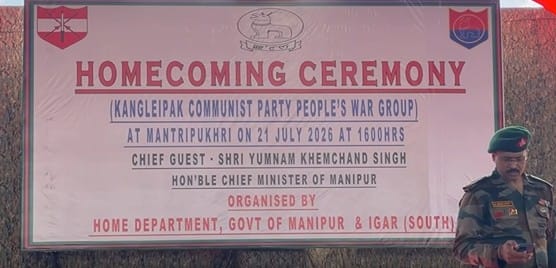
In a significant development in Manipur’s ongoing peace process, 46 cadres of the banned Kangleipak Communist Party–People’s War Group (KCP-PWG) “surrendered” before the state government on Tuesday, laying down 28 firearms along with explosives and ammunition under the Centre’s rehabilitation programme for former militants.
The surrender, as per PIB Defence Wing, took place during a “Homecoming Ceremony” organised by the Manipur Home Department at the Headquarters of the Inspector General Assam Rifles (South) in Mantripukhri, Imphal.
The cadres “surrendered” before Chief Minister Yumnam Khemchand Singh as part of the Revised Scheme for Surrender-cum-Rehabilitation of Militants in the North Eastern States, 2018.
According PIB Defence Wing, the “surrendered” weapons included three AK-series rifles, four AK-56 rifles, one INSAS Ex-Calibur rifle, one Self-Loading Rifle (SLR), one 9 mm carbine, three .303 rifles, one RPG launcher, two 9 mm pistols, one 7.65 mm pistol, two double-barrel guns and nine single-barrel guns.
The cache also included 16 magazines, nine RPG shells, 23 hand grenades, 40 electric detonators, six No. 27 detonators, 300 blasting caps, seven improvised explosive devices (IEDs) weighing around 15 kg, seven communication devices and 342 rounds of ammunition.
Under the rehabilitation scheme, each surrendered cadre will receive a one-time financial assistance of Rs 4 lakh, which will be kept as a fixed deposit for three years. They will also receive a monthly stipend of Rs 6,000 during the rehabilitation period, along with incentives for surrendered weapons. The cadres will stay at a rehabilitation camp for three years and undergo vocational training to facilitate their reintegration into society.
The state government said the surrender was facilitated through coordinated efforts by the Manipur Police, Assam Rifles, Army, CRPF, BSF and ITBP, adding that security forces would continue encouraging more insurgents to return to the mainstream.
Addressing the ceremony, Chief Minister Yumnam Khemchand Singh described the “surrender” as a positive step towards restoring peace in the state and welcomed the cadres’ decision to renounce violence.
He said Manipur had witnessed peaceful coexistence among different communities before the ethnic violence that erupted on May 3, 2023, and noted that the conflict had led to the looting of around 1,200 weapons, worsening the law-and-order situation.
“Gun culture can never build a good society. Violence cannot provide lasting solutions to any problem. Peace, dialogue, mutual trust and cooperation are the only ways to secure a better future for our state,” the Chief Minister said.
He reiterated the government’s commitment to supporting the rehabilitation and reintegration of those returning to the mainstream and commended the efforts of the Manipur Police and central security forces for protecting civilians and displaced persons during the prolonged conflict.
Director General of Police Mukesh Singh said lasting peace in Manipur could not be achieved through security measures alone and stressed the need for public participation, socio-economic development and effective implementation of government initiatives.
The DGP said the rehabilitation policy had been strengthened to encourage more insurgents to surrender and revealed that 851 militants have joined the rehabilitation initiative since its inception, with many already completing the rehabilitation process and returning to normal life.
The surrendered cadres will stay at a rehabilitation camp for three years, where they will undergo vocational training in trades of their choice to help them earn a sustainable livelihood after completing the programme.
The official statement added that the surrender was facilitated through the coordinated efforts of the District Police, CRPF, BSF, ITBP, Assam Rifles and the Army, and that security forces will continue their efforts to encourage more militants to return to the mainstream.
Home Minister Konthoujam Govindas, Chief Secretary Puneet Kumar Goel, Security Advisor Kuldiep Singh, senior police officials, MLAs and officers of the security forces attended the ceremony.
Assigned Gazette No. 317 and dated December 30, 2020, the rules were never formally made available to the public. TFM Report For five years, a legal framework that could regulate Manipur’s burgeoning hemp industry sat buried on government servers, hidden from the very public it was meant to govern. The excuse, there was an IT-based […]
Assigned Gazette No. 317 and dated December 30, 2020, the rules were never formally made available to the public.
TFM Report
For five years, a legal framework that could regulate Manipur’s burgeoning hemp industry sat buried on government servers, hidden from the very public it was meant to govern. The excuse, there was an IT-based technical glitch! Now, as the state prepares to bring the Manipur Narcotic Drugs (Amendment) Rules, 2020 online, an unforeseen controversy of “retrospective legalisation” is threatening to undermine the rule of law.
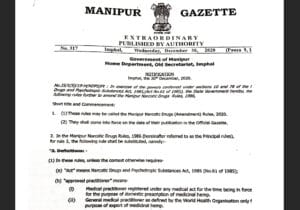
Internal documents and official admissions reveal that the State government drafted rules in December 2020 to regulate the cultivation of industrial and medicinal hemp. Assigned Gazette No. 317 and dated December 30, 2020, the rules were never formally made available to the public. According to a dossier obtained by a vigilant citizen, the administration has admitted the files remained “internal,” existing solely within the printing department’s archives, inaccessible to citizens.
“The mere existence of a rule within internal government servers does not constitute ‘publication,’” the dossier states, citing established Supreme Court jurisprudence. The ‘Back-Dating’ Concern
The core of the current controversy involves the Directorate of Printing and Stationery’s efforts to “reconstruct” missing gazette records. Sources suggest the government is preparing to publish the 2020 amendment with its original timestamp, a move critics describe as an attempt to create a retrospective legal shield for hemp licenses issued between 2020 and 2026.
The legal peril is significant. Under Indian law, specifically the doctrine established in Harla v. State of Rajasthan (1951), delegated legislation only acquires the force of law upon publication in the Official Gazette. A law must be made known to the public to be binding. A secret document cannot impose burdens on citizens or provide a legal basis for administrative actions.
“The law, to bind, must first exist. And to exist, it must be made known in the manner ordained by the legislature,” the Supreme Court reaffirmed in Viraj Impex Pvt. Ltd. v. Union of India, a case cited in the dossier. In the Viraj Impex case, the court explicitly ruled that a notification becomes enforceable only upon its publication in the Official Gazette, rejecting attempts to apply rules retrospectively. A ‘Back-Dated’ Fiction
By publishing the unmodified 2020 rules in 2026 with a 2020 timestamp, authorities risk creating a legal fiction that the rules were always accessible. This would provide a “retrospective legal shield” for licenses issued during years the rules were non-existent in the public domain.
Legal experts argue that any hemp cultivation licenses issued between 2020 and 2026 were, from the start (“ab initio”), lacking a valid legal basis. Any attempt to use a 2020 timestamp to “legalize” these past licenses must be challenged as an attempt to retrospectively shield irregular administrative actions.
The Path Forward: Transparency vs. Cover-Up
The dossier calls for mandatory transparency measures to prevent what it terms a “fraudulent back-dating.” It urges the Directorate to include a clear disclaimer: “This amendment was enacted in 2020 but is being made publicly available for the first time in July 2026.”
Additionally, the Department of Information Technology (DIT), which controls server metadata, faces a formal request to ensure the publication metadata aligns with the actual activation date in the public domain. Critical Vigilance Points:
– Metadata Verification: Immediate checks are required to ensure digital timestamps are not falsified to 2020.
– Challenge to Licensing: Any attempt to use the 2020 date to validate past hemp licenses must be legally challenged as procedurally irregular.
The administration faces a choice: acknowledge the oversight and publish the rules with a current date, or proceed with a retrospective publication that could invite legal challenges and erode public trust. As one source close to the matter put it, “Vigilance regarding the actual date of online publication is the only way to ensure the administration remains accountable and that the rule of law is upheld over retrospective justification.”
Unidentified armed men had allegedly planted three improvised explosive devices (IEDs) on both sides of a bridge along the route. Two of the IEDs exploded as the convoy crossed the area, triggering a coordinated attack involving heavy gunfire from multiple directions. TFM Report Two personnel of the 40 Assam Rifles were killed after armed men […]
Unidentified armed men had allegedly planted three improvised explosive devices (IEDs) on both sides of a bridge along the route. Two of the IEDs exploded as the convoy crossed the area, triggering a coordinated attack involving heavy gunfire from multiple directions.
TFM Report
Two personnel of the 40 Assam Rifles were killed after armed men ambushed a security convoy in Manipur’s Ukhrul district on Monday, officials said.
The deceased have been identified as Warrant Officer Balwant Singh and Rifleman CM Singh, who was driving one of the convoy vehicles. Both hailed from Uttarakhand and succumbed to injuries sustained in the attack. While some officials initially reported the personnel died on the spot, others stated they were administered first aid at the Assam Rifles camp in Shangshak before being evacuated for advanced medical treatment, but later succumbed to their injuries.
According to security officials, the ambush took place around 1:30 PM near Nungshang Kong village, approximately 16-17 km from the district headquarters on National Highway 202, when a convoy of the 40 Assam Rifles was returning to its battalion headquarters at Shangshak from Ukhrul town .
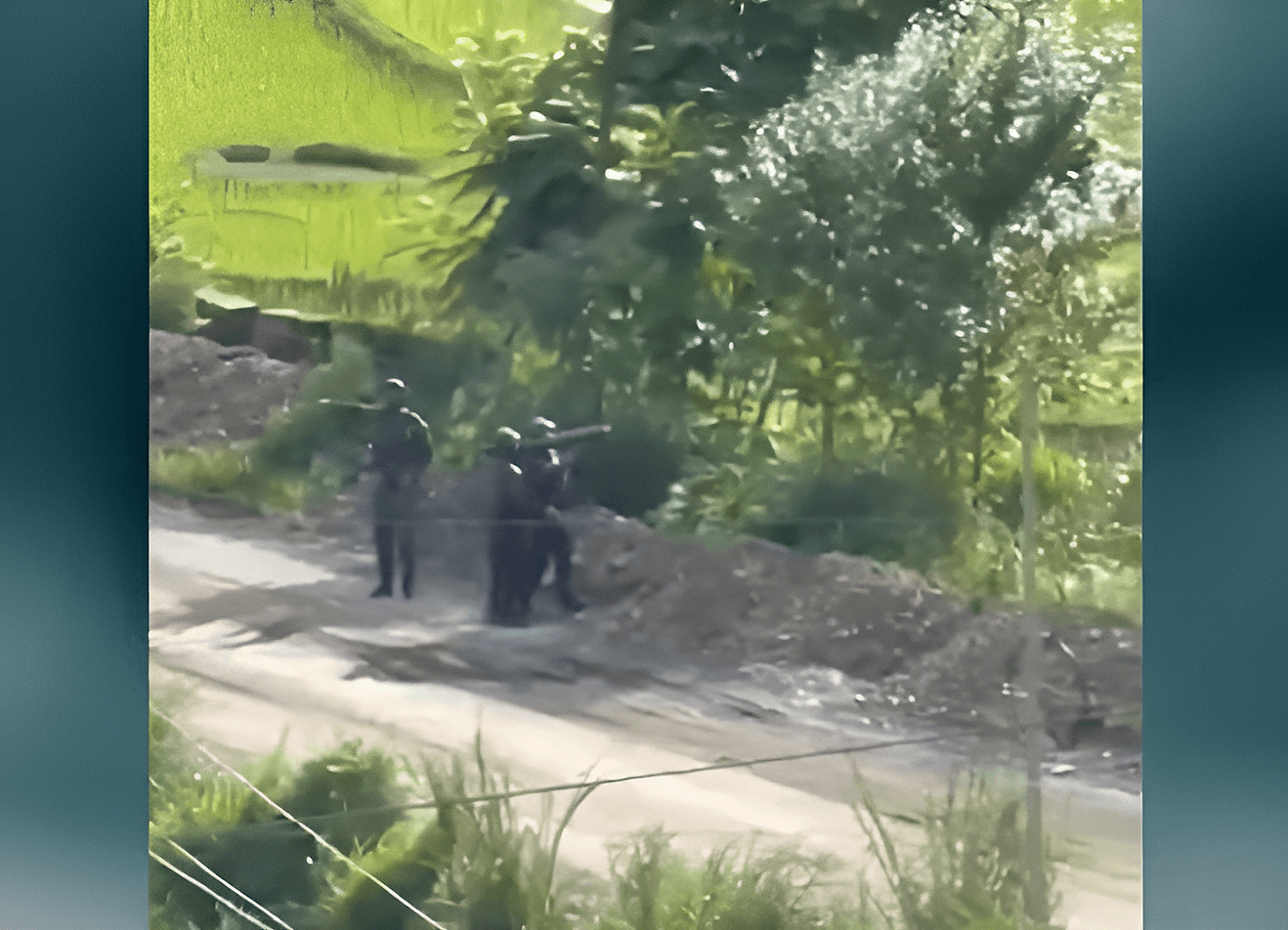
Suspected armed men had allegedly planted three improvised explosive devices (IEDs) on both sides of a bridge along the route. Two of the IEDs exploded as the convoy crossed the area, triggering a coordinated attack involving heavy gunfire from multiple directions.
Security personnel immediately retaliated, resulting in an exchange of fire that reportedly lasted for nearly two hours. Residents of nearby villages reported hearing heavy gunfire and multiple explosions that sent panic through the area.
During a subsequent search operation, security forces recovered one unexploded IED from the site. Additional security personnel have been deployed in the area, and the incident spot has been cordoned off. A forensic team has been dispatched from Imphal to conduct an inspection.
Security forces have launched an extensive search and area-domination operation in the surrounding area to track down those responsible for the attack. According to local villagers, several farmers working in nearby paddy fields at the time of the firing were detained by security forces for interrogation.
Authorities are yet to officially identify the group behind the ambush. However, the National Socialist Council of Nagalim (NSCN-IM), a prominent militant outfit from the Northeast engaged in peace talks with the Centre, issued a statement denying any involvement. The outfit said it “has no connection whatsoever” with those involved and “remains firmly committed to the ceasefire agreement with the Government of India”.
The ambush marks the second major strike on Assam Rifles personnel since the outbreak of the Manipur ethnic conflict in May 2023, following the September 2025 assault in Nambol in Bishnupur district that killed two and injured five other personnel.
Meanwhile, Manipur Governor A.K. Bhalla condemned the incident, stating such attacks “have no place in our society and cannot weaken our collective resolve to uphold peace and security”. Chief Minister Yumnam Khemchand Singh strongly condemned the “heinous and cowardly militant ambush,” asserting the government “will not tolerate such brutal violence and will not remain a mute spectator to these atrocities,” and that those “responsible for the murder will be arrested and punished as per the law of the land”.
State Home Minister Govindas Konthoujam also condemned the attack on security forces, saying, “I am deeply saddened by the unfortunate ambush on the convoy of the 40 Assam Rifles at Nungshang Kong in Ukhrul. Such incidents only disrupt the peace and harmony that we all aspire to uphold. My thoughts and prayers are with the injured personnel, and I wish them a speedy and complete recovery”.
He also expressed confidence that the security forces will take all necessary measures to ensure that those responsible are dealt with strictly in accordance with the law.
The situation in the area remains tense. The ethnic clashes in Manipur first began between the Meitei and Kuki communities in May 2023, leaving at least 260 people dead and displacing 60,000 . Security forces have been conducting search operations and area domination in fringe and vulnerable localities across Manipur since the violence erupted.
Unidentified armed men had allegedly planted three improvised explosive devices (IEDs) on both sides of a bridge along the route. Two of the IEDs exploded as the convoy crossed the area, triggering a coordinated attack involving heavy gunfire from multiple directions. TFM Report Two personnel of the 40 Assam Rifles were killed after armed men […]
Unidentified armed men had allegedly planted three improvised explosive devices (IEDs) on both sides of a bridge along the route. Two of the IEDs exploded as the convoy crossed the area, triggering a coordinated attack involving heavy gunfire from multiple directions.
TFM Report
Two personnel of the 40 Assam Rifles were killed after armed men ambushed a security convoy in Manipur’s Ukhrul district on Monday, officials said.
The deceased have been identified as Warrant Officer Balwant Singh and Rifleman CM Singh, who was driving one of the convoy vehicles. Both hailed from Uttarakhand and succumbed to injuries sustained in the attack. While some officials initially reported the personnel died on the spot, others stated they were administered first aid at the Assam Rifles camp in Shangshak before being evacuated for advanced medical treatment, but later succumbed to their injuries.
According to security officials, the ambush took place around 1:30 PM near Nungshang Kong village, approximately 16-17 km from the district headquarters on National Highway 202, when a convoy of the 40 Assam Rifles was returning to its battalion headquarters at Shangshak from Ukhrul town .
Suspected armed men had allegedly planted three improvised explosive devices (IEDs) on both sides of a bridge along the route. Two of the IEDs exploded as the convoy crossed the area, triggering a coordinated attack involving heavy gunfire from multiple directions.
Security personnel immediately retaliated, resulting in an exchange of fire that reportedly lasted for nearly two hours. Residents of nearby villages reported hearing heavy gunfire and multiple explosions that sent panic through the area.
During a subsequent search operation, security forces recovered one unexploded IED from the site. Additional security personnel have been deployed in the area, and the incident spot has been cordoned off. A forensic team has been dispatched from Imphal to conduct an inspection.
Security forces have launched an extensive search and area-domination operation in the surrounding area to track down those responsible for the attack. According to local villagers, several farmers working in nearby paddy fields at the time of the firing were detained by security forces for interrogation.
Authorities are yet to officially identify the group behind the ambush. However, the National Socialist Council of Nagalim (NSCN-IM), a prominent militant outfit from the Northeast engaged in peace talks with the Centre, issued a statement denying any involvement. The outfit said it “has no connection whatsoever” with those involved and “remains firmly committed to the ceasefire agreement with the Government of India”.
The ambush marks the second major strike on Assam Rifles personnel since the outbreak of the Manipur ethnic conflict in May 2023, following the September 2025 assault in Nambol in Bishnupur district that killed two and injured five other personnel.
Meanwhile, Manipur Governor A.K. Bhalla condemned the incident, stating such attacks “have no place in our society and cannot weaken our collective resolve to uphold peace and security”. Chief Minister Yumnam Khemchand Singh strongly condemned the “heinous and cowardly militant ambush,” asserting the government “will not tolerate such brutal violence and will not remain a mute spectator to these atrocities,” and that those “responsible for the murder will be arrested and punished as per the law of the land”.
State Home Minister Govindas Konthoujam also condemned the attack on security forces, saying, “I am deeply saddened by the unfortunate ambush on the convoy of the 40 Assam Rifles at Nungshang Kong in Ukhrul. Such incidents only disrupt the peace and harmony that we all aspire to uphold. My thoughts and prayers are with the injured personnel, and I wish them a speedy and complete recovery”.
He also expressed confidence that the security forces will take all necessary measures to ensure that those responsible are dealt with strictly in accordance with the law.
The situation in the area remains tense. The ethnic clashes in Manipur first began between the Meitei and Kuki communities in May 2023, leaving at least 260 people dead and displacing 60,000 . Security forces have been conducting search operations and area domination in fringe and vulnerable localities across Manipur since the violence erupted.
“For years, Manipur has held the blueprint for a regulated hemp industry, which is a policy designed to foster innovation while ensuring safety. Yet, this framework remains frozen in administrative limbo. With the government’s current efforts to reconcile and authenticate its official gazette records, there has never been a more opportune moment to bring the […]
“For years, Manipur has held the blueprint for a regulated hemp industry, which is a policy designed to foster innovation while ensuring safety. Yet, this framework remains frozen in administrative limbo. With the government’s current efforts to reconcile and authenticate its official gazette records, there has never been a more opportune moment to bring the Manipur Narcotic Drugs (Amendment) Rules, 2020 out of the shadows. It is time to finalize the notification of Gazette No. 317 and turn a long-awaited policy into a transparent, enforceable law.”
TFM Analysis
Manipur has officially envisioned a sustainable and regulated framework for the medicinal, scientific, and industrial use of hemp. The objective was to create a balanced environment that supports legitimate economic growth and research while maintaining the strict oversight required by law. Yet, despite the Manipur Narcotic Drugs (Amendment) Rules, 2020 (see pic) being drafted and prepared, this framework remains effectively dormant, leaving potential stakeholders in a state of regulatory uncertainty edging on to mystery. The Rules had also escaped public scrutiny.
The Missing Notification
In December 2020, the Government of Manipur prepared a comprehensive set of rules to govern hemp cultivation and manufacturing (Notification No. 35/1(5)/19-H(NDPS)Pt). As evidenced by Gazette No. 317, the document is thorough, outlining clear licensing forms, security protocols for vault storage, and standard operating procedures for handling botanical materials.
However, there is a critical disconnect between policy and practice. The amendment explicitly states that these rules “shall come into force on the date of their publication in the Official Gazette”. To date, this final administrative step, which is a formal notification, has not been fully enacted for public use since 2020. While the state has empowered Excise officials to enforce the NDPS Act, 1985, the legal mechanism to allow the public to apply for regulated cultivation licenses remains inaccessible.
A Path Towards Transparency
The Directorate of Printing & Stationery, Government of Manipur, recently issued a circular regarding the “Reconstruction of Missing Gazettes” (ID-DPS-203/10/2025-DPS-DP&S). In this public notice, the Directorate, led by Director Ng. Roben Singh, invited stakeholders to submit claims, comments, or suggestions to help bridge gaps in government records, emphasizing a commitment to completeness and procedural integrity.
Reliable information indicates that a copy of the 2020 amendment is currently held within the records of the Directorate under Ng. Roben Singh. This presents a unique and timely opportunity for the state to resolve the current impasse. There is a need to urge the Directorate of Printing & Stationery and the Home Department to “do the needful” by ensuring that the Manipur Narcotic Drugs (Amendment) Rules, 2020 (Gazette No. 317) are formally validated, notified, and made accessible to the public.
Legal Clarity and Subsequent Action
By finalizing the notification of these rules, the government can move from a draft framework to a transparent, regulated system. This step would provide the legal clarity that entrepreneurs, researchers, and the public require. The blueprint for a regulated hemp policy is ready. It is high time the authorities finalize this administrative process, thereby allowing Manipur to foster legal industry while upholding the high standard of oversight the law requires.
(Disclaimer: This article is intended for informational purposes and advocates for administrative transparency regarding existing government policy frameworks).
“For years, Manipur has held the blueprint for a regulated hemp industry, which is a policy designed to foster innovation while ensuring safety. Yet, this framework remains frozen in administrative limbo. With the government’s current efforts to reconcile and authenticate its official gazette records, there has never been a more opportune moment to bring the […]
“For years, Manipur has held the blueprint for a regulated hemp industry, which is a policy designed to foster innovation while ensuring safety. Yet, this framework remains frozen in administrative limbo. With the government’s current efforts to reconcile and authenticate its official gazette records, there has never been a more opportune moment to bring the Manipur Narcotic Drugs (Amendment) Rules, 2020 out of the shadows. It is time to finalize the notification of Gazette No. 317 and turn a long-awaited policy into a transparent, enforceable law.”
TFM Analysis
Manipur has officially envisioned a sustainable and regulated framework for the medicinal, scientific, and industrial use of hemp. The objective was to create a balanced environment that supports legitimate economic growth and research while maintaining the strict oversight required by law. Yet, despite the Manipur Narcotic Drugs (Amendment) Rules, 2020 (see pic) being drafted and prepared, this framework remains effectively dormant, leaving potential stakeholders in a state of regulatory uncertainty edging on to mystery. The Rules had also escaped public scrutiny.
The Missing Notification
In December 2020, the Government of Manipur prepared a comprehensive set of rules to govern hemp cultivation and manufacturing (Notification No. 35/1(5)/19-H(NDPS)Pt). As evidenced by Gazette No. 317, the document is thorough, outlining clear licensing forms, security protocols for vault storage, and standard operating procedures for handling botanical materials.
However, there is a critical disconnect between policy and practice. The amendment explicitly states that these rules “shall come into force on the date of their publication in the Official Gazette”. To date, this final administrative step, which is a formal notification, has not been fully enacted for public use since 2020. While the state has empowered Excise officials to enforce the NDPS Act, 1985, the legal mechanism to allow the public to apply for regulated cultivation licenses remains inaccessible.
A Path Towards Transparency
The Directorate of Printing & Stationery, Government of Manipur, recently issued a circular regarding the “Reconstruction of Missing Gazettes” (ID-DPS-203/10/2025-DPS-DP&S). In this public notice, the Directorate, led by Director Ng. Roben Singh, invited stakeholders to submit claims, comments, or suggestions to help bridge gaps in government records, emphasizing a commitment to completeness and procedural integrity.
Reliable information indicates that a copy of the 2020 amendment is currently held within the records of the Directorate under Ng. Roben Singh. This presents a unique and timely opportunity for the state to resolve the current impasse. There is a need to urge the Directorate of Printing & Stationery and the Home Department to “do the needful” by ensuring that the Manipur Narcotic Drugs (Amendment) Rules, 2020 (Gazette No. 317) are formally validated, notified, and made accessible to the public.
Legal Clarity and Subsequent Action
By finalizing the notification of these rules, the government can move from a draft framework to a transparent, regulated system. This step would provide the legal clarity that entrepreneurs, researchers, and the public require. The blueprint for a regulated hemp policy is ready. It is high time the authorities finalize this administrative process, thereby allowing Manipur to foster legal industry while upholding the high standard of oversight the law requires.
(Disclaimer: This article is intended for informational purposes and advocates for administrative transparency regarding existing government policy frameworks).
“For years, Manipur has held the blueprint for a regulated hemp industry, which is a policy designed to foster innovation while ensuring safety. Yet, this framework remains frozen in administrative limbo. With the government’s current efforts to reconcile and authenticate its official gazette records, there has never been a more opportune moment to bring the […]
“For years, Manipur has held the blueprint for a regulated hemp industry, which is a policy designed to foster innovation while ensuring safety. Yet, this framework remains frozen in administrative limbo. With the government’s current efforts to reconcile and authenticate its official gazette records, there has never been a more opportune moment to bring the Manipur Narcotic Drugs (Amendment) Rules, 2020 out of the shadows. It is time to finalize the notification of Gazette No. 317 and turn a long-awaited policy into a transparent, enforceable law.”
TFM Analysis
Manipur has officially envisioned a sustainable and regulated framework for the medicinal, scientific, and industrial use of hemp. The objective was to create a balanced environment that supports legitimate economic growth and research while maintaining the strict oversight required by law. Yet, despite the Manipur Narcotic Drugs (Amendment) Rules, 2020 (see pic) being drafted and prepared, this framework remains effectively dormant, leaving potential stakeholders in a state of regulatory uncertainty edging on to mystery. The Rules had also escaped public scrutiny.
The Missing Notification
In December 2020, the Government of Manipur prepared a comprehensive set of rules to govern hemp cultivation and manufacturing (Notification No. 35/1(5)/19-H(NDPS)Pt). As evidenced by Gazette No. 317, the document is thorough, outlining clear licensing forms, security protocols for vault storage, and standard operating procedures for handling botanical materials.
However, there is a critical disconnect between policy and practice. The amendment explicitly states that these rules “shall come into force on the date of their publication in the Official Gazette”. To date, this final administrative step, which is a formal notification, has not been fully enacted for public use since 2020. While the state has empowered Excise officials to enforce the NDPS Act, 1985, the legal mechanism to allow the public to apply for regulated cultivation licenses remains inaccessible.
A Path Towards Transparency
The Directorate of Printing & Stationery, Government of Manipur, recently issued a circular regarding the “Reconstruction of Missing Gazettes” (ID-DPS-203/10/2025-DPS-DP&S). In this public notice, the Directorate, led by Director Ng. Roben Singh, invited stakeholders to submit claims, comments, or suggestions to help bridge gaps in government records, emphasizing a commitment to completeness and procedural integrity.
Reliable information indicates that a copy of the 2020 amendment is currently held within the records of the Directorate under Ng. Roben Singh. This presents a unique and timely opportunity for the state to resolve the current impasse. There is a need to urge the Directorate of Printing & Stationery and the Home Department to “do the needful” by ensuring that the Manipur Narcotic Drugs (Amendment) Rules, 2020 (Gazette No. 317) are formally validated, notified, and made accessible to the public.
Legal Clarity and Subsequent Action
By finalizing the notification of these rules, the government can move from a draft framework to a transparent, regulated system. This step would provide the legal clarity that entrepreneurs, researchers, and the public require. The blueprint for a regulated hemp policy is ready. It is high time the authorities finalize this administrative process, thereby allowing Manipur to foster legal industry while upholding the high standard of oversight the law requires.
(Disclaimer: This article is intended for informational purposes and advocates for administrative transparency regarding existing government policy frameworks).
For over 41 years, Shija Shija Hospitals & Research Institute Continues to Heal Lives, Shape Future and Strengthen Manipur. By Maibam Romiyo On 3rd July 2026, Shija Hospitals & Research Institute marks a remarkable milestone, 41 years of dedicated service to humanity. More than an anniversary, the occasion offers an opportunity to reflect on a […]
For over 41 years, Shija Shija Hospitals & Research Institute Continues to Heal Lives, Shape Future and Strengthen Manipur.
By Maibam Romiyo
On 3rd July 2026, Shija Hospitals & Research Institute marks a remarkable milestone, 41 years of dedicated service to humanity. More than an anniversary, the occasion offers an opportunity to reflect on a journey that mirrors the aspirations, resilience, challenges, and progress of Manipur itself. From its modest beginnings in 1985, Shija has grown into one of Northeast India’s leading healthcare institutions. Built on a vision of making quality and affordable healthcare accessible closer to home, the institution has evolved into a comprehensive healthcare ecosystem encompassing advanced clinical care, medical education, research, organ transplantation, medical tourism, employment generation, and sustainable healthcare innovation. Over four decades, Shija has transformed the healthcare landscape of the region. Through continuous investments in infrastructure, technology, human resources, and innovation, the institution has become a symbol of healthcare excellence for Manipur and beyond.
Yet the story of Shija extends far beyond hospital walls. One of its most enduring contributions lies in the field of education. Recognizing that the future of healthcare depends upon the quality of its professionals, the institution has invested significantly in nurturing the next generation of doctors, specialists, nurses, and paramedical personnel. This commitment to academic excellence was recently demonstrated by the outstanding performance of the first MBBS batch of Shija Academy of Health Sciences. In the final MBBS examinations conducted by Manipur University, Shija students achieved exceptional results, securing 8 positions among the top 10 rank holders, 15 positions among the top 20, and 35 positions among the top 50 performers. Such achievements reflect not only academic excellence but also the institution’s commitment to producing future healthcare leaders capable of serving the state, the region, and the nation. In addition to MBBS education, Shija has contributed significantly to healthcare workforce development through the training of DrNB specialists, nursing professionals, and paramedical personnel. These efforts have strengthened healthcare delivery systems across the Northeast and beyond while reducing the region’s dependence on external manpower.
The institution’s commitment to excellence is equally reflected in its clinical achievements. Today, Shija stands as one of the pioneers of organ transplantation in Northeast India. As of July 2026, the institute has successfully performed 132 kidney transplants, benefiting patients from Manipur, Tripura, Nagaland, Bihar, and neighboring Myanmar. Significantly, seven of these transplants were performed in Tripura, demonstrating the institution’s growing role as a regional center of excellence in renal science. Equally noteworthy is Shija’s pioneering contribution to the promotion of deceased organ donation. Through sustained public awareness campaigns, community engagement, and professional education initiatives, the institution has helped transform public understanding of organ donation. The successful facilitation of five deceased organ donations has provided renewed hope to numerous patients and families while promoting one of the noblest expressions of human compassion.
The impact of Shija extends beyond healthcare and education. Over the years, the institution has become a significant contributor to the economy of Manipur through employment generation, skill development, and service-sector growth. The hospital directly supports a large workforce comprising doctors, nurses, educators, researchers, administrators, technicians, and support personnel. Its activities also generate substantial indirect employment through hospitality, transport, pharmaceuticals, diagnostics, maintenance services, local vendors, and allied sectors. The institution has further strengthened the state’s economy through its pioneering role in medical tourism. Medical tourism supports hotels, restaurants, transportation services, retailers, and numerous small and medium enterprises that form part of the state’s service economy.
One of Shija’s most significant yet often underappreciated contributions has been its role in reducing the economic outflow associated with healthcare and medical education. For decades, thousands of families from Manipur travelled to metropolitan cities such as Delhi, Kolkata, Chennai, Bengaluru, Guwahati, and Vellore in search of specialized treatment and quality medical education. These journeys imposed enormous financial burdens through travel, accommodation, food, attendant expenses, and loss of income, resulting in a substantial outflow of resources from the state’s economy. By bringing advanced tertiary and quaternary healthcare services closer to home, Shija has enabled patients to receive affordable, high-quality treatment within Manipur itself. Services such as organ transplantation, neurology, neurosurgery, nephrology, Cardiology, urology, critical care, minimally invasive surgeries, and specialized diagnostics have significantly reduced the need for patients to seek treatment outside the state. This has not only improved accessibility and affordability but has also helped retain valuable economic resources within Manipur.
Equally important is the institution’s contribution to medical education. Through Shija Academy of Health Sciences, aspiring doctors and healthcare professionals can now pursue quality medical education within the state rather than relocating elsewhere. This reduces the financial burden on families while ensuring that educational expenditure remains within the local economy. More importantly, it nurtures a skilled healthcare workforce capable of serving Manipur and the Northeast for generations to come. The success of the first MBBS batch demonstrates that excellence in medical education can flourish within Manipur itself. By providing quality education at the doorstep of the people, Shija is helping build a future where talented students no longer need to leave the state to realize their professional aspirations. The institution is therefore not only saving lives but also retaining talent, knowledge, and economic value within Manipur.
Prior to the unfortunate events of 3rd May 2023, Manipur was witnessing encouraging economic progress. The state’s Gross State Domestic Product (GSDP) was projected at approximately ?45,145 crore, with an anticipated growth rate of 21.9 percent. Tourism, healthcare, education, trade, and services were emerging as important pillars of economic growth. Institutions such as Shija were playing a vital role in strengthening these sectors by retaining healthcare and educational expenditure within the state while simultaneously attracting patients and students from beyond its borders.
However, the unfortunate events that unfolded from 3rd May 2023 significantly altered the state’s socio-economic trajectory. The prolonged socio-political unrest and deterioration of the law-and-order situation disrupted normal economic activity, affected business confidence, constrained mobility, and impacted multiple sectors including tourism, healthcare, hospitality, transportation, and trade. Among the most visible consequences was the decline in tourism. Official reports indicate that tourist arrivals, which had exceeded 1.79 lakh visitors annually, declined dramatically to nearly 17,000 visitors during 2024-25, representing a reduction of more than 90 percent. The impact was felt across hotels, transport services, restaurants, travel agencies, handicraft businesses, and countless small enterprises dependent on visitor spending.
Healthcare institutions were similarly affected. Reduced mobility, disruptions in transportation networks, economic uncertainty, and weakened referral systems contributed to declining patient footfall, particularly among patients travelling from distant districts, neighboring states, and international destinations. Healthcare providers increasingly found their service reach confined to a limited geographical catchment area compared to the broader regional footprint they had previously served. At the same time, rising inflation increased the cost of medicines, medical consumables, equipment maintenance, logistics, fuel, electricity, and skilled manpower. Hospitals faced the difficult challenge of balancing financial sustainability while ensuring that healthcare remained affordable and accessible to patients. Despite the economic pressures and operational difficulties of recent years, Shija remained steadfast in its commitment to serving society. The institution continued to provide uninterrupted healthcare services, strengthen medical education, advance research, support organ transplantation programs, and invest in future-ready healthcare solutions.
Today, Shija is looking beyond conventional healthcare delivery towards a more sustainable future. Recognizing the responsibility of healthcare institutions in addressing environmental challenges, the hospital has embraced a vision of developing a Net Zero Healthcare Campus in the years ahead. This commitment to sustainable healthcare innovation recently earned international recognition when the institution received the Sustainable Hospital Design Award from Health & Environment Leadership Platform (H.E.L.P) at an international conference held in Hyderabad on 20th June 2026. The award recognizes Shija’s efforts to integrate environmentally responsible infrastructure, energy-efficient systems, sustainable resource management, and green healthcare practices into its long-term development strategy. The significance of such initiatives extends beyond environmental stewardship. Sustainable healthcare reduces operational costs, improves resource efficiency, strengthens long-term resilience, and creates a model for responsible institutional growth. It demonstrates how healthcare institutions can simultaneously serve patients, protect the environment, and contribute to economic sustainability.
In many ways, Shija’s journey mirrors the spirit of Manipur itself, a story of perseverance, courage, innovation, and hope. Through periods of growth and through times of uncertainty, the institution has remained committed to its founding mission of serving humanity with compassion, excellence, and integrity. As Shija Hospitals & Research Institute enters its fifth decade of service, it does so with gratitude for the trust placed in it by generations of patients, students, healthcare professionals, and communities. More importantly, it looks ahead with renewed determination to continue healing lives, advancing education, generating opportunities, driving innovation, protecting the environment, and contributing to the progress of Manipur and the nation.
Forty-one years after its founding, Shija stands not merely as a hospital, but as a symbol of resilience, self-reliance, and possibly a reminder that institutions built on vision, service, and purpose can illuminate the path forward even in the most challenging times. By healing lives, educating future generations, retaining economic value within the state, and attracting people from beyond its borders, Shija continues to strengthen the social and economic foundations of Manipur.
(Maibam Romiyo is Asst.Manager, Public Relations Department, Shija Hospitals & Research Institute and Member, Public Relations Society of India & Indian Communication Congress)
Criticism and intellectual debate are essential components of any democratic society, yet criticism alone cannot become a substitute for action. By Yaiphaba Khumanthem In the past few days, some scholars in Manipur have been circulating articles that appear […]
Criticism and intellectual debate are essential components of any democratic society, yet criticism alone cannot become a substitute for action.
By Yaiphaba Khumanthem
In the past few days, some scholars in Manipur have been circulating articles that appear to project themselves as the sole saviors of the masses and the only ones capable of making a critical analysis of the issues and challenges facing the state. However, their writings often reflect an “all-knowing attitude” and a certain intellectual stubbornness.
These scholars frequently fail to acknowledge any argument that does not align with their own line of thought. For them, those who disagree are labeled opportunists, while those who attempt to explore alternative ways of addressing the problems are dismissed as irrational, power-hungry elites attempting to mislead the masses and the youth.
In recent months, the debate around the emergence of a strong regional political force capable of carrying the voice of the people has resurfaced. This revival is largely due to two important reasons: first, the perceived inability of political leadership of the state to act independently of central leadership; and second, the growing need to expand political space within the federal structure of the Indian state.
In this context, academia, activists, and retired bureaucrats have come forward to initiate a discussion on the need for a strong regional party that can properly represent the people of the state. This marks the first time since the 1970s that such groups have collectively reignited an academic and political debate on regionalism in this manner.
These same scholars, however, often critique this development by arguing that academia, activists, and retired bureaucrats represent an elite section of a particular community attempting to revive regional or electoral politics despite its repeated failures, ultimately seeking formal political influence. Another argument they advance is that this group lacks popular support and that there is no genuine mass demand for a regional party. While this may appear reasonable on the surface, it often lacks deeper understanding of the prevailing situation in Manipur.
Firstly, it is widely understood that it is politically risky, even politically suicidal, to openly oppose the ruling establishment at the centre, and its proxies in the state, in the present context, where dominant political forces are perceived to suppress dissenting voices. Secondly, the concern of these individuals who are now engaged in regional politics is not merely academic debate but also to engage and respond to the existing political structure in a more direct and meaningful way.
Moreover, even in a scenario where a regional party comes to power, critics argue that such groups would not necessarily gain political spoils or economic benefits, as seen in other states governed by regional parties. In order to participate in formal politics, it is often suggested that one must either align with the ideology of the ruling national party or negotiate within its framework. So, there is nothing much one can gain by advancing regional party politics. Hence, it will be wrong to say that an elite section of Manipur will amass significant political power through regional party politics in the state even if their party comes to power magically. Even if they do so, will it not be tactically useful for the larger struggle for the identity and future of the state? In this context, one must understand that nuances of the strategy and tactics involved in the struggle of Manipur.
In their enthusiasm to present themselves as the conscious voice of the working class, these scholars often fail to seriously examine why regional political parties have historically failed. They provide multiple explanations, but often overlook the structural pressures exerted by the central leadership of the national parties, particularly during the 1970s, 1980s, and 1990s, when regional parties were significantly constrained. The situation, however, has changed considerably in the post-2000 era, marking a new political phase.
Another argument they make is that this group lacks public support and that there is no mass demand for a regional party. This claim also appears to be superficial, as it does not adequately engage with the ground realities or the subjective and objective conditions that have emerged in recent months.
While they do advise youth engaged in electoral politics to understand that electoral participation is not the ultimate goal, this criticism remains incomplete without offering any viable alternative. For many years, such scholars have focused primarily on dissecting problems and movements without presenting concrete solutions. Their analyses of social and political movements may be insightful, but they often avoid the fundamental question: what is the actual outcome of these movements, and have they truly benefited the masses? If not, and if the problem is structural in nature, then why is there no attempt to explore alternative approaches to address it? No one is suggesting a compromise of core principles—especially the welfare of the masses—but there is a need for constructive direction.
Instead of doing nothing, something must be done. Endless theoretical debates, without practical engagement, cannot be a solution. Whether any experiment succeeds or fails depends on the effort and energy invested. However, continuously discussing problems without attempting to address them risks creating a sense of intellectual stagnation.
Scholars and academics must also acknowledge that we are no longer in the Cold War era, and the world has moved on. If the entire argument rests on the claim that problems are purely structural and therefore have no solutions, then it ceases to be a meaningful debate. Every problem must, in principle, have a potential solution. Within Marxist thought as well, Antonio Gramsci supports the idea of engaging with parliamentary processes as a means of capturing power, unlike certain other Marxist traditions.
The question before Manipur today is not whether every proposed solution is perfect, but whether society is willing to engage in meaningful efforts to address its challenges. Criticism and intellectual debate are essential components of any democratic society, yet criticism alone cannot become a substitute for action. If individuals, academics, activists, and concerned citizens are attempting to explore new political possibilities through democratic means, their efforts should be evaluated on the basis of their outcomes and intentions rather than dismissed outright. Political experiments may succeed or fail, but the willingness to engage with the realities of the people remains a necessary step toward change.
Ultimately, the responsibility of scholars is not only to identify contradictions and expose structural limitations but also to contribute constructively to the search for solutions. The masses do not benefit from endless theoretical disputes detached from practical realities. As circumstances evolve, political strategies must also adapt to changing conditions. The future of Manipur will depend not on who can offer the sharpest critique, but on who can bridge ideas with action and transform public aspirations into meaningful political and social progress. Lastly, these scholars remind us of the phrase ‘infantile disorder,’ a childishness of thought and practice, which Lenin uses to describe young scholars who refuses to grow up to understand that we do not need to oppose parliamentary politics every time.
(Yaiphaba Khumanthem is a PhD Scholar at DMU, Manipur)
A faction of Naga leaders appears to have hardened its stance on the ‘struggle’ for the Naga political movement while maintaining its resolve on the Naga-Kuki issue. TFM Report On June 16, 2026, a document emerged from the Northeastern hills that would send shockwaves through the corridors of power in both New Delhi and the […]
A faction of Naga leaders appears to have hardened its stance on the ‘struggle’ for the Naga political movement while maintaining its resolve on the Naga-Kuki issue.
TFM Report
On June 16, 2026, a document emerged from the Northeastern hills that would send shockwaves through the corridors of power in both New Delhi and the Naga armed resistance strongholds. The “Eastern Flank Statement” was not merely another political communiqué—it was a declaration of well-articulated tirade against what its leaders saw as the surrender of their hard-won principles.
The statement, purportedly issued by Hs. Ramsan, A. Raman, Ikato I. Chishi Swu (Executive Member, Steering Committee), Victor Angami (Member of Collective Leadership) and Angyo Jacob Tangshang, began with a tone of weary defiance: “We have, time and again, written letters and issued clarifications to the government, the party, and the Naga public at large. We have always kept the door open for reconciliation and unity.” But the door, they made clear, had been slammed shut by forces they could no longer ignore.
Hanshi Ramsan
The signatories traced their lineage back to the very foundations of “Naga nationalism”—to “the submission of a memorandum to the Simon Commission on 10th January, 1929 by the Naga Club, demanding that the Nagas be left alone to decide their own future.” This was not a casual reaction; it was the latest chapter in a struggle that had defined their people for nearly a century.
Alleged Betrayal of the Framework Agreement
At the heart of the conflict stood the Framework Agreement (FA) signed on August 3, 2015—a document that had once promised hope for the future of the Nagas. Under the leadership of late Chairman Isak Chishi Swu and General Secretary Th. Muivah, the agreement had represented the culmination of decades of struggle.
But hope, the Eastern Flank argued, had curdled into compromise. “Since the signing of the FA, the GoI has effectively backtracked and betrayed the Agreement,” the statement declared with bitter finality. The “betrayal became concrete” when, in August 2019, the Government of India delivered a three-month ultimatum: abandon demands for a separate flag and constitution, or face the end of all negotiations, says the statement.
The Eastern Flank saw this as a moment of reckoning. Rather than capitulate, they moved to strengthen their military position. On September 3, 2019, a new Standard of Operation created the Eastern Flank itself—a strategic move to “establish our base in the East across the present artificial Indo-Myanmar border.” But what followed would fracture the Naga movement from within.
Brothers Turned Enemies
Just one month after the Eastern Flank’s creation, the unity of the “Naga Army” shattered. The then Longvibu, Anthony Ningkhan Shimray, supposedly issued an order that superseded the new arrangements, effectively “dismantling the strengthening of the Naga Army, the backbone of the Naga political movement”, claims the statement.
The Eastern Flank described a nightmare of internal betrayal. They recounted how Anthony Ningkhan Shimray “sent the then Brig. Alen Siro to Homalin to surround and annihilate us in coordination with our adversaries.” For more than forty days, they kept Brigadier Siro with them, “trying our best to reason with him against such treacherous activity and refraining from shedding the blood of our own Naga brothers.”
He refused to listen. When a Peace Mission Team visited Brigadier Sorei at Homalin Camp, he reportedly “openly stated that he was ordered by the then Longvibu and Brig. Alen Siro to shoot at the cadres of the Eastern Flank.” The bloodshed that would follow was, in their view, a foregone conclusion.
The Eastern Flank’s greatest grievance, however, was political rather than military. They detailed how a peace proposal drafted on December 7, 2019 had qualified the Naga national identity through deliberate euphemisms—”the government of India is not in a position to recognize it,” “respecting the will of the Naga people and prevailing sentiments.”
To the Eastern Flank, these were not words of compromise but of surrender. Hs. Ramsan and others wrote an urgent letter objecting to these formulations. Their stand forced a correction: “flag and constitution would be settled through political decision, without which there can be no honorable solution.”
But words, they discovered, were hollow. “Despite this official correction, the deeds of some of our authorities suggested otherwise.” The leadership continued its “meaningless talks for more than ten years after the signing of the FA”, says the Eastern Flank statement.
Terminations, Revocations, and Reinstatements
What followed was a systematic removal of those who dared to speak principle over pragmatism. The statement details a series of terminations, revocations, and reinstatements that read like a bureaucratic tragedy:
Hs. Ramsan was *”wrongly terminated on 12th July 2023 through false accusations” and later “given pardon at will”—only to be terminated again on July 18, 2024, this time “under false accusations of anti-national activities, branding them as anti-nationals”, says the statement.
The Eastern Flank claimed that those who had raised their voices against compromise were “systematically purged”. Meanwhile, those who had ordered attacks on fellow Naga cadres remained in power, says the statement.
The Eastern Flank’s response was defiant: “Rejecting this injustice, the national workers and senior officers of the Naga Army in the East resolved on 10th August 2024 to remain under the leadership of Lieut. Gen. Retd. Hs. Ramsan-VC.”
A New Coalition of Resistance
By March 2026, the Eastern Flank had found unexpected allies. “Mr. Ikato I. Chishi Swu, Executive Member Steering Committee and Mr. Victor Angami, Member of Collective Leadership and their entourage have taken the right decision to join hands with us to save the nation from another surrender,” claimed the statement.
The alliance was born not of ambition but of shared outrage. Both sides had watched helplessly as the Hebron leadership allegedly “failed to take concrete steps to save the nation” and continued negotiations that had become “meaningless, endless talks with the GoI.”
The Hongbei Massacre: Brotherhood Betrayed
Then came the trigger—the event that, for the Eastern Flank, proved beyond doubt that the Hebron leadership had allegedly become an instrument of their “adversaries”.
On March 28, 2026, four Naga cadres were killed at Hongbei Village, “even while a Peace Mission was still in process.” The dead were not enemies. They were brothers, says the statement. “At the time when the GoI is using the Kukis as a proxy to wage war against us to suppress the Naga political issue, and to create a Kuki Homeland within Nagalim,” the statement explains, “our cadres were sent to work in unison with the cadres of Ghq/Hebron.”
The Eastern Flank’s cadres met their counterparts stationed at Hongbei. They talked. They agreed on uniting against their common enemy. They exchanged pleasantries. And then some authorities chose betrayal, asserted the Eastern Flank. “They directed the cadres to shoot one’s own brother,” the statement reads. Two cadres survived “through divine intervention,” exposing “the secret evil intentions, and plans of some of the authorities of the Hebron/Ghq.”
The massacre was not just murder—it was proof, says the Eastern Flank. “Killing the force that stands for the Nagas is a clear indication of a force working in alignment with the policy of our adversaries.”
Response of the CSOs; Naga-Kuki Issue
In response, the Tangkhul Naga Long and other civil society organisations issued a non-cooperation directive against the Wung-Tangkhul Region, demanding justice. The Eastern Flank fully supported this: “Any attempt to revoke the non-cooperation against the WTR (NSCN/GPRN) before justice is served will be an abatement to create bigger problems among us.”
Their stance on the Kuki issue remained absolute: “There can be no peace and no compromise if the Kukis insist on creating a Kuki Homeland within Nagalim.”
The Eastern Flank’s disagreement with the Hebron leadership, they insisted, was not personal but principled. They pointed to specific clauses in the proposed competencies that represented, in their view, a betrayal of the Framework Agreement:
-“Competency serial no. 4(c) states that Nagas will send Lok Sabha and Rajya Sabha members to the Parliament of India.”
-“The Naga Constitution/Yeahzabo is to be inserted in the Constitution of India as a separate chapter.”
– “The Election Commission of the Tatar Hoho shall function in conjunction with the Election Commission of India.”
– “The oath of office of Midan Kilonser and all Kilonsers of the NRTC shall be administered by the Governor of the State concerned.”
These provisions, the Eastern Flank argued, did not represent an honourable solution but a “surrender dressed in diplomatic clothing”. “After more than 70 years of struggle and the sacrifice of thousands of lives for our beloved Nagalim, can we now compromise our right to sovereign existence as a nation on account of the difficulties and position of the GoI?” they demanded.
A Rallying Cry
The statement concludes with a rallying cry—not just to armed cadres and politicians, but to all Nagas: “We appeal to all Nagas and national workers to rise up for the God-given rights of the Nagas. God Almighty is using the Nagas to build up according to His divine purpose. Therefore, let us abandon the spirit of doubt and timidity. Woe to those who doubt the faithfulness of God,” said the Eastern Flank. And with the traditional battle cry that has echoed through Naga history—”Kuknalim!”—the Eastern Flank made their position unmistakably clear.
As June 2026 draws to a close, the Naga movement stands at a crossroads. The Eastern Flank has drawn a line in the sand, invoking the spirit of the 1929 memorandum, the 1947 declaration of independence, and the 1951 plebiscite. They have rejected what they see as compromise and embraced what they believe to be principle.
Whether the Hebron leadership can bridge this chasm remains uncertain. The Government of India watches, waiting. The Naga-Kuki issue smolders. And Naga wait to see which path they will take.
One thing is clear: the struggle for “Nagalim” is far from over. And the Eastern Flank has made it known that, in their view, any solution that falls short of the Framework Agreement’s principles is no solution at all.
“We will stand our ground to seek an honourable and acceptable solution based on the principle of the FA that was signed under the leadership of our Chairman, late Mr. Isak Chishi Swu and General Secretary Mr. Th. Muivah.”
“He Said He Loved Me Like a Son”: Former KV Student Alleges Years of Sexual Abuse by Headmaster who has been granted bail in connection with a POCSO Case TFM Investigative Report A former student of Kendriya Vidyalaya No. 1, Lamphelpat, has come forward with allegations of repeated sexual abuse spanning several years, naming the […]
“He Said He Loved Me Like a Son”: Former KV Student Alleges Years of Sexual Abuse by Headmaster who has been granted bail in connection with a POCSO Case
TFM Investigative Report
A former student of Kendriya Vidyalaya No. 1, Lamphelpat, has come forward with allegations of repeated sexual abuse spanning several years, naming the school’s headmaster, as the perpetrator. The revelation comes just days after a special POCSO court in Imphal West granted the headmaster interim anticipatory bail in connection with a related FIR.
The allegations detail a pattern of abuse that began when the survivor, now a young adult, was a student at the school between 2006 and 2016. The abuse reportedly occurred on multiple occasions during Class 6 (2012-13) and again in Class 9 (2014-15). The survivor, who has chosen to remain anonymous due to the sensitive nature of the case, has provided a harrowing account of the trauma inflicted.
A Trust Betrayed
The survivor recalls first being drawn to the headmaster’s room as a child, describing how the headmaster would “play” with him. Vulnerable and seeking affection, the survivor explains that his real father was abusive and a drunkard. “At that time, I had already experienced similar things before and I thought it was ‘normal,’ especially when he said he loved me like his son, and that triggered a sense of wanting affection,” the survivor stated.
The abuse escalated to a sexual assault when the headmaster allegedly performed a sexual act on him. “I was shocked, confused, aroused, and taken away during the moment,” the survivor recounted. He was then coerced into reciprocating the act, which he did because, at the time, he believed it was “normal.”
The Encounter That Changed Everything
The survivor stopped seeing the headmaster for a while after his class shifted to a different area. However, a fateful encounter in 2014-15 at the school brought the abuse back. While waiting for a pickup after school hours, the headmaster allegedly took him to the CCA room. “I thought he was just going to play with me again, but he… asked me to do the same,” the survivor said.
A few days later, another incident occurred at the primary boys’ toilet. The survivor, who was deeply depressed and contemplating suicide, felt a confusing sense of exhilaration and sought the feeling again. “I wanted to feel it again, as I was deeply depressed during that period of time, with suicide on my mind,” he confessed.
The abuse then escalated further. “Upon him asking me repeatedly, I gave in. I didn’t know why I agreed, but he stopped when I said it hurts,” the survivor said. “Whatever experience I have narrated is true to the best of my knowledge and I would like to remain anonymous.”
The School and the Accused
The then headmaster at KV No. 1, Imphal: According to a provisional seniority list from Kendriya Vidyalaya Sangathan, the headmaster holds a BA (Hons), MA, and B.Ed and joined the service on July 30, 2013 . He recently addressed the media during the school’s diamond jubilee celebration in December 2024, speaking of the institution’s commitment to societal betterment . He is also reportedly a member of a school committee that dealt with a 2025 altercation between Class XI and XII students .
Court Grants Interim Bail
An FIR was registered at Lamphel Police Station on June 9, 2026, under Section 8 of the POCSO Act, 2012, which deals with sexual assault and carries a maximum punishment of five years. In court, the headmaster’s counsel argued that he had been “falsely implicated” and that the allegations might be a “fallout” of the student incident from 2025 .
Granting him ad-interim bail on June 9, the court noted that “the apprehension felt by the petitioner has a reasonable basis.” He was released on a PR bond of Rs. 1,00,000 with conditions that he must cooperate with the investigation, not influence witnesses, and not leave the state without permission .
The court has called for a bail objection report from the Officer-in-Charge of Lamphel Police Station, returnable by Wednesday, June17, 2026, and has fixed the next hearing for that date.
Outrage and Questions
The allegations have sent shock-waves through the community, raising serious questions about the safety and well-being of children in one of Manipur’s premier educational institutions. The survivor’s detailed account, spanning years of abuse and manipulation, stands in stark contrast to the headmaster’s public persona as a leader dedicated to creating a “positive future” for his students.
This case also highlights the profound and often hidden struggle of child sexual abuse survivors who may not comprehend the nature of the abuse until years later, and whose vulnerability is often exploited by perpetrators in positions of trust. The next court hearing is expected to draw significant attention as the investigation unfolds.
PREPAK (Progressive) accused local Members of the Legislative Assembly (MLAs) of being New Delhi’s “proxy leaders,” alleging that after winning elections, they fail to hold meaningful discussions with local communities and prioritise attending religious rituals and public functions over governance. TFM Desk On the 16th Progressive Day of the proscribed PREPAK (Progressive) on June 1, […]
PREPAK (Progressive) accused local Members of the Legislative Assembly (MLAs) of being New Delhi’s “proxy leaders,” alleging that after winning elections, they fail to hold meaningful discussions with local communities and prioritise attending religious rituals and public functions over governance.
TFM Desk
On the 16th Progressive Day of the proscribed PREPAK (Progressive) on June 1, its chairman, Longjam Paliba M, issued a strongly worded statement alleging that India has lost its credibility as a “Vishwa Guru” and has instead become a “Vishwa Joker.”
In the press release, the proscribed group accused India’s electoral system of being fundamentally flawed, claiming that elections in Manipur resemble an “auction market” where votes are effectively sold to the highest bidder. The statement further alleged that the Election Commission of India (ECI) and those who handle Electronic Voting Machines (EVMs) “decide everything,” rendering voters powerless.
The organisation also accused local Members of the Legislative Assembly (MLAs) of being New Delhi’s “proxy leaders,” alleging that after winning elections, they fail to hold meaningful discussions with local communities and prioritise attending religious rituals and public functions over governance. “People now felt that the emancipation from these India’s proxy leaders is initially necessary so as to decolonise from India,” the statement read.
PREPAK (Progressive) further alleged that Manipur’s natural resources and land — constituting 90% of the state — have been “wrongfully handed over to anti-Meitei communities” through what it called a “colonial” pre-planned law. The group also accused certain MLAs of being indifferent to violence, including the killing of two minors in Tronglaobi and the violence in Ukhrul and Kamjong districts, claiming that such incidents are “quickly forgotten after sipping a peg of liquor.”
In a highly charged section, the proscribed organisation alleged that New Delhi has refused to condemn Israel’s actions in Palestine, while also accusing the Kuki community — referred to derogatorily as “Narco-terrorists” and “the lost tribe of Israel” — of committing massacres against indigenous communities. The statement claimed that a US-Israel-led global hegemon is pursuing a “New World Order” through religious zeal, and alleged that India is following the ancient Mandala Game Theory of Chanakya, which it said would “ultimately wipe out Manipur”.
The press release concluded with a call for the youth to consolidate their energy to “save Eema leipak Manipur” and to recognise that New Delhi’s strategic aim is to end Meitei insurgency by purging the indigenous community.
“The act of procuring public employment through impersonation and fraudulent identity constitutes forgery for the purpose of cheating… and creation of unlawful entitlement to a government post,” the police report states. Investigators also suspect the involvement of an “organized network/racket,” given the nature of the impersonation in a national-level examination. TFM Report In a startling case […]
“The act of procuring public employment through impersonation and fraudulent identity constitutes forgery for the purpose of cheating… and creation of unlawful entitlement to a government post,” the police report states. Investigators also suspect the involvement of an “organized network/racket,” given the nature of the impersonation in a national-level examination.
TFM Report
In a startling case of examination fraud that has sent shockwaves through India’s premier medical recruitment system, a government employee at the Regional Institute of Medical Sciences (RIMS), Imphal, has been arrested after official biometric verification revealed that the fingerprints and facial data of the person who took the entrance exam did not match his own.
Based on the police remand application filed before the Chief Judicial Magistrate, Imphal West, on May 11, 2026, the accused, identified as Jitendra Meena (30), a native of Karauli district in Rajasthan, was serving as a Multi-Tasking Staff (MTS) at RIMS, Imphal, based on his selection in the Common Recruitment Examination (CRE)-2024 conducted by the All India Institute of Medical Sciences (AIIMS), New Delhi.
However, an investigation by Lamphel Police Station has uncovered that Meena never actually appeared for the exam. Instead, an unknown impersonator sat for the test on his behalf, using fraudulent means to secure a government job.
Scientific Evidence Proves Impersonation
According to the official Biometric Verification Report issued by AIIMS and authenticated by agencies TCS and Innovatiview, neither Meena’s fingerprints nor his facial biometrics matched the data captured during the CRE-2024 examination.
“The certified biometric records clearly and unequivocally establish that both the fingerprint as well as facial biometric data of the accused do not match with the biometric data captured during the examination process,” states the police investigation report.
Investigators further noted that the facial appearance, physical structure, and identifiable features of the person who actually wrote the exam are “materially different” from those of the present accused.
Accused’s Explanation Dismissed as ‘Baseless’
During sustained interrogation, Meena allegedly claimed that the mismatch was due to a “finger skin problem” or possible “malfunctioning of biometric devices.” Police have dismissed this as an “untenable and misleading explanation,” noting that the exam was conducted under strict AIIMS supervision using scientifically validated systems.
Adding to the prosecution’s case, investigators revealed that when asked to read and translate simple alphabetic sentences and basic written content during custody, Meena “failed to do so satisfactorily” and could not demonstrate even the minimum comprehension expected of a candidate who qualified in a competitive national-level exam.
Charges: Cheating, Forgery, Conspiracy
Police have formally added charges under Sections 336, 338, 340, and 61(2) of the Bharatiya Nyaya Sanhita (BNS), 2023 — covering cheating, forgery for the purpose of cheating, use of forged documents as genuine, and criminal conspiracy.
The investigation has revealed that Meena not only secured selection through impersonation but also used fraudulently obtained documents — including the application form, admit card, result notification, appointment order, and joining papers — as genuine to obtain a public post with pecuniary benefits.
“The act of procuring public employment through impersonation and fraudulent identity constitutes forgery for the purpose of cheating… and creation of unlawful entitlement to a government post,” the police report states.
Investigators also suspect the involvement of an “organized network/racket,” given the nature of the impersonation in a national-level examination.
Judicial Custody Sought
Police have requested 15 days of judicial custody for Meena (from May 11 to May 25, 2026) to complete ongoing investigations, including:
– Collection of original biometric records,
– Forensic comparison of biometric data,
– Examination of AIIMS/TCS/Innovatiview officials,
– Identification of the actual impersonator, and
– Unearthing the wider conspiracy.
The investigating officer, SI S. Chandrikishor Singh of Lamphel Police Station, submitted before the court that the accused has been “deliberately concealing material facts, furnishing false and unreasonable explanations, and attempting to obstruct the progress of investigation.”
The case remains under active investigation, with authorities now probing whether similar impersonations have occurred in other recruitment examinations conducted by AIIMS and other central institutions.
Zeliangrong United Front (ZUF) has issued a press release denying any involvement in the ambush. United Naga Council (UNC) issued a strong condemnation of the attack and expressed concerns over reports that some Nagas from Konsakhul village had allegedly been held hostage by villagers from Leilon Vaiphei following the ambush. TFM Report A deadly ambush […]
Zeliangrong United Front (ZUF) has issued a press release denying any involvement in the ambush. United Naga Council (UNC) issued a strong condemnation of the attack and expressed concerns over reports that some Nagas from Konsakhul village had allegedly been held hostage by villagers from Leilon Vaiphei following the ambush.
TFM Report
A deadly ambush targeting church leaders of the Thadou Baptist Association (TBA) has sent shockwaves across Manipur after several prominent Christian leaders were attacked between Kotzim and Kotlen villages in Kangpokpi district on Tuesday.
According to sources, the church leaders were returning to Kangpokpi from Churachandpur after attending a TBA conference when armed assailants allegedly ambushed their convoy midway. The victims were traveling in two vehicles at the time of the attack.
Among those killed in the ambush was Rev. V. Sitlhou, former General Secretary of the Manipur Baptist Convention (MBC), Pastor Paogoulen, and Pastor Kaigoulun. The killings have triggered widespread grief and outrage among many organisations.
As per sources, others who sustained injuries in the incident include Rev. S.M. Haopu, Rev. Hekai Simte, Rev. Paothang, Lelen (driver), and Goumang (driver). It is stated that some of the injured were rushed for medical treatment as authorities began assessing the scale of the attack.
The ambush has sparked fresh tensions in the already volatile hill districts of Manipur, where ethnic and armed conflicts have continued to destabilise normal life.
UNC Condemns “Outrageous Ambush”
The United Naga Council (UNC) issued a strong condemnation of the attack through an official press release dated May 13, 2026. The organization described the ambush as an “outrageous” act and stated that three persons had been killed while five others were grievously injured according to available reports.
The UNC specifically mentioned that the incident occurred between Kotzin and Kotlen while the church leaders were returning from Churachandpur. The council expressed deep condolences to the bereaved families and prayed for strength and peace during the period of mourning.
The statement also highlighted concerns over reports that around 20 Nagas from Konsakhul village had allegedly been held hostage by villagers from Leilon Vaiphei following the ambush. Calling such actions unacceptable, the UNC urged the immediate and unconditional release of the hostages and appealed to all communities, church leaders, and civil society organizations to work together to prevent further escalation of violence and restore communal harmony.
ZUF Denies Involvement
Meanwhile, the Zeliangrong United Front (ZUF) issued a press release denying any involvement in the ambush. The statement, released by the organization’s Ministry of Information and Publicity from its Dilung headquarters, said the group had learned of the attack “with deep shock and concern.”
The organization categorically rejected allegations circulating on social media and in certain public circles linking the ZUF to the incident. According to the statement, the allegations were “baseless, unfounded and misleading,” and the organization claimed it was neither aware of nor connected to the attack in any manner.
The ZUF further appealed to civil society groups and media organizations not to spread unverified information or make premature accusations without factual evidence, warning that misinformation could further inflame the already sensitive situation in the state.
Fear and Uncertainty Grip Region
The brutal nature of the ambush, reportedly targeting unarmed church leaders returning from a religious gathering, has generated fear and uncertainty across the hill region. Images circulating after the incident showed damaged vehicles and critically injured victims, underscoring the severity of the attack.
Security agencies are expected to launch a detailed investigation into the incident. However, no official statement had yet been issued by the state government or law enforcement authorities regarding the identity of the attackers or the exact casualty figures till the filing of this report.
The incident is likely to deepen concerns over the deteriorating security situation in the hill districts, where armed activity, ethnic distrust, and retaliatory violence continue to threaten civilian lives.
Church organizations, tribal bodies, and civil society groups are expected to hold emergency consultations in the coming days as calls grow louder for justice, accountability, and restoration of peace in the conflict-affected areas of Manipur.
Trends collectively suggest that TF risk is becoming more diffuse, networked and embedded in legitimate global flows, requiring intelligence?driven, multi?sectoral responses rather than reliance on static typology checklists. By Lt Col Ujjual Abhishek Jha, Retd Comprehending Terrorist Financing (TF) origins requires an analytical thinking beyond conventional Anti-Money Laundering (AML) framework. Money Laundering (ML) is circular […]
Trends collectively suggest that TF risk is becoming more diffuse, networked and embedded in legitimate global flows, requiring intelligence?driven, multi?sectoral responses rather than reliance on static typology checklists.
By Lt Col Ujjual Abhishek Jha, Retd
Comprehending Terrorist Financing (TF) origins requires an analytical thinking beyond conventional Anti-Money Laundering (AML) framework. Money Laundering (ML) is circular process wherein illicitly acquired money is integrated back to legitimate economy. TF is a linear process wherein source of money can be legal or illegal and is aimed towards a violent action. This differentiation is very important in TF, as it makes detection of TF extremely difficult (no Red Flags, source legal or intent and end point not established). Terrorist financing (TF) are finances that enable terrorist activities. TF differs from typical money laundering in three important ways, origin of funds may be legitimate, amounts involved can be relatively small and primary objective is to ensure funds reach operatives. ?? ????? ?? ??????????? ?? ??????? ??? ??????????? ???? ???? ??????????? ?? ??????. Four stage frameworks of TF model are ??????????, ????, ???????? ??? ?????.
Four Stage Framework TF Model
Stage 1: Collection. The generation of capital from a diverse source (both legal and illegal/ criminal) to support organization’s expenditures or specific operations. Can be donations, criminal activity, business profits or state sponsored.
Stage 2: Hold. The aggregation and holding of funds until they are required for an operational need. This stage has the risk of seizure and needs to overcome the same. Can be in bank accounts, high-value commodities, pre-paid cards or un-hosted crypto-wallets.
Stage 3: Transfer. The transfer of value from the storage point to the end destination or user, often across international borders i.e. transfer of value from holding point to end destination or user. Formal banking, Informal Value Transfer System (Hawala), trade-based or virtual assets are few examples of the same. This stage is often said to be the point of highest risk for the financier as this can expose the organisation. However, the evolution of decentralised finance (DeFi) and peer-to-peer (P2P) technologies has increasingly allowed groups to mitigate these risks by bypassing centralized intermediaries.
Stage 4: Usage. The final expenditure of funds to facilitate attacks or maintain the organization’s long-term sustainability. Can be for weapon procurement, training, travel, media messaging or social services.
Typology of Sources of Terrorist Financing
TF: Legal & Semi-Legitimate Sources
A substantial portion of TF is resultant of legitimate economic activity, which presents a distinct challenge for financial institutions. If funds originate from a lawful activity and do not stain of criminal predicate, then it necessitates a shift from identifying dirty money to dirty intent. The means are discussed below.
Abuse of the Non-Profit Sector (NPOs) – NPOs and charities have been identified by the FATF as particularly vulnerable to abuse for terrorist financing. E.g. fund diversion of legitimate donations for humanitarian purposes are siphoned off by complicit staff or external actors.
Commercial Interests and Legitimate Businesses – Large terrorist organizations often act as venture capitalists, investing surplus capital into legitimate commercial sectors to ensure a steady stream of income, serving dual purpose, provide a clean revenue stream and offer cover for operatives stay and move.
Self-Finance and the Lone Wolf – The individual operatives have own legitimate income as the primary source of funding. It is often supplemented by micro-financing strategies like welfare and benefit fraud, small loans and personal savings & family donations.
TF: Illegal & Criminal Sources
Industries and Territorial Taxation – For groups that control territory, such as ISIS at its zenith, the primary source of revenue is the exploitation of natural resources and the taxation of the local population.
Kidnapping for Ransom (KFR) – Kidnapping for ransom has become a principal revenue generation source for groups like Al-Qaeda in the Islamic Maghreb (AQIM) and even in the case of ISIS provinces in West Africa, Khorasan, and South Africa.
Drug Trafficking – The intersection of drug trafficking and terrorism is one of the most known aspects of the crime-terror nexus. The reported Taliban’s dependance on the opium trade and Hezbollah’s said involvement in the cocaine trade from South America to Europe show exploitation of drug market by these groups to fund their political projects.
Fraud and Identity Theft – In Western countries terror cells involves in low level but high-volume frauds supporting terrorist financing methods.
Digital Landscape – Introduced new vulnerabilities into FT leading to increased abuse of digital platforms (virtual assets, crowdfunding and social media) to facilitate collection and transfer of funds with speed and anonymity.
Move Typology: Mechanics of Transfer
Post raising and storing of funds, movement of funds is required for operations/ sustenance. The terror outfits mostly employ hybrid method of fund transfer, formal, informal and trade-based systems to evade surveillance.
Formal Fund Transfer – In spite of exhaustive regulation, the formal banking sector remains a primary target for misuse, using individuals with clean backgrounds (straw men) for opening accounts and transactions. Usage of shell companies is also common method to mask the movement of funds. A common method in the formal sector is structuring or smurfing, where large sums is broken into small transactions to avoid trigger of Suspicious Transaction Reports (STRs).
Hawala and Informal Value Transfer Systems (IVTS) – Hawala is an ancient system of value transfer that operates outside the conventional banking sector. It is based on a network of brokers (hawaladars) who facilitate transfers through trust and net settlement rather than the physical movement of money. The characteristics of Hawala as speed, lower costs and potential anonymity, makes it highly attractive for both legitimate remittances and illicit financing. Hawala settlement in often through Reverse Hawala or Bilateral Settlement, where hawaladars balance their accounts by paying for each other’s expenses in or through the invoicing of legitimate trade.
Trade-Based Money Laundering and Terrorist Financing (TBML/TBTF) – TBML is defined as the process of disguising the proceeds of crime and moving value through the use of trade transactions to legitimize their origins. It is one of the most complex methods of value transfer. Mechanisms of TBML include Over and Under-Invoicing, Phantom Shipments (documents generated for goods that are never shipped), Multiple Invoicing and Surrogate Shopping/ Daigou (high purchase of goods using illicit cash and collecting clean money from end-users). As per FATF, TBML is increasingly attractive and is frequently used by groups like Hezbollah and the Taliban, who have established deep connections with international trade and transport companies.
Digital Frontier & Emerging Technologies
The rapid evolution of financial technology has introduced new vulnerabilities into the FT landscape. Terrorists are increasingly misusing digital platforms including virtual assets, crowdfunding and social media, to generate and move funds with unprecedented speed and anonymity.
Virtual Assets (VAs) and Cryptocurrencies – Virtual assets are characterized by non-face-to-face relationships and can permit anonymous funding. While Bitcoin was the initial currency of choice, the transparency of its blockchain has led to a shift toward more privacy-centric and stable assets. The overall VA use in terrorist financing remains relatively lower than cash and Hawala, but its reportedly growing in South and Central Asia.
Crowdfunding and Social Media Integration – Social media platforms as Facebook and Twitter act as broadcast mechanisms to ask donations. Once a potential donor is identified, the conversation moves to private, often encrypted, as Telegram or WhatsApp. Crowdfunding platforms are misused through campaigns, disguising funds as humanitarian aid for conflict zones, using combination of traditional payment methods and new technologies (Crypto) to avoid detection.
Emerging Threats and AI Factor
FATF Update on TF Risks of 2024 and 2025 highlights surge in activity by young, tech-savvy actors who are radicalized online and employ micro-financing. FATF also warned specific AI risks of not only in the recruitment and radicalization but also in automation of fund operations.
Trends collectively suggest that TF risk is becoming more diffuse, networked and embedded in legitimate global flows, requiring intelligence?driven, multi?sectoral responses rather than reliance on static typology checklists. For corporate security and compliance functions, this means that the “financial footprint” of terrorism often appears as small, routine, sometimes even charitable or community?oriented transactions.
(Lt Col Ujjual Abhishek Jha, Retd is a Certified Data Privacy Professional and Strategic & Geopolitical Advisor with over two decades of experience in intelligence, insider threat management, financial crime investigations, and geopolitical risk analysis, advising on complex security and strategic risks.)
Highlighting public sentiment, Yumnam Khemchand said people across communities have expressed a strong desire for peace and stability. He urged citizens to remain united and vigilant against elements seeking to create division. TFM Report Manipur Chief Minister Yumnam Khemchand Singh on Wednesday (April 29) said the April 7 Tronglaobi blast, which killed two children, was […]
Highlighting public sentiment, Yumnam Khemchand said people across communities have expressed a strong desire for peace and stability. He urged citizens to remain united and vigilant against elements seeking to create division.
TFM Report
Manipur Chief Minister Yumnam Khemchand Singh on Wednesday (April 29) said the April 7 Tronglaobi blast, which killed two children, was likely the handiwork of groups attempting to destabilize the state and obstruct ongoing peace efforts.
Referring to the Tronglaobi incident in which two children (siblings) were killed, he said the government under him believe that the incident must have been triggered by “those who did not want the formation of a popular government or those who want to create a volatile atmosphere. We will apprehend those responsible, they have no place to run”.
Addressing a gathering in Langthabal constituency in Imphal West district after inaugurating five infrastructure projects, the Chief Minister placed the incident in context. He noted that Manipur had been under President’s Rule since February 13, 2025, following the resignation of former Chief Minister N Biren Singh amid prolonged ethnic violence that began on May 3, 2023. President’s Rule was revoked on February 4, 2026, paving the way for the formation of a new government led by Singh, due to demand of forming a popular government from the general public.
“After a consistent demand for the revocation of President’s Rule and installation of a popular government through the voices of the public, I became the Chief Minister (I did not lobby for the post nor did I know that I would be the one for the post),” said the Chief Minister.
On the occasion, Khemchand also emphasized that peace remains the foremost requirement for development. The projects included three water supply schemes and two community halls. He added that since assuming office, his focus has been on initiating a “journey for peace” aimed at rebuilding trust and harmony among communities.
Over the past two months and twenty days, Singh said he has engaged extensively with MLAs, officials, and civil society groups, while also visiting both hill and valley districts—including Jiribam, Senapati, Kangpokpi, and Ukhrul—to understand public grievances and promote reconciliation. He pointed out that the Tronglaobi blast occurred shortly after his visit to Jiribam, calling it an “unfortunate” attempt to derail the fragile peace process.
Highlighting public sentiment, Singh said people across communities have expressed a strong desire for peace and stability. He urged citizens to remain united and vigilant against elements seeking to create division.
Reaffirming the government’s commitment, Singh said development initiatives would continue across all regions, including remote areas, despite ongoing challenges, and called for collective cooperation to build a peaceful and progressive Manipur.
Highlighting public sentiment, Yumnam Khemchand said people across communities have expressed a strong desire for peace and stability. He urged citizens to remain united and vigilant against elements seeking to create division. TFM Report Manipur Chief Minister Yumnam Khemchand Singh on Wednesday (April 29) said the April 7 Tronglaobi blast, which killed two children, was […]
Highlighting public sentiment, Yumnam Khemchand said people across communities have expressed a strong desire for peace and stability. He urged citizens to remain united and vigilant against elements seeking to create division.
TFM Report
Manipur Chief Minister Yumnam Khemchand Singh on Wednesday (April 29) said the April 7 Tronglaobi blast, which killed two children, was likely the handiwork of groups attempting to destabilize the state and obstruct ongoing peace efforts.
Referring to the Tronglaobi incident in which two children (siblings) were killed, he said the government under him believe that the incident must have been triggered by “those who did not want the formation of a popular government or those who want to create a volatile atmosphere. We will apprehend those responsible, they have no place to run”.
Addressing a gathering in Langthabal constituency in Imphal West district after inaugurating five infrastructure projects, the Chief Minister placed the incident in context. He noted that Manipur had been under President’s Rule since February 13, 2025, following the resignation of former Chief Minister N Biren Singh amid prolonged ethnic violence that began on May 3, 2023. President’s Rule was revoked on February 4, 2026, paving the way for the formation of a new government led by Singh, due to demand of forming a popular government from the general public.
“After a consistent demand for the revocation of President’s Rule and installation of a popular government through the voices of the public, I became the Chief Minister (I did not lobby for the post nor did I know that I would be the one for the post),” said the Chief Minister.
On the occasion, Khemchand also emphasized that peace remains the foremost requirement for development. The projects included three water supply schemes and two community halls. He added that since assuming office, his focus has been on initiating a “journey for peace” aimed at rebuilding trust and harmony among communities.
Over the past two months and twenty days, Singh said he has engaged extensively with MLAs, officials, and civil society groups, while also visiting both hill and valley districts—including Jiribam, Senapati, Kangpokpi, and Ukhrul—to understand public grievances and promote reconciliation. He pointed out that the Tronglaobi blast occurred shortly after his visit to Jiribam, calling it an “unfortunate” attempt to derail the fragile peace process.
Highlighting public sentiment, Singh said people across communities have expressed a strong desire for peace and stability. He urged citizens to remain united and vigilant against elements seeking to create division.
Reaffirming the government’s commitment, Singh said development initiatives would continue across all regions, including remote areas, despite ongoing challenges, and called for collective cooperation to build a peaceful and progressive Manipur.
The enactment of the DPDPA 2023 and the DPDP Rules 2025 indicates the dawn of a new era for digital economy in India, where privacy is a fundamental operational requirement. However, the compliance path is steep, requiring a fundamental shift from reactive legal measures to a proactive “privacy-by-design” framework. By Lt Col Ujjual Abhishek Jha, […]
The enactment of the DPDPA 2023 and the DPDP Rules 2025 indicates the dawn of a new era for digital economy in India, where privacy is a fundamental operational requirement. However, the compliance path is steep, requiring a fundamental shift from reactive legal measures to a proactive “privacy-by-design” framework.
The entry of DPDPA, 2023, is more than a law. This is a fundamental shift in our life, work and interaction in the digital age. The law is pioneer in legal system, in drawing a clear line that personal data belongs to the people. This Act is a brave attempt to find the delicate balance between the right to privacy and the need for innovation in modern era. But a well-known fact remains that, there is often a gap between a law being passed and the reality of how it works on the ground and subsequent challenges faced by small businesses to corporate giants or law enforcement agency. This part brings out human-centred implementation strategy and explore how each player in the ecosystem can move beyond routine compliance and move towards building a culture where data privacy is treated as a core value.
As organizations navigate the complexities of the DPDPA 2023 & DPDP Rules 2025, compliance should not be viewed as only a legal requirement but as a pillar of operational resilience. Across all segments, successful implementation will depend on four cross-cutting strategic pillars: –
Gap Assessment and Roadmap – First and foremost task is to identify technical and procedural vulnerabilities. Then utilize the 18-month window to identify and prioritize risks and address those by long-term infrastructure changes. Leveraging the statutory transition window needs to applied to cover the identified gaps using quantified roadmap.
Investment in Human Talent – Create own pool of internal talents and use expertise of external consultants to bridge the gap between legal framework and technical necessities. Qualified internal pool will act as intermediaries and needs to be supplemented by specialized external advisors to address complex regulatory nuances and technical implementation hurdles.
Governance Integration – The upliftment of privacy from back-office function to to a primary board-level priority for governance integration of board-level oversight. Also, accountability needs to be set using dedicated risk registers, Key Performance Indicators (KPIs) and periodic reporting.
Continuous Improvement – Dynamic alignment and regular recalibration of internal processes based on emerging guidance from the Data Protection Board of India (DPBI). Also, global benchmarking by evolving own strategies in line with shifting global best practices and evolving sectoral regulations to maintain a sustainable posture.
Recommendations
Individuals
Statutory rights under the DPDPA empower individuals to manage their digital identity use of rights to see, fix or delete own data and keep own records of the permissions or any complaints. To exercise these effectively, individuals should follow these protocols: –
Access Inquiry – Formally request a summary of personal data currently being processed and the identities of third parties with whom it has been shared.
Correction & Completion – Initiate requests to rectify inaccurate data or complete evolving datasets to ensure processing remains fair.
Erasure Mandate – Request the deletion of personal data once the specific purpose for collection has been exhausted or consent is withdrawn.
Audit Trail Maintenance – Keep independent logs of all consents granted, notices received, and grievances filed to facilitate swift resolution through the DPBI if necessary.
MSMEs
For MSMEs, the path to compliance begins with a pragmatic data inventory. The foundation for all privacy actions can be determined by: –
What – Classify the specific types of personal data collected.
Why – Define the specific legal purpose for processing.
Where – Plan the precise storage locations, whether in-premise, in the cloud or with third-party vendors.
Who – Identify all internal stakeholder and external partner with data access.
Data Inventory Steps
Map Data Ingress – Identify exact purpose of personal data collected from individuals.
Define Purpose – Clearly document the legal and operational for every data point.
Localize Storage – Precise data location both digital and physical.
Trace Data Egress: Document every third party with whom data is shared.
Compliance Tools Checklist
Standardize Policies – Adopt core privacy policies, data retention schedules and breach response SOPs.
Cloud-Native Services – Use managed services for consent management rather than internal solutions.
Standardized Notices – Implement simple language, standard notice and consent flows.
Security Defaults – Leverage cloud-based logging, encryption and access control features to meet security mandates.
Alert: Regulatory Risk – MSMEs face limited but obligations regarding consent, notices, security and breach notification. While SDF is unlikely for MSMEs, sector-wise or large-scale classification can impact Fintech, Healthtech, Edtech and high-volume SaaS providers.
Corporates
Large-scale entities must organize a sophisticated, integrated and deep defence strategy. The steps that corporate needs to undertake are: –
Establishment of Privacy Office – Appoint a Chief Privacy Officer (CPO) or Data Protection Officer (DPO) to lead a dedicated office integrated with CISO, Legal, Risk and Compliance verticals.
Active Record of Processing Activities (ROPA) – Build and maintain a live data inventory mapped to specific purposes, retention schedules and legal bases.
Implement Data Protection Impact Assessments (DPIAs) – Integrate DPIAs into the lifecycle of all high-risk initiatives to institutionalize privacy-by-design.
Upgrade Third-Party Risk Management: Incorporate DPDPA-specific clauses and contractual safeguards into all vendor agreements, mandated with regular audits and certifications.
Align with Global and Sectoral Regulators: Coordinate DPDPA requirements with existing frameworks (ISO, NIST) and sectoral mandates (RBI, IRDAI, TRAI) to remove redundant efforts and leverage shared controls.
Government and Law Enforcement
SOP and Accountability – Government departments must formalize Standard Operating Procedures (SOPs) for data access and sharing. These SOPs must be designed to endure judicial scrutiny and DPBI audits.
Proportionality Oversight – Internal mechanisms must ensure that data access is necessary, limited in scope and proportionate to the stated objective.
Automated Logging – Comprehensive, unalterable logs must be maintained for all data access events to ensure accountability.
Infrastructure and Training – Legacy IT systems must be modernized to meet DPDPA security standards. Simultaneously, specialized training programs are required for investigators and prosecutors. This training must focus on the lawful handling of digital evidence and the strict procedural requirements for processing personal data during investigations. This means to transform LEA and departmental IT infrastructure to withstand DPBI and judicial scrutiny
International Business & Organisations
Extraterritorial Compliance: The extraterritorial applicability of DPDPA is to entities outside India offering goods/ services to individuals in India, requiring them to comply with rules (including consent, notices, rights handling and DPBI enforcement). Foreign entities must strictly adhere to Indian mandates regarding consent, notices and rights handling to avoid DPBI enforcement actions.
Cross-Border Transfer Mechanics – While transfers are allowed by default, organizations must monitor the government-notified “negative list” of prohibited countries or sectors. However, these needs to be kept in mind: –
Critical Sector Restrictions: High-risk or highly regulated sectors may face additional localization requirements or localized storage mandates.
Contractual Updates – Global organizations must map Indian data flows separately and update global privacy notices and vendor contracts with India-specific clauses.
Global Control Baselines: Establish privacy as a common control baseline across the organization while applying specific Indian legal overlays to local data flows.
Strategic Mapping: Separate Indian data flows from global flows in internal mapping to allow for rapid response to localization or transfer restrictions.
The enactment of the DPDPA 2023 and the DPDP Rules 2025 indicates the dawn of a new era for digital economy in India, where privacy is a fundamental operational requirement. However, the compliance path is steep, requiring a fundamental shift from reactive legal measures to a proactive “privacy-by-design” framework. Ultimately, those who view privacy as a strategic asset rather than a regulatory hurdle will be best positioned to thrive in India’s maturing, trust-based data landscape. In the present era of screens and servers, awareness of handling of our personal information is preferred way for a digital society. The transition will take time and requires a massive shift in mindset. As we move forward, the companies and institutions that lead with transparency and empathy will be the ones that truly succeed in this new landscape.
(Lt Col Ujjual Abhishek Jha, Retd is a Certified Data Privacy Professional and Strategic & Geopolitical Advisor with over two decades of experience in intelligence, insider threat management, financial crime investigations, and geopolitical risk analysis, advising on complex security and strategic risks.)