

The enactment of the DPDPA 2023 and the DPDP Rules 2025 indicates the dawn of a new era for digital economy in India, where privacy is a fundamental operational requirement. However, the compliance path is steep, requiring a fundamental shift from reactive legal measures to a proactive “privacy-by-design” framework.

By Lt Col Ujjual Abhishek Jha, Retd
For Part III – Digital Personal Data Protection Act (DPDPA) 2023 Series: Part III – Impact & Implementation Challenges – The Frontier Manipur
The entry of DPDPA, 2023, is more than a law. This is a fundamental shift in our life, work and interaction in the digital age. The law is pioneer in legal system, in drawing a clear line that personal data belongs to the people. This Act is a brave attempt to find the delicate balance between the right to privacy and the need for innovation in modern era. But a well-known fact remains that, there is often a gap between a law being passed and the reality of how it works on the ground and subsequent challenges faced by small businesses to corporate giants or law enforcement agency. This part brings out human-centred implementation strategy and explore how each player in the ecosystem can move beyond routine compliance and move towards building a culture where data privacy is treated as a core value.
Implementation Strategy: Cross?Cutting Recommendations
As organizations navigate the complexities of the DPDPA 2023 & DPDP Rules 2025, compliance should not be viewed as only a legal requirement but as a pillar of operational resilience. Across all segments, successful implementation will depend on four cross-cutting strategic pillars: –
- Gap Assessment and Roadmap – First and foremost task is to identify technical and procedural vulnerabilities. Then utilize the 18-month window to identify and prioritize risks and address those by long-term infrastructure changes. Leveraging the statutory transition window needs to applied to cover the identified gaps using quantified roadmap.
- Investment in Human Talent – Create own pool of internal talents and use expertise of external consultants to bridge the gap between legal framework and technical necessities. Qualified internal pool will act as intermediaries and needs to be supplemented by specialized external advisors to address complex regulatory nuances and technical implementation hurdles.
- Governance Integration – The upliftment of privacy from back-office function to to a primary board-level priority for governance integration of board-level oversight. Also, accountability needs to be set using dedicated risk registers, Key Performance Indicators (KPIs) and periodic reporting.
- Continuous Improvement – Dynamic alignment and regular recalibration of internal processes based on emerging guidance from the Data Protection Board of India (DPBI). Also, global benchmarking by evolving own strategies in line with shifting global best practices and evolving sectoral regulations to maintain a sustainable posture.
Recommendations
Individuals
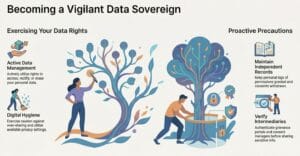
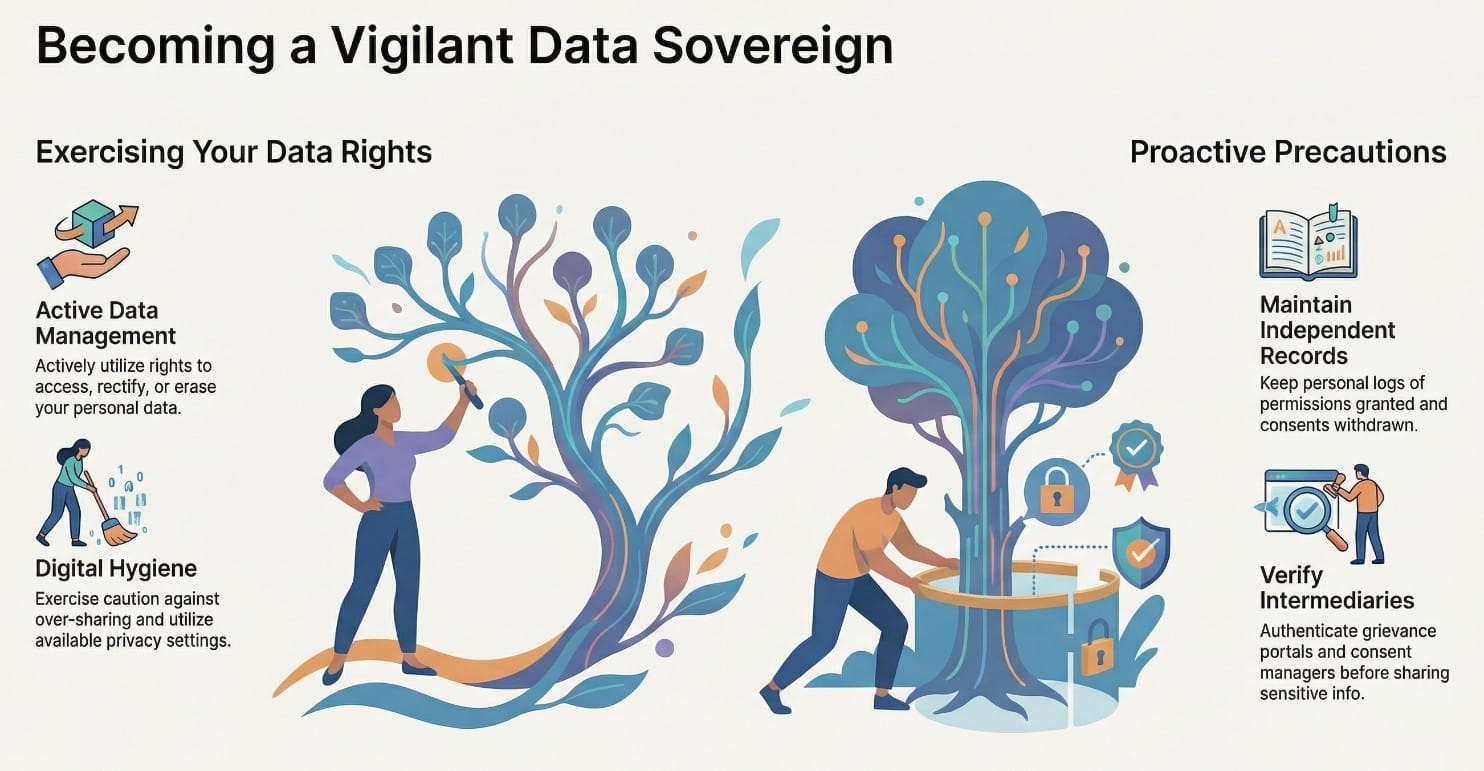
Statutory rights under the DPDPA empower individuals to manage their digital identity use of rights to see, fix or delete own data and keep own records of the permissions or any complaints. To exercise these effectively, individuals should follow these protocols: –
- Access Inquiry – Formally request a summary of personal data currently being processed and the identities of third parties with whom it has been shared.
- Correction & Completion – Initiate requests to rectify inaccurate data or complete evolving datasets to ensure processing remains fair.
- Erasure Mandate – Request the deletion of personal data once the specific purpose for collection has been exhausted or consent is withdrawn.
- Audit Trail Maintenance – Keep independent logs of all consents granted, notices received, and grievances filed to facilitate swift resolution through the DPBI if necessary.
MSMEs
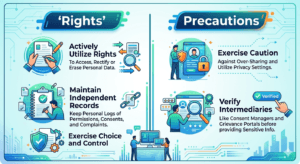
For MSMEs, the path to compliance begins with a pragmatic data inventory. The foundation for all privacy actions can be determined by: –
- What – Classify the specific types of personal data collected.
- Why – Define the specific legal purpose for processing.
- Where – Plan the precise storage locations, whether in-premise, in the cloud or with third-party vendors.
- Who – Identify all internal stakeholder and external partner with data access.
Data Inventory Steps
Map Data Ingress – Identify exact purpose of personal data collected from individuals.
Define Purpose – Clearly document the legal and operational for every data point.
Localize Storage – Precise data location both digital and physical.
Trace Data Egress: Document every third party with whom data is shared.
Compliance Tools Checklist
- Standardize Policies – Adopt core privacy policies, data retention schedules and breach response SOPs.
- Cloud-Native Services – Use managed services for consent management rather than internal solutions.
- Standardized Notices – Implement simple language, standard notice and consent flows.
- Security Defaults – Leverage cloud-based logging, encryption and access control features to meet security mandates.
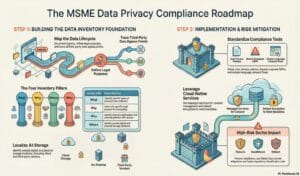
Alert: Regulatory Risk – MSMEs face limited but obligations regarding consent, notices, security and breach notification. While SDF is unlikely for MSMEs, sector-wise or large-scale classification can impact Fintech, Healthtech, Edtech and high-volume SaaS providers.
Corporates
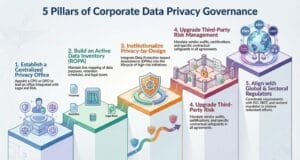
Large-scale entities must organize a sophisticated, integrated and deep defence strategy. The steps that corporate needs to undertake are: –
- Establishment of Privacy Office – Appoint a Chief Privacy Officer (CPO) or Data Protection Officer (DPO) to lead a dedicated office integrated with CISO, Legal, Risk and Compliance verticals.
- Active Record of Processing Activities (ROPA) – Build and maintain a live data inventory mapped to specific purposes, retention schedules and legal bases.
- Implement Data Protection Impact Assessments (DPIAs) – Integrate DPIAs into the lifecycle of all high-risk initiatives to institutionalize privacy-by-design.
- Upgrade Third-Party Risk Management: Incorporate DPDPA-specific clauses and contractual safeguards into all vendor agreements, mandated with regular audits and certifications.
- Align with Global and Sectoral Regulators: Coordinate DPDPA requirements with existing frameworks (ISO, NIST) and sectoral mandates (RBI, IRDAI, TRAI) to remove redundant efforts and leverage shared controls.
Government and Law Enforcement
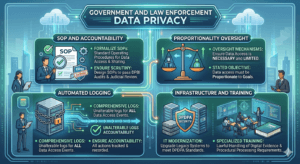
- SOP and Accountability – Government departments must formalize Standard Operating Procedures (SOPs) for data access and sharing. These SOPs must be designed to endure judicial scrutiny and DPBI audits.
- Proportionality Oversight – Internal mechanisms must ensure that data access is necessary, limited in scope and proportionate to the stated objective.
- Automated Logging – Comprehensive, unalterable logs must be maintained for all data access events to ensure accountability.
- Infrastructure and Training – Legacy IT systems must be modernized to meet DPDPA security standards. Simultaneously, specialized training programs are required for investigators and prosecutors. This training must focus on the lawful handling of digital evidence and the strict procedural requirements for processing personal data during investigations. This means to transform LEA and departmental IT infrastructure to withstand DPBI and judicial scrutiny
International Business & Organisations
- Extraterritorial Compliance: The extraterritorial applicability of DPDPA is to entities outside India offering goods/ services to individuals in India, requiring them to comply with rules (including consent, notices, rights handling and DPBI enforcement). Foreign entities must strictly adhere to Indian mandates regarding consent, notices and rights handling to avoid DPBI enforcement actions.
- Cross-Border Transfer Mechanics – While transfers are allowed by default, organizations must monitor the government-notified “negative list” of prohibited countries or sectors. However, these needs to be kept in mind: –
- Critical Sector Restrictions: High-risk or highly regulated sectors may face additional localization requirements or localized storage mandates.
- Contractual Updates – Global organizations must map Indian data flows separately and update global privacy notices and vendor contracts with India-specific clauses.
- Global Control Baselines: Establish privacy as a common control baseline across the organization while applying specific Indian legal overlays to local data flows.
- Strategic Mapping: Separate Indian data flows from global flows in internal mapping to allow for rapid response to localization or transfer restrictions.

The enactment of the DPDPA 2023 and the DPDP Rules 2025 indicates the dawn of a new era for digital economy in India, where privacy is a fundamental operational requirement. However, the compliance path is steep, requiring a fundamental shift from reactive legal measures to a proactive “privacy-by-design” framework. Ultimately, those who view privacy as a strategic asset rather than a regulatory hurdle will be best positioned to thrive in India’s maturing, trust-based data landscape. In the present era of screens and servers, awareness of handling of our personal information is preferred way for a digital society. The transition will take time and requires a massive shift in mindset. As we move forward, the companies and institutions that lead with transparency and empathy will be the ones that truly succeed in this new landscape.
(Lt Col Ujjual Abhishek Jha, Retd is a Certified Data Privacy Professional and Strategic & Geopolitical Advisor with over two decades of experience in intelligence, insider threat management, financial crime investigations, and geopolitical risk analysis, advising on complex security and strategic risks.)
The post Digital Personal Data Protection Act (DPDPA) 2023 Series: Part IV –Implementation Recommendations first appeared on The Frontier Manipur.
Read more / Original news source: https://thefrontiermanipur.com/digital-personal-data-protection-act-dpdpa-2023-series-part-iv-implementation-recommendations/