


Myanmar National Drug Kingpin Arrested in Manipur

Narcotics Control Bureau (NCB) stated that the arrested individual is a ‘drug kingpin’ and a resident of Haichin, Chin State, Myanmar and a Myanmar-based transnational drug trafficking syndicate. TFM Report In a significant development against transnational drug trafficking across India-Myanmar border, a joint team of Manipur police and Narcotics Control Bureau (NCB) arrested drug kingpin […]

The post Myanmar National Drug Kingpin Arrested in Manipur first appeared on The Frontier Manipur.

Narcotics Control Bureau (NCB) stated that the arrested individual is a ‘drug kingpin’ and a resident of Haichin, Chin State, Myanmar and a Myanmar-based transnational drug trafficking syndicate.
TFM Report
In a significant development against transnational drug trafficking across India-Myanmar border, a joint team of Manipur police and Narcotics Control Bureau (NCB) arrested drug kingpin allegedly to be a major drug supplier and a wanted in multiple NDPS cases on Wednesday (July 22) from Manipur’s Churachandpur district.
The individual has been identified as one Nengjatuan alias Tuanpi and was arrested from hotel Venus in Churachandpur district of Manipur during a raid conducted by the joint team.
Manipur police in a statement stated that, “the arrested individual is alleged to be a major drug supplier and is wanted in multiple NDPS cases registered with NCB, DRI and Manipur Police.”
A separate statement issued by Narcotics Control Bureau (NCB) stated that the arrested individual is a ‘drug kingpin’ and a resident of Haichin, Chin State, Myanmar and a Myanmar-based transnational drug trafficking syndicate.
The statement further stated that “The arrest follows months of intelligence development, technical surveillance, coordinated interstate operations and sustained investigations, underscoring NCB’s strategy of targeting the leadership of transnational drug trafficking networks rather than merely intercepting individual consignments.”
Investigation has established that he was one of the principal international suppliers operating from Chin State, controlling a trafficking network that routed Methamphetamine and Heroin through Manipur, Mizoram, Assam and Tripura for distribution across different parts of India and Bangladesh, the statement added.
The accused is wanted in multiple NDPS cases registered by NCB and other Drug Law Enforcement Agencies. He is the principal accused in three NCB cases involving seizures of approximately 28.22 kg of Methamphetamine tablets and 1.278 kg of Heroin, valued at over ?25 crore. He is also linked to seven other NDPS cases registered by Churachandpur Police, Singngat Police and the Directorate of Revenue Intelligence (DRI).
The investigation has established that the syndicate operated through a well-organised network of international suppliers, cross-border couriers, transport coordinators, local facilitators, receivers and financial handlers. The syndicate has so far been linked to seizures of Methamphetamine, Heroin and proceeds of crime collectively valued at over ?53 crore.
Financial investigations are continuing to identify additional proceeds of crime, assets and other members of the network. Over the past several months, NCB has systematically dismantled the syndicate through a series of intelligence-led operations resulting in the arrest of several key members, including carriers, receivers, transport coordinators and local facilitators operating across Manipur and Assam.
Among those arrested are Abdullah Ahmed of Silchar, Assam, who functioned as the principal receiver and coordinator of consignments entering Assam; Lalthlamuong Pulamte of Churachandpur, Manipur; Nengultinkhum Hrangngul of Pherzawl, Manipur; and Paominlen Munlo of Churachandpur, Manipur, the suspected receiver in a major Methamphetamine seizure, besides several other associates involved in transportation, storage and distribution of narcotic consignments.
Their interrogation, corroborated by technical surveillance, digital evidence and financial investigation, enabled NCB to identify and apprehend Nengzatuan @ Tuanpi as the principal Myanmar-based supplier directing the syndicate from across the international border.
The arrest of Nengzatuan @ Tuanpi follows the earlier arrests of Lalhmingsanga in March 2026 and Thancintuang @ Chintuang @ Tluanga in May 2026. These successive operations reflect NCB’s sustained network-centric enforcement strategy of dismantling entire transnational drug trafficking syndicates by targeting their international suppliers, financiers, coordinators, logistics providers and other key members of the criminal network.
The arrest marks another significant milestone in NCB’s sustained offensive against organised drug trafficking networks operating along the India–Myanmar border. NCB remains committed to disrupting and dismantling transnational drug trafficking syndicates through intelligence-driven investigations and close coordination with national and international law enforcement agencies.
Members of the public are encouraged to share information relating to narcotic drugs, psychotropic substances and illicit trafficking through the MANAS (Madak Padarth Nishedh Asuchna Kendra) National Narcotics Helpline – 1933 or the MANAS portal. Every credible input strengthens enforcement efforts and contributes to protecting society from the menace of illicit drugs.

The post Myanmar National Drug Kingpin Arrested in Manipur first appeared on The Frontier Manipur.

Read more / Original news source: https://thefrontiermanipur.com/myanmar-national-drug-kingpin-arrested-in-manipur/

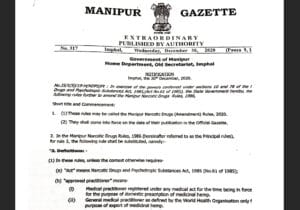
Manipur’s ‘Phantom Hemp Law’: How a 2020 Amendment Could Shield Illegal Hemp Trade

Assigned Gazette No. 317 and dated December 30, 2020, the rules were never formally made available to the public. TFM Report For five years, a legal framework that could regulate Manipur’s burgeoning hemp industry sat buried on government servers, hidden from the very public it was meant to govern. The excuse, there was an IT-based […]

The post Manipur’s ‘Phantom Hemp Law’: How a 2020 Amendment Could Shield Illegal Hemp Trade first appeared on The Frontier Manipur.

Assigned Gazette No. 317 and dated December 30, 2020, the rules were never formally made available to the public.

TFM Report

For five years, a legal framework that could regulate Manipur’s burgeoning hemp industry sat buried on government servers, hidden from the very public it was meant to govern. The excuse, there was an IT-based technical glitch! Now, as the state prepares to bring the Manipur Narcotic Drugs (Amendment) Rules, 2020 online, an unforeseen controversy of “retrospective legalisation” is threatening to undermine the rule of law.
Internal documents and official admissions reveal that the State government drafted rules in December 2020 to regulate the cultivation of industrial and medicinal hemp. Assigned Gazette No. 317 and dated December 30, 2020, the rules were never formally made available to the public. According to a dossier obtained by a vigilant citizen, the administration has admitted the files remained “internal,” existing solely within the printing department’s archives, inaccessible to citizens.
“The mere existence of a rule within internal government servers does not constitute ‘publication,’” the dossier states, citing established Supreme Court jurisprudence.
The ‘Back-Dating’ Concern
The core of the current controversy involves the Directorate of Printing and Stationery’s efforts to “reconstruct” missing gazette records. Sources suggest the government is preparing to publish the 2020 amendment with its original timestamp, a move critics describe as an attempt to create a retrospective legal shield for hemp licenses issued between 2020 and 2026.
The legal peril is significant. Under Indian law, specifically the doctrine established in Harla v. State of Rajasthan (1951), delegated legislation only acquires the force of law upon publication in the Official Gazette. A law must be made known to the public to be binding. A secret document cannot impose burdens on citizens or provide a legal basis for administrative actions.
“The law, to bind, must first exist. And to exist, it must be made known in the manner ordained by the legislature,” the Supreme Court reaffirmed in Viraj Impex Pvt. Ltd. v. Union of India, a case cited in the dossier. In the Viraj Impex case, the court explicitly ruled that a notification becomes enforceable only upon its publication in the Official Gazette, rejecting attempts to apply rules retrospectively.
A ‘Back-Dated’ Fiction
By publishing the unmodified 2020 rules in 2026 with a 2020 timestamp, authorities risk creating a legal fiction that the rules were always accessible. This would provide a “retrospective legal shield” for licenses issued during years the rules were non-existent in the public domain.
Legal experts argue that any hemp cultivation licenses issued between 2020 and 2026 were, from the start (“ab initio”), lacking a valid legal basis. Any attempt to use a 2020 timestamp to “legalize” these past licenses must be challenged as an attempt to retrospectively shield irregular administrative actions.

The Path Forward: Transparency vs. Cover-Up
The dossier calls for mandatory transparency measures to prevent what it terms a “fraudulent back-dating.” It urges the Directorate to include a clear disclaimer: “This amendment was enacted in 2020 but is being made publicly available for the first time in July 2026.”
Additionally, the Department of Information Technology (DIT), which controls server metadata, faces a formal request to ensure the publication metadata aligns with the actual activation date in the public domain.
Critical Vigilance Points:
– Metadata Verification: Immediate checks are required to ensure digital timestamps are not falsified to 2020.
– Challenge to Licensing: Any attempt to use the 2020 date to validate past hemp licenses must be legally challenged as procedurally irregular.
The administration faces a choice: acknowledge the oversight and publish the rules with a current date, or proceed with a retrospective publication that could invite legal challenges and erode public trust. As one source close to the matter put it, “Vigilance regarding the actual date of online publication is the only way to ensure the administration remains accountable and that the rule of law is upheld over retrospective justification.”

Also Read: https://thefrontiermanipur.com/unlocking-manipurs-hemp-policy-the-case-of-the-missing-gazette/

The post Manipur’s ‘Phantom Hemp Law’: How a 2020 Amendment Could Shield Illegal Hemp Trade first appeared on The Frontier Manipur.

Read more / Original news source: https://thefrontiermanipur.com/manipurs-phantom-hemp-law-how-a-2020-amendment-could-shield-illegal-cannabis-trade/

Unlocking Manipur’s Hemp Policy: The Case of the Missing Gazette

“For years, Manipur has held the blueprint for a regulated hemp industry, which is a policy designed to foster innovation while ensuring safety. Yet, this framework remains frozen in administrative limbo. With the government’s current efforts to reconcile and authenticate its official gazette records, there has never been a more opportune moment to bring the […]

The post Unlocking Manipur’s Hemp Policy: The Case of the Missing Gazette first appeared on The Frontier Manipur.

“For years, Manipur has held the blueprint for a regulated hemp industry, which is a policy designed to foster innovation while ensuring safety. Yet, this framework remains frozen in administrative limbo. With the government’s current efforts to reconcile and authenticate its official gazette records, there has never been a more opportune moment to bring the Manipur Narcotic Drugs (Amendment) Rules, 2020 out of the shadows. It is time to finalize the notification of Gazette No. 317 and turn a long-awaited policy into a transparent, enforceable law.”

TFM Analysis

Manipur has officially envisioned a sustainable and regulated framework for the medicinal, scientific, and industrial use of hemp. The objective was to create a balanced environment that supports legitimate economic growth and research while maintaining the strict oversight required by law. Yet, despite the Manipur Narcotic Drugs (Amendment) Rules, 2020 (see pic) being drafted and prepared, this framework remains effectively dormant, leaving potential stakeholders in a state of regulatory uncertainty edging on to mystery. The Rules had also escaped public scrutiny.

The Missing Notification

In December 2020, the Government of Manipur prepared a comprehensive set of rules to govern hemp cultivation and manufacturing (Notification No. 35/1(5)/19-H(NDPS)Pt). As evidenced by Gazette No. 317, the document is thorough, outlining clear licensing forms, security protocols for vault storage, and standard operating procedures for handling botanical materials.

However, there is a critical disconnect between policy and practice. The amendment explicitly states that these rules “shall come into force on the date of their publication in the Official Gazette”. To date, this final administrative step, which is a formal notification, has not been fully enacted for public use since 2020. While the state has empowered Excise officials to enforce the NDPS Act, 1985, the legal mechanism to allow the public to apply for regulated cultivation licenses remains inaccessible.

A Path Towards Transparency

The Directorate of Printing & Stationery, Government of Manipur, recently issued a circular regarding the “Reconstruction of Missing Gazettes” (ID-DPS-203/10/2025-DPS-DP&S). In this public notice, the Directorate, led by Director Ng. Roben Singh, invited stakeholders to submit claims, comments, or suggestions to help bridge gaps in government records, emphasizing a commitment to completeness and procedural integrity.

Reliable information indicates that a copy of the 2020 amendment is currently held within the records of the Directorate under Ng. Roben Singh. This presents a unique and timely opportunity for the state to resolve the current impasse. There is a need to urge the Directorate of Printing & Stationery and the Home Department to “do the needful” by ensuring that the Manipur Narcotic Drugs (Amendment) Rules, 2020 (Gazette No. 317) are formally validated, notified, and made accessible to the public.

Legal Clarity and Subsequent Action

By finalizing the notification of these rules, the government can move from a draft framework to a transparent, regulated system. This step would provide the legal clarity that entrepreneurs, researchers, and the public require. The blueprint for a regulated hemp policy is ready. It is high time the authorities finalize this administrative process, thereby allowing Manipur to foster legal industry while upholding the high standard of oversight the law requires.

(Disclaimer: This article is intended for informational purposes and advocates for administrative transparency regarding existing government policy frameworks).


The post Unlocking Manipur’s Hemp Policy: The Case of the Missing Gazette first appeared on The Frontier Manipur.

Read more / Original news source: https://thefrontiermanipur.com/unlocking-manipurs-hemp-policy-the-case-of-the-missing-gazette/

Unlocking Manipur’s Hemp Policy: The Case of the Missing Gazette

“For years, Manipur has held the blueprint for a regulated hemp industry, which is a policy designed to foster innovation while ensuring safety. Yet, this framework remains frozen in administrative limbo. With the government’s current efforts to reconcile and authenticate its official gazette records, there has never been a more opportune moment to bring the […]

The post Unlocking Manipur’s Hemp Policy: The Case of the Missing Gazette first appeared on The Frontier Manipur.

“For years, Manipur has held the blueprint for a regulated hemp industry, which is a policy designed to foster innovation while ensuring safety. Yet, this framework remains frozen in administrative limbo. With the government’s current efforts to reconcile and authenticate its official gazette records, there has never been a more opportune moment to bring the Manipur Narcotic Drugs (Amendment) Rules, 2020 out of the shadows. It is time to finalize the notification of Gazette No. 317 and turn a long-awaited policy into a transparent, enforceable law.”

TFM Analysis

Manipur has officially envisioned a sustainable and regulated framework for the medicinal, scientific, and industrial use of hemp. The objective was to create a balanced environment that supports legitimate economic growth and research while maintaining the strict oversight required by law. Yet, despite the Manipur Narcotic Drugs (Amendment) Rules, 2020 (see pic) being drafted and prepared, this framework remains effectively dormant, leaving potential stakeholders in a state of regulatory uncertainty edging on to mystery. The Rules had also escaped public scrutiny.

The Missing Notification

In December 2020, the Government of Manipur prepared a comprehensive set of rules to govern hemp cultivation and manufacturing (Notification No. 35/1(5)/19-H(NDPS)Pt). As evidenced by Gazette No. 317, the document is thorough, outlining clear licensing forms, security protocols for vault storage, and standard operating procedures for handling botanical materials.

However, there is a critical disconnect between policy and practice. The amendment explicitly states that these rules “shall come into force on the date of their publication in the Official Gazette”. To date, this final administrative step, which is a formal notification, has not been fully enacted for public use since 2020. While the state has empowered Excise officials to enforce the NDPS Act, 1985, the legal mechanism to allow the public to apply for regulated cultivation licenses remains inaccessible.

A Path Towards Transparency

The Directorate of Printing & Stationery, Government of Manipur, recently issued a circular regarding the “Reconstruction of Missing Gazettes” (ID-DPS-203/10/2025-DPS-DP&S). In this public notice, the Directorate, led by Director Ng. Roben Singh, invited stakeholders to submit claims, comments, or suggestions to help bridge gaps in government records, emphasizing a commitment to completeness and procedural integrity.

Reliable information indicates that a copy of the 2020 amendment is currently held within the records of the Directorate under Ng. Roben Singh. This presents a unique and timely opportunity for the state to resolve the current impasse. There is a need to urge the Directorate of Printing & Stationery and the Home Department to “do the needful” by ensuring that the Manipur Narcotic Drugs (Amendment) Rules, 2020 (Gazette No. 317) are formally validated, notified, and made accessible to the public.

Legal Clarity and Subsequent Action

By finalizing the notification of these rules, the government can move from a draft framework to a transparent, regulated system. This step would provide the legal clarity that entrepreneurs, researchers, and the public require. The blueprint for a regulated hemp policy is ready. It is high time the authorities finalize this administrative process, thereby allowing Manipur to foster legal industry while upholding the high standard of oversight the law requires.

(Disclaimer: This article is intended for informational purposes and advocates for administrative transparency regarding existing government policy frameworks).


The post Unlocking Manipur’s Hemp Policy: The Case of the Missing Gazette first appeared on The Frontier Manipur.

Read more / Original news source: https://thefrontiermanipur.com/unlocking-manipurs-hemp-policy-the-case-of-the-missing-gazette/

Unlocking Manipur’s Hemp Policy: The Case of the Missing Gazette

“For years, Manipur has held the blueprint for a regulated hemp industry, which is a policy designed to foster innovation while ensuring safety. Yet, this framework remains frozen in administrative limbo. With the government’s current efforts to reconcile and authenticate its official gazette records, there has never been a more opportune moment to bring the […]

The post Unlocking Manipur’s Hemp Policy: The Case of the Missing Gazette first appeared on The Frontier Manipur.

“For years, Manipur has held the blueprint for a regulated hemp industry, which is a policy designed to foster innovation while ensuring safety. Yet, this framework remains frozen in administrative limbo. With the government’s current efforts to reconcile and authenticate its official gazette records, there has never been a more opportune moment to bring the Manipur Narcotic Drugs (Amendment) Rules, 2020 out of the shadows. It is time to finalize the notification of Gazette No. 317 and turn a long-awaited policy into a transparent, enforceable law.”

TFM Analysis

Manipur has officially envisioned a sustainable and regulated framework for the medicinal, scientific, and industrial use of hemp. The objective was to create a balanced environment that supports legitimate economic growth and research while maintaining the strict oversight required by law. Yet, despite the Manipur Narcotic Drugs (Amendment) Rules, 2020 (see pic) being drafted and prepared, this framework remains effectively dormant, leaving potential stakeholders in a state of regulatory uncertainty edging on to mystery. The Rules had also escaped public scrutiny.

The Missing Notification

In December 2020, the Government of Manipur prepared a comprehensive set of rules to govern hemp cultivation and manufacturing (Notification No. 35/1(5)/19-H(NDPS)Pt). As evidenced by Gazette No. 317, the document is thorough, outlining clear licensing forms, security protocols for vault storage, and standard operating procedures for handling botanical materials.

However, there is a critical disconnect between policy and practice. The amendment explicitly states that these rules “shall come into force on the date of their publication in the Official Gazette”. To date, this final administrative step, which is a formal notification, has not been fully enacted for public use since 2020. While the state has empowered Excise officials to enforce the NDPS Act, 1985, the legal mechanism to allow the public to apply for regulated cultivation licenses remains inaccessible.

A Path Towards Transparency

The Directorate of Printing & Stationery, Government of Manipur, recently issued a circular regarding the “Reconstruction of Missing Gazettes” (ID-DPS-203/10/2025-DPS-DP&S). In this public notice, the Directorate, led by Director Ng. Roben Singh, invited stakeholders to submit claims, comments, or suggestions to help bridge gaps in government records, emphasizing a commitment to completeness and procedural integrity.

Reliable information indicates that a copy of the 2020 amendment is currently held within the records of the Directorate under Ng. Roben Singh. This presents a unique and timely opportunity for the state to resolve the current impasse. There is a need to urge the Directorate of Printing & Stationery and the Home Department to “do the needful” by ensuring that the Manipur Narcotic Drugs (Amendment) Rules, 2020 (Gazette No. 317) are formally validated, notified, and made accessible to the public.

Legal Clarity and Subsequent Action

By finalizing the notification of these rules, the government can move from a draft framework to a transparent, regulated system. This step would provide the legal clarity that entrepreneurs, researchers, and the public require. The blueprint for a regulated hemp policy is ready. It is high time the authorities finalize this administrative process, thereby allowing Manipur to foster legal industry while upholding the high standard of oversight the law requires.

(Disclaimer: This article is intended for informational purposes and advocates for administrative transparency regarding existing government policy frameworks).


The post Unlocking Manipur’s Hemp Policy: The Case of the Missing Gazette first appeared on The Frontier Manipur.

Read more / Original news source: https://thefrontiermanipur.com/unlocking-manipurs-hemp-policy-the-case-of-the-missing-gazette/

Opium seized

A combined team of BSF and Narcotic Control Bureau Sub Zone, Imphal arrested one person along with 13.420 kg of opium worth Rs 13.42 lakh in the international market from S Canan Veng under Churachandpur police station. A reliable source said that based on a specific information provided by the Field Ground team of BSF […]

A combined team of BSF and Narcotic Control Bureau Sub Zone, Imphal arrested one person along with 13.420 kg of opium worth Rs 13.42 lakh in the international market from S Canan Veng under Churachandpur police station. A reliable source said that based on a specific information provided by the Field Ground team of BSF […]

Read more / Original news source: http://kanglaonline.com/2016/05/opium-seized/