

Linear Path of Terror: Architecture of Modern Terrorist Financing

Trends collectively suggest that TF risk is becoming more diffuse, networked and embedded in legitimate global flows, requiring intelligence?driven, multi?sectoral responses rather than reliance on static typology checklists. By Lt Col Ujjual Abhishek Jha, Retd Comprehending Terrorist Financing (TF) origins requires an analytical thinking beyond conventional Anti-Money Laundering (AML) framework. Money Laundering (ML) is circular […]

The post Linear Path of Terror: Architecture of Modern Terrorist Financing first appeared on The Frontier Manipur.

Trends collectively suggest that TF risk is becoming more diffuse, networked and embedded in legitimate global flows, requiring intelligence?driven, multi?sectoral responses rather than reliance on static typology checklists.

By Lt Col Ujjual Abhishek Jha, Retd

Comprehending Terrorist Financing (TF) origins requires an analytical thinking beyond conventional Anti-Money Laundering (AML) framework. Money Laundering (ML) is circular process wherein illicitly acquired money is integrated back to legitimate economy. TF is a linear process wherein source of money can be legal or illegal and is aimed towards a violent action. This differentiation is very important in TF, as it makes detection of TF extremely difficult (no Red Flags, source legal or intent and end point not established). Terrorist financing (TF) are finances that enable terrorist activities. TF differs from typical money laundering in three important ways, origin of funds may be legitimate, amounts involved can be relatively small and primary objective is to ensure funds reach operatives. ?? ????? ?? ??????????? ?? ??????? ??? ??????????? ???? ???? ??????????? ?? ??????. Four stage frameworks of TF model are ??????????, ????, ???????? ??? ?????.
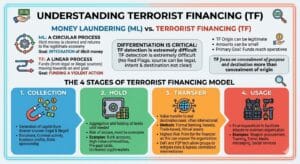
Four Stage Framework TF Model

  • Stage 1: Collection. The generation of capital from a diverse source (both legal and illegal/ criminal) to support organization’s expenditures or specific operations. Can be donations, criminal activity, business profits or state sponsored.
  • Stage 2: Hold. The aggregation and holding of funds until they are required for an operational need. This stage has the risk of seizure and needs to overcome the same. Can be in bank accounts, high-value commodities, pre-paid cards or un-hosted crypto-wallets.
  • Stage 3: Transfer. The transfer of value from the storage point to the end destination or user, often across international borders i.e. transfer of value from holding point to end destination or user. Formal banking, Informal Value Transfer System (Hawala), trade-based or virtual assets are few examples of the same. This stage is often said to be the point of highest risk for the financier as this can expose the organisation. However, the evolution of decentralised finance (DeFi) and peer-to-peer (P2P) technologies has increasingly allowed groups to mitigate these risks by bypassing centralized intermediaries.
  • Stage 4: Usage. The final expenditure of funds to facilitate attacks or maintain the organization’s long-term sustainability. Can be for weapon procurement, training, travel, media messaging or social services.

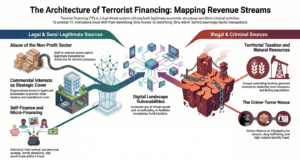
 Typology of Sources of Terrorist Financing

 TF: Legal & Semi-Legitimate Sources

A substantial portion of TF is resultant of legitimate economic activity, which presents a distinct challenge for financial institutions. If funds originate from a lawful activity and do not stain of criminal predicate, then it necessitates a shift from identifying dirty money to dirty intent. The means are discussed below.

Abuse of the Non-Profit Sector (NPOs) – NPOs and charities have been identified by the FATF as particularly vulnerable to abuse for terrorist financing. E.g. fund diversion of legitimate donations for humanitarian purposes are siphoned off by complicit staff or external actors.

Commercial Interests and Legitimate Businesses – Large terrorist organizations often act as venture capitalists, investing surplus capital into legitimate commercial sectors to ensure a steady stream of income, serving dual purpose, provide a clean revenue stream and offer cover for operatives stay and move.

Self-Finance and the Lone Wolf – The individual operatives have own legitimate income as the primary source of funding. It is often supplemented by micro-financing strategies like welfare and benefit fraud, small loans and personal savings & family donations.

TF: Illegal & Criminal Sources

Industries and Territorial Taxation – For groups that control territory, such as ISIS at its zenith, the primary source of revenue is the exploitation of natural resources and the taxation of the local population.

Kidnapping for Ransom (KFR) – Kidnapping for ransom has become a principal revenue generation source for groups like Al-Qaeda in the Islamic Maghreb (AQIM) and even in the case of ISIS provinces in West Africa, Khorasan, and South Africa.

Drug Trafficking – The intersection of drug trafficking and terrorism is one of the most known aspects of the crime-terror nexus. The reported Taliban’s dependance on the opium trade and Hezbollah’s said involvement in the cocaine trade from South America to Europe show exploitation of drug market by these groups to fund their political projects.

Fraud and Identity Theft – In Western countries terror cells involves in low level but high-volume frauds supporting terrorist financing methods.

 Digital Landscape – Introduced new vulnerabilities into FT leading to increased abuse of digital platforms (virtual assets, crowdfunding and social media) to facilitate collection and transfer of funds with speed and anonymity.
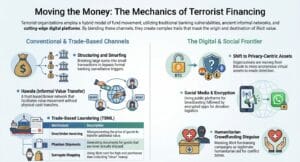
Move Typology: Mechanics of Transfer

Post raising and storing of funds, movement of funds is required for operations/ sustenance. The terror outfits mostly employ hybrid method of fund transfer, formal, informal and trade-based systems to evade surveillance.

Formal Fund Transfer – In spite of exhaustive regulation, the formal banking sector remains a primary target for misuse, using individuals with clean backgrounds (straw men) for opening accounts and transactions. Usage of shell companies is also common method to mask the movement of funds. A common method in the formal sector is structuring or smurfing, where large sums is broken into small transactions to avoid trigger of Suspicious Transaction Reports (STRs).

Hawala and Informal Value Transfer Systems (IVTS) – Hawala is an ancient system of value transfer that operates outside the conventional banking sector. It is based on a network of brokers (hawaladars) who facilitate transfers through trust and net settlement rather than the physical movement of money. The characteristics of Hawala as speed, lower costs and potential anonymity, makes it highly attractive for both legitimate remittances and illicit financing. Hawala settlement in often through Reverse Hawala or Bilateral Settlement, where hawaladars balance their accounts by paying for each other’s expenses in or through the invoicing of legitimate trade.

Trade-Based Money Laundering and Terrorist Financing (TBML/TBTF) – TBML is defined as the process of disguising the proceeds of crime and moving value through the use of trade transactions to legitimize their origins. It is one of the most complex methods of value transfer. Mechanisms of TBML include Over and Under-Invoicing, Phantom Shipments (documents generated for goods that are never shipped), Multiple Invoicing and Surrogate Shopping/ Daigou (high purchase of goods using illicit cash and collecting clean money from end-users). As per FATF, TBML is increasingly attractive and is frequently used by groups like Hezbollah and the Taliban, who have established deep connections with international trade and transport companies.

Digital Frontier & Emerging Technologies

The rapid evolution of financial technology has introduced new vulnerabilities into the FT landscape. Terrorists are increasingly misusing digital platforms including virtual assets, crowdfunding and social media, to generate and move funds with unprecedented speed and anonymity.

Virtual Assets (VAs) and Cryptocurrencies – Virtual assets are characterized by non-face-to-face relationships and can permit anonymous funding. While Bitcoin was the initial currency of choice, the transparency of its blockchain has led to a shift toward more privacy-centric and stable assets. The overall VA use in terrorist financing remains relatively lower than cash and Hawala, but its reportedly growing in South and Central Asia.

Crowdfunding and Social Media Integration – Social media platforms as Facebook and Twitter act as broadcast mechanisms to ask donations. Once a potential donor is identified, the conversation moves to private, often encrypted, as Telegram or WhatsApp. Crowdfunding platforms are misused through campaigns, disguising funds as humanitarian aid for conflict zones, using combination of traditional payment methods and new technologies (Crypto) to avoid detection.
Emerging Threats and AI Factor

FATF Update on TF Risks of 2024 and 2025 highlights surge in activity by young, tech-savvy actors who are radicalized online and employ micro-financing. FATF also warned specific AI risks of not only in the recruitment and radicalization but also in automation of fund operations.

Trends collectively suggest that TF risk is becoming more diffuse, networked and embedded in legitimate global flows, requiring intelligence?driven, multi?sectoral responses rather than reliance on static typology checklists. For corporate security and compliance functions, this means that the “financial footprint” of terrorism often appears as small, routine, sometimes even charitable or community?oriented transactions.

(Lt Col Ujjual Abhishek Jha, Retd is a Certified Data Privacy Professional and Strategic & Geopolitical Advisor with over two decades of experience in intelligence, insider threat management, financial crime investigations, and geopolitical risk analysis, advising on complex security and strategic risks.)


The post Linear Path of Terror: Architecture of Modern Terrorist Financing first appeared on The Frontier Manipur.

Read more / Original news source: https://thefrontiermanipur.com/linear-path-of-terror-architecture-of-modern-terrorist-financing/


Manipur Crisis Through Conflict Theory: A Two-Level Mistrust Model

The Manipur crisis as a simultaneous breakdown of vertical trust between citizens and the state, and horizontal trust among communities. Using conflict theory, it argues that structural inequalities, identity fears, security dilemmas, and cultural violence have transformed the crisis into a self-sustaining cycle of mutual insecurity. Lasting peace requires rebuilding institutional legitimacy and intergroup trust, […]

The post Manipur Crisis Through Conflict Theory: A Two-Level Mistrust Model first appeared on The Frontier Manipur.

The Manipur crisis as a simultaneous breakdown of vertical trust between citizens and the state, and horizontal trust among communities. Using conflict theory, it argues that structural inequalities, identity fears, security dilemmas, and cultural violence have transformed the crisis into a self-sustaining cycle of mutual insecurity. Lasting peace requires rebuilding institutional legitimacy and intergroup trust, not merely restoring law and order.

By Sheikh Abdul Hakim

The Manipur crisis can be theorised as a breakdown of social cohesion at two levels: the vertical level, between citizens and the state, and the horizontal level, among communities. Social-cohesion theory defines the horizontal dimension as trust among people and groups, while the vertical dimension concerns trust between citizens and institutions such as the government. In Manipur, both have weakened at the same time, making the crisis far deeper than a normal law-and-order problem.

Core thesis

From the perspective of conflict theory, Manipur is not merely a clash of communities. It is a conflict over security, land, recognition, political power, identity, dignity, and trust. The immediate violence began in May 2023 around ethnic tensions linked to Scheduled Tribe status, affirmative-action benefits, land and political anxieties; by 2026, Reuters reported around 260 deaths and more than 60,000 displaced, while ACLED described the two major communities as living in near-complete segregation after two years of violence.

The central problem is this: each community now sees its own survival as insecure, and many citizens no longer believe that institutions can protect them with neutrality, speed, and fairness. Once that happens, every incident is interpreted not as an individual crime, but as evidence of collective danger.

1. Structural conflict: unequal power, land, representation and resources

Classical conflict theory begins from the idea that society is not always harmonious; it is often shaped by struggles over scarce resources and institutional power. In Manipur, the relevant resources are not only money or jobs. They include land, constitutional protection, political representation, administrative control, access to security, development, mobility, and cultural recognition.

Frances Stewart’s theory of horizontal inequalities is especially useful. It argues that conflict becomes more likely when economic, political, social and cultural inequalities are experienced not merely by individuals, but by identity groups. Stewart’s framework defines horizontal inequalities as inequalities among groups sharing a common identity, and notes that when cultural differences overlap with economic and political differences, resentment can deepen into violent struggle.

Applied to Manipur, the hill-valley divide becomes more than geography. The valley is associated with demographic concentration, political centrality and administrative visibility; the hills are associated with land protection, tribal autonomy, distance from state services and fear of domination. The Meitei demand for Scheduled Tribe status, and the opposition to it from Kuki-Zo and other tribal groups, therefore, became a symbolic struggle over who will control the future rules of land, reservation, recognition and security. That is why the conflict cannot be reduced to one incident alone.

2. Identity conflict: when grievance becomes community consciousness

Social Identity Theory, developed by Henri Tajfel and John Turner, helps explain how people begin to see events through the lens of “us” and “them.” Their work showed that even minimal group distinctions can generate in-group preference and out-group suspicion; in a violent setting, this tendency becomes far more dangerous.

In Manipur, the crisis has turned identity into a security boundary. A killing, arrest, rumour, checkpoint, relief measure or government statement is no longer judged only on facts. It is often judged through the question: “Is this against my community or in favour of the other?” This is the psychological moment where horizontal mistrust becomes self-reinforcing.

The tragedy is that people who once shared markets, schools, roads, workplaces and friendships can begin to see one another as representatives of collective threat. At that stage, individual guilt disappears behind collective suspicion. Conflict theory calls this the hardening of group boundaries.

3. Security dilemma: every group’s self-defence frightens the other

The ethnic security dilemma is one of the most powerful explanations for Manipur today. Lake and Rothchild argue that intense ethnic conflict is not caused simply by “ancient hatred”; it is often produced by collective fear of the future, especially when groups doubt whether the state can credibly protect them. When the state’s authority weakens or is seen as biased, communities begin preparing for their own defence; those preparations then look threatening to the other side, causing a spiral.

This is visible in Manipur’s armed village-defence atmosphere, buffer zones, checkpoints, displacement camps, segregated settlements, and fear of crossing into the “other” area. Reuters reported that weapons were in circulation, including arms stolen from police or smuggled from Myanmar, while many Kukis and Meiteis moved out of mixed areas.

The security dilemma works like this:

One side says: “We are arming or blocking roads only to protect ourselves.”

The other side hears: “They are preparing to attack us.”

The state intervenes: one group sees protection, another sees bias.

Result: fear grows even when both sides claim they want safety.

Thus, Manipur’s crisis has moved from grievance to fear, and from fear to separation.

4. Vertical mistrust: the crisis of state legitimacy

Conflict theory also asks: who controls institutions, and do people see those institutions as neutral? In Manipur, vertical mistrust has become central. Many citizens no longer evaluate the state only by laws written on paper; they evaluate it by lived experience: Who came when we were attacked? Whose FIR was registered? Whose dead were honoured? Whose displaced families were heard? Whose roads were opened? Whose suffering was ignored?

The Supreme Court’s intervention itself shows the gravity of the institutional-trust problem. In its [Manipur violence order], the Court stressed the need to restore faith and confidence in the justice system, ensure that perpetrators are punished according to law, and sustain public confidence in investigation and prosecution. It also constituted a three-judge committee led by Justice Gita Mittal for relief, rehabilitation and survivor support, and appointed an outside police officer to supervise investigations.

This matters theoretically because when citizens lose confidence in institutions, they seek security from community organisations, armed volunteers, pressure groups, ethnic councils, rumour networks and local defence structures. The state then loses its monopoly over trust, even if it still has formal authority.

In simple terms: a government may control territory, but it cannot produce peace unless people believe it is fair.

5. Cultural violence: when language makes violence acceptable

Johan Galtung’s theory divides violence into direct violence, structural violence, and cultural violence. Direct violence is visible: killings, arson, sexual violence, displacement, attacks. Structural violence is built into unequal systems. Cultural violence is the language, symbols, stereotypes and narratives that make direct or structural violence appear acceptable.

In Manipur, cultural violence appears when entire communities are reduced to labels: “illegal,” “terrorist,” “drug-linked,” “land-grabber,” “anti-national,” “aggressor,” or “enemy.” Once such language spreads, the crime of an individual is transferred onto a whole community. This is how collective blame is manufactured.

The theoretical danger is that cultural violence does not always look like violence. It may look like a slogan, a speech, a rumour, a meme, a funeral speech, a protest placard, or a social-media post. But it prepares the mind to accept cruelty.

6. Conflict entrepreneurs: those who benefit from division

Conflict theory also pays attention to actors who gain from instability. These may include extremist groups, armed networks, political hardliners, black-market actors, rumour-spreaders, and leaders who gain influence by presenting themselves as sole protectors of a community.

Lake and Rothchild note that [ethnic activists and political entrepreneurs] can build upon insecurity and polarise society. In Manipur, this means the conflict is not sustained only by spontaneous anger. It is also sustained by networks that turn fear into mobilisation, mobilisation into power, and power into bargaining strength.

This is why peace is difficult: for ordinary people, peace means returning home; for conflict entrepreneurs, peace may mean losing relevance.

7. Displacement and segregation: mistrust becomes geography

Displacement changes conflict from an event into a living structure. Once people are separated into camps, protected zones and community-specific territories, mistrust becomes geographical. ACLED’s description of near-complete segregation is therefore not only a demographic fact; it is a conflict-theory warning. Separation reduces everyday contact, and reduced contact allows rumours to replace relationships.

Intergroup Contact Theory, associated with Gordon Allport and later work by Pettigrew, suggests that contact reduces prejudice best when there is equal status, common goals, cooperation and authority support. But unsafe, unequal or forced contact can deepen fear. Therefore, simply telling communities to “live together again” is not enough. They need conditions where coexistence is safe, dignified and institutionally protected.

The Manipur crisis in one theoretical formula

Structural insecurity + identity fear + weak institutional trust + armed separation + hostile narratives = prolonged ethnic conflict.

Or more simply:

Vertical mistrust makes people doubt the state. Horizontal mistrust makes people fear neighbours. Together, they create a society where every action is suspected, every rumour travels fast, and every tragedy can become another trigger.

What conflict theory teaches for Manipur

The first lesson is that policing alone cannot solve a conflict that has become structural and psychological. Security is necessary, but security without trust can be read as occupation, bias or threat.

The second lesson is that justice must be both real and visible. The Supreme Court’s emphasis on restoring public confidence in investigation and prosecution is crucial because, in a mistrust society, justice hidden from public confidence will not heal public wounds.

The third lesson is that peace must operate at three levels: stop direct violence, correct structural grievances, and defeat cultural hatred. Galtung’s framework makes clear that removing guns is only the beginning; societies must also remove the narratives and inequalities that make violence return.

Final theoretical framing

Manipur today is best understood as a crisis of mutual insecurity. The Meitei fear loss of identity, land security, demographic balance and historical centrality. The Kuki-Zo fear loss of land, autonomy, physical safety and equal protection. Other communities fear being dragged into a binary conflict that may erase their own concerns. The government faces a legitimacy deficit because different communities judge its actions through different wounds. Therefore, the problem is not only that communities disagree. The deeper problem is that they no longer trust the same facts, the same institutions, or the same future.

The crisis began with events. It now survives through structures. It will end only when Manipur rebuilds both: vertical trust in the state and horizontal trust among communities.

(Sheikh Abdul Hakim is Director, Social Welfare, Government of Manipur)


The post Manipur Crisis Through Conflict Theory: A Two-Level Mistrust Model first appeared on The Frontier Manipur.

Read more / Original news source: https://thefrontiermanipur.com/manipur-crisis-through-conflict-theory-a-two-level-mistrust-model/

Manipur Crisis Through Conflict Theory: A Two-Level Mistrust Model

The Manipur crisis as a simultaneous breakdown of vertical trust between citizens and the state, and horizontal trust among communities. Using conflict theory, it argues that structural inequalities, identity fears, security dilemmas, and cultural violence have transformed the crisis into a self-sustaining cycle of mutual insecurity. Lasting peace requires rebuilding institutional legitimacy and intergroup trust, […]

The post Manipur Crisis Through Conflict Theory: A Two-Level Mistrust Model first appeared on The Frontier Manipur.

The Manipur crisis as a simultaneous breakdown of vertical trust between citizens and the state, and horizontal trust among communities. Using conflict theory, it argues that structural inequalities, identity fears, security dilemmas, and cultural violence have transformed the crisis into a self-sustaining cycle of mutual insecurity. Lasting peace requires rebuilding institutional legitimacy and intergroup trust, not merely restoring law and order.

By Sheikh Abdul Hakim

The Manipur crisis can be theorised as a breakdown of social cohesion at two levels: the vertical level, between citizens and the state, and the horizontal level, among communities. Social-cohesion theory defines the horizontal dimension as trust among people and groups, while the vertical dimension concerns trust between citizens and institutions such as the government. In Manipur, both have weakened at the same time, making the crisis far deeper than a normal law-and-order problem.

Core thesis

From the perspective of conflict theory, Manipur is not merely a clash of communities. It is a conflict over security, land, recognition, political power, identity, dignity, and trust. The immediate violence began in May 2023 around ethnic tensions linked to Scheduled Tribe status, affirmative-action benefits, land and political anxieties; by 2026, Reuters reported around 260 deaths and more than 60,000 displaced, while ACLED described the two major communities as living in near-complete segregation after two years of violence.

The central problem is this: each community now sees its own survival as insecure, and many citizens no longer believe that institutions can protect them with neutrality, speed, and fairness. Once that happens, every incident is interpreted not as an individual crime, but as evidence of collective danger.

1. Structural conflict: unequal power, land, representation and resources

Classical conflict theory begins from the idea that society is not always harmonious; it is often shaped by struggles over scarce resources and institutional power. In Manipur, the relevant resources are not only money or jobs. They include land, constitutional protection, political representation, administrative control, access to security, development, mobility, and cultural recognition.

Frances Stewart’s theory of horizontal inequalities is especially useful. It argues that conflict becomes more likely when economic, political, social and cultural inequalities are experienced not merely by individuals, but by identity groups. Stewart’s framework defines horizontal inequalities as inequalities among groups sharing a common identity, and notes that when cultural differences overlap with economic and political differences, resentment can deepen into violent struggle.

Applied to Manipur, the hill-valley divide becomes more than geography. The valley is associated with demographic concentration, political centrality and administrative visibility; the hills are associated with land protection, tribal autonomy, distance from state services and fear of domination. The Meitei demand for Scheduled Tribe status, and the opposition to it from Kuki-Zo and other tribal groups, therefore, became a symbolic struggle over who will control the future rules of land, reservation, recognition and security. That is why the conflict cannot be reduced to one incident alone.

2. Identity conflict: when grievance becomes community consciousness

Social Identity Theory, developed by Henri Tajfel and John Turner, helps explain how people begin to see events through the lens of “us” and “them.” Their work showed that even minimal group distinctions can generate in-group preference and out-group suspicion; in a violent setting, this tendency becomes far more dangerous.

In Manipur, the crisis has turned identity into a security boundary. A killing, arrest, rumour, checkpoint, relief measure or government statement is no longer judged only on facts. It is often judged through the question: “Is this against my community or in favour of the other?” This is the psychological moment where horizontal mistrust becomes self-reinforcing.

The tragedy is that people who once shared markets, schools, roads, workplaces and friendships can begin to see one another as representatives of collective threat. At that stage, individual guilt disappears behind collective suspicion. Conflict theory calls this the hardening of group boundaries.

3. Security dilemma: every group’s self-defence frightens the other

The ethnic security dilemma is one of the most powerful explanations for Manipur today. Lake and Rothchild argue that intense ethnic conflict is not caused simply by “ancient hatred”; it is often produced by collective fear of the future, especially when groups doubt whether the state can credibly protect them. When the state’s authority weakens or is seen as biased, communities begin preparing for their own defence; those preparations then look threatening to the other side, causing a spiral.

This is visible in Manipur’s armed village-defence atmosphere, buffer zones, checkpoints, displacement camps, segregated settlements, and fear of crossing into the “other” area. Reuters reported that weapons were in circulation, including arms stolen from police or smuggled from Myanmar, while many Kukis and Meiteis moved out of mixed areas.

The security dilemma works like this:

One side says: “We are arming or blocking roads only to protect ourselves.”

The other side hears: “They are preparing to attack us.”

The state intervenes: one group sees protection, another sees bias.

Result: fear grows even when both sides claim they want safety.

Thus, Manipur’s crisis has moved from grievance to fear, and from fear to separation.

4. Vertical mistrust: the crisis of state legitimacy

Conflict theory also asks: who controls institutions, and do people see those institutions as neutral? In Manipur, vertical mistrust has become central. Many citizens no longer evaluate the state only by laws written on paper; they evaluate it by lived experience: Who came when we were attacked? Whose FIR was registered? Whose dead were honoured? Whose displaced families were heard? Whose roads were opened? Whose suffering was ignored?

The Supreme Court’s intervention itself shows the gravity of the institutional-trust problem. In its [Manipur violence order], the Court stressed the need to restore faith and confidence in the justice system, ensure that perpetrators are punished according to law, and sustain public confidence in investigation and prosecution. It also constituted a three-judge committee led by Justice Gita Mittal for relief, rehabilitation and survivor support, and appointed an outside police officer to supervise investigations.

This matters theoretically because when citizens lose confidence in institutions, they seek security from community organisations, armed volunteers, pressure groups, ethnic councils, rumour networks and local defence structures. The state then loses its monopoly over trust, even if it still has formal authority.

In simple terms: a government may control territory, but it cannot produce peace unless people believe it is fair.

5. Cultural violence: when language makes violence acceptable

Johan Galtung’s theory divides violence into direct violence, structural violence, and cultural violence. Direct violence is visible: killings, arson, sexual violence, displacement, attacks. Structural violence is built into unequal systems. Cultural violence is the language, symbols, stereotypes and narratives that make direct or structural violence appear acceptable.

In Manipur, cultural violence appears when entire communities are reduced to labels: “illegal,” “terrorist,” “drug-linked,” “land-grabber,” “anti-national,” “aggressor,” or “enemy.” Once such language spreads, the crime of an individual is transferred onto a whole community. This is how collective blame is manufactured.

The theoretical danger is that cultural violence does not always look like violence. It may look like a slogan, a speech, a rumour, a meme, a funeral speech, a protest placard, or a social-media post. But it prepares the mind to accept cruelty.

6. Conflict entrepreneurs: those who benefit from division

Conflict theory also pays attention to actors who gain from instability. These may include extremist groups, armed networks, political hardliners, black-market actors, rumour-spreaders, and leaders who gain influence by presenting themselves as sole protectors of a community.

Lake and Rothchild note that [ethnic activists and political entrepreneurs] can build upon insecurity and polarise society. In Manipur, this means the conflict is not sustained only by spontaneous anger. It is also sustained by networks that turn fear into mobilisation, mobilisation into power, and power into bargaining strength.

This is why peace is difficult: for ordinary people, peace means returning home; for conflict entrepreneurs, peace may mean losing relevance.

7. Displacement and segregation: mistrust becomes geography

Displacement changes conflict from an event into a living structure. Once people are separated into camps, protected zones and community-specific territories, mistrust becomes geographical. ACLED’s description of near-complete segregation is therefore not only a demographic fact; it is a conflict-theory warning. Separation reduces everyday contact, and reduced contact allows rumours to replace relationships.

Intergroup Contact Theory, associated with Gordon Allport and later work by Pettigrew, suggests that contact reduces prejudice best when there is equal status, common goals, cooperation and authority support. But unsafe, unequal or forced contact can deepen fear. Therefore, simply telling communities to “live together again” is not enough. They need conditions where coexistence is safe, dignified and institutionally protected.

The Manipur crisis in one theoretical formula

Structural insecurity + identity fear + weak institutional trust + armed separation + hostile narratives = prolonged ethnic conflict.

Or more simply:

Vertical mistrust makes people doubt the state. Horizontal mistrust makes people fear neighbours. Together, they create a society where every action is suspected, every rumour travels fast, and every tragedy can become another trigger.

What conflict theory teaches for Manipur

The first lesson is that policing alone cannot solve a conflict that has become structural and psychological. Security is necessary, but security without trust can be read as occupation, bias or threat.

The second lesson is that justice must be both real and visible. The Supreme Court’s emphasis on restoring public confidence in investigation and prosecution is crucial because, in a mistrust society, justice hidden from public confidence will not heal public wounds.

The third lesson is that peace must operate at three levels: stop direct violence, correct structural grievances, and defeat cultural hatred. Galtung’s framework makes clear that removing guns is only the beginning; societies must also remove the narratives and inequalities that make violence return.

Final theoretical framing

Manipur today is best understood as a crisis of mutual insecurity. The Meitei fear loss of identity, land security, demographic balance and historical centrality. The Kuki-Zo fear loss of land, autonomy, physical safety and equal protection. Other communities fear being dragged into a binary conflict that may erase their own concerns. The government faces a legitimacy deficit because different communities judge its actions through different wounds. Therefore, the problem is not only that communities disagree. The deeper problem is that they no longer trust the same facts, the same institutions, or the same future.

The crisis began with events. It now survives through structures. It will end only when Manipur rebuilds both: vertical trust in the state and horizontal trust among communities.

(Sheikh Abdul Hakim is Director, Social Welfare, Government of Manipur)


The post Manipur Crisis Through Conflict Theory: A Two-Level Mistrust Model first appeared on The Frontier Manipur.

Read more / Original news source: https://thefrontiermanipur.com/manipur-crisis-through-conflict-theory-a-two-level-mistrust-model/

Digital Personal Data Protection Act (DPDPA) 2023 Series: Part II — From Principles to Practice: The DPDP Rules 2025, Global Paradigms & India’s Middle Path

The DPDP Rules serve as the procedural manual for the Act, detailing the mechanisms through which the law will function. They provide granularity on board composition, grievance workflows, classification criteria, and the technical and organisational measures required for compliance. By Lt Col Ujjual Abhishek Jha, Retd The enactment of the Digital Personal Data Protection Act, […]

The post Digital Personal Data Protection Act (DPDPA) 2023 Series: Part II — From Principles to Practice: The DPDP Rules 2025, Global Paradigms & India’s Middle Path first appeared on The Frontier Manipur.

The DPDP Rules serve as the procedural manual for the Act, detailing the mechanisms through which the law will function. They provide granularity on board composition, grievance workflows, classification criteria, and the technical and organisational measures required for compliance.

By Lt Col Ujjual Abhishek Jha, Retd

The enactment of the Digital Personal Data Protection Act, 2023 (DPDPA) established the foundational architecture for India’s data privacy regime. However, the operationalisation of any legislation lies in its rules. The notification of the DPDP Rules, 2025, marks the transition from statutory intent to enforceable reality. This second installment in the series unpacks these rules, contextualises India’s framework within the global privacy landscape, and analyses the unique “Third Way” that India has carved out for itself.

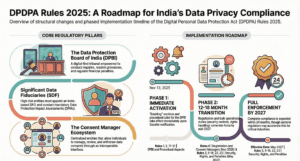
The DPDP Rules 2025: Operationalising the Act

The DPDP Rules serve as the procedural manual for the Act, detailing the mechanisms through which the law will function. They provide granularity on board composition, grievance workflows, classification criteria, and the technical and organisational measures required for compliance. Crucially, they establish a phased enforcement timeline, allowing regulated entities a structured runway to achieve compliance.

The Regulatory Arbitrator: Data Protection Board of India (DPBI)

The Rules formally empower the Data Protection Board of India (DPBI) as a specialised, digital-first adjudicatory body. Unlike traditional regulators, the DPBI is designed to function as a tribunal, conducting inquiries into data breaches, presiding over formal hearings, and levying financial penalties. Its primary mandate is to ensure that Data Fiduciaries—entities that determine the purpose and means of data processing—remain accountable to the law.

Tiered Accountability: Significant Data Fiduciaries (SDFs)

Recognising that not all data processing carries equal risk, the framework introduces the concept of Significant Data Fiduciaries (SDFs). The Central Government will designate entities as SDFs based on criteria such as the volume and sensitivity of data processed, the potential risk to the rights of Data Principals (individuals to whom the data pertains), and implications for national security or public order.

Entities classified as SDFs must adhere to enhanced obligations:

– Mandatory appointment of a Data Protection Officer (DPO) based in India.

– Engagement of independent auditors to validate compliance.

– Conduct of Data Protection Impact Assessments (DPIAs) to proactively evaluate privacy risks associated with new technologies or processes.

The Consent Ecosystem: A Novel Introduction

In a significant innovation over global models, the DPDPA introduces the role of Consent Managers. These entities act as a bridge between the individual and the Data Fiduciary, providing a seamless, interoperable interface. Through a Consent Manager, individuals can grant, manage, review, and withdraw their consents in a centralised, real-time manner, transforming consent from a one-time checkbox into an ongoing, auditable process.

Cross-Border Data Transfers: The Negative List Strategy

One of the most pragmatic features of the framework is its approach to cross-border data flows. Departing from earlier drafts that mandated strict data localisation, the DPDPA operates on a Negative List principle. Under this model, cross-border data transfers are generally permitted to all countries and sectors except those specifically notified by the government as restricted. This approach ensures the smooth functioning of international trade and cloud-based services while retaining the state’s sovereign power to block data flows to hostile or high-risk jurisdictions.

Transparency, Grievance Redressal, and Compensation

The efficacy of the law rests on the clarity of its notice and grievance workflows. The Act specifies the modalities through which a Data Fiduciary must communicate with users—whether through electronic notifications, app-based prompts, or assisted means for those with limited digital literacy. Furthermore, it establishes strict timelines and tracking obligations for responding to user requests, ensuring that the Right to Correction and Right to Erasure are actionable through standard, time-bound processes.

Enforcement and Implementation Timeline

The rules establish a staggered implementation schedule to facilitate a smooth transition:

– Immediate Effect (from date of Gazette notification, 13 November 2025): Certain “enabling” sections of the Act, along with Rules 1, 2, and 17-21 (covering preliminary aspects, DPBI constitution, and procedural matters), are effective immediately.

– One Year (by late 2026): Rule 4, which pertains to registration and specific compliance obligations, comes into force one year after publication.

– Eighteen Months (by mid-2027): The bulk of operational duties—including rights handling, security controls, classification of SDFs, and penalty procedures (Rules 3, 5-16, 22, and 23)—become effective eighteen months after publication. This implies full compliance obligations will be in force by 2027, although sectoral regulators may compress timelines for critical industries.

The Global Privacy Landscape: A Comparative Overview

India’s privacy framework does not exist in a vacuum. It is shaped by, and must interoperate with, the leading data protection regimes from around the world. The most influential of these remains the European Union’s General Data Protection Regulation (GDPR), which has set a benchmark for modern privacy laws globally.

– European Union: General Data Protection Regulation (GDPR)

The GDPR applies to any entity offering goods or services to EU residents, regardless of its location. It introduced seminal concepts such as the “Right to be Forgotten” and “Data Portability.” It mandates one of six legal bases for processing and is renowned for its stringent penalties, which can reach up to €20 million or 4% of global annual turnover.

– United States: California Consumer Privacy Act (CCPA/CPRA)

In the absence of a federal privacy law, the CCPA serves as the de facto standard in the US. It focuses on consumer rights, particularly the right to opt out of the “sale” or “sharing” of personal data. It is enforced by the California Privacy Protection Agency (CPPA).

– China: Personal Information Protection Law (PIPL)

Often referred to as the “GDPR of China,” the PIPL is characterised by a strong state-centric approach. It imposes stringent restrictions on cross-border data transfers, requiring security assessments by state authorities. Its definition of “sensitive data” is notably broad.

– Brazil: Lei Geral de Proteção de Dados (LGPD)

The LGPD is largely based on the GDPR framework but adapted to the Brazilian market. It applies to any data processing activity within Brazil, irrespective of where the processing entity is located.

A comparative analysis of these frameworks against India’s DPDPA reveals the distinct contours of India’s approach:


Feature GDPR (EU) CCPA (USA-CA) PIPL (China) DPDPA (India)
Model Rights-based Consumer-based State-centric Consent-based
Applicability Digital & non-digital Digital Digital & non-digital Digital only
Data Localization No (Adequacy based) No Strict Limited (Negative List)
Sensitive Data Explicit Categories Explicit Categories Explicit Categories No Separate Category
Penalties Up to 4% of Global Revenue Per Violation ($) % of Revenue / Fixed Fixed (up to ?250 Cr)


Contextualising DPDPA: India’s “Third Way”


The operationalisation of the DPDPA through the 2025 Rules signals India’s deliberate entry into the global ecosystem of regulated data sovereignty. India’s position can best be understood by examining three dominant global data governance models:

  1. The European Model: “Rights-Based” Approach

Key Legislation: GDPR.

– Viewpoint: Privacy is a fundamental human right. This model focuses on comprehensive protection, granular user control, and heavy penalties.

– Impact on DPDPA: The GDPR served as the primary architect for the DPDPA. Concepts such as Data Fiduciary (controller), Data Principal (subject), and the requirement for valid Consent are directly derived from it. However, the DPDPA is notably more concise and business-friendly, aiming for a lower compliance burden than its European counterpart.

  1. The US Model: “Market-Driven” Mosaic

Key Legislation: No single federal law; relies on state laws like the CCPA and sectoral laws (HIPAA, GLBA).

– Viewpoint: Privacy is a consumer protection issue, focusing on preventing specific harms through targeted regulation.

– Contrast with DPDPA: Unlike the fragmented US approach, India has opted for a singular, comprehensive federal framework applicable across all sectors.

  1. The Authoritarian/Sovereign Model: “Security-First” Approach

– Key Legislation: China’s PIPL, Russia’s Data Laws. 

– Viewpoint: Data is a national asset. The focus is on data localisation—keeping data within national borders for state access and national security.

– India’s Shift: Early drafts of the Indian law (2018/2019) leaned toward this model, mandating strict localisation. However, the final DPDPA pivoted to a more pragmatic “trusted geography” approach, permitting cross-border flows unless a jurisdiction is specifically restricted.

India’s Position: A Deliberate Balance

The DPDPA represents a calculated effort to forge a middle path. It avoids the immense compliance complexity of the GDPR and the fragmentation of the US model, while strategically stepping back from the rigid data localisation of the Chinese framework. This “Third Way” is characterised by:

– Simplicity: Unlike the 99 articles of the GDPR, the DPDPA is a concise, principle-based statute.

– Digital-First Approach: It is one of the few laws to explicitly acknowledge the digital nature of modern data, excluding offline records to reduce administrative burden.

– Global Interoperability: By shifting from a “whitelist” (only allowed countries) to a “blacklist” (all allowed except those restricted) for cross-border data transfers, India signals its intent to integrate with the global digital economy while retaining the sovereign power to restrict data flows for geopolitical reasons.

A Dual-Lens Framework

The DPDPA, as operationalised by the 2025 Rules, is designed to be viewed through a dual lens. First, it serves as a mechanism to give effect to the fundamental right to privacy, as affirmed by the Supreme Court in K.S. Puttaswamy v. Union of India (2017). Second, it is structured to be technology-friendly, positioning India as a trusted and attractive destination for the digital economy. By striking a balance between individual rights and national interests, India’s data protection framework aspires to be more than a compliance checklist—it aims to become a cornerstone of its digital future.

[For Part I — The Foundations of Privacy: Evolution of Indian Laws & A Roadmap to DPDPA, click here]

(Lt Col Ujjual Abhishek Jha, Retd is a Certified Data Privacy Professional and Strategic & Geopolitical Advisor with over two decades of experience in intelligence, insider threat management, financial crime investigations, and geopolitical risk analysis, advising on complex security and strategic risks.)

*(This is the second installment in a series. The next part will explore the sectoral impact of the DPDPA, focusing on the obligations for specific industries such as healthcare, fintech, and e-commerce.)*

The post Digital Personal Data Protection Act (DPDPA) 2023 Series: Part II — From Principles to Practice: The DPDP Rules 2025, Global Paradigms & India’s Middle Path first appeared on The Frontier Manipur.

Read more / Original news source: https://thefrontiermanipur.com/digital-personal-data-protection-act-dpdpa-2023-series-part-ii-from-principles-to-practice-the-dpdp-rules-2025-global-paradigms-indias-middle-path/