Manipur Crisis Through Conflict Theory: A Two-Level Mistrust Model

The Manipur crisis as a simultaneous breakdown of vertical trust between citizens and the state, and horizontal trust among communities. Using conflict theory, it argues that structural inequalities, identity fears, security dilemmas, and cultural violence have transformed the crisis into a self-sustaining cycle of mutual insecurity. Lasting peace requires rebuilding institutional legitimacy and intergroup trust, […]

The post Manipur Crisis Through Conflict Theory: A Two-Level Mistrust Model first appeared on The Frontier Manipur.

The Manipur crisis as a simultaneous breakdown of vertical trust between citizens and the state, and horizontal trust among communities. Using conflict theory, it argues that structural inequalities, identity fears, security dilemmas, and cultural violence have transformed the crisis into a self-sustaining cycle of mutual insecurity. Lasting peace requires rebuilding institutional legitimacy and intergroup trust, not merely restoring law and order.
By Sheikh Abdul Hakim

The Manipur crisis can be theorised as a breakdown of social cohesion at two levels: the vertical level, between citizens and the state, and the horizontal level, among communities. Social-cohesion theory defines the horizontal dimension as trust among people and groups, while the vertical dimension concerns trust between citizens and institutions such as the government. In Manipur, both have weakened at the same time, making the crisis far deeper than a normal law-and-order problem.

Core thesis

From the perspective of conflict theory, Manipur is not merely a clash of communities. It is a conflict over security, land, recognition, political power, identity, dignity, and trust. The immediate violence began in May 2023 around ethnic tensions linked to Scheduled Tribe status, affirmative-action benefits, land and political anxieties; by 2026, Reuters reported around 260 deaths and more than 60,000 displaced, while ACLED described the two major communities as living in near-complete segregation after two years of violence.

The central problem is this: each community now sees its own survival as insecure, and many citizens no longer believe that institutions can protect them with neutrality, speed, and fairness. Once that happens, every incident is interpreted not as an individual crime, but as evidence of collective danger.

1. Structural conflict: unequal power, land, representation and resources

Classical conflict theory begins from the idea that society is not always harmonious; it is often shaped by struggles over scarce resources and institutional power. In Manipur, the relevant resources are not only money or jobs. They include land, constitutional protection, political representation, administrative control, access to security, development, mobility, and cultural recognition.

Frances Stewart’s theory of horizontal inequalities is especially useful. It argues that conflict becomes more likely when economic, political, social and cultural inequalities are experienced not merely by individuals, but by identity groups. Stewart’s framework defines horizontal inequalities as inequalities among groups sharing a common identity, and notes that when cultural differences overlap with economic and political differences, resentment can deepen into violent struggle.

Applied to Manipur, the hill-valley divide becomes more than geography. The valley is associated with demographic concentration, political centrality and administrative visibility; the hills are associated with land protection, tribal autonomy, distance from state services and fear of domination. The Meitei demand for Scheduled Tribe status, and the opposition to it from Kuki-Zo and other tribal groups, therefore, became a symbolic struggle over who will control the future rules of land, reservation, recognition and security. That is why the conflict cannot be reduced to one incident alone.

2. Identity conflict: when grievance becomes community consciousness

Social Identity Theory, developed by Henri Tajfel and John Turner, helps explain how people begin to see events through the lens of “us” and “them.” Their work showed that even minimal group distinctions can generate in-group preference and out-group suspicion; in a violent setting, this tendency becomes far more dangerous.

In Manipur, the crisis has turned identity into a security boundary. A killing, arrest, rumour, checkpoint, relief measure or government statement is no longer judged only on facts. It is often judged through the question: “Is this against my community or in favour of the other?” This is the psychological moment where horizontal mistrust becomes self-reinforcing.

The tragedy is that people who once shared markets, schools, roads, workplaces and friendships can begin to see one another as representatives of collective threat. At that stage, individual guilt disappears behind collective suspicion. Conflict theory calls this the hardening of group boundaries.

3. Security dilemma: every group’s self-defence frightens the other

The ethnic security dilemma is one of the most powerful explanations for Manipur today. Lake and Rothchild argue that intense ethnic conflict is not caused simply by “ancient hatred”; it is often produced by collective fear of the future, especially when groups doubt whether the state can credibly protect them. When the state’s authority weakens or is seen as biased, communities begin preparing for their own defence; those preparations then look threatening to the other side, causing a spiral.

This is visible in Manipur’s armed village-defence atmosphere, buffer zones, checkpoints, displacement camps, segregated settlements, and fear of crossing into the “other” area. Reuters reported that weapons were in circulation, including arms stolen from police or smuggled from Myanmar, while many Kukis and Meiteis moved out of mixed areas.

The security dilemma works like this:

One side says: “We are arming or blocking roads only to protect ourselves.”

The other side hears: “They are preparing to attack us.”

The state intervenes: one group sees protection, another sees bias.

Result: fear grows even when both sides claim they want safety.

Thus, Manipur’s crisis has moved from grievance to fear, and from fear to separation.

4. Vertical mistrust: the crisis of state legitimacy

Conflict theory also asks: who controls institutions, and do people see those institutions as neutral? In Manipur, vertical mistrust has become central. Many citizens no longer evaluate the state only by laws written on paper; they evaluate it by lived experience: Who came when we were attacked? Whose FIR was registered? Whose dead were honoured? Whose displaced families were heard? Whose roads were opened? Whose suffering was ignored?

The Supreme Court’s intervention itself shows the gravity of the institutional-trust problem. In its [Manipur violence order], the Court stressed the need to restore faith and confidence in the justice system, ensure that perpetrators are punished according to law, and sustain public confidence in investigation and prosecution. It also constituted a three-judge committee led by Justice Gita Mittal for relief, rehabilitation and survivor support, and appointed an outside police officer to supervise investigations.

This matters theoretically because when citizens lose confidence in institutions, they seek security from community organisations, armed volunteers, pressure groups, ethnic councils, rumour networks and local defence structures. The state then loses its monopoly over trust, even if it still has formal authority.

In simple terms: a government may control territory, but it cannot produce peace unless people believe it is fair.

5. Cultural violence: when language makes violence acceptable

Johan Galtung’s theory divides violence into direct violence, structural violence, and cultural violence. Direct violence is visible: killings, arson, sexual violence, displacement, attacks. Structural violence is built into unequal systems. Cultural violence is the language, symbols, stereotypes and narratives that make direct or structural violence appear acceptable.

In Manipur, cultural violence appears when entire communities are reduced to labels: “illegal,” “terrorist,” “drug-linked,” “land-grabber,” “anti-national,” “aggressor,” or “enemy.” Once such language spreads, the crime of an individual is transferred onto a whole community. This is how collective blame is manufactured.

The theoretical danger is that cultural violence does not always look like violence. It may look like a slogan, a speech, a rumour, a meme, a funeral speech, a protest placard, or a social-media post. But it prepares the mind to accept cruelty.

6. Conflict entrepreneurs: those who benefit from division

Conflict theory also pays attention to actors who gain from instability. These may include extremist groups, armed networks, political hardliners, black-market actors, rumour-spreaders, and leaders who gain influence by presenting themselves as sole protectors of a community.

Lake and Rothchild note that [ethnic activists and political entrepreneurs] can build upon insecurity and polarise society. In Manipur, this means the conflict is not sustained only by spontaneous anger. It is also sustained by networks that turn fear into mobilisation, mobilisation into power, and power into bargaining strength.

This is why peace is difficult: for ordinary people, peace means returning home; for conflict entrepreneurs, peace may mean losing relevance.

7. Displacement and segregation: mistrust becomes geography

Displacement changes conflict from an event into a living structure. Once people are separated into camps, protected zones and community-specific territories, mistrust becomes geographical. ACLED’s description of near-complete segregation is therefore not only a demographic fact; it is a conflict-theory warning. Separation reduces everyday contact, and reduced contact allows rumours to replace relationships.

Intergroup Contact Theory, associated with Gordon Allport and later work by Pettigrew, suggests that contact reduces prejudice best when there is equal status, common goals, cooperation and authority support. But unsafe, unequal or forced contact can deepen fear. Therefore, simply telling communities to “live together again” is not enough. They need conditions where coexistence is safe, dignified and institutionally protected.

The Manipur crisis in one theoretical formula

Structural insecurity + identity fear + weak institutional trust + armed separation + hostile narratives = prolonged ethnic conflict.

Or more simply:

Vertical mistrust makes people doubt the state. Horizontal mistrust makes people fear neighbours. Together, they create a society where every action is suspected, every rumour travels fast, and every tragedy can become another trigger.

What conflict theory teaches for Manipur

The first lesson is that policing alone cannot solve a conflict that has become structural and psychological. Security is necessary, but security without trust can be read as occupation, bias or threat.

The second lesson is that justice must be both real and visible. The Supreme Court’s emphasis on restoring public confidence in investigation and prosecution is crucial because, in a mistrust society, justice hidden from public confidence will not heal public wounds.

The third lesson is that peace must operate at three levels: stop direct violence, correct structural grievances, and defeat cultural hatred. Galtung’s framework makes clear that removing guns is only the beginning; societies must also remove the narratives and inequalities that make violence return.

Final theoretical framing

Manipur today is best understood as a crisis of mutual insecurity. The Meitei fear loss of identity, land security, demographic balance and historical centrality. The Kuki-Zo fear loss of land, autonomy, physical safety and equal protection. Other communities fear being dragged into a binary conflict that may erase their own concerns. The government faces a legitimacy deficit because different communities judge its actions through different wounds. Therefore, the problem is not only that communities disagree. The deeper problem is that they no longer trust the same facts, the same institutions, or the same future.

The crisis began with events. It now survives through structures. It will end only when Manipur rebuilds both: vertical trust in the state and horizontal trust among communities.

(Sheikh Abdul Hakim is Director, Social Welfare, Government of Manipur)


The post Manipur Crisis Through Conflict Theory: A Two-Level Mistrust Model first appeared on The Frontier Manipur.

Read more / Original news source: https://thefrontiermanipur.com/manipur-crisis-through-conflict-theory-a-two-level-mistrust-model/


Manipur Crisis Through Conflict Theory: A Two-Level Mistrust Model

The Manipur crisis as a simultaneous breakdown of vertical trust between citizens and the state, and horizontal trust among communities. Using conflict theory, it argues that structural inequalities, identity fears, security dilemmas, and cultural violence have transformed the crisis into a self-sustaining cycle of mutual insecurity. Lasting peace requires rebuilding institutional legitimacy and intergroup trust, […]

The post Manipur Crisis Through Conflict Theory: A Two-Level Mistrust Model first appeared on The Frontier Manipur.

The Manipur crisis as a simultaneous breakdown of vertical trust between citizens and the state, and horizontal trust among communities. Using conflict theory, it argues that structural inequalities, identity fears, security dilemmas, and cultural violence have transformed the crisis into a self-sustaining cycle of mutual insecurity. Lasting peace requires rebuilding institutional legitimacy and intergroup trust, not merely restoring law and order.

By Sheikh Abdul Hakim

The Manipur crisis can be theorised as a breakdown of social cohesion at two levels: the vertical level, between citizens and the state, and the horizontal level, among communities. Social-cohesion theory defines the horizontal dimension as trust among people and groups, while the vertical dimension concerns trust between citizens and institutions such as the government. In Manipur, both have weakened at the same time, making the crisis far deeper than a normal law-and-order problem.

Core thesis

From the perspective of conflict theory, Manipur is not merely a clash of communities. It is a conflict over security, land, recognition, political power, identity, dignity, and trust. The immediate violence began in May 2023 around ethnic tensions linked to Scheduled Tribe status, affirmative-action benefits, land and political anxieties; by 2026, Reuters reported around 260 deaths and more than 60,000 displaced, while ACLED described the two major communities as living in near-complete segregation after two years of violence.

The central problem is this: each community now sees its own survival as insecure, and many citizens no longer believe that institutions can protect them with neutrality, speed, and fairness. Once that happens, every incident is interpreted not as an individual crime, but as evidence of collective danger.

1. Structural conflict: unequal power, land, representation and resources

Classical conflict theory begins from the idea that society is not always harmonious; it is often shaped by struggles over scarce resources and institutional power. In Manipur, the relevant resources are not only money or jobs. They include land, constitutional protection, political representation, administrative control, access to security, development, mobility, and cultural recognition.

Frances Stewart’s theory of horizontal inequalities is especially useful. It argues that conflict becomes more likely when economic, political, social and cultural inequalities are experienced not merely by individuals, but by identity groups. Stewart’s framework defines horizontal inequalities as inequalities among groups sharing a common identity, and notes that when cultural differences overlap with economic and political differences, resentment can deepen into violent struggle.

Applied to Manipur, the hill-valley divide becomes more than geography. The valley is associated with demographic concentration, political centrality and administrative visibility; the hills are associated with land protection, tribal autonomy, distance from state services and fear of domination. The Meitei demand for Scheduled Tribe status, and the opposition to it from Kuki-Zo and other tribal groups, therefore, became a symbolic struggle over who will control the future rules of land, reservation, recognition and security. That is why the conflict cannot be reduced to one incident alone.

2. Identity conflict: when grievance becomes community consciousness

Social Identity Theory, developed by Henri Tajfel and John Turner, helps explain how people begin to see events through the lens of “us” and “them.” Their work showed that even minimal group distinctions can generate in-group preference and out-group suspicion; in a violent setting, this tendency becomes far more dangerous.

In Manipur, the crisis has turned identity into a security boundary. A killing, arrest, rumour, checkpoint, relief measure or government statement is no longer judged only on facts. It is often judged through the question: “Is this against my community or in favour of the other?” This is the psychological moment where horizontal mistrust becomes self-reinforcing.

The tragedy is that people who once shared markets, schools, roads, workplaces and friendships can begin to see one another as representatives of collective threat. At that stage, individual guilt disappears behind collective suspicion. Conflict theory calls this the hardening of group boundaries.

3. Security dilemma: every group’s self-defence frightens the other

The ethnic security dilemma is one of the most powerful explanations for Manipur today. Lake and Rothchild argue that intense ethnic conflict is not caused simply by “ancient hatred”; it is often produced by collective fear of the future, especially when groups doubt whether the state can credibly protect them. When the state’s authority weakens or is seen as biased, communities begin preparing for their own defence; those preparations then look threatening to the other side, causing a spiral.

This is visible in Manipur’s armed village-defence atmosphere, buffer zones, checkpoints, displacement camps, segregated settlements, and fear of crossing into the “other” area. Reuters reported that weapons were in circulation, including arms stolen from police or smuggled from Myanmar, while many Kukis and Meiteis moved out of mixed areas.

The security dilemma works like this:

One side says: “We are arming or blocking roads only to protect ourselves.”

The other side hears: “They are preparing to attack us.”

The state intervenes: one group sees protection, another sees bias.

Result: fear grows even when both sides claim they want safety.

Thus, Manipur’s crisis has moved from grievance to fear, and from fear to separation.

4. Vertical mistrust: the crisis of state legitimacy

Conflict theory also asks: who controls institutions, and do people see those institutions as neutral? In Manipur, vertical mistrust has become central. Many citizens no longer evaluate the state only by laws written on paper; they evaluate it by lived experience: Who came when we were attacked? Whose FIR was registered? Whose dead were honoured? Whose displaced families were heard? Whose roads were opened? Whose suffering was ignored?

The Supreme Court’s intervention itself shows the gravity of the institutional-trust problem. In its [Manipur violence order], the Court stressed the need to restore faith and confidence in the justice system, ensure that perpetrators are punished according to law, and sustain public confidence in investigation and prosecution. It also constituted a three-judge committee led by Justice Gita Mittal for relief, rehabilitation and survivor support, and appointed an outside police officer to supervise investigations.

This matters theoretically because when citizens lose confidence in institutions, they seek security from community organisations, armed volunteers, pressure groups, ethnic councils, rumour networks and local defence structures. The state then loses its monopoly over trust, even if it still has formal authority.

In simple terms: a government may control territory, but it cannot produce peace unless people believe it is fair.

5. Cultural violence: when language makes violence acceptable

Johan Galtung’s theory divides violence into direct violence, structural violence, and cultural violence. Direct violence is visible: killings, arson, sexual violence, displacement, attacks. Structural violence is built into unequal systems. Cultural violence is the language, symbols, stereotypes and narratives that make direct or structural violence appear acceptable.

In Manipur, cultural violence appears when entire communities are reduced to labels: “illegal,” “terrorist,” “drug-linked,” “land-grabber,” “anti-national,” “aggressor,” or “enemy.” Once such language spreads, the crime of an individual is transferred onto a whole community. This is how collective blame is manufactured.

The theoretical danger is that cultural violence does not always look like violence. It may look like a slogan, a speech, a rumour, a meme, a funeral speech, a protest placard, or a social-media post. But it prepares the mind to accept cruelty.

6. Conflict entrepreneurs: those who benefit from division

Conflict theory also pays attention to actors who gain from instability. These may include extremist groups, armed networks, political hardliners, black-market actors, rumour-spreaders, and leaders who gain influence by presenting themselves as sole protectors of a community.

Lake and Rothchild note that [ethnic activists and political entrepreneurs] can build upon insecurity and polarise society. In Manipur, this means the conflict is not sustained only by spontaneous anger. It is also sustained by networks that turn fear into mobilisation, mobilisation into power, and power into bargaining strength.

This is why peace is difficult: for ordinary people, peace means returning home; for conflict entrepreneurs, peace may mean losing relevance.

7. Displacement and segregation: mistrust becomes geography

Displacement changes conflict from an event into a living structure. Once people are separated into camps, protected zones and community-specific territories, mistrust becomes geographical. ACLED’s description of near-complete segregation is therefore not only a demographic fact; it is a conflict-theory warning. Separation reduces everyday contact, and reduced contact allows rumours to replace relationships.

Intergroup Contact Theory, associated with Gordon Allport and later work by Pettigrew, suggests that contact reduces prejudice best when there is equal status, common goals, cooperation and authority support. But unsafe, unequal or forced contact can deepen fear. Therefore, simply telling communities to “live together again” is not enough. They need conditions where coexistence is safe, dignified and institutionally protected.

The Manipur crisis in one theoretical formula

Structural insecurity + identity fear + weak institutional trust + armed separation + hostile narratives = prolonged ethnic conflict.

Or more simply:

Vertical mistrust makes people doubt the state. Horizontal mistrust makes people fear neighbours. Together, they create a society where every action is suspected, every rumour travels fast, and every tragedy can become another trigger.

What conflict theory teaches for Manipur

The first lesson is that policing alone cannot solve a conflict that has become structural and psychological. Security is necessary, but security without trust can be read as occupation, bias or threat.

The second lesson is that justice must be both real and visible. The Supreme Court’s emphasis on restoring public confidence in investigation and prosecution is crucial because, in a mistrust society, justice hidden from public confidence will not heal public wounds.

The third lesson is that peace must operate at three levels: stop direct violence, correct structural grievances, and defeat cultural hatred. Galtung’s framework makes clear that removing guns is only the beginning; societies must also remove the narratives and inequalities that make violence return.

Final theoretical framing

Manipur today is best understood as a crisis of mutual insecurity. The Meitei fear loss of identity, land security, demographic balance and historical centrality. The Kuki-Zo fear loss of land, autonomy, physical safety and equal protection. Other communities fear being dragged into a binary conflict that may erase their own concerns. The government faces a legitimacy deficit because different communities judge its actions through different wounds. Therefore, the problem is not only that communities disagree. The deeper problem is that they no longer trust the same facts, the same institutions, or the same future.

The crisis began with events. It now survives through structures. It will end only when Manipur rebuilds both: vertical trust in the state and horizontal trust among communities.

(Sheikh Abdul Hakim is Director, Social Welfare, Government of Manipur)


The post Manipur Crisis Through Conflict Theory: A Two-Level Mistrust Model first appeared on The Frontier Manipur.

Read more / Original news source: https://thefrontiermanipur.com/manipur-crisis-through-conflict-theory-a-two-level-mistrust-model/
INNOCENT BLOODS SHED: Rocket Attack Kills Two Children & Severely Injures Mother, Imphal Valley Seized By Massive Tension

Fresh Horror Struck Tronglaobi in Bishnupur District as Suspected Militant Strike Turns a Home into a Living Grave.   TFM Report The Imphal Valley, particularly Bishnupur District, has been gripped by tension and rising public anger since early morning Tuesday (April 7, 2026), after the news of the killing of two children and their mother  […]

The post INNOCENT BLOODS SHED: Rocket Attack Kills Two Children & Severely Injures Mother, Imphal Valley Seized By Massive Tension first appeared on The Frontier Manipur.

Fresh Horror Struck Tronglaobi in Bishnupur District as Suspected Militant Strike Turns a Home into a Living Grave.  

TFM Report

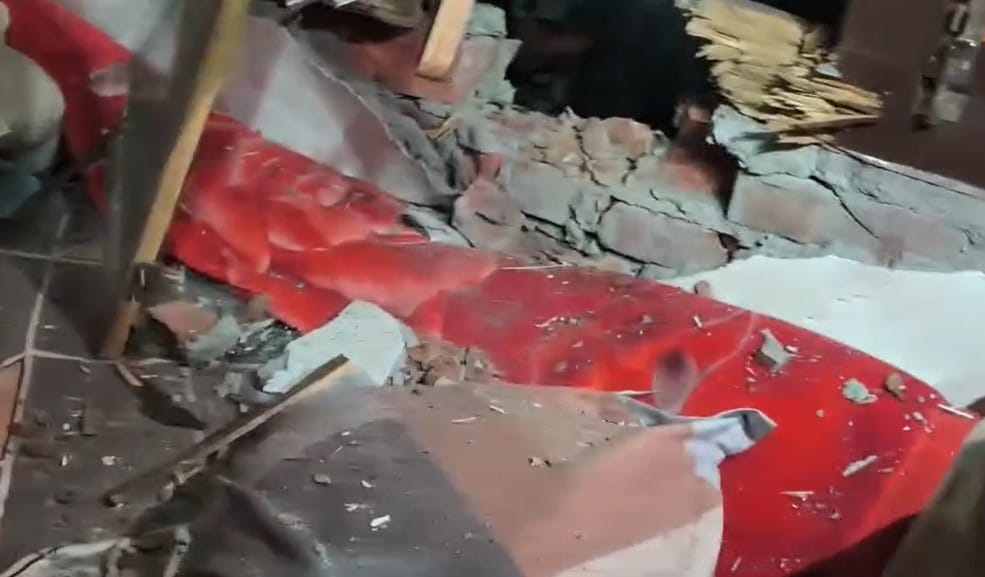
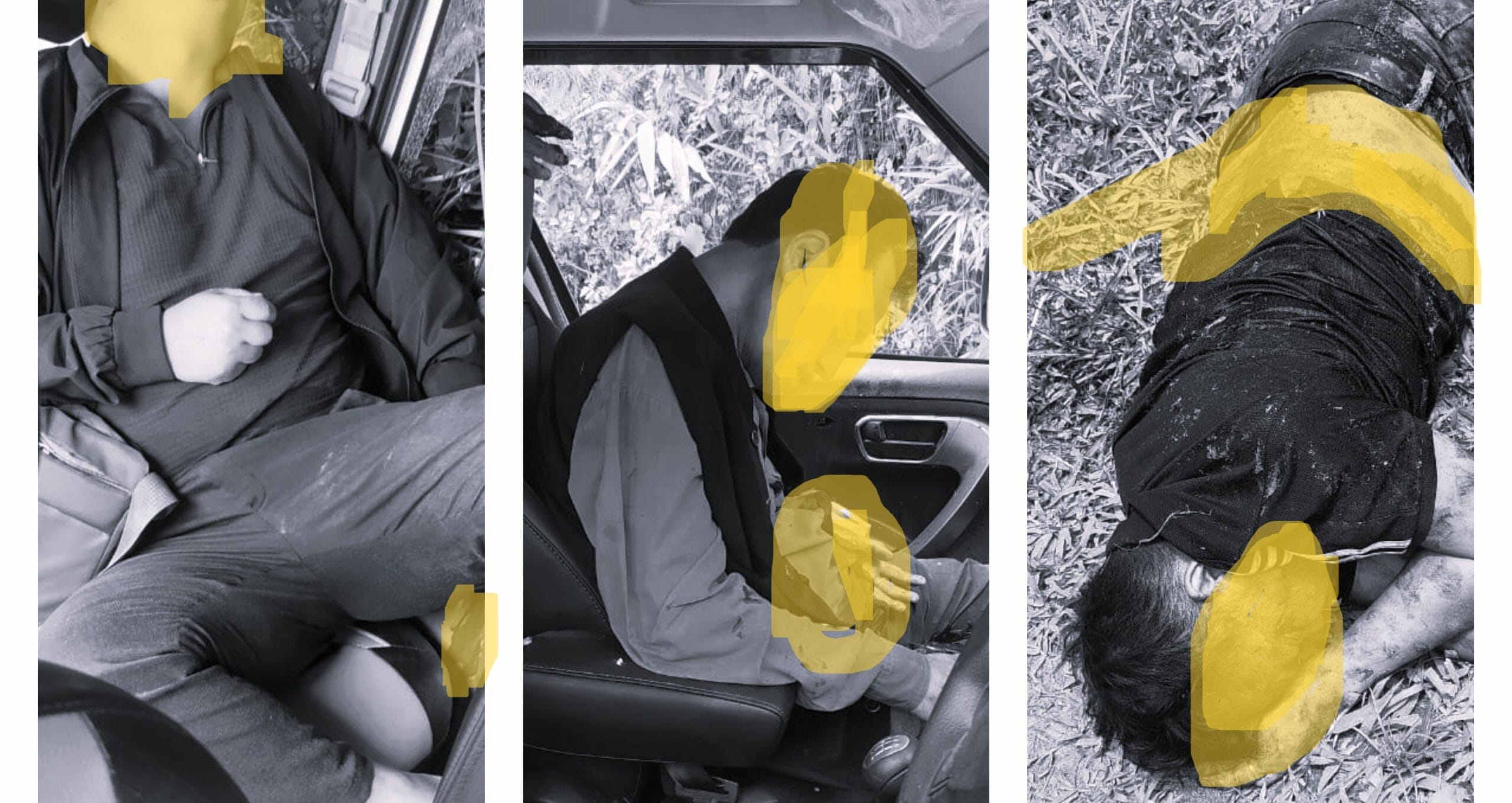
The Imphal Valley, particularly Bishnupur District, has been gripped by tension and rising public anger since early morning Tuesday (April 7, 2026), after the news of the killing of two children and their mother  in an improvised rocket/pompi attack.

According to sources, suspected Kuki militants launched a projectile—believed to be a rocket—targeting a civilian residence in Moirang Tronglaobi village. The explosive struck the house directly through a window, triggering a powerful blast that killed two young siblings and left their mother seriously injured.

Siblings Aged 5 Years and 5 Months Killed

The victims have been identified as a five-year-old boy, his five-month-old sister and their mother who later succumbed to injuries, as per sources from the locality. The explosion caused significant damage to the house and sent shockwaves across Imphal valley, with village residents rushing to the scene in an attempt to rescue the injured.

The children struck by the splinters of from the rocket blast being ruched to a nearby hospital. Source: Social Media


Locals claimed the projectile was fired from nearby hill slopes, suggesting that the launch point was located more than three kilometres away. Tronglaobi lies along the vulnerable hill-valley fringe near Moirang in Bishnupur district, close to the elevated areas of Churachandpur district, a region that has witnessed repeated tensions in since May 3, 2023.

Fury Spills into Streets – Police Station Gate Torched by Irate Mob

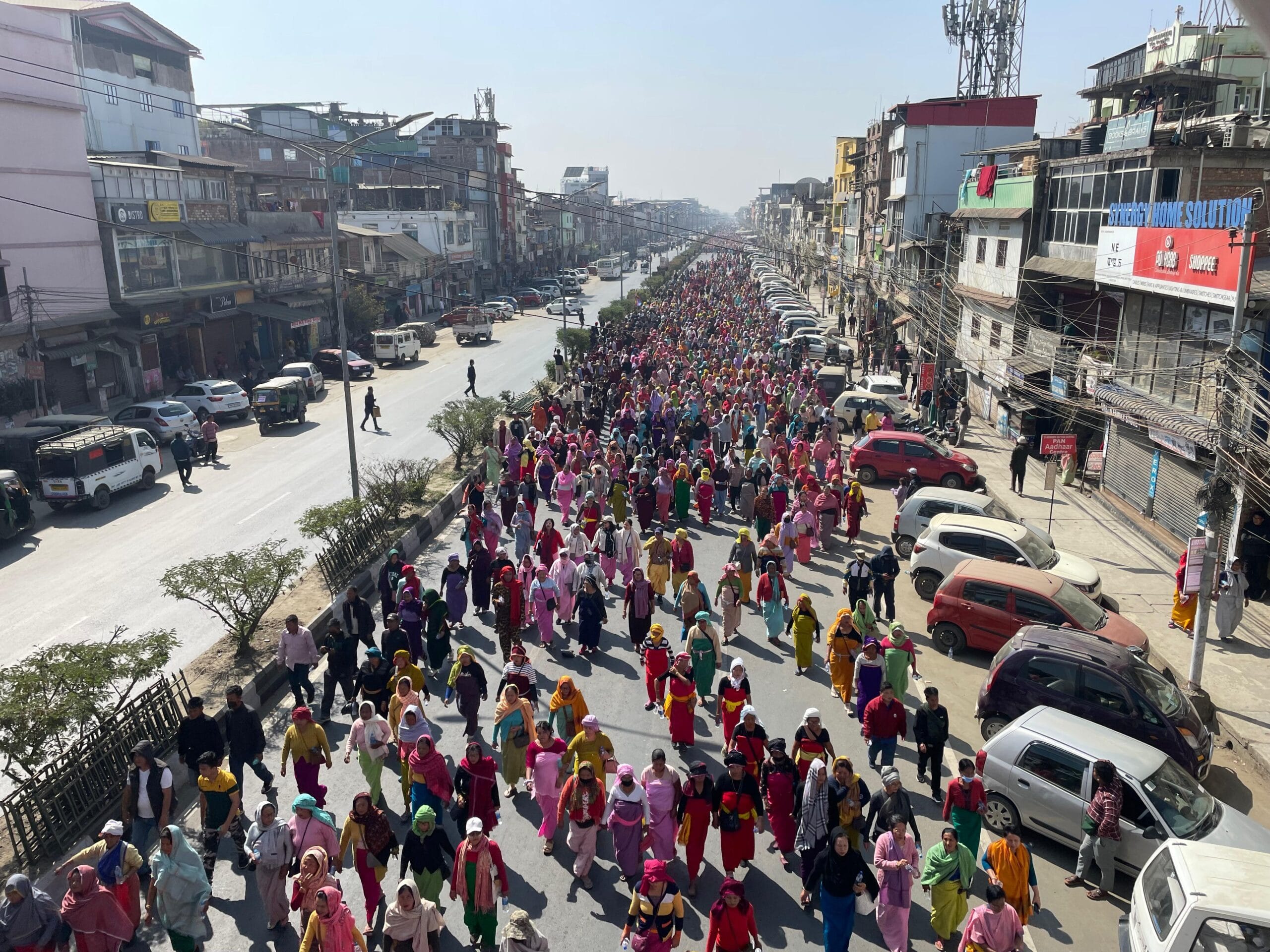
By post-dawn, irate mobs converged at the Moirang Police Station and burnt down the gate, as anger over the deaths of the two children boiled over. Reports are emerging that the incident is likely to trigger widespread protest and subsequent reactions across the valley, raising fears of a fresh spiral of violence.

Security Tightened – Forces Deployed Along Hill-Valley Boundary

As expected, security has been significantly tightened across the area following the attack, an act considered too late by the public. Additional forces have been deployed to prevent further escalation, while surveillance and search operations are underway in adjoining hill regions. Authorities are also closely monitoring other sensitive villages along the hill-valley boundary to avert any further incidents, said a source.

The post INNOCENT BLOODS SHED: Rocket Attack Kills Two Children & Severely Injures Mother, Imphal Valley Seized By Massive Tension first appeared on The Frontier Manipur.

Read more / Original news source: https://thefrontiermanipur.com/innocent-bloods-shed-rocket-attack-kills-two-children-severely-injures-mother-imphal-valley-seized-by-massive-tension/

INNOCENT BLOODS SHED: Rocket Attack Kills Two Children & Severely Injures Mother, Imphal Valley Seized By Massive Tension

Fresh Horror Struck Tronglaobi in Bishnupur District as Suspected Militant Strike Turns a Home into a Living Grave.   TFM Report The Imphal Valley, particularly Bishnupur District, has been gripped by tension and rising public anger since early morning Tuesday (April 7, 2026), after the news of the killing of two children and their mother  […]

The post INNOCENT BLOODS SHED: Rocket Attack Kills Two Children & Severely Injures Mother, Imphal Valley Seized By Massive Tension first appeared on The Frontier Manipur.

Fresh Horror Struck Tronglaobi in Bishnupur District as Suspected Militant Strike Turns a Home into a Living Grave.  

TFM Report

The Imphal Valley, particularly Bishnupur District, has been gripped by tension and rising public anger since early morning Tuesday (April 7, 2026), after the news of the killing of two children and their mother  in an improvised rocket/pompi attack.

According to sources, suspected Kuki militants launched a projectile—believed to be a rocket—targeting a civilian residence in Moirang Tronglaobi village. The explosive struck the house directly through a window, triggering a powerful blast that killed two young siblings and left their mother seriously injured.

Siblings Aged 5 Years and 5 Months Killed

The victims have been identified as a five-year-old boy, his five-month-old sister and their mother who later succumbed to injuries, as per sources from the locality. The explosion caused significant damage to the house and sent shockwaves across Imphal valley, with village residents rushing to the scene in an attempt to rescue the injured.

The children struck by the splinters of from the rocket blast being ruched to a nearby hospital. Source: Social Media


Locals claimed the projectile was fired from nearby hill slopes, suggesting that the launch point was located more than three kilometres away. Tronglaobi lies along the vulnerable hill-valley fringe near Moirang in Bishnupur district, close to the elevated areas of Churachandpur district, a region that has witnessed repeated tensions in since May 3, 2023.

Fury Spills into Streets – Police Station Gate Torched by Irate Mob

By post-dawn, irate mobs converged at the Moirang Police Station and burnt down the gate, as anger over the deaths of the two children boiled over. Reports are emerging that the incident is likely to trigger widespread protest and subsequent reactions across the valley, raising fears of a fresh spiral of violence.

Security Tightened – Forces Deployed Along Hill-Valley Boundary

As expected, security has been significantly tightened across the area following the attack, an act considered too late by the public. Additional forces have been deployed to prevent further escalation, while surveillance and search operations are underway in adjoining hill regions. Authorities are also closely monitoring other sensitive villages along the hill-valley boundary to avert any further incidents, said a source.

The post INNOCENT BLOODS SHED: Rocket Attack Kills Two Children & Severely Injures Mother, Imphal Valley Seized By Massive Tension first appeared on The Frontier Manipur.

Read more / Original news source: https://thefrontiermanipur.com/innocent-bloods-shed-rocket-attack-kills-two-children-severely-injures-mother-imphal-valley-seized-by-massive-tension/

INNOCENT BLOODS SHED: Rocket Attack Kills Two Children & Severely Injures Mother, Imphal Valley Seized By Massive Tension

Fresh Horror Struck Tronglaobi in Bishnupur District as Suspected Militant Strike Turns a Home into a Living Grave.   TFM Report The Imphal Valley, particularly Bishnupur District, has been gripped by tension and rising public anger since early morning Tuesday (April 7, 2026), after the news of the killing of two children and their mother  […]

The post INNOCENT BLOODS SHED: Rocket Attack Kills Two Children & Severely Injures Mother, Imphal Valley Seized By Massive Tension first appeared on The Frontier Manipur.

Fresh Horror Struck Tronglaobi in Bishnupur District as Suspected Militant Strike Turns a Home into a Living Grave.  

TFM Report

The Imphal Valley, particularly Bishnupur District, has been gripped by tension and rising public anger since early morning Tuesday (April 7, 2026), after the news of the killing of two children and their mother  in an improvised rocket/pompi attack.

According to sources, suspected Kuki militants launched a projectile—believed to be a rocket—targeting a civilian residence in Moirang Tronglaobi village. The explosive struck the house directly through a window, triggering a powerful blast that killed two young siblings and left their mother seriously injured.

Siblings Aged 5 Years and 5 Months Killed

The victims have been identified as a five-year-old boy, his five-month-old sister and their mother who later succumbed to injuries, as per sources from the locality. The explosion caused significant damage to the house and sent shockwaves across Imphal valley, with village residents rushing to the scene in an attempt to rescue the injured.

The children struck by the splinters of from the rocket blast being ruched to a nearby hospital. Source: Social Media


Locals claimed the projectile was fired from nearby hill slopes, suggesting that the launch point was located more than three kilometres away. Tronglaobi lies along the vulnerable hill-valley fringe near Moirang in Bishnupur district, close to the elevated areas of Churachandpur district, a region that has witnessed repeated tensions in since May 3, 2023.

Fury Spills into Streets – Police Station Gate Torched by Irate Mob

By post-dawn, irate mobs converged at the Moirang Police Station and burnt down the gate, as anger over the deaths of the two children boiled over. Reports are emerging that the incident is likely to trigger widespread protest and subsequent reactions across the valley, raising fears of a fresh spiral of violence.

Security Tightened – Forces Deployed Along Hill-Valley Boundary

As expected, security has been significantly tightened across the area following the attack, an act considered too late by the public. Additional forces have been deployed to prevent further escalation, while surveillance and search operations are underway in adjoining hill regions. Authorities are also closely monitoring other sensitive villages along the hill-valley boundary to avert any further incidents, said a source.

The post INNOCENT BLOODS SHED: Rocket Attack Kills Two Children & Severely Injures Mother, Imphal Valley Seized By Massive Tension first appeared on The Frontier Manipur.

Read more / Original news source: https://thefrontiermanipur.com/innocent-bloods-shed-rocket-attack-kills-two-children-severely-injures-mother-imphal-valley-seized-by-massive-tension/

Stolen years of Manipur’s history ?

Today, Manipur stands fractured. What is often described as “ethnic violence” between Meiteis and Kukis has stretched into its third year, with no clear end in sight. Highways remain blockaded, normal life is suspended, and an entire generation of young people is growing up amid fear, displacement, and uncertainty. By Leichombam Kullajit Manipur’s present tragedy […]

The post Stolen years of Manipur’s history ? first appeared on The Frontier Manipur.

Today, Manipur stands fractured. What is often described as “ethnic violence” between Meiteis and Kukis has stretched into its third year, with no clear end in sight. Highways remain blockaded, normal life is suspended, and an entire generation of young people is growing up amid fear, displacement, and uncertainty.

By Leichombam Kullajit

Manipur’s present tragedy is not merely a clash of communities; it is the cumulative outcome of years of political manipulation, calculated neglect, and strategic opportunism. What is unfolding today is not an accident of history, but the consequence of choices long made and quietly sustained.
The Government of India is well aware that a significant portion of the Kuki population in Manipur traces its origins to cross-border migration from Myanmar, facilitated by the porous and forested frontiers of Mizoram and Manipur. It is also aware of the harsh realities many of these migrants face—precarious living conditions, economic marginalisation, and the pervasive influence of criminal networks, including drug trafficking, in the region across the eastern border.
Yet, instead of addressing these vulnerabilities through meaningful development, rehabilitation, and integration, the Indian state chose a different path. It identified grievance as an instrument and despair as a resource. These marginalised communities were not uplifted; they were used—deployed as strategic proxies in the state’s long-standing effort to counter insurgencies it perceived as existential threats, particularly those involving Meitei and Naga movements in the northeastern subcontinent.


This reality is not lost on the Kukis themselves. They understand the nature of their exploitation and the unspoken bargain it entailed: compliance in exchange for recognition, protection, and the distant promise of political accommodation. It is within this context that the Suspension of Operations (SoO) agreement of 2008 must be understood.
Many continue to ask how nearly 25 armed Kuki militant organisations—fragmented along clan lines—could suddenly emerge under the banner of defending the Indian Constitution. Unlike Meitei or Naga insurgent groups, which evolved over decades in open defiance of the Indian state, these organisations appeared abruptly, accepted constitutional legitimacy, and entered into SoO arrangements with remarkable ease. Prior to the 1990s, there were no consolidated Kuki militant platforms such as the KNO or UPF, nor were there articulated political demands of comparable scale. This raises an unavoidable question: on what basis did the Indian Army negotiate a Suspension of Operations with groups that posed no direct challenge to the territorial integrity of the country?
The answer, many believe, lies in a strategic calculation. For New Delhi, the principal obstacle was never the Kukis or their armed groups—it was the entrenched political aspirations of the Meiteis and the Nagas. In that equation, the Kukis became a convenient counterweight.
Today, Manipur stands fractured. What is often described as “ethnic violence” between Meiteis and Kukis has stretched into its third year, with no clear end in sight. Highways remain blockaded, normal life is suspended, and an entire generation of young people is growing up amid fear, displacement, and uncertainty. Under these circumstances, it is reasonable to ask whether the crisis has been allowed—perhaps even engineered—to linger, quietly stealing the future of Manipur’s youth and erasing irreplaceable chapters of its history.
Political games may succeed for a time, but they cannot endure indefinitely. If the Government of India genuinely seeks peace, stability, and justice in Manipur, it must abandon short-term tactical thinking and confront the deeper causes of the conflict it helped shape. Otherwise, the burden of this unresolved crisis will not only continue to devastate Manipur—it will return, heavier and more complex, to the very state that once believed it could control the outcome.

( Leichombam Kullajit is a senior jounalist based in Imphal.)

The post Stolen years of Manipur’s history ? first appeared on The Frontier Manipur.

Read more / Original news source: https://thefrontiermanipur.com/stolen-years-of-manipurs-history/

ST Demand Issue: Positive discrimination, affirmative action and the cracks within

India’s reservation policy has spawned forms of conflicting categories of the ‘exploiter’ and the ‘exploited’, the ‘dominant’ and the ‘subservient’ as if these binaries exist in a permanent cycle sans the dynamics of wresting political power at play. By Dhiren A. Sadokpam In recent times, the political elites of three primary ethnic groups in Manipur […]

The post ST Demand Issue: Positive discrimination, affirmative action and the cracks within first appeared on The Frontier Manipur.

India’s reservation policy has spawned forms of conflicting categories of the ‘exploiter’ and the ‘exploited’, the ‘dominant’ and the ‘subservient’ as if these binaries exist in a permanent cycle sans the dynamics of wresting political power at play.

By Dhiren A. Sadokpam

In recent times, the political elites of three primary ethnic groups in Manipur are caught in a whirlpool of anxiety propelled by palpable dissonance in political objectives. This anxiety is not necessarily triggered by the differences in speculative autonomy-demands or even demands based on administrative separatism.

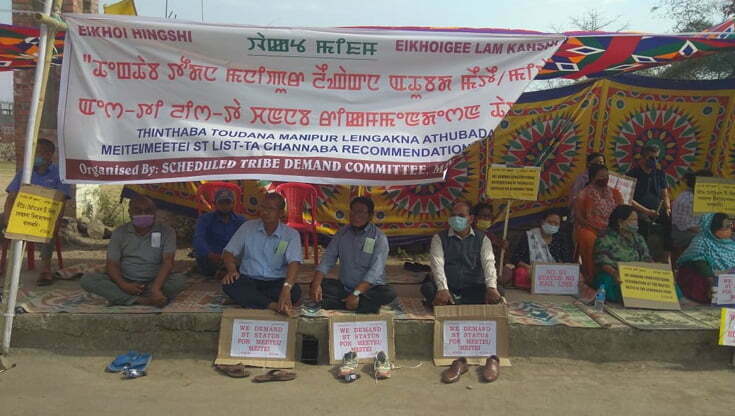
The main anxiety has been caused by the way how the communities have effectively understood the political ideas behind positive discrimination, affirmative action or what in the Indian subcontinent is being referred to as the reservation policy of communities that have apparently lagged behind in holistic development. The most recent play-out that has triggered the spells of anxiety and tension has been the demand of a community considered advanced in comparison to its neighbours, to be included in the Scheduled List of Tribes in India.

While the proponents of the demand and those opposing the same have resorted to socio-political and historical reasoning, both the parties seem to have skipped re-looking at either redefining or refining the concepts they would love to toy with. One is not sure if both the conflicting parties have understood that India’s reservation policy presupposes a social fact – centuries of oppression of one group by another. This presupposition assumes a determinate but constant ‘unchanging oppressor and oppressed’ and ‘advanced’ and ‘backward’ communities. The ‘constant’ is supposedly created by a social order that determined identities of each castes, communities and tribes. This has spawned forms of conflicting categories of the ‘exploiter’ and the ‘exploited’, the ‘dominant’ and the ‘subservient’ as if these binaries exist in a permanent cycle in all societies sans the dynamics of wresting political power at play.

For the mainland India, these terms are defined in relation to the hereditary caste order whereas for Northeast India, the same has been defined by amorphous understandings of communities guided by colonial agenda of the British whose administrators first chose to categorize people from the mixed-prism of the caste order or an anthropological understanding of a system which they considered was durable.

It is against this backdrop that United Naga Council, Manipur (UNC) and the Kuki Inpi Manipur (KIM) have raised objections to the Manipur High Court’s directive to the Government of Manipur to send its recommendation for the inclusion of Meetei Community in the list of Scheduled list of Tribes to the Government of India. The directive of the high court was passed on March 27.

Strident Voices and Social Tension

The UNC stated that “the Meitei/Meetei community of Manipur is an advanced community of India” with their language, Manipuri (Meiteilon) listed in the Eight Schedule to the constitution of India.

“They are already protected under Constitution of India and categorized as (i) General (ii) Other Backward Classes (OBC) and (iii) Schedule Caste (SC),” said the UNC.

UNC termed it irrational that the High Court of Manipur directed the Government of Manipur to recommend for inclusion of Meitei/Meetei community in the Scheduled Tribe (ST) list of India, “negating the sole objective of scheduling group of people for protective discrimination as ST in the Constitution of India”. The Naga body has strongly condemned and called the high court order “inane” for making “such imbecilic recommendation despite strong opposition from Scheduled tribes of the state”.

The common refrain and rationale behind the objections raised by both UNC and KIM has been rubbished by the proponents of those demanding a Scheduled Tribe status for the Meetei community. One strident voice has been that of the Kangleipak Kanba Lup (KKL). KKL has critiqued the objections in their own characteristic way stating that the demand for the inclusion of Meetei in the Scheduled list of Tribes in the Constitution of India is not aimed at grabbing “jobs” either from the Naga or Kuki communities of Manipur. It has asserted that the demand is based on safeguarding their “little bit of land” now confined to less than 2000 square kilometers out of the 20,000 square kilometers of the entire state of Manipur.

The KKL has made it clear that the Naga and the Kuki communities need not fear about grabbing “their job reservation quotas currently enforced in Manipur which will remain status quo”. The organization also unequivocally asserted that the UNC and KIM have “no birth right” to deny any other scheduled tribes of India that job opportunity.

The KKL had a message for the UNC too. It reiterated that the Manipuri Language being classified as scheduled languages of India under the Eight Schedule has nothing to do with the classification of the Meetei as a scheduled tribe of India. “Anyway Manipuri language is not confined to the Meeteis only but serves as a Lingua Franca amongst all the tribal communities of Manipur be it between the Nagas and the Kukis but amongst their various sub-tribes also”, it pointed out.

Moreover, the UNC has also been reminded that it was Th Muivah, the top National Socialist Council of Nagalim (NSCN-IM) leader who had stated that “only the Nagas and the Meeteis are the indigenous peoples” of Manipur. KKL asked, “So what is the idea of joining hands with the Kukis to block the way for the survival of the Meeteis under the Indian Constitution”. To the question of Meeteis being more advanced than the other tribes of Manipur, KKL asserted that it has nothing to do with genealogy but “mode of production” experienced by the communities.

The Meetei community began to practice settled agriculture and had more time to concentrate on arts, culture and literature while the hill tribes hitherto used to follow a different form of agriculture “before switching to poppy plantation” in recent times that had made them “all become rich”, said KKL.

The organization winded up their statement on a harsher note stating that it would be wrong on the part of both the Naga and the Kuki communities to consider the Meetei community as their “common enemy or else will be constrained to  oppose every move or demand made by any tribal group either Naga or Kuki”.

The exchange of statements may not lead towards a reconciliation on the sensitive topic. As the articulation of the issue by those supporting the demand for inclusion of Meetei in Scheduled Tribe list up the ante on their movement, the objections by Naga and Kuki tribal bodies may get shriller by the day.

Empowerment and Social Justice

In all these voices, what has been missed is a dispassionate inter-community/ethnic group deliberation on what would be the best option for all communities to progress and under what protective or empowering mechanism. While the fact of discrimination cannot be denied in one’s everyday experience, ethnicization or communalization of the issue would only create unbridgeable distance between communities. Under such circumstances, one will not be able to project the fact that there are no permanent oppressor and permanent oppressed or instil the fact that the idea of permanent and constant binaries will lead to over-generalization of a theoretical framework to achieve quick practical results.

What is of utmost importance now is truly and honestly grasping the fact that emancipating the socially underprivileged and the marginalized irrespective of community or tribal affiliation or within the same community is a move towards social justice. While doing so, one should not forget that the idea of empowerment of the individual has a far greater value and virtue than a protective mechanism that tends to perpetuate redundant binaries or historical contradictions.

Here, it should also be noted that India’s reservation policy emerged out of a deep flaw in understanding the complex relationship between the conceptions of the ‘cultural/social’ and the ‘economic’. Having said this, elsewhere, this writer had also argued that the stereotyping of the Meetei as a Hindu society both within Manipur and outside, in the image of mainland Hindu ethos and practices has manufactured the idea of the ‘constant exploiter’ and the ‘constant exploited’ in Manipur.

While Hinduised Meeteis have been identified with the former, all other non-Hindu communities are shown as ‘exploited’. Such is the handiwork of those who harp on the ‘politics of divide’ and benefit from it; and endorsed by the ‘ignorant other’ who is happy to own up anything that comes closer to the intolerant and imagined pan-Indian vision.

(Dhiren A. Sadokpam is Editor-in-Chief, The Frontier Manipur. This article was first published by EastMojo under the title ‘ST demand for Meetei: First, acknowledge the cracks within’)


The post ST Demand Issue: Positive discrimination, affirmative action and the cracks within first appeared on The Frontier Manipur.

Read more / Original news source: https://thefrontiermanipur.com/st-demand-issue-positive-discrimination-affirmative-action-and-the-cracks-within/

Making their stand known : On collision course

The decision to create the seven new districts cannot be rolled back. This was Chief Minister N Biren a few days back. A party engaged in the tripartite talks is intentionally trying to sabotage the ongoing dialogue on the district creation issue. This was the United Naga Council. The UNC did not name the State […]

The decision to create the seven new districts cannot be rolled back. This was Chief Minister N Biren a few days back. A party engaged in the tripartite talks is intentionally trying to sabotage the ongoing dialogue on the district creation issue. This was the United Naga Council. The UNC did not name the State […]

Read more / Original news source: http://kanglaonline.com/2017/07/making-their-stand-known-on-collision-course/

Next talk should be held by June 19 : UNC

Newmai News Network SENAPATI, Jun 9: With just 10 days to go for the deadline of the one month’s time within which the ‘tripartite talks’ on the district creation issue was agreed upon to be held at the political level, the United Naga Council (UNC) today asserted that there should be a ‘time frame’ for […]

Newmai News Network SENAPATI, Jun 9: With just 10 days to go for the deadline of the one month’s time within which the ‘tripartite talks’ on the district creation issue was agreed upon to be held at the political level, the United Naga Council (UNC) today asserted that there should be a ‘time frame’ for […]

Read more / Original news source: http://kanglaonline.com/2017/06/next-talk-should-be-held-by-june-19-unc/

Modi and Naga peace talk

IMPHAL, May 14 : ‘Modi Walking on Elusive Naga Peace’, a book authored by Nagaland based journalist Oken Jeet Sandham was released today at State Information Centre, Palace Gate here.

The post Modi and Naga peace talk appeared first on The Sangai Express.

IMPHAL, May 14 : ‘Modi Walking on Elusive Naga Peace’, a book authored by Nagaland based journalist Oken Jeet Sandham was released today at State Information Centre, Palace Gate here.

The post Modi and Naga peace talk appeared first on The Sangai Express.

Read more / Original news source: http://www.thesangaiexpress.com/modi-naga-peace-talk/

Manipuri is a classical language

Free Thinker What is the oldest language in the world? Historians remain inconclusive and indifferent because of fragile and conflicting evidences. However, we can mention some of the oldest languages like – Hebrew, Harappan, Mesopotamian, Mayan, Sanskrit, Prakrit, Chinese, Tamil, Egyptian, Nordic, Latin, Greek, Tibetan, Persian, Africans and many others. Of course, Manipuri is also one […]

Free Thinker What is the oldest language in the world? Historians remain inconclusive and indifferent because of fragile and conflicting evidences. However, we can mention some of the oldest languages like – Hebrew, Harappan, Mesopotamian, Mayan, Sanskrit, Prakrit, Chinese, Tamil, Egyptian, Nordic, Latin, Greek, Tibetan, Persian, Africans and many others. Of course, Manipuri is also one […]

Read more / Original news source: http://kanglaonline.com/2017/04/manipuri-is-a-classical-language/

Manipur during 1960s

About Manipur: Manipur is a state in northeastern India, with the city of Imphal as its capital. It is bounded by Nagaland to the north, Mizoram to the south, and Assam to the west; Burma (Myanmar) lies to its east. The state covers an area of 22,327 square kilometres (8,621 sq mi) and has a […]

About Manipur: Manipur is a state in northeastern India, with the city of Imphal as its capital. It is bounded by Nagaland to the north, Mizoram to the south, and Assam to the west; Burma (Myanmar) lies to its east. The state covers an area of 22,327 square kilometres (8,621 sq mi) and has a […]

Read more / Original news source: http://kanglaonline.com/2017/03/manipur-during-1960s/

Looking along community divide For administrative convenience

Four major communities in Manipur. The Meitei, Naga, Kuki and Pangal. The population as per the 2011 Census is 28,55,794 and the geographical area of the State is 22,327 square kilometres. For 28,55,794 people stretched over an area of 22,327 square kilometres, Manipur has nine districts, Bishnupur, Chandel, Churachandpur, Imphal East, Imphal West, Senapati, Tamenglong, […]

Four major communities in Manipur. The Meitei, Naga, Kuki and Pangal. The population as per the 2011 Census is 28,55,794 and the geographical area of the State is 22,327 square kilometres. For 28,55,794 people stretched over an area of 22,327 square kilometres, Manipur has nine districts, Bishnupur, Chandel, Churachandpur, Imphal East, Imphal West, Senapati, Tamenglong, […]

Read more / Original news source: http://kanglaonline.com/2016/11/looking-along-community-divide-for-administrative-convenience/

Naga issue to be resolved once and for all : Rajnath Singh

NEW DELHI, Nov 5 : The ongoing Naga peace talks have made good progress and the decade-long insurgency issue will be resolved to the greatest satisfaction of all, Union Home Minister Rajnath Singh said on Saturday. Addressing the annual event of the Na…

NEW DELHI, Nov 5 : The ongoing Naga peace talks have made good progress and the decade-long insurgency issue will be resolved to the greatest satisfaction of all, Union Home Minister Rajnath Singh said on Saturday. Addressing the annual event of the Naga Students Union, Delhi (NSUD) in New Delhi, Singh said the Central Government was confident that enduring peace in Naga areas is not far away.

The post Naga issue to be resolved once and for all : Rajnath Singh appeared first on The Sangai Express.

Read more / Original news source: http://www.thesangaiexpress.com/naga-issue-resolved-rajnath-singh/

Peace talks on the verge of final solution : NSCN (IM) Settle our case first : Kuki bodies

IMPHAL, Sep 1 : In the face of the NSCN (IM) recently announcing that the peace talk with the Government of India is on the verge of a final solution, the Kuki Inpi (Revived Apex Body) and Kuki Movement for Human Rights Trust have submitted a joint memorandum to Prime Minister Narendra Modi to first […]

The post Peace talks on the verge of final solution : NSCN (IM) Settle our case first : Kuki bodies appeared first on KanglaOnline.

IMPHAL, Sep 1 : In the face of the NSCN (IM) recently announcing that the peace talk with the Government of India is on the verge of a final solution, the Kuki Inpi (Revived Apex Body) and Kuki Movement for Human Rights Trust have submitted a joint memorandum to Prime Minister Narendra Modi to first […]

The post Peace talks on the verge of final solution : NSCN (IM) Settle our case first : Kuki bodies appeared first on KanglaOnline.

Read more / Original news source: http://kanglaonline.com/2016/09/peace-talks-verge-final-solution-nscn-im-settle-case-first-kuki-bodies/

Peace talks on the verge of final solution : NSCN (IM) Settle our case first : Kuki bodies

IMPHAL, Sep 1 : In the face of the NSCN (IM) recently announcing that the peace talk with the Government of India is on the verge of a final solution, the Kuki Inpi (Revived Apex Body) and Kuki Movement for Human Rights Trust have submitted a joint memorandum to Prime Minister Narendra Modi to first […]

The post Peace talks on the verge of final solution : NSCN (IM) Settle our case first : Kuki bodies appeared first on KanglaOnline.

IMPHAL, Sep 1 : In the face of the NSCN (IM) recently announcing that the peace talk with the Government of India is on the verge of a final solution, the Kuki Inpi (Revived Apex Body) and Kuki Movement for Human Rights Trust have submitted a joint memorandum to Prime Minister Narendra Modi to first […]

The post Peace talks on the verge of final solution : NSCN (IM) Settle our case first : Kuki bodies appeared first on KanglaOnline.

Read more / Original news source: http://kanglaonline.com/2016/09/peace-talks-verge-final-solution-nscn-im-settle-case-first-kuki-bodies/

Looking at the major issues of the land Glaring differences

The demand that the Inner Line Permit System or a similar mechanism to protect the indigenous people of the land be enforced in the State. The staunch opposition against the three Bills passed by the State Assembly last year on August 31, resulting in the death of nine people in Churachandpur, with the bodies still […]

The post Looking at the major issues of the land Glaring differences appeared first on KanglaOnline.

The demand that the Inner Line Permit System or a similar mechanism to protect the indigenous people of the land be enforced in the State. The staunch opposition against the three Bills passed by the State Assembly last year on August 31, resulting in the death of nine people in Churachandpur, with the bodies still […]

The post Looking at the major issues of the land Glaring differences appeared first on KanglaOnline.

Read more / Original news source: http://kanglaonline.com/2016/09/looking-major-issues-land-glaring-differences/

The vacuum Swu left

The death of Isak Chishi Swu, the Chairman of the National Socialist Council of Nagalim, NSCN(IM) and President of the underground Government of the People’s Republic of Nagaland, GPRN, without question would mean a new chapter and with it new uncertainties for the former underground organisation now engaged in a peace negotiation with the Government […]

The post The vacuum Swu left appeared first on KanglaOnline.

The death of Isak Chishi Swu, the Chairman of the National Socialist Council of Nagalim, NSCN(IM) and President of the underground Government of the People’s Republic of Nagaland, GPRN, without question would mean a new chapter and with it new uncertainties for the former underground organisation now engaged in a peace negotiation with the Government […]

The post The vacuum Swu left appeared first on KanglaOnline.

Read more / Original news source: http://kanglaonline.com/2016/06/vacuum-swu-left/

Five Hohos of Nagaland urge Center to resume two laning road constructions immediately

KOHIMA, Jun 23 (NEPS): The five tribal Hohos – Phom Peoples’ Council, Sumi Hoho, Chakhesang Public Organization, Ao Senden and Konyak Hoho – have come down heavily on the indifferent attitude and the step-motherly treatment to the people of Nagaland. They said by not resuming the construction of two laning road projects in the State, […]

KOHIMA, Jun 23 (NEPS): The five tribal Hohos – Phom Peoples’ Council, Sumi Hoho, Chakhesang Public Organization, Ao Senden and Konyak Hoho – have come down heavily on the indifferent attitude and the step-motherly treatment to the people of Nagaland. They said by not resuming the construction of two laning road projects in the State, […]

Read more / Original news source: http://kanglaonline.com/2016/06/five-hohos-of-nagaland-urge-center-to-resume-two-laning-road-constructions-immediately/

Nagaland Post: Nagaland-Manipur peace working committee formed

A working committee to assist in addressing crucial issues confronting the people of Manipur and Nagaland has been formed at the conclusion of the two-day workshop of peace activists of Manipur and Nagaland at the Life Spring Corner here Saturday. The morning session began with the release of the book by Editor Nagaland Post Geoffrey […]

A working committee to assist in addressing crucial issues confronting the people of Manipur and Nagaland has been formed at the conclusion of the two-day workshop of peace activists of Manipur and Nagaland at the Life Spring Corner here Saturday. The morning session began with the release of the book by Editor Nagaland Post Geoffrey […]

Read more / Original news source: http://kanglaonline.com/2016/05/nagaland-post-nagaland-manipur-peace-working-committee-formed/