
SHDDC Issue Hon`ble! The CM? Hammer Is In Your Hands Strike The Bell `“ But You Have To Pull The Bell Closer Here

Author Means Bell – The People By RS Jassal It is an open fact that every type of people in Manipur want the problem of Sadar Hills to be settled… Read more »

Author Means Bell – The People
By RS Jassal
It is an open fact that every type of people in Manipur want the problem of Sadar Hills to be settled permanently without further loss of time.  Everyone appreciates that economic blockades, bandhs and destruction of public property do not benefit anyone.  It only adds to the sufferings of the people especially those who are not in viable position to secure Government protection.  The author feels encouraged when reads about opinion of some Naga leaders that district may be created but with mutual discussions and consent.  There is also no doubt that discussions have been held earlier too, hard points moulded to reduced repugnancy, and perhaps  it was because of those worthy efforts in the past which prompted previous Ministries led by Y. Shaiza, Rishang Keishing Nipamacha to declare that Sadar Hills District must be created as Revenue District taking various odds into consideration.  It is believed that maximum had been done by Rishang Ministry and Nipamacha Ministry which made it convenient to upgrade all the deptts under ADC Sadar Hills and they are almost functioning like a District in virtue.

However, following fears among the minds of some Naga people appear to be creating doubts and suspicions causing recurrent terminals:-That a certain portions or the considerable portion of land/ jungles belonging to Nagas will go away under control of Kuki’s for their possession permanently.  With the expansionism in the number of villages of Kuki`s as brought out by some Naga Research scholars may reduce Nagas to minority in their own ancestral lands. Kuki`s  are asking for certain areas to be included where there are no habitation at all in miles around ranging from 20-30 miles. Though (a) and (b) can be equated with archaic psychic think tank but definitely fear of powerful Naga UG organisation to affect Nagalim is there. Areas belong to people who live there it may be Nagas, Kuki`s, Meitei’s and Gorkhas too. Fear of political imbalance in future may happen as democracy breeds on numbers game.  Similar factors are affecting creation of Jiribam as a district when Nagas proclaim areas from their Sub Division
will not be given. New demands of Tengnuopal and Phungyar as districts are in the offing depending on the decision on Sadar Hills.  It is worth to  recall that as CM, Rishang Keishing had put up the statute on Sadar Hills duly approved by his cabinet for obtaining signatures and seal of His Excellency, the then  Governor of Manipur. Same was withdrawn within few days under threat from some powerful UG organization or otherwise is difficult to say. But it is true it was to avoid the repercussions from the various Naga organizations. It is also crystal clear that Nagas and Kuki’s enjoy the same constitutional privileges so far protection of lands and right to live is concerned but governance of lands under chiefship of Kuki & Village Headman under Naga system differs.  People have been staying together observing their own systems since times immemorial and will continue doing so in future to come is also a palpable fact in realty till Autonomous District Councils get entrenched and the system of Chief/Headmen gets modified or quashed completely.

Theoretically some research scholars compare village of a Naga and a Kuki as yardstick to measure expansionism ignoring that average Naga village is at least 50% and at places even more than cent percent bigger than any Kuki village.  Perhaps Lacuna lied and is still there in permission being granted by Govt. to do so since British times to establish any village with minimum 25 households or so / above provided no objection from surrounding village chiefs/Head men. So a graph of increase in population need be taken than the number of increase in villages.  Population now stands closer to each other. This problem can be overcome if meaning full bodies from Kukis and Nagas extend sincere and closer co-operation in preparation of National Census Register on population with the Unique identification Card issued to one and all.

In view of the above, the Hon’ble chief minister in capacity of his exalted, unbiased and most respected office, must gather courage and bang the bell telling with full force announcing: SADAR HILL district and JIRIBAM district will be declared within 90 to 120 days, and Tengnoupal – Phunygar districts in the offing will follow suite WHY?? People understand reasons fully well for inherent historicos – social and Politicos accumulating since centuries due to flawed policies that this was bound to happen for present generation to confront it. Some of the factors affecting current situation can be understood better: look at the map prepared by Britisher (Ref TC Hudson – MEITHEIS) right form Cooch Behar – to Yangoon including then NEFA- NAGA HILLS and surrounding areas. Viewer will fail to understand where which community/tribe starts/ ends, each overlaps and even over jumps others just like when you look down from aero plane where and  which state of NE in particular starts and ends. There were no well demarcated borders except gaps posed by apparent ending of valley and commencement of uphill slopes fortified with linguistic divides. The nomad tribes compelled by hunger, search for green lands and due political kickings kept on moving in and out into  others ‘lambersum’ and occupied vast unoccupied areas, somewhere Rajas brought to serve his  agendas, some where Britishers created British reserves and allotted areas to their loyals.  This trans   village boundary moves have remained in vogue even at International Borders till recently stopped by insurgents occupied border junction points for their moves and controls. Naga insurgency however cautioned the minor tribes and forced them to groupings with some strong groups secretively though to start with. 1990s Naga Kuki skirmishes ended in hundreds losing their lives & many villages getting upstuck.  At places where Nagas were in strength grabbed paddy fields belonging to Kuki’s and at places by Kuki’s in vice the versa situation. With ‘outsiders go’ call  by valley based insurgent groups in valley in 1980’s forced the Nepalese (Now Indian Gurkhas) to get grouped in area Kanglatombi- Kalapahar- Irangpat I& Irangpat II. This factor is also affecting the horoscope of Sadar Hills though not immediately. But how long will you ignore? Can you? Not at all.

What CM needs doing now:-
Prevail on blockade organizers to end this blockade, indicating breathing time as said before with declaration Sadar Hills & Jiribam districts will be formed for administrative convenience.
• Constitute a super council of all Nagas – Kuki’s (former and present legislator’s councilors only)   and two to four representatives from Church from both the tribes to work out on demarcation of areas and where absolutely necessary Kuki’s should also be prevailed upon to agree to  keep areas out to make Sadar Hill District compact and smooth administration  worthy.
• Reorganized districts should be people oriented and not ethnicity based, since it does not affect the constitutional privileges of tribals even if they are grouped with non tribals for easy and smooth administration. Gorkhas, Kuki’s, Nagas, Meitei’s in Sadar Hill can be an ideal district to start with.
• After these four districts as have been indicated in this write-up, other districts may also be modified for administrative ease and comforts So that lateral roads can come up and developmental activities speed up.

Conclusion   
With the bold step and with Nepalese (Indian Gurkhas) factor stitched in Sadar Hills it can be an ideal revenue district to enable persons like late Maj. Bob Khatting MC, Padmshree a Tangkhul to win political Assembly seat from Kangpokpi constituency and dreams of persons like Kishore Thapa who got elected as MLA for three consecutive terms from same constituency can also be re- realized. Gurkhas are still fighting from Kangpokpi constituency as candidate who are neither ST nor SC but constituency still remains ST. Isn’t it worth a matter of research topic? All hopes and aspirations for peace in Manipur are now rivetted on the hammer in the hands of Hon’ble CM,   Sh O Ibobi Singh! This hide and seek policy must end. Time comes when such friendly players though, have to come face to face each other in smile. And that TIME has now come. Let us not miss the opportunity.

Two Fasts Too Far Apart
Sharmila’s response to the invitation by Team Anna to join the hunger strike campaign to make the Union government introduce a legislation in Parliament to constitute a statutory people’s ombudsman aimed at curbing official corruption effectively, was measured and mature. The invitation was obviously an afterthought following many comparisons and questions raised in the media about the public clamour over the fast by Anna Hazare and the lack of it in the case of Sharmila who had been on a fast for a record 10 years and still counting. It is unlikely Team Anna did not know the facts of Sharmila’s status as a jail inmate and for this reason it was not totally up to her individual volition to participate in their protest strike in New Delhi. The invitation in this sense was, so to say, a token gesture, or the biblical fig leaf, to cover up what was increasingly becoming an uneasy embarrassment. It was interesting to note how a great section of the media in the Northeast rallied behind Sharmila in varying shades of outrage calling for parity of concern of the Indian public in the two cases. There was also a good section of the national media, lead from the front by Chennai headquartered The Hindu, constantly reminding the Indian public of the difference in their reception of the two cases. Most memorable of all was well known social activist, author of Booker Prize winning novel “God of Small Things” and acknowledged champion of the underdogs in the Indian state’s assimilative nationalising mission, Arundhati Roy, who lent her voice to highlight this discrepancy further. The main thrust of her hard hitting articles derided the public hysteria over the campaign against corruption as this looked only at official corruption and not that of the corporate world or for that matter the corporate media, the indication of which became quite stark after scandals like the infamous Radia tapes expose.

Sharmila was humble in her reply. She wholeheartedly expressed her solidarity with Anna Hazare’s campaign but expressed her inability to join him and his team because of her internship in a Manipur jail. She instead invited Team Anna to visit Manipur, which she described as the most corrupt of all Indian states. Her last jab should have had the sting intended. Manipur must rank as the state with one of the most corrupt official establishment. From the lowly fourth grade employees to the top bosses in the political leadership and bureaucracy, all have collectively and in a collaborative manner, ensured that corruption is entrenched not just into the system but in the psyche of the people. Even the most humble citizen today talks with a clear conscience of the need to pay bribes to get in a child or ward to a government job position as if this was the most natural and only way such things were to be done. Roads and other infrastructures constructed continually are so substandard that they cannot even withstand the onslaught of a single monsoon not because of paucity of funds but because funds were siphoned off into individual pockets. Of such works, there will be no proof needed, as they are plenty of extremely visible examples stark before everybody to see. Corruption in other states is about occasional explosive scandals that break out in high places. Corruption in Manipur, although relatively much less in magnitude, is much more in spread and extend. Indeed it has been made a part of everyday life, therefore endemic and perpetuated endlessly in an unnatural cycle. We hope, even if as just another token gesture, Team Hazare visits Sharmila after their high profile campaign is brought hopefully to a happy conclusion. That would be such a jolt to the corrupt system at in this state. We hope Team Hazare also lends its highly audible voice to Sharmila’s own campaign against the Armed Forces Special Powers Act, AFSPA. They are out there on a campaign to what they believe would ultimately save India but this too is equally about saving the spirit of India.

No argument about it, putting an end to corruption would be a big fillip in the public morale and the economy of the country, considering the estimate that close to 40 percent of the Indian economy is black. But as critics have pointed out sharply and sometimes disparagingly, we hope the campaign also ultimately brings in other forms of corruption other than just the official ones. Corruption happens everywhere including outside the official realms. It includes the ways of cheating small time traders and contactors as well as those who award and approve their cheating ways. The very fact that prices sky rockets every time there is a road blockade or landslide is itself an indication of the cheating ways of many. On all these occasions, essential commodities, in particular petrol and diesel, disappear from the petrol pumps, but nonetheless begin to appear for inflated prices in the black market. How could this happen other than through the vile contagion of corruption?

Read more / Original news source: http://kanglaonline.com/2011/08/shddc-issue-honble-the-cm-hammer-is-in-your-hands-strike-the-bell-but-you-have-to-pull-the-bell-closer-here/

Editorial – Two Fasts Too Far Apart

Sharmila’s response to the invitation by Team Anna to join the hunger strike campaign to make the Union government introduce a legislation in Parliament to constitute a statutory people’s ombudsman… Read more »

Sharmila’s response to the invitation by Team Anna to join the hunger strike campaign to make the Union government introduce a legislation in Parliament to constitute a statutory people’s ombudsman aimed at curbing official corruption effectively, was measured and mature. The invitation was obviously an afterthought following many comparisons and questions raised in the media about the public clamour over the fast by Anna Hazare and the lack of it in the case of Sharmila who had been on a fast for a record 10 years and still counting. It is unlikely Team Anna did not know the facts of Sharmila’s status as a jail inmate and for this reason it was not totally up to her individual volition to participate in their protest strike in New Delhi. The invitation in this sense was, so to say, a token gesture, or the biblical fig leaf, to cover up what was increasingly becoming an uneasy embarrassment. It was interesting to note how a great section of the media in the Northeast rallied behind Sharmila in varying shades of outrage calling for parity of concern of the Indian public in the two cases. There was also a good section of the national media, lead from the front by Chennai headquartered The Hindu, constantly reminding the Indian public of the difference in their reception of the two cases. Most memorable of all was well known social activist, author of Booker Prize winning novel “God of Small Things” and acknowledged champion of the underdogs in the Indian state’s assimilative nationalising mission, Arundhati Roy, who lent her voice to highlight this discrepancy further. The main thrust of her hard hitting articles derided the public hysteria over the campaign against corruption as this looked only at official corruption and not that of the corporate world or for that matter the corporate media, the indication of which became quite stark after scandals like the infamous Radia tapes expose.

Sharmila was humble in her reply. She wholeheartedly expressed her solidarity with Anna Hazare’s campaign but expressed her inability to join him and his team because of her internship in a Manipur jail. She instead invited Team Anna to visit Manipur, which she described as the most corrupt of all Indian states. Her last jab should have had the sting intended. Manipur must rank as the state with one of the most corrupt official establishment. From the lowly fourth grade employees to the top bosses in the political leadership and bureaucracy, all have collectively and in a collaborative manner, ensured that corruption is entrenched not just into the system but in the psyche of the people. Even the most humble citizen today talks with a clear conscience of the need to pay bribes to get in a child or ward to a government job position as if this was the most natural and only way such things were to be done. Roads and other infrastructures constructed continually are so substandard that they cannot even withstand the onslaught of a single monsoon not because of paucity of funds but because funds were siphoned off into individual pockets. Of such works, there will be no proof needed, as they are plenty of extremely visible examples stark before everybody to see. Corruption in other states is about occasional explosive scandals that break out in high places. Corruption in Manipur, although relatively much less in magnitude, is much more in spread and extend. Indeed it has been made a part of everyday life, therefore endemic and perpetuated endlessly in an unnatural cycle. We hope, even if as just another token gesture, Team Hazare visits Sharmila after their high profile campaign is brought hopefully to a happy conclusion. That would be such a jolt to the corrupt system at in this state. We hope Team Hazare also lends its highly audible voice to Sharmila’s own campaign against the Armed Forces Special Powers Act, AFSPA. They are out there on a campaign to what they believe would ultimately save India but this too is equally about saving the spirit of India.

No argument about it, putting an end to corruption would be a big fillip in the public morale and the economy of the country, considering the estimate that close to 40 percent of the Indian economy is black. But as critics have pointed out sharply and sometimes disparagingly, we hope the campaign also ultimately brings in other forms of corruption other than just the official ones. Corruption happens everywhere including outside the official realms. It includes the ways of cheating small time traders and contactors as well as those who award and approve their cheating ways. The very fact that prices sky rockets every time there is a road blockade or landslide is itself an indication of the cheating ways of many. On all these occasions, essential commodities, in particular petrol and diesel, disappear from the petrol pumps, but nonetheless begin to appear for inflated prices in the black market. How could this happen other than through the vile contagion of corruption?

Read more / Original news source: http://kanglaonline.com/2011/08/two-fasts-too-far-apart/

AIR Imphal News –24th Aug 2011 7.30 Morning

Source:- AIR Imphal; Recorded by:- KO in public interest.

Audio MP3


Source:- AIR Imphal; Recorded by:- KO in public interest.

Read more / Original news source: http://kanglaonline.com/2011/08/air-imphal-news-%E2%80%9324th-aug-2011-7-30-morning/

AIR Imphal News -23rd Aug 2011 7.30 Evening

Source:- AIR Imphal; Recorded by:- KO in public interest.

Audio MP3


Source:- AIR Imphal; Recorded by:- KO in public interest.

Read more / Original news source: http://kanglaonline.com/2011/08/air-imphal-news-23rd-aug-2011-7-30-evening/

Defunct Family Court of Manipur

Original source: The Imphal Free Press Sir, The Family Court, Lamphelpat which also happens to be the only court for the whole of Manipur state dealing with family matters and… Read more »

Original source: The Imphal Free Press

Sir,

The Family Court, Lamphelpat which also happens to be the only court for the whole of Manipur state dealing with family matters and matrimonial disputes is almost defunct and its present condition and state of affairs is not only deplorable but also pitiable . With the promotion and transfer of the sitting Judge to the Sessions Court, this Family Court is left without a regular Judge even though ‘in papers’ it is being looked after by a Judge. The conduct and transaction of the cases are coming to a halt and a virtual siege due to the absence of a regular Judge.Consequently, the volume of the pending cases increase day by day by leaps and bounds and most of the of cases get delayed without reasonable causes much to the disappointment and annoyance of the litigant parties. This has aggrieved the parties and a sizeable section of the public coming to find a solution to their family woes and disputes like divorce, alimony claims, judicial separations etc. It is not an exaggeration to say that the Family Court of Manipur has been totally negelected by the authority and the Government’s turning a blind eye to it has been the sole reason for the sorry state of affairs in the lone family court in Manipur.

What is worth mentioning is the fact that without a regular Judge a court is crippled to the bones and cannot properly deliver justice to the needy. If the cases which are supposed to be disposed off in a few weeks consume several months or years together due to repeated adjournments and wanton deferments, the very purpose of keeping a court to arbitrate on family disputes gets defeated because there is an old saying that justice delayed is justice denied. What is actually needed is to immediately appoint a regular Judge to dispose of the numerous cases pending in this Family Court with no comprehensible reasons.

Therefore, the authorities concerned look must into the issue seriously and quickly appoint a regular Jugde for the lone Family Court in Manipur in the larger interest of the general public.The Government should never forget that this is the only Family court catering to the needs of a population of 27 lakh people in the State.

Yours sincerely,
Samson Khaba,
Sagolband, Imphal, Manipur-795001.

Read more / Original news source: http://kanglaonline.com/2011/08/defunct-family-court-of-manipur/

A Left-hander`s Muse

By: Manas Maisnam I came to know from a social networking site a few months back that every year, 13th of August is observed as “International Lefthanders Day”. Frankly speaking,… Read more »

By: Manas Maisnam
I came to know from a social networking site a few months back that every year, 13th of August is observed as “International Lefthanders Day”. Frankly speaking, I have heard of Valentine’s Day, Friendship Day etc.; but Lefthanders Day? Never had I heard or am aware about it. Being a left-handed person, I felt extremely delighted that one day in a year is designated by the left-handed community to highlight problems, inconveniences and sometimes prejudices, we encounter in a world which is predominantly comprised of right-handed populace. It is a well known fact that almost exactly 10 percent of the world’s population is left-handed and why left-handed persons are in such minority is still an unsolved mystery.

Till date, there has been no satisfactory explanation on why the right hand became the dominant hand for majority of mankind, or how a person becomes either right-handed or left-handed. Many interesting and thought-provoking theories have been postulated by experts, but none of them are able to give a conclusive proof/ reason to why humans are predominantly right-handed. Whatever may be the reasons, it is accepted that being either right-handed or left-handed also largely depend on the surrounding environment one grows up, apart from other factors like genetics, hereditary, birth defects etc.  As for example, my son, who is a normal right-handed boy has become a “lefty” as far as usage of computer mouse is concerned. Ever since he started using my laptop a few years ago, he didn’t change the side on which the mouse was kept (I keep it on the left side). Instead, he clicks the mouse with his left hand. Now, he is not conversant in using the mouse with his right hand. I even observe that he moves the mouse to left   side, if he happened to use someone else’s computer!

Out of the many tests used by experts, two simple tests will be helpful in ascertaining the handedness of a person. Firstly, a left-hander will tend to draw a side profile picture facing right, while a right handed-person will draw it facing left. Secondly, a left-hander will draw a circle in anticlockwise direction as compared to a right-handed person, who will draw it in clockwise direction.

The prejudice against the left-handers has been in existence throughout the history. Till not so long ago, left-handers were stigmatized and oppressed owing to socio-religious reasons. Many negative aspects of human life were made to be associated with the left hand. Like for instance, in our country the left hand is considered to be “impure” and one is not supposed to touch food, sacred objects with left hand. In some other parts of the world, women were not allowed to use their left hand during cooking, fearing the food might be poisoned by sorcery. Only a few decades ago, in Japan left-handedness in wife was enough ground for divorce! During Victorian period in England, left-handed students were forced to write with right-hand. Women, who are so called ‘weaker sex’ (though personally I don’t agree to this concept), are described in our own parlance as “Oigee Lamdang Oibee” and the males, who are supposed to be ‘superior’ are described as “Yetki Lamdang Oibaa”. At social or religious functions, the place for women is on the left side of their male counterparts. There is no need to elucidate on which hand is given more prominence vis-à-vis the preceding two phrases and description.

According to some study, forcefully changing the inborn left-handedness of a person due to societal prejudices might lead to depression, introversion etc. owing to overburdening of the non-dominant part of the brain as the dominant part of the brain remains unchanged even if the handedness is changed. But a voluntary change of handedness doesn’t appear to lead to such consequences. In National Geographic channel, I once saw a programme where a right-handed woman, who was a squash player voluntarily participated in an experiment to study the effects of change handedness. In the experiment she had to change herself to a left-handed woman within one month. Initially, she faced trouble performing daily activities or hitting the ball with squash racquet. But as time progressed, her capability to use left hand gradually improved. Even the reflex actions are oriented towards left hand. By the end of the month, she became quite a good ‘left-handed’ person and could even play squash with her left hand. There were no negative impacts on her mental health owing to the changeover of the handedness from right to left.

My grandfather and his two brothers are left-handers. During my childhood, I heard stories about how their elders restrained their left hands and forced them to pick up morsels of food by right hand. Tearfully, they complied and thus, outwardly became right-handed persons, but their inherent left-handedness still remains for they use the left-hand while performing day to day works. Thankfully, for me there was no pressure to change the use of my hand and I eat and write with my left hand. However, in deference to religious customs, I use my right hand while offering/ picking flowers or offering money at religious functions. I manage to do it somehow with some tacit support from my left hand!

A left-handed, or southpaw person has to face many a practical difficulties and inconveniences while performing day to day activities. This stems out from the fact that almost all the tools, machineries and gadgets used in our daily life or for educational purpose are manufactured to suit its usage by right-handers, who are 90 percent of the total global population. During my student life, using a burette in Chemistry laboratory was a bit problematic, because the tap was placed on the right side with the graduation marks facing the user. If I had to use the burette, controlling its tap with my left hand then, the burette had to be turned the other way round. In that case, the graduation mark was away from me and I had to look around to get the reading. Such problems occurred with a mini drafter too. In fact, during my college days, my mini-drafter was placed during drafting classes only for cosmetic purpose. I hardly used it. Even taking lecture notes in a classroom filled with writing pad chairs was also quite troublesome. As the pad was fixed on the right side of the chair, I had to drag in another empty chair and keep it at my left side to keep my notebook. But if the classroom happened to be fully occupied then I was left with no other option but to twist my torso and write on the notebook placed on the right side. There are many other tasks in everyday life which a southpaw person finds it hard to perform owing to the non-conformity of the tools with his handedness; like for instance, pulling a generator’s cord. Most of the modern gadgets have their buttons and knobs on the right side and when used by a left-hander, it is bound to create some difficulty.

Acknowledging these practical difficulties faced by the southpaw community, a shop at London is selling products designed especially for left-handers. They range from scissors to cameras. Even the clock on sale in the shop moves in anticlockwise direction with the hourly markings as mirror image of the conventional clock!

In conclusion, we the left-handed community should not feel inferior to others or embarrassed on account of our handedness. Nature has meant us to be left-handed and we should respect it. Despite all odds and challenges, we should look at life through a positive prism and try to get maximum advantage from it.

Read more / Original news source: http://kanglaonline.com/2011/08/a-lefthanders-muse/

Proceed On Sadar Hills & Jiribam!

By: – G.S.Oinam Sadar Hills situation is worsening, volatile, and highly sensitive and perhaps, beyond state government to control over, in case of violence is erupted. We don’t like the… Read more »

By: – G.S.Oinam
Sadar Hills situation is worsening, volatile, and highly sensitive and perhaps, beyond state government to control over, in case of violence is erupted. We don’t like the history to repeat itself (1993 ethnic clashes).  Should like to ask you to agree for the moment to think of Sadar hills conflict as neither good nor bad; will consider it without ethnic prejudgment to think of it as warfare of the people, but as the appearance of difference- difference of opinions and interests. When two desires are integrated, that means that a solution has been found in which both desires have found a place that neither side has had to sacrifice anything. I will not give any conclusive note right now, but a suggestive note may suitable for Sadar hills message goes rightly. Only my comment is that feel yourself as an inhabitant of Sadar hills, Jiribam, Ukhrul, Tamenglong, Chandel  etc before and while talking on the issue— that’s ethnic sense. Second point, district creation/ bifurcations of district are not related to race, cast and religion; it is related with manageable geographical area and its population in the district administration. Core reasons – why they demand full fledged revenue district? What is the objective? What happen to the present district administration? What benefit will gain after new district creation? What is loss or gain of the parent district? How & what will replace the loss if they fill something missing?  If you understand the reality you can do sacrifice your vested interest to a certain degree.

The Senapati District was earlier called the Manipur North District which came into existence on 14 November, 1969 with its headquarters at Karong, later the DHQ was shifted to Senapati on 13th December, 1976. Proposed Sadar hills (east and west) comprising of 3 subdivisions i.e. Kangpokpi, Saikul and Saitu, shall not be base on ethnic issue. This is an issue for fast track development- model district. Kukis are the majority inhabitants in Sadar hills—that’s why they raise up the issue; however, they integrated and united on the issue base on ethnic foundation for long lasting demand or have any other option to rise up the issue –how many people can gather and work together for a cause in Manipur and how long? If not today, districts of Manipur will bifurcate / upgraded tomorrow.

However, protesting tactics has to be change from time to time considering poor people of valleys. SPF supporters have no problem- still they do not feel pain of protest. They have everything; even they have no, they may ask from their boss netas. Election is on the card, candidates are willing to get opportunity for vote and spending crore is no problem for candidates /MLAs. That is why government remained buying time and waits and watch tactics. Their supporter will realise only when their boss falls.

This is the duty of the government to decide for the solution; of course, you may give your humble suggestion to government or protest to the government. Please don’t’ speak any bad comments to the agitators unless you know the subject matter in deep or an inhabitant of Sadar hills, Jiribam, Ukhrul, Tamenglong,Chandel etc. Voice of people is the voice of god!

In my observation, Kipgen, Haokip, Khongsai tribes etc have fast sighted. They are courageous and honest too. People of Sadar Hills have three options to climb up future ladder—1) improve the efficiency, performance of their elected MLAs, 2) increase the number of assembly constituency and 3) District bifurcation / up gradation. So, what is the problem?

1) Improve the efficiency and performance of MLAs can be done to a certain level; however, numbers of voters has increased from 20,000—40,000—80,000…… MLAs can’t contact all voters now a day; relationship with people has decreases day by day due to multiple increases of voters. Further, no new idea/ technique can be created— see the state political problems, political workers attitude and mentalities.
2) creation of new assembly constituency can be done only after 2026 according to the Constitution (Eighty-fourth Amendment) Act, 2001 and the Constitution (Eighty-seventh Amendment) Act, 2003 have, inter alia, amended Articles 81, 82, 170, 330 and 332 of the Constitution of India. It says that the total number of existing seats in the Legislative Assemblies of all States as fixed on the basis of 1971 census shall also remain unaltered till the first census to be taken after the year 2026.
3) There is no single urban population recorded in hilly states of Manipur except Moreh of Chandel district since Manipur got state hood in1971. And, no possibility of fast urbanization trend is seen in hill districts. Over all urbanization trend of Manipur is very slow. Archaic method of district administration is functioning in the state. Even, the designation “Deputy Commissioner” used in the time and under the supervision of  Commissioner Hills/ Plain, still not replace by District Collector/ Magistrate. Please check how many tour of DC is recorded in a year in their respective jurisdictions (villages). In neighboring Assam, Tarun Gogoi government orders the District Magistrate (himself) to hold night at villages and interact with people at least one week in a month. You may get much information from the records of their tour visit. Submit a file today to DC office and then roam around the world; when you return, file may not be move even from one table to another.

How many times will you go to Senapati from Kangpokpi or Jiribam to Porompat (about 200km) for SC/ST/OBC certificate? In today’s world, development goes fast and fast from rural to Urban; Urban to city; city to big city; big city to metropolitan, cosmopolitan city etc. Can you imagine the road map of our hill people? It is over 40 years since statehood; they remained as far remote villagers. There are many people in Chandel district never see Imphal; they casually came for shopping to Sugunu bazaar of Thoubal district, perhaps, once or twice in a year. District Collector office is very important in rural area because most of the government scheme, programme and public distribution system are under control of District collector. Beside, land revenue, magisterial work, registration, and issuing cast/ tribe/OBC certificate etc are directly deal with DC office. In city, nobody care who is DC or where is DC office? Instead, who is the chairman of the company/where the corporate office is located— are common questions in city / big city.

Politics means relationship; relationship means love, support and heal; it’s contrarily is pain, anger and hatred. A good relationship is one where there is enough predictability to lull us into security but not enough to make it boring for us. There’s one word for each of us that embodies who we are, what we’re all about and where we come from. But how many of us know what that good word is? Quite often we are dithering on the edge of a discovery or decision- waiting for a sign or an announcement. Often the actual power resides with the one who is seemingly powerless, but actual controls the ropes when it comes to critical situation. Remember, those pocket size able to make a good decision on critical situation are powerful persons.

My God! Bad boss and his band of cowboys fall into trap!! These magnificent 12 must better replacing, really irritated. Forbidden fruits are always sweeter, that’s what got Adam and Eve into huge trouble. One can never really know one’s vulnerability unless actually faced with temptation. Each of us know our strengths and weakness in normal conditions; but it would help to consider what exactly we are capable for doing in our vulnerable moments. Anybody (chamchas of SPF) whom? Do something, people are dying!  They want to learn from their own mistakes; experience tells—you will have no value (appreciation) for giving them good suggestion. Last year was the break point; however, SPF government is running in extra time with the blessing of Chittragupta (Yam Raj follower). What is in the name SP-F??? The name was given so sweet and appropriate. Centre does not know what is the real, truth or untruth in Manipur and they are very busy for parliament season.

A bad boss is someone who does not take decisions; sits on issues expecting them to get resolved on their own; and when something goes wrong, readily passes the buck to the subordinate. Anger, frustration, shouting, illogical treatment of subordinate, impatience, and indecision are few signs of a bad boss. Even if the boss is too friendly, the employee must never take advantage. He must be careful that even though temporarily he may enjoy the powers given to him by the boss, the situation will not remain the same in future. So what are the most common traits of a difficult boss? Just what is it that makes your boss so bad through? A bad boss is condescending, dogmatic, a poor listener, skeptical and a poor team leader.

It’s been said that people rarely leave bad jobs; they leave bad bosses! A number of studies show that in most cases, an employee doesn’t quit a company but quits a boss. But the idea of a perfect boss remains much undecided.

So, if you are being forced to work under a boss who is either too stern or too friendly, here are a few suggestions that can help you soar through successfully. “An employee should have good listening ability, must be result oriented, should be willing to put in extra hours to meet a deadline and also be willing to work on non related assignments,” suggests Rajaram Agrawal, Managing Director, Talent Ahead India Pvt Ltd.

“A bad boss affects the morale and enthusiasm of the team and adds to their stress levels. He/she has no clear goals, doesn’t communicate, often blames others, never delegates and never mentors others,” expresses Deepak Kaistha, managing partner and director, Planman HR. Dr Anil Sethi, motivator and management guru opines, “If a boss appreciates and reprimands both as per the situation, then he/she qualifies to be a good boss. However, a difficult boss is one who puts you in tough situations and reprimands you despite of your best results.”

Tackling tactfully
Management gurus are of view that organizational growth can be achieved even in difficult situation if bad boss is changed —save organization image to face competitors. Fundamentals of leadership will always keep people engaged and motivated. They are to treat everyone with respect and maintain their self esteem, be transparent and honest, involve people and empathise when need be.

A bad boss translates into unhappy subordinates and this is the most common consequence leading to attrition. When subordinates are unhappy, their performance is definitely affected. A lot of people have to grit their teeth and struggle in ugly situations when their respective bosses are hell bent on making their professional lives miserable. The obvious question now is what do you do? What can one do to improve the situation and make things dandy?

“One of the ways to handle the situation well is to try and understand the reason behind the said behaviour of your boss. There might be a genuine reason for the misconduct, such as a grave personal problem that is spilling onto his professional life. If this is the case, then the problem at best is temporary. Sometimes, you just have to be a little diplomatic in your dealings with your boss. There are times, when people in positions of power feel insecure of their subordinates. In these kinds of situations, you have to make sure you give colleagues and your boss credit for what you are able to accomplish,” explains Kaistha.

Dasgupta, vice president – group HR, VLCC Health Care Limited suggests, “Have a one-to-one chat with the boss if you do not like his/her behaviour and explain the experience to the boss. When he/she throws a fit, get up and leave the table and say you will come back when he/she is in a more reasonable mood. Counsel the boss, whenever such situation arises. And finally, laugh it out!” According to Sethi, “Bad roads help you become a good driver and in the same way, a tough boss gives you the opportunity to do better and improve professionally. If you have a cool head, a positive attitude, patience and commitment, you can face any kind of situations in life. If you keep on delivering whatever is expected out of your job role, then you’ll get a chance to make your boss think positive about you.”

Do not let your performance be hampered by a bad boss. Make the most of it, keep up your spirit, keep scaling the heights and maybe the boss will change after a time… and even if the boss doesn’t change, your consistent good performance will pave the way for your success in life,” Dasgupta elucidates.

Kaistha suggests, “If the situation gets out of hand, you might have to report your boss to the higher authorities. But never complain. If your superior’s actions are hindering your work, then you have every right to report his actions to someone senior or to the HR department. But before doing that you should be ready with concrete information, which you can source from co-workers or others to support the case.” And if nothing seems to be working out, you always have the option of either asking for a change of department or moving on to some other organization.

So what are the reasons why employees look for a change in job? The findings of the survey have revealed eight reasons for employees looking for change. Employees change jobs due to organisational circumstances, better employment opportunity, personal desire for change, personal ambitions to get into senior levels of management, personal ambitions in specific areas, personal circumstances, and dissatisfaction with present employer and employer being dissatisfied with the employee. While employees at senior management level change jobs due to their personal ambition to work in a topical area, for junior management level employees the primary reason for job change is driven by improving employment conditions and a personal desire for change.

“Salary / perk are not the only reason why employees look for a change. Apart from the compensation, employees also look at the commitment which the future employer has towards their development. Are the employers treating employees fairly? Will this employer protect them even if there is a downturn in future?  Does the new employer have an Employee Value Proposition which consists of career development, inclusive leadership style and fair treatment? These are some of the key reasons why employees make a decision to change the job.

A friendly boss is always the better boss! If he is friendly, he comes across as a very open person and employees feel comfortable sharing various things, ideas and concerns. Also, a home like and family atmosphere is created in the organization.

As they say, nothing is impossible in this world and handling a difficult boss too is something you can master with patience and commitment. Give out positive vibes and one day you will certainly get them back! Just have the right attitude and keep moving up in life!

Read more / Original news source: http://kanglaonline.com/2011/08/proceed-on-sadar-hills-jiribam/

Editorial – Hysterical Societies

At many crucial and traumatic junctures of history, a very disturbing question always have thrown itself up and not very often was a satisfactory answer found to it. What is… Read more »

At many crucial and traumatic junctures of history, a very disturbing question always have thrown itself up and not very often was a satisfactory answer found to it. What is this entity called “civil society” on whose judgment many who claim to believe in democracy and democratic norms far too often rally behind, proclaiming they thus have the mandate to do what they do even if what they do is coercive in nature? Is it just a matter of popular will or must there be some qualification to this popular will? In situations of conflict this thought actually can get terrifying. Just suppose the majority voice begins to demand blood or else silently approves bloodletting and victimisation of other sections of the people, would that voice still be called the voice of the civil society. In many of the atrocities committed through history in every part of the world, the disturbing question has often been not just about where have the “civil society” disappeared during those cataclysmic events but of whether the so called “civil society” then was at all a “civil society”. The moot point is, must not the notion of civil society be predicated by certain conditions? If yes, what must these conditions be? This cloud over the concept of “civil society” became pronounced say in the case of Gujarat where chief minister Narendra Modi, the man demonised and reviled by liberals everywhere in India and elsewhere for supposedly masterminding the 2002 massacre of Muslims was returned back to power with a thumping majority by his electorate. Similar mandates was also given earlier to radical parties in Serbia which were acknowledged as responsible for working up ethnic hatred during the country’s orgy of ethnic cleansing wars. Could the public which did this be equated to “civil society”? Could the people of Germany which by their silence tacitly egged on the Holocaust be called “civil society”? Could the Americans of the 19th Century which similarly endorsed the systematic genocide of Native Americans be called “civil society”?

These are indeed disturbing questions, but nonetheless it is an interrogation which conscientious citizens anywhere in the world must subject themselves to periodically in the assessment of their planned interventions in social issues? Manipur needs to do this too and earnestly. In the most immediate issue of conflict of interests on the SADAR hills district creation, this question must be asked by all concerned? What exactly must be the nature of the consensus that must be arrived at which would settle the issue conclusively? Surely it cannot be about different “civil society” bodies, demarcated clearly on ethnic lines, standing on different sides of the conflict line and pushing their interests claiming only their respective views have the mandate of the people. The question would virtually be the same on practically every other issue in the state over which self-proclaimed “civil society” bodies take it upon themselves to champion. In the literal sense, what everybody end up witnessing are not “civil societies” but  “hysterical societies” spitting polemics laced liberally with fire and brimstone at each other.

We would contest that a real “civil society” would emerge only when those championing social movements are capable of making disinterested judgments on issues, informed by sound scientific logic and above all empathetic humanitarianism considerations before throwing their weights behind whatever the cause deemed as just. Women “civil society” for instance must be able to stand up for women cause regardless of which community they belong to. Likewise, human rights organisation must champion human rights and not human rights of particular communities only. The nomenclature “civil society” implies that the particular society must be civil first and foremost. True, “civil societies” are the vital buffers in the negotiation of interests when the individual is pitted against the might of the State. By this virtue “civil society” is an organic and natural outgrowth of any democratic polity. Only in authoritarian regimes where the emergence of civil society is suppressed would people know how awesome and indeed impossible it is to face the might of the State. Imagine how protesting against such acts as the Armed Forces Special Powers Act, AFSPA, would be if there had been no civil society buffer between the State and the individual and that the individual is left to fight the battle alone. This must be the helplessness of people in many of India’s neighbours. Imagine the dread of rubbing the State the wrong way individuals in a country like Myanmar must be living with. At least we are spared of this, but there is much more to be done yet. The most important of these is to first and foremost civilize our largely compulsively hysterical “civil societies” so that they rise above sectarian interests and cease to be extensions of ethnic wars and antagonisms.

Read more / Original news source: http://kanglaonline.com/2011/08/hysterical-societies/

Power cuts

By: Maisnam Chanu Liklainu The house plunging in darkness.Imagine a house which cannot afford an inverter or a generator.Worse still,a house having both but not in a workable condition.A total… Read more »

By: Maisnam Chanu Liklainu

The house plunging in darkness.Imagine a house which cannot afford an inverter or a generator.Worse still,a house having both but not in a workable condition.A total blackout…The condition where you are cut off from the rest of the world and you just dont want to find out why for no rhyme or reason.

Power cuts are very frequent….Our right to electricity is restricted and is of a controlled and limited variety.To our friends in Dehli and in other states.This is unthinkable and unmanageable.We live in the dark age in this modern age.With frequent bandhs and blockades on the blink of an eye…We need this energy badly….I can see a lot of people making a beeline for purchasing rice-cookers.LPGs are sold at an all time high price.We can even think of using electric two- wheelers or four- wheelers given the condition of shortage of fuel in our state if the supply of power is good.

The power supply is too meagre.There were times when people stopped using the microwaves,internet,mobile chargers,lights,fans,ACs,refrigerators,telivisions.If this was the case in any metropolitan states in India….The whole of India will rise to curse the Electricity Board and the Government.

In Manipur,as the loadshedding is frequent.People are prepared for it.There are always the inverters or the generators for backup….We do have the Chinese made LEDs to supplement… The Chinese made LEDs are a big hit here.Thanks to The Peoples Replublic of China for this.Atleast, temporarily your products have adorned the households in our Manipur.And it glows well….

I cannot bear the heat for a minute. The mercury is soaring here in Manipur. Your sanity is lost the whole day.Thanks to the rain….The rain saves me from a lot of discomfort.

The frequent power cuts in my work place made me very irritated,very grumbled and very uneasy.I didnt mean to be a snob. But the idea of using a hand fan didnt hit me.When will we get our power supply for 24 hours uninterrupted?

Enhanced by Zemanta

Read more / Original news source: http://kanglaonline.com/2011/08/power-cuts/

Time to look within and have some shame and self-respect

By: A. Bimol Akoijam To all those denizens of Manipur who are offended or hurt by the manner in which the “mainstream”, the “national media” and “politicians” at the “Centre”… Read more »

By: A. Bimol Akoijam

To all those denizens of Manipur who are offended or hurt by the manner in which the “mainstream”, the “national media” and “politicians” at the “Centre” have “neglected” or “marginalized” Sharmila’s fast…

BUT IS THE ISSUE FOR WHICH SHARMILA IS ON FAST A TANGIBLE POLITICAL ISSUE THAT DESERVES THEIR ATTENTION?

THINK ABOUT THIS: Only a few years back, one of your brothers burnt himself to death while some of your “Imas” (mothers) had stripped in public and yes, Sharmila has been on a fast for a decade now…”the people” in traditional attires (such as pungou faneks, feijoms and colourful ethnic dresses) and children in school uniforms formed human chains in protest against AFSPA…

BUT…

SOON AFTER THAT, “THE PEOPLE” VOTED BACK TO POWER A PARTY LED BY A MAN WHOM MANY SEEMINGLY HATE AND IRONICALLY ENVY AT THE SAME TIME – HAVEN’T YOU HEARD HOW PEOPLE TALK ABOUT THOSE RICH MEN…CONTRACTORS, HANGER-ONS OF POLITICIANS AND OFFICIALS IN POWER? —  OVERWHELMINGLY FOR NOT EVEN MENTIONING AFSPA IN HIS PARTY’S ELECTION MANIFESTOS!

INDEED, IS THE ISSUE FOR WHICH SHARMILA IS ON FAST A TANGIBLE POLITICAL ISSUE FOR THE PEOPLE OF MANIPUR?

OH YES, ELECTIONS ARE ROUND THE CORNER

I AM SURE EVEN THE PIMPS AND PROSTITUTES KNOW WHAT AFFECTS THEIR SENSE OF DIGNITY AND WILL FIGHT FOR THEIR SELF-RESPECT AND WELL-BEING, DESPITE THE PREJUDICES AGAINST THEM…

I HOPE THOSE WHO DO NOT BELIEVE IN “THEORY” BUT KNOW THE  “GROUND REALITY”  AND ALWAYS DO   “ACTIONS”,  A RESULT OF WHICH IS WHAT WE SEE AS MANIPUR AS IT STANDS TODAY ALSO KNOW THE SAME!

Enhanced by Zemanta

Read more / Original news source: http://kanglaonline.com/2011/08/time-to-look-within-and-have-some-shame-and-self-respect/

Steal, My Countrymen, Steal: A Survival Kit in Contemporary India

By: Amar Yumnam The fundamental drive for human beings is survival, Darwin or no Darwin. Now this survival has meanings only when we can afford what we feel like possessing… Read more »

By: Amar Yumnam
The fundamental drive for human beings is survival, Darwin or no Darwin. Now this survival has meanings only when we can afford what we feel like possessing and still have something (better if we have much more)  to satisfy our greed.  This is because human beings are not absolutists but are always comparatives.  It is always better if we have things which others do not, and even if others have, we should have more than the others. Otherwise how are we going to enjoy a meaningful life? Remember we live life only once. So it is either you have it now or you do not have it forever.
Universal Limits: The “Queen of Social Sciences” (read Economics) teaches you that the resources of a society or the world are limited at any moment of time as compared to the collective needs and desires. Juxtapose this to reality that you live life only once. So it is an absolutely logical that you follow the nature of things by indulging in efforts to possess things at others’ cost for otherwise it is impossible to satisfy your relativist principles. Here you may recall Einstein if you like, but better if you do not.  Possessing things at the cost of others can mean either direct looting or misusing (includes abusing) your organisational or official position to ensure flows of resources to your kitty which otherwise would not occur in the normal process. One can excel in this game if newer means of dispossessing office and others can forever be innovated.

Stars and Luck: At this point, you may wonder as to what would happen if you are not lucky enough. If you are not successful, you need not be successful for you are just a fool. While so many have been successful, you are not able to prove your mettle.  So you do not deserve anything, and you should forthwith stop worrying about a happy life.

Here you may think of consulting the astrologers and other fortune tellers as to how you can have a turn for better fortune. You may resort to this, at most, only once in your life. This would be just at the beginning of your journey for adventure and conquer, or if you continuously look towards it, you are not a worldly-wise person. Once you are able to strike a little bit of initial success in your venture of possessing for self even if it means dispossessing others or abusing official position, you should garner more energy and be increasingly aggressive in your pursuits forever. Forget the stars and luck, you should be able to buy through the stars and own the luck with the sheer strength of your “ill-acquired” (this is a term the poor jealous masses use, but you should never allow yourself to be distracted by such silly comments) riches; you should flaunt your riches or how would the others become aware of your success, and thus become respectful of you.

Law and You: At this point, you may feel like asking of me as to what we should go about the law of the land. Remember, the rule of law is a disease inherited by the human society from the Age of Enlightenment. The best would be if you have never heard of the Enlightenment and thus your mind remains unpolluted by the various legacies of it. But you definitely should be aware of the contemporary noise about governance. You need not bother about the nuances of it. I would, however, advise you that you be aware of one major component of the recent concerns for governance. It centres on establishing alternative forms of legalities, emphasise alternative. As a successful person, it demands of you that you are skilled enough (remember skill is better than intelligence for success) to project your way of functioning as a new form of governance – an alternative legality.

As regards the method for dealing with the existing laws, it is easier done than said. You should be able to buyout the enforcers and buy in their loyalty to your cause. A lesson from Economics would be relevant here. Exchange has been heralded as one of the fundamental pillars of modern civilisation. As a successful person, you should be adept in the practical application of this principle. Exchange some of your possessions for a larger protection.  In other words, you should be a good pragmatist as well as empiricist. Being pragmatic is enough if you are not comfortable with the term ‘empiricist’.

Moving Upward: As I said above, you live life only once. Further success implies being larger than others, whatever that means. It necessarily connotes moving upward hierarchically and spreading your wings horizontally.  Here you should dispossess yourself of the ideas of shame, ego and justice (or whatever idea you may have of right or wrong). All ideas are right if they are going to serve the cause of your moving upward. Any moving upward should be treated synonymously with moving forward. So you should not leave any stone unturned in order to see to it that you move upward, and situate yourself in a position to impose your whims and fancies as new forms of governance – the alternative legality.

Practice Where: Biharunder Nitish Kumar and Gujarat under Narendra  Modi are not favourable places for the practice of this survival tool-kit. But do not lose heart. By and large India remains your fertile ground. Above all, Manipur is the right place for your pragmatism in herself and more so in her federal manifestations.

Read more / Original news source: http://kanglaonline.com/2011/08/steal-my-countrymen-steal-a-survival-kit-in-contemporary-india/

AIR Imphal News –22nd Aug 2011 7.30 Morning

Source:- AIR Imphal; Recorded by:- KO in public interest.

Audio MP3


Source:- AIR Imphal; Recorded by:- KO in public interest.

Read more / Original news source: http://kanglaonline.com/2011/08/air-imphal-news-%E2%80%9322nd-aug-2011-7-30-morning/

Driving Out of Manipur (Jiri Part of Part-B) and Thoughts Thereof

By T. Vunglallian Introduction A 2003 Report on our National Highways reads: ‘Recently, the Manipur Road Infrastructure Development Technical Assistance Project was  launched as part of a major plan prepared… Read more »

By T. Vunglallian
Introduction
A 2003 Report on our National Highways reads:
‘Recently, the Manipur Road Infrastructure Development Technical Assistance Project was  launched as part of a major plan prepared by the Government of India in collaboration with the  World Bank, for upgrading the states’ roads, and their maintenance and rehabilitation.

The study, Infrastructure Development in Manipur unfortunately, gives undue weightage to  the congestion criterion, which immediately gives it an urban bias with a focus on heavily  populated elite areas having a high concentration of  vehicles. The bias is also reflected in  concentration of resources on the already  developed areas.’ (Bold, mine)

The Connections: Districts and Highways
Part-B of my long long essay on Manipur’s Roads – ready for e-mailing to TSE and IFP on 8th  August – deals specifically with the Imphal-Jiribam road, and had a 300-worded END NOTE on  Jiribam and its district issue. My un-planned delay in e-mailing has given me time for a re-look.

Now 300 words have grown to 4000 words! All because the timing, or co-incidence, reference ‘district demands’ made my thinking-out-of-the-box antenna pick up some disturbing static.

Hence, I bring forward the last part of my essay right up here, because it happened to be so topical, but more so because of TSE’s 13 August, 2011 report: ‘Jiri dist demand: CM opens dialogue door’.

Today’s literally burning issue makes me dwell on a thought that disturbs viz.: Was and is this clamouring, pushing and shoving for an improved NH-37 more of a ‘kill two birds with one stone’ tactic? Meaning, on the surface, is it shouting for a better highway, while the quieter deeper aim is for a Jiribam District?   Hence my Aside below:-
ASIDE:
The NH-37 connects Imphal to Jiribam where the River Barak – before entering Assam – has to be crossed at Jirighat. Peculiarly, through some very convoluted reasoning, Jiribam, has been a Sub-Division of Imphal East District, a good 220 km away and is, in reality, over-the-hills-and-far-away. Not only that, the said sub-division hops over the whole of Tamenglong, steps over Imphal West (West!) and jumps into Imphal East. And Jiribam is, like, extreme western Manipur!
Convoluted, certainly. Communal, well camouflaged!

If not the above, one cannot help wondering why on earth, right from the beginning, Jiribam wasn’t simply just a part of either of the surrounding contiguous districts of Tamenglong or Churachandpur, like the very small plains of Moreh. Had it been so then it would have been Tamenglong’s or Churachandpur’ 2nd town (that  would have had the potential of being bigger and more important than the District HQ, something like Kohima the capital and Dimapur the commercial centre! That is what it ought to have been).

Today, the demand has suddenly turned aggressive – like, if our demands are not met by 13th August, 2011, then a total blockade of NH-37 shall commence from 6 pm of 14 August! Next, of course, a tactful consideration of hardships faced due to the SHDDC blockade, and deferment of total blockade of NH-37 till August 29. In a way, it is much like copying the moves of the SHDDC, but for this deferment. However, there is a lurking suspicion that, regarding GOM’s future action, there shall be a gulf of difference between the dealings towards the SHDDC and JDDC. Only time will tell.

Manipur must now come to its sense, and do something definite, like, leave Jiribam as it is, a sub-divisional HQ of Imphal East. Or, merge it to either one of its natural ‘older, senior brothers’, Tamenglong or Churachandpur, that peer down from all sides into Jiribam’s small 284 sq. km and 50,000 population. Or, bifurcate it, with one part in Tamenglong and the other in Churachandpur, obviously using the highway as the boundary. That impersonal dividing road would have nothing communal in it. Whereas, declaring it a full-fledged district could be seen, among others, as communal. And certainly most unfair! Such an act would then, once again, deny the hills their demands that are more genuine than tiny Jiribam’s. (My hills’ demands shall be clearer a paragraph further down).

It is high time that GOM treads cautiously and wisely, for a Pandora’s box seems to be opening, especially with the ongoing demand for a Sadar Hills District and news of Tengnoupal too wanting to become a full-fledged district. Given the present imbroglio and the loud demands, i am driven to look closely at the larger picture and come up with ways to address the really genuine need for real development in the hills of Manipur. i have nothing to do with politics, vote banks and communal overtones … mine is purely ‘development’ with a capital D! i want to see all hill folks enjoy the good life with dignity, integrity and a large heart …

A Real Way Forward, Without Hurting Anyone
In search of ways forward – read that as for all-round development of the hills – i will go many steps further and demand that the hills of Manipur be made into 25 smaller and more manageable hill districts! Yes, twenty-five hill districts – 25HDs – to bring in a controlled rush of modern, sustainable and environment-friendly development!

Read more / Original news source: http://kanglaonline.com/2011/08/driving-out-of-manipur-jiri-part-of-partb-and-thoughts-thereof/

Valley of neglect

By Yambem Laba On 15 June 2011,  I accompanied a 30-member team of the Manipur Mountaineering and Trekking Association (MMTA) Dzuko Valley expedition to Dzuko Valley. We started from Mao… Read more »

By Yambem Laba
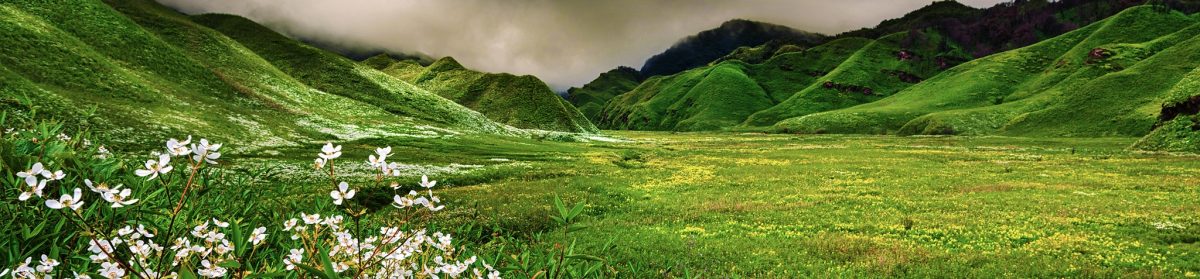
On 15 June 2011,  I accompanied a 30-member team of the Manipur Mountaineering and Trekking Association (MMTA) Dzuko Valley expedition to Dzuko Valley. We started from Mao on the Manipur-Nagaland border, 96 km from Imphal . Our  first destination was a water point some eight km away which was to serve as our base camp. We spent the first  night there. The next morning, we headed for Mt. Isso (2996 metres), Manipur’s highest  peak and climbed down to the Dzuko Valley (2500 metres).

The 6-km trek uphill to Mt. Isso in the monsoon is perhaps the toughest for any climber. This was my second visit in  25 years. Being the former president of the MMTA and a member of the Indian Mountaineering Foundation, I was chosen the expedition leader almost by default. The climbing leader was Puyamcha Mohon,  one of India’s upcoming mountaineers with many a Himalayan peak to his credit.The rest of the members comprised scientists, foresters, college lecturers, students and small-time businessmen fired by the spirit of adventure and desire to see Dzuko Valley.

Unlike other popular trekking sites  elsewhere in the country there was no track at all. Even if there was one it was covered with thick foliage and plants. After about three hours’ climb, we faced the first formidable obstacle to our destination ~ a 100-feet-high rock face.  We had to use ropes. It took us about five hours to cross this hurdle and by that time the entire  topography of the area changed. There were no large trees nor springs but only dwarf bamboo around. We hung on to the bamboo clumps which were no higher than two feet as natural hand holds as we pulled ourselves up the steep face with incessant rain making the track muddier.

We had started at around 8 in the morning, crossed the rock face at 12:30 p.m. and finally made it to Mr. Isso at 4.00 pm. We later became a group of five ~ one  comprising myself, instructor Gynaeshwor, Joykumar, Inaocha and Edison. We first attempted to get into the valley westward but Gynaeshwor cautioned saying: “Sir, Dzuko should be approached from the  north.” We then doubled back to the peak and then forayed northwards and then soon darkness descended. At an age when my peers are busy cuddling their grandchildren in the comforts of their homes, there was me with four young men trying to make shelter for the night on the ridge of Mt. Isso. We made a makeshift camp for the night, using plastic sheets for our roof and the five of us huddled close to spend the night amidst the pouring rain and the howling wind  even as water trickled inside our sleeping bags. We had not had any food for the entire day.

The next morning, it stopped raining and around 9 a.m, we could see the sprawling valley below us in all its emerald finery. The word Dzuko is derived from the language of the Mao tribe who inhabit the Mao area of Manipur’s Senapati district. Dzu means water and Ko  frozen, to denote the frozen water of the valley during winter. One or two inches of ice cover  the streams of Dzuko during the winter and it snows in the top region. Dzuko covers an  area of approximately 3.1 sq-km. Three streams originating from the  south Isso range traverse through the valley and fall into the Barak in Assam.

The Dzuko could be described as the valley of flowers of the east as the  purple Dzuko Lily (Lilium chitraganda-Bikramjit) and other summer flowers bloom in full glory in thousands and on the fringes are numerous caves where one can take shelter for the night. While the Mao and Paomei tribes of Manipur settled in the adjoining areas of Dzuko, they hold the valley dear to their belief, customs and traditions and have claimed the entire area to be their own tribal land, the Angamis of Nagaland have challenged this and have staked their claim on it. At the  moment, the Dzuko river seems to serve as the line of  actual control between Manipur and Nagaland. While the latter appears to have taken a pro-active role in its claim to Dzuko Valley by constructing two roads from Zakhama and Viswema  ~ 7 and 13 km-long respectively ~ and a functional guest house and plans are afoot to construct a water supply scheme for Kohima, the Manipur government appears to have abandoned Dzuko Valley to its fate.This was evident from non-maintenance of the road leading to the base camp. It was  constructed when Mr M Thorii, local MLA, was a minister in the Manipur government. After he  ceased to be a minister, no one has bothered about maintenance. The Manipur government  talks of attracting tourists and pledges to protect the state’s territorial integrity but does not seem to have any knowledge about the needs of the region.

To start with, the road should be properly maintained. There has to be a rest house at the base camp. Also, a proper trekking route. While one can reach Dzuko via Nagaland in a day’s time, it takes two days of strenuous climbing and trekking from the Manipur side. While the dispute over the ownership of the valley may rage between the two governments of Manipur and Nagaland, it would do the states well to come together and pool their resources to petition the Unesco for declaring the valley a World Heritage Site ~ a tag enjoyed by Manas National Park that straddles Assam and Bhutan.
First published in The Statesman, Kolkata. The writer is a veteran Imphal-based journalist

Read more / Original news source: http://kanglaonline.com/2011/08/valley-of-neglect/

Bothering the Borderless

By Bobo Khuraijam Recently some old friends insisted us to take a ride to the eastern most frontier of the state. We demanded that we be left alone in our… Read more »

By Bobo Khuraijam
Recently some old friends insisted us to take a ride to the eastern most frontier of the state. We demanded that we be left alone in our own languor.  They were adamant enough to displace us from our comfort coterie.  In no time we reach the most popular town. The place needs no introduction. A hotspot for shopping for things made in foreign at a reasonable price. A favorite site for venturing out with a seemingly ideal purpose – they called it study tour. You must have caught a glace of them on their return journey. Their vehicles would be overloaded with their study materials. From multi colored blankets to monochromatic hawai chappals, from glitzy electric appliances to squashy plastic toys, there are endless list to shop for. Located some three hours’ drive from the state capital, the small town is always teeming with life. With an altitude lower than the Imphal valley the place welcomes you with impartial heat. We did not try to find out who guards the street lamps. We find most of the lamps glowing with liveliness like the ones in the Kangla pat area, which are always under the watchful eyes of the security forces. The solar lamps take the bright responsibility whenever there is a power cut. A resident told us that there is regular power supply in the town. But nobody can forecast its arrival once it left for its mapam.

MEETING IN THE GATHERING: As we were told there was an important gathering in the town at the trade Centre. Friends from the other side of the border coming to take part were the main attraction. It was nearly eleven o clock; only four or five people were around the venue. Ten in the morning was the scheduled time written on the card. We heard that our friends had already come but they left as there was none to receive them. Meanwhile we refresh ourselves starring at the fake flowers decorating the wall of the hall. A guy with a room freshener sprays it with joy once in a while. The previous day’s general strike constrained the traders and officials from Imphal to arrive in advance. A point hard to be understood by the foreign dignitaries, but rain was the excuse given by official from our side of the border. The explanation was silly as it could be. It confused us wondering whether there was no rainfall at the other side of the border which is at a stone’s throw. We do not know what better explanation would the official give for the wrong spelling printed loud and clear on the backdrop. Can we suggest one? Say it: the printing machine was not oiled well, following the shortage after the economic blockade. The foreign dignitaries did turn up again. But much to their surprise they were not received well. Our side of the official was busy attending a phone call. He walked out of the room brushing aside the delegates as if they were his subordinate staffs. No one is to be blamed, except for the good network of the cellular phones, we thought. A man who seemed to be tipsy introduced himself as a relative of the minister of the department concern. What a way of loi thaaba at the border town. Halfway into the session we realize half of the people attending the session had come just like that. For the record, there were also traders who were serious to learn more about international trade. The intricacies of Trans border trade, the technicalities involved in financial transaction, the role of the banks, and the logistics of moving the consignments. There was in-debt discussion. In tandem with our tradition there were plenty of mathels for the lunch break. Fish of both atoiba and ataoba, chicken, eromba, vegetables, only a buffet of that kind would allow us of not even sparing the vegetarians’ table without any mercy. Without doubt, the main VIP from Imphal was the last man to arrive. His articulation and his sense of duty was a saving grace. The following day, as usual, the foreign friends arrived earlier than the rest of the crowd. Our wannabe international traders from Imphal have gone shopping at the other side of the international fence. The session did come to an end with the international friends sharing their optimism of a booming international trade at the border town. Should we also mention that our omnipresent social worker/ activist/ trader/, All-in-one, to be precise were also present in the gathering? With aplomb some of them jump into a photo session with the international friends. How thoughtful? The photos would be their priced credential to prove their involvement in the helms of affairs. We are convinced that their far sightedness would put them to the leadership of steering the nation to a place called nowhere. And for the time being, we hope, their leikai habbits would not dampened the spirit of international trade in the border town.

BEYOND THE BORDER: the Indo-Myanmar friendship road was sparkling not like any other road in the state. The road is perhaps much superior in quality than the one we find in the metropolis. We are not wise enough to throw light on India’s sudden sense of friendship with the neighboring country. But we can well sense the duplicity of the mandarins in Delhi. The country gives shelter to pro- democracy refugees. At another instance they would share grand lunch with the top military leadership. Not only that they would also sign MoU and agreements on trade. Come morning, there will be swarm of small traders riding on their Japanese made bikes crossing the international border. They are allowed to sell their product without any restrictions. A kind of infrastructural opium and false comfort of a friendship with designs is bestowed by the great Indian nation. The high growth rate (which has little to do state or the border town) inspires the big traders sitting in the mainland to expand their business beyond the border. And therefore the hype of flourishing border trade is played by the political honchos to please the multi-millionaire traders. At this backdrop, we do not know where the small time traders of both side of the border stand in the future. The small Chak hotels, the small vehicles that ferry people from the valley to the town, the small traders that share a symbiotic relation with small towns like Kakching, Pallel, and more precisely Imphal, would not become a history when the border trade is formalize, with the trans-Asian highway and mega traders passing across the state at the speed of light. When night falls, the vaisnavite ema endols practice Sankirtan for the upcoming Krishna Jarma unlike the localities in Imphal, late into the night they sang. Would the speeding vehicles and trains on the futuristic Highway subdue their devotional hymns in the future? Can we be still left alone in our own languor?

FOOTNOTE: to all those who do so many things while talking on the phone, like driving, crossing the road, and what not? Leipung Ningthou requests them to try another feature of “chaak chana chana khong haambasu yabara yengbiyu”.

Read more / Original news source: http://kanglaonline.com/2011/08/bothering-the-borderless/

Politics: Productive, Unproductive, Destructive and Evasive

By Amar Yumnam Why is India so bad? Despite the recent growth spurt, why it now faces such a big political-economic challenge to moving further upward? Well, we need not… Read more »

By Amar Yumnam
Why is India so bad? Despite the recent growth spurt, why it now faces such a big political-economic challenge to moving further upward? Well, we need not mince words here. India is so bad because there is hardly anything which one cannot get done with money, irrespective of the nature of the work. This happens in all organisations relating to the offices of the state or offices of the people. There is now ample experience to imagine that it could be true even with quite a few of the “revolutionary” organisations.

But Why: At this point. We may justifiably ask as to why such a situation now characterises the country. The shortest answer to this would follow the Anna line. Money has now emerged as the most important weapon in this country because politics and corruption have become synonymous due to the repeated practices symbolising the merger of the two. Politics is the most important component in the conduct of human life within a structured society. This is because politics as practised by the politicians decide the character of the state. In fact, the state is to a large extent the aggregate of the functioning of the politicians in power in a democracy. To this extent politics is an inevitable part of democratic polity. Here lies the significance of politics.

The Divisions: Significant, powerful and impactful as it is, it is absolutely important that the practitioners of politics take utmost care such that the sanctity and sustenance of the state is not put at risk. In other words, they need to be very clear of the zone of operation of their politics and the limits to that. If they start assuming that there is no limit to their areas of operation and behave accordingly, chaos would sooner than later rule rather than order. This is exactly what is happening in India today.

Given this we may now borrow an analysis in Economics where the Entrepreneurs – the agents of growth in a society – are divided into productive, unproductive and destructive and evasive ones. The productive entrepreneur brings to operation a more efficient way of functioning which was otherwise lying un-adopted in the society. Further, he/she causes an innovation in the society and thereby taking the society to an altogether a new plane of well-being. Unproductive and destructive entrepreneurs, on the other hand, devote their ability to innovate in devising ways for committing higher crimes, rent-seeking and the destruction of existing resources of the society. They do innovate, but their activities do not contribute at all in taking the society to a higher level of well-being. Rather, their activities kill the spirit of competition in the society, which otherwise should serve as the basis for advancement. The best example in this genre is corruption.

The other group of entrepreneurs are what is called evasive. This group invests resources in avoiding the legal system or to escape from the ill-effects of other unproductive entrepreneurs. Tax evasion and gangs scheming to better other unfriendly gangs are all examples of this.

With this understanding of entrepreneur classes, we may now venture into classifying the political class in this country. Politics the politicians play can be productive, unproductive, destructive or plain evasive. Productive politics would be one which facilitates the existence, exchange and interactions of all individuals in the society in such a way that the scope for productive activities gets expanded. Unproductive and destructive politics would be one where the practitioners indulge in exploiting their hold on decision making in matters of the state and polity. Here the practitioners leave no holds barred in interfering in every sphere of state action and influencing the decision indirections that serve their vested interests. For them every decision is apolitical decision. The existence of this group ensures the emergence and presence of another group practicing evasive politics.

India’s Predicament:  The problem of India, history has proved repeatedly, is not with the entrepreneurial class as such. Right from the pre-Independence times till today, we have had many entrepreneurs of the productive kind. In fact, they are the ones who have made recent economic rise of India possible. Here too the role of circumstantially enforced behaviour of productive politics has served as the greatest facilitator for the manifestation of entrepreneurial talent of the country. But very unfortunately, sooner than later the unproductive and destructive politics has gained supremacy over the productive one. This recent disease seems to have taken very deep roots in a very short span of time so much so that the offices of state and the offices of people are themselves suspects now in the eyes of the people. This is a condition India, with all her heterogeneity in geography, people and issues, can ill-afford to have.

Read more / Original news source: http://kanglaonline.com/2011/08/politics-productive-unproductive-destructive-and-evasive/

AIR Imphal News –20th Aug 2011 7.30 Morning

Source:- AIR Imphal; Recorded by:- KO in public interest.

Audio MP3


Source:- AIR Imphal; Recorded by:- KO in public interest.

Read more / Original news source: http://kanglaonline.com/2011/08/air-imphal-news-%E2%80%9320th-aug-2011-7-30-morning/

Press Release: Mass rally held at Ukhrul, Manipur

Press Release There was a mass rally held today, 19th. 08.2011 starting from 9.30 am in Ukhrul District and all other Naga hill area in Manipur protesting against the upgradation… Read more »

Press Release

There was a mass rally held today, 19th. 08.2011 starting from 9.30 am in Ukhrul District and all other Naga hill area in Manipur protesting against the upgradation of Sadar Hill District into full fledged District. The rally in Ukhrul was joined en mass by the Tangkhul frontal organization which includes Students, concern citizens, farmers, housewives, senior citizens, civil societies and other various organizations. The rally is mainly spearheaded by Tangkhul Katamnao Long, Tangkhul Shanao Long, Tangkhul Naga Long and Tangkhul Mayar Ngala Long.

The rally which was initiated by United Naga Council (UNC) were seen being participated by thousands of concern Tangkhul-Naga joins hands demanding and making a firm declaration that – without the consent of the Nagas not an inch of the Nagas land could be touched by an outsider, part away and alter in creation of Sadar Hills District. The Tangkhul- Nagas strongly condemn the devisive policy of Ibobi’s led Government to infuse communal hatred among the peaceful co-existing tribals. They call upon the government of Manipur to respect the previous MOU which was sign between the government of Manipur and the Nagas apex social organization on 1981,1982,1996 and 1998.


The Tangkhul Katamnao Saklong (TKS) during an exclusive interview mentioned that the Naga villages under the demand of Sadar hill District cover Naga tribal villages from liangmai tribe, Tangkhul, Thangal , Maring, Mao and poumai. More than around 47 Tangkhul- Naga villages are situated in the said demand of the so-called Sadar hill District. Nagas have been living in their forefather land from time immemorial unlike the Kuki refugees who were migrated mostly from the Chin-Burma (Myanmar) province during the British era as a labourer and who started setting up camps around the places wherever the Britisher’s made their Headquarters mostly in North East of India. In regard to the statement they claim that the Kuki-refugees in Manipur state have no rights to blow their own trumpet to claim a District or Homeland by bifurcating an inch of the Nagas land without the consent of the Nagas.

The Naga people as a mass warn the Government of Manipur (GoM) that they should look into the matter thoroughly and should not take hasty decisions which will resulted in marring the sentiments of the Naga people in Manipur or which will resulted in inter- communal disturbance. If such incidents happen in future it was declared that the responsibility and the consequences will be directly pointed at GoM.

Kuknalim!

The above press release was sent to KanaglaOnline.com by Shimray Alem {shimrayalem[at]yahoo.com}

Enhanced by Zemanta

Read more / Original news source: http://kanglaonline.com/2011/08/press-release-mass-rally-held-at-ukhrul-manipur/

Situating the Koms (Komrem) Narrative in Manipur

By: Alex Akhup Abstract This paper is an attempt to evolve an analytical frame of understanding identity and ethnicity in the ‘northeast region’. Positioned from an emic perspective, the article… Read more »

By: Alex Akhup

Abstract

This paper is an attempt to evolve an analytical frame of understanding identity and ethnicity in the ‘northeast region’. Positioned from an emic perspective, the article conceptualizes the reality of the Komrem tribes of Manipur vis-à-vis their identity and ethnicity. Manipur is one of the States in ‘northeast region’, with a high degree of cultural diversity. A number of ethnic groups reside in the region giving rise to a unique ethnic socio-political environment rarely witnessed in any other parts of the country. Ethnic Identity political processes become a prominent mobilization strategy for ethnic groups to negotiate for space within a democratic frame. This process manifests itself in self-determination movements expressed in the forms of ‘proto-nationalism’ and ‘infra-nationalism’ vividly observable among tribes in Manipur.

Mr. Alex Akhup is Assistant Professor, Centre for Social Justice and Governance, School of Social Work in the Tata Institute of Social Sciences. His areas of interest are identity, ethnicity and northeast studies.

Introduction

The ‘Spirit of Northeast’ within the domain of identity is an experience and a celebration of multiple realities, a co-existence of many nations and ethnic groups within specific boundaries of the eight States . The process of Identity and ethnicity is multidimensional and dynamic, requiring problematization at various levels and drawing connections from particular to universal. It arises as a consequence of multi-cultural or multi-people realities which are closely related to the social structure and larger socio-political environment. There are various situations leading to identity and ethnicity which generates dynamic interactions of specific socio-ethnic structures located in a particular geopolitical milieu of State , districts, nations and frontier region, and also in the broader context of hegemonic capitalist globalization. This, as argued by Burman (Burman in Bhadra, 2007, p.11) has had profound impact on the struggle of world democratic forces.

If one looks at the process in totality, there is broad framework of analysis which is required to understand the context objectively. The ‘northeast’ region is culturally and politically distinct from the rest of India because of its multiple ethnic characteristics. This distinction or the difference marks the specific ethnic context which is in constant dynamic process of interaction with external environment; social, economic and political circumstances. This dynamic process is expressed in varied forms of culture drawing an understanding within a framework of boundary definition, extension and resilience (Barth, 1970). There is a tension in the process of self identification (Jenkins, 1997) and change processes.

Analysis Frame

Identity from the perspective of ethnicity is very often considered as basic ‘givens’ of an identity in social science. This understanding has very often confined the conceptualization along exclusivist approach within primordial school of thought (refer Geertz, 1973), as also seen in ethnonalism processes achored along the colonial constructs in the region. However, Barth regards ethnicity more as a product of interaction, rather than reflecting essential qualities inherent to human groups. Barth’s conceptualization is a major shift from cultural specific studies to a movement focusing on interaction of boundaries. This conceptualization has brought in a shift of paradigm in the understanding of ethnicity and given the concept a political dimension (refers Glazer and Moynihan, 1970, Phadnis, 1989, Doshi, 1990, and Cohen, 1996). Here, there is shift from ‘culture as given’ to ‘permeability of boundary’, ‘ethnic identity as idiosyncratic characteristic’ to ‘ethnicity as political processes’, a circumstantial product and/or instrument.

Identity Process in Manipur – Context and Frame

Manipur is consistently and constantly in the limelight, because of its highly intricate and complex political reality. This vibrant political reality exerts immense pressure on processes of identity formation of various distinct cultural groups in the State which manifests in observable symptoms of assertion and resistance across ethnic groups. The geopolitical reality of the state has had an important bearing on political and social identity configuration. The relationship that exists between state politics, its territorial space and population distribution , defines power and positions, and shape identity of various societies, people and communities.

The state-society consists of differential ethnic groups (arround 36 in number) which have been referred as ‘ethnic groups’ by recent scholars (refer Zehol, 1998). These ethnic groups have a distinct history and culture. The distinctiveness of an ethnic group penetrates down to the village community. These villages have a long history of contact and co-existence with the plain culture under the Meitei Kings . The present political consciousness of tribes or ethnic groups in Manipur is largely an outcome of modern political and social processes generated through the nation-state frame and concomitant system of electoral politics.

The hill areas, constituting five hill districts, are inhabited by ethnic groups categorized as ‘Scheduled Tribes’. Due to the diversity of social structure between tribes expressed in culture and region, politico-administrative categorization hardly permits a common consensual socio-political platform for negotiation. The tribes would rather prefer to be identified by specific cultural and political entities which influence the processes of identity in State. Therefore, ‘tribe’, as political identity and political process is exogenous and thereby very negligible consciousness about the term in the area and perhaps remains only at the level of welfare policies of politico-administrative term used for Government. In the present state of affairs in the State of Manipur, there is no single operational tribal specific policy except for skewed and highly disparate system of political representation in the State.

British administrative agents were the first who made attempts to classify the collective identities in Manipur within linguistic criteria and a politico-administrative frame. Today these exogenous categorizations determines a considerably the forces of identity and ethnicity process. They are being tested at the consciousness level of the people in the present social and political environment. These processes of categorizations have often misperceived and subverted the articulations of a perspective ‘from within’ the community, and are at times operationally coercive, as is seen in case of ‘old kuki’ (Shakespear, 1909, 1912). People rarely identify themselves by such categorizations and in fact it has become detrimental to preservation and creation of cultural and political space for numerically fewer tribes.

The contribution of Christianity to education and development towards an articulation of culturo-political identity especially in the context of tribes has been very significant. This process have enhanced, re-enforced and augmented identity boundary within a ‘Barthian’ frame. Collective identities have become better adept to face other cultures and global forces and negotiate with state systems proactively. Had it not been for Christianity, education and development for multiple ethnic groups in the region would have been significantly different from what is being observed presently. In fact the smaller communities would have been in a critical position as regards their culture and political entity.

The various articulation of self determination of ethnic groups in the State is a socio-political phenomenon of negotiation between ‘culturally indigenous tribes’ . Here, self determination process ‘within the State’ is comparatively different from self determination from ‘without’. The former negotiates within the democratic frame of the country and latter refers to a ‘demand for independent Sovereign State’. The articulation comes from definite experience of common shared culture and history which according to Burman (Burman in Kabui, 1985) are processes of ‘infra-nationalism’ and ‘proto-nationalism’ referring to twin processes of ‘spontaneous internal self identification’ and ‘self identification inspired by educated leaders of the community’. In these processes boundary of common shared culture is defined and intensified by territory and language. They are defined as ‘nationalities’ (B.K. Roy Burman ). ‘Nationalities’ as argued by Burman is understood as having a common or shared cultural identity but not necessarily implicating a demand for an independent sovereign State. They are perceived and also referred to as being ‘ethnically marginalized’ (Oommen, 1997). But one thing is obvious, embedded culturo-political elements forming the core of distinct entities, spread across territorial boundaries explicitly indicates that modern state and nation is not co-terminus in the context of northeast. Therefore formulation of collective identity has to be situated in the context of state and multiple collective identities.

Identity and ethnicity processes in Manipur is complex and challenging yet opens up to a unique and significant opportunity for conceptualizing culture, identity and ethnicity within a volatile political environment. The State is a conglomeration of ‘culturally embedded communities’ (Biswas, 2000) which have distinct boundaries, yet having a mutual relatively inclusive social fabric within the co-existence frame. The existence of multiplicity of ethnic identity in the State represents a microcosm of the larger ‘northeast’ reality from the perspective of a numerically less significant and yet culturally, and politically distinct entities which many a time has not been perceived as significant, consciously or unconsciously within the current policy, politics and academic discourse. In fact the mainstream or dominant discourse on ethnic groups have largely been from the perspective of numerically larger and politically well placed ethnic groups in the State. Therefore the state of ‘non-recognition’ of such entities is often in a disempowered position and thus appropriated by dominant group discourse within the frame of electoral democracy. The strength of discourse or policy of the state on ethnic groups in a democratic system lies on how it handles the space of numerically lesser tribes, which are equally critical for the functioning of a well meaning democratic system.

A Khurpui (Komrem) Narrative

The cultural and historical experience of identity and ethnicity among the tribes of Komrem community exemplify an endogenous self-identification as an ethnic group. The community defines and redefines itself consistently to be able to maintain and adapt its cultural and political reality in the context of the emerging cultural and political environment.

The community proactively defines itself as ‘Komrem’; the ersthwhile ‘composite culturo-political entity’ consisting of the six kindred ethnic groups constitutionally categorized as Aimol, Kom, Kharam, Chiru, Purum and Koireng (also listed in Kom, 1990) in Manipur. However, as response to the emerging socio political context of the state, the Komrem people social organization has given birth to other kindred tribe specific independent social organizations in the recent times. Infact, as it stands today, Komrem as socio-religious or political collective entity confines itself pridominantly to the Kom speaking kindred group. However, the shared cultural and historical experiences of these kindred group is intrinsically connected and extends far into the prehistoric times, usually termed as ‘Khurpui narrative’, origin narrative. The narrative usually sung among all these kindred as:

Kan hongsuk e kan hongsuk, e Khurpui e kan hongsuk e
Khurpui akhan hongsuk e
Thingkalat lhongkatet mhorang e
Heiya he heiya he ya
Heiya he heiya he yo

Koms (collectively) identity self ascription, Kakom inchangna, is derived from this song of history. It is the basic foundation on which community ethnonym, Kakom or Kom got constructed.
Kan hongsuk e kan hongsuk e Khurpui e kahong suk e
Heiya he heiya he
Kan honsuk e kan hongsuk e
Khurpui a kan hongsuk e
KanKom luin abong heiye
KaKom kachang ung a

The history of Komrem ethnicity processes dates back to 1927 under a nomenclature of Sadar Hills Kom Union which was initiated to define and re-enforce a common identity based on cultural and historical experiences. In the post independence era the Union resurrected with a new nomenclature ‘Komrem’; conceptually a configuration of endogenous and exogenous terminology. ‘Kom’ basically is a Meitei word, a derivative of ‘Khurpui’, a kom terminology of the origin theory. ‘Rem’ as in ‘Komrem’ refers to ‘people’. Therefore, Komrems (Koms) identify as ‘Khurmi’s. However, ‘Komrem’ as an ethnonym was given birth during the initial stage of the socio religious movement as commonly accepted nomenclature for peoplehood and mobilization in the context and process of history and has found space in the consciousness of the community and other ethnic groups in the State. The Komrem historical reality implicitly and explicitly is premised on the frame of harmony, co-existence and mutual interactions within the State-community.

An observation of Komrem Identity process reflects that Identity is multidimensional and is closely linked to culture which has its own dynamics and exerts its own political status. For example, documentation of Kom culture by Indira Gandhi National Centre for Arts (IGNCA), in collaboration with state institutions and Kom Cultural Society of Khoirentak Village Society is unique and occupies prominent place in defining cultural identity of Kom tribe (Purvottari, 2009). Religion has also emerged as an important factor of identity re-enforcement and change. Infact, Komrem community today is basically Christian in religion. There is direct and mutual interaction between religion and culture of the people which continuously define and redefine the identity of Komrem from ‘socio-religious perspective’ anchored through Kemrem Baptist Church Association (KRBCA) and the Komrem Union (KRU). The role of these emerging institutions in Komrem identity and peoplehood consciousness and organization is prominent. Education and development of Komrem community is definitely a direct contribution of Christianity which has augmented the cultural and political identity of the people.

In the historical and cultural reality of the Komrem community, Identity is more a means towards social and political empowerment. It is a strategy or organization which could be defined as ethnicity, ethnicity understood as political identity assertion within the context of inter-power relations between communities and also between the communities and the State. ‘Komrem Identity’ is therefore basically a political identity. It emerged in 1927 and got further re-enforced in context of asserting better political participation particularly in the then Autonomous District Councils of the state (Kom, 1990) and various other emerging internal and external social and political circumstances that constitute the environment of the community.

Komrem tribes occupy an important geopolitical standpoint in the socio-political and economic cycle of the State of Manipur as one of the indigenous tribes. The political space of their identity remains resilient even in the midst of majority-minority identity politics in the time when larger cultural political identity process become not only a mere pro-active self identification but forceful categorization, or co-option by the larger identity politics. There is, as observed by Burman (Kabui, 1985 and Kamkhenthang, 1988), constant defining and redefining of numerically fewer tribes manifested through oscillation of identity on political consideration. In such reality, ‘Komrem’ identity has been a strategy of cultural and political assertion within the politics of coercive categorization which has resisted and negotiated with the politics of categorization as was observed in the ‘neutral stance’ taken by the community during the ethnic conflict in the 1990s. The community has always demonstrated a cultural and political ability to negotiate in relation to the politics of its immediate larger ethnic group within the paradigm of ‘co-existence’ and ‘peaceful living’ .

Concluding Analysis; A Komrem Perspective

The change processes is all pervasive with inherent tension of interface between emic and etic processes within the socio-politico reality. Identity is thus best understood within the frame of change and recreation, which is greatly influenced by processes of identity politics (especially played along the colonial construct of Naga, Kuki or Meitei dialectics) that at times spirals into acts of hostility as often witnessed in Manipur. The process of political assertion based on identity has tremendous political and social impact on distinct identities of the varied ethnic groups. The impact of the processes related to the interplay of identity politics is felt much more by numerically fewer communities who are also geographically sparsely populated and spread out across revenue districts. Within this reality, the principle of coexistence reveals itself as the determining law of both state and community in which ethnic life worlds (Biswas, 2006), inter and intra community relationships and rational socio-legal governance structure of the state must be premised. This formulation furthers the importance of understanding co-existence as an organic trajectory of the peaceful existence and relationships of all collective identities. Existence and co-existence of every collective identity requires mutual understanding and respect of spatial needs, human security and social development of entwined communities within the socio-legal democratic set up. All are equally important as units of society. It is an issue of grave concern that the status of ‘invisibility’ of culturally indigenous tribes who are numerically fewer in number, are often ‘notionally non-existent’ within the realm of the consciousness of both state and dominant ethnic groups. A democratic system that facilitates, provides and promote a responsive public space for a respectful articulation of voices of the ‘invisibles’ within the public sphere is imperative. The author firmly opines and envisions that the argument articulated in this paper will find a critical space in the emerging political and reality discourse of the northeast region.

References

Barth, Fredrik (ed.). (1969). Ethnic groups and boundaries; The Social
Organization of Culture Difference. Oslo: Universitetsforlaget.

Bhadra, R.K. and Mita Bhadra (ed.). (2007). Ethnicity, Movements and Social
Structure. New Delhi: Rawat Publication.

Biswas, Prasenjit (2008). Ethnic Life-Worlds in North-East India. New Delhi:
Sage Publication

Cohen, A. (1996). Ethnicity and Politics, in J. Hutchinson and A.D. Smith (eds.)
Ethnicity, New Delhi: Oxford University.

Chaudhury, Sukant K., Patnaik, Soumendra Mohan (ed.) (2008). Indian Tribes
and The Mainstream. Jaipur: Rawat Publication.

Doshi, S.L. (1990). Tribal Ethnicity, Class and Integration. Jaipur: Rawat
Publication.

Geertz, Clifford (1973). The Interpretation of Cultures. Basic Books 2000
Paperback.

Glazer, Nathan and Moynihan, Daniel P. (1970). Beyond the Melting Pot: The
Negroes, Puerto Ricans, Jews, Italians and Irish of New York City. Cambridge: MIT Press
Indira Gandhi National Centre for Arts, Purvottari; Spirit of North-east, New Delhi,
2009
Jenkins, Richard (1997). Rethinking Ethnicity; Arguments and Explorations. New
Delhi: Sage Publication.

Kabui, Gangmumei (1985). Anal: A Trans-border Tribe of Manipur. Delhi: Mittal
Publications.

Kamkhenthang, H. (1988). The Paite: A Transborder Tribe of India and Burma.
Delhi: Mittal Publications.

Kom, L. Benjamin (1990). The Kom-rem People. Manipur: Lower Keirap, Loktak
Project.

Oommen, T.K. (1997). Citizenship Nationality and Ethnicity. Cambridge: Polity
Press.

Phadnis, Urmila (1989). Ethnicity and Nation-building in South Asia. New Delhi:
Sage Publication.

Shakespear, J. (Jul. – Dec., 1909). “The Kuki-chin Clans” The Journal of the
RoyalAnthropological Institute of Great Britain and Ireland. Vol. 39, pp. 371-385

Zehol, Lucy (1998). Ethnicity in Manipur: Experience, Issues and Perspectives.
New Delhi: Regency Publications.

Enhanced by Zemanta

Read more / Original news source: http://kanglaonline.com/2011/08/situating-the-koms-komrem-narrative-in-manipur/

KO releases its social networking site – “Leipung.com”

Kanglaonline is proud to release its sister site www.leipung.com (beta version) and is live from 15th August.  ”Leipung” is derived from the concept of “Leipung Phamba”, a popular form of hang-out… Read more »

Kanglaonline is proud to release its sister site www.leipung.com (beta version) and is live from 15th August.  ”Leipung” is derived from the concept of “Leipung Phamba”, a popular form of hang-out still practised in the Meitei localities of Manipur. It is in such “Leipung-phamba” where the local youths discuss about any topics of their choices – from cracking jokes, fashion, politics, music, history to any topics they can think of at that moment.

Leipung will try to provide similar kind of experience in the virtual world. You can imagine it to be a combination of social-networking and discussion/sharing platform with the motto: “Connect + Share + Learn“. Leipung currently allows you to

1. Connect – connect with your friends by creating your free account & get acces to all features of Leipung. http://leipung.com/register

2. Share – share your knowledge by writing poems, articles, jokes, blogs or simply share pictures, videos with your friends

3. Learn – a chance to learn about other’s stories, write your reviews/comment etc

So please register and enjoy the full lot of features which is specially created for you. Please remember “Leipung” is under development, dont be surprise to see changes on the site on everyday basis :-) And your feedbacks are most welcome, help us to improve !

More updates on the status will follow.. watch out this space..

*** NOTE *** Currently if you are using your gmail id to register @ leipung the activation mails are sent to spam or bulk folder.

~ Leipung Team ( powered by KO )

Enhanced by Zemanta

Read more / Original news source: http://kanglaonline.com/2011/08/leipung-com/