

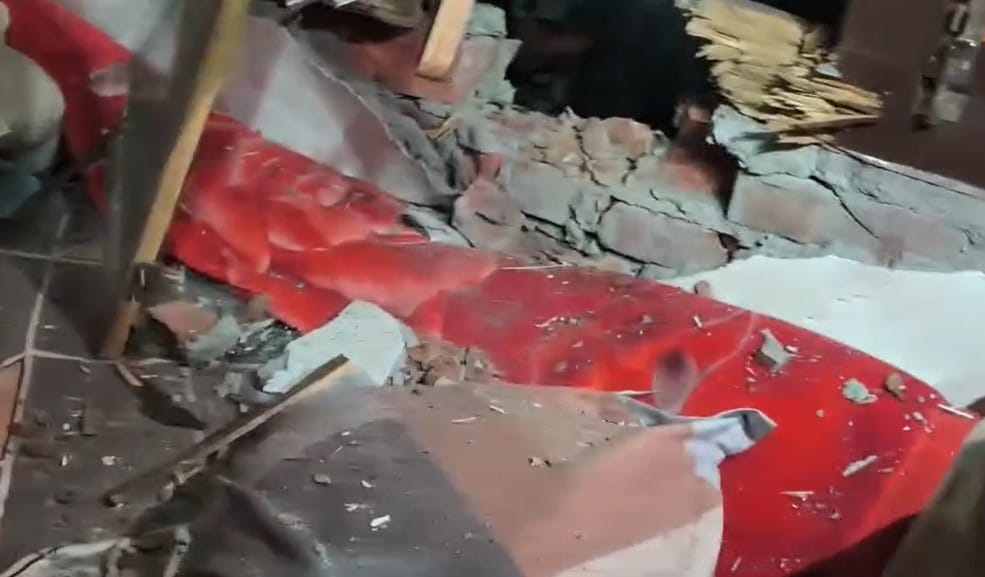
Manipur Crisis Through Conflict Theory: A Two-Level Mistrust Model

The Manipur crisis as a simultaneous breakdown of vertical trust between citizens and the state, and horizontal trust among communities. Using conflict theory, it argues that structural inequalities, identity fears, security dilemmas, and cultural violence have transformed the crisis into a self-sustaining cycle of mutual insecurity. Lasting peace requires rebuilding institutional legitimacy and intergroup trust, […]

The post Manipur Crisis Through Conflict Theory: A Two-Level Mistrust Model first appeared on The Frontier Manipur.

The Manipur crisis as a simultaneous breakdown of vertical trust between citizens and the state, and horizontal trust among communities. Using conflict theory, it argues that structural inequalities, identity fears, security dilemmas, and cultural violence have transformed the crisis into a self-sustaining cycle of mutual insecurity. Lasting peace requires rebuilding institutional legitimacy and intergroup trust, not merely restoring law and order.

By Sheikh Abdul Hakim

The Manipur crisis can be theorised as a breakdown of social cohesion at two levels: the vertical level, between citizens and the state, and the horizontal level, among communities. Social-cohesion theory defines the horizontal dimension as trust among people and groups, while the vertical dimension concerns trust between citizens and institutions such as the government. In Manipur, both have weakened at the same time, making the crisis far deeper than a normal law-and-order problem.

Core thesis

From the perspective of conflict theory, Manipur is not merely a clash of communities. It is a conflict over security, land, recognition, political power, identity, dignity, and trust. The immediate violence began in May 2023 around ethnic tensions linked to Scheduled Tribe status, affirmative-action benefits, land and political anxieties; by 2026, Reuters reported around 260 deaths and more than 60,000 displaced, while ACLED described the two major communities as living in near-complete segregation after two years of violence.

The central problem is this: each community now sees its own survival as insecure, and many citizens no longer believe that institutions can protect them with neutrality, speed, and fairness. Once that happens, every incident is interpreted not as an individual crime, but as evidence of collective danger.

1. Structural conflict: unequal power, land, representation and resources

Classical conflict theory begins from the idea that society is not always harmonious; it is often shaped by struggles over scarce resources and institutional power. In Manipur, the relevant resources are not only money or jobs. They include land, constitutional protection, political representation, administrative control, access to security, development, mobility, and cultural recognition.

Frances Stewart’s theory of horizontal inequalities is especially useful. It argues that conflict becomes more likely when economic, political, social and cultural inequalities are experienced not merely by individuals, but by identity groups. Stewart’s framework defines horizontal inequalities as inequalities among groups sharing a common identity, and notes that when cultural differences overlap with economic and political differences, resentment can deepen into violent struggle.

Applied to Manipur, the hill-valley divide becomes more than geography. The valley is associated with demographic concentration, political centrality and administrative visibility; the hills are associated with land protection, tribal autonomy, distance from state services and fear of domination. The Meitei demand for Scheduled Tribe status, and the opposition to it from Kuki-Zo and other tribal groups, therefore, became a symbolic struggle over who will control the future rules of land, reservation, recognition and security. That is why the conflict cannot be reduced to one incident alone.

2. Identity conflict: when grievance becomes community consciousness

Social Identity Theory, developed by Henri Tajfel and John Turner, helps explain how people begin to see events through the lens of “us” and “them.” Their work showed that even minimal group distinctions can generate in-group preference and out-group suspicion; in a violent setting, this tendency becomes far more dangerous.

In Manipur, the crisis has turned identity into a security boundary. A killing, arrest, rumour, checkpoint, relief measure or government statement is no longer judged only on facts. It is often judged through the question: “Is this against my community or in favour of the other?” This is the psychological moment where horizontal mistrust becomes self-reinforcing.

The tragedy is that people who once shared markets, schools, roads, workplaces and friendships can begin to see one another as representatives of collective threat. At that stage, individual guilt disappears behind collective suspicion. Conflict theory calls this the hardening of group boundaries.

3. Security dilemma: every group’s self-defence frightens the other

The ethnic security dilemma is one of the most powerful explanations for Manipur today. Lake and Rothchild argue that intense ethnic conflict is not caused simply by “ancient hatred”; it is often produced by collective fear of the future, especially when groups doubt whether the state can credibly protect them. When the state’s authority weakens or is seen as biased, communities begin preparing for their own defence; those preparations then look threatening to the other side, causing a spiral.

This is visible in Manipur’s armed village-defence atmosphere, buffer zones, checkpoints, displacement camps, segregated settlements, and fear of crossing into the “other” area. Reuters reported that weapons were in circulation, including arms stolen from police or smuggled from Myanmar, while many Kukis and Meiteis moved out of mixed areas.

The security dilemma works like this:

One side says: “We are arming or blocking roads only to protect ourselves.”

The other side hears: “They are preparing to attack us.”

The state intervenes: one group sees protection, another sees bias.

Result: fear grows even when both sides claim they want safety.

Thus, Manipur’s crisis has moved from grievance to fear, and from fear to separation.

4. Vertical mistrust: the crisis of state legitimacy

Conflict theory also asks: who controls institutions, and do people see those institutions as neutral? In Manipur, vertical mistrust has become central. Many citizens no longer evaluate the state only by laws written on paper; they evaluate it by lived experience: Who came when we were attacked? Whose FIR was registered? Whose dead were honoured? Whose displaced families were heard? Whose roads were opened? Whose suffering was ignored?

The Supreme Court’s intervention itself shows the gravity of the institutional-trust problem. In its [Manipur violence order], the Court stressed the need to restore faith and confidence in the justice system, ensure that perpetrators are punished according to law, and sustain public confidence in investigation and prosecution. It also constituted a three-judge committee led by Justice Gita Mittal for relief, rehabilitation and survivor support, and appointed an outside police officer to supervise investigations.

This matters theoretically because when citizens lose confidence in institutions, they seek security from community organisations, armed volunteers, pressure groups, ethnic councils, rumour networks and local defence structures. The state then loses its monopoly over trust, even if it still has formal authority.

In simple terms: a government may control territory, but it cannot produce peace unless people believe it is fair.

5. Cultural violence: when language makes violence acceptable

Johan Galtung’s theory divides violence into direct violence, structural violence, and cultural violence. Direct violence is visible: killings, arson, sexual violence, displacement, attacks. Structural violence is built into unequal systems. Cultural violence is the language, symbols, stereotypes and narratives that make direct or structural violence appear acceptable.

In Manipur, cultural violence appears when entire communities are reduced to labels: “illegal,” “terrorist,” “drug-linked,” “land-grabber,” “anti-national,” “aggressor,” or “enemy.” Once such language spreads, the crime of an individual is transferred onto a whole community. This is how collective blame is manufactured.

The theoretical danger is that cultural violence does not always look like violence. It may look like a slogan, a speech, a rumour, a meme, a funeral speech, a protest placard, or a social-media post. But it prepares the mind to accept cruelty.

6. Conflict entrepreneurs: those who benefit from division

Conflict theory also pays attention to actors who gain from instability. These may include extremist groups, armed networks, political hardliners, black-market actors, rumour-spreaders, and leaders who gain influence by presenting themselves as sole protectors of a community.

Lake and Rothchild note that [ethnic activists and political entrepreneurs] can build upon insecurity and polarise society. In Manipur, this means the conflict is not sustained only by spontaneous anger. It is also sustained by networks that turn fear into mobilisation, mobilisation into power, and power into bargaining strength.

This is why peace is difficult: for ordinary people, peace means returning home; for conflict entrepreneurs, peace may mean losing relevance.

7. Displacement and segregation: mistrust becomes geography

Displacement changes conflict from an event into a living structure. Once people are separated into camps, protected zones and community-specific territories, mistrust becomes geographical. ACLED’s description of near-complete segregation is therefore not only a demographic fact; it is a conflict-theory warning. Separation reduces everyday contact, and reduced contact allows rumours to replace relationships.

Intergroup Contact Theory, associated with Gordon Allport and later work by Pettigrew, suggests that contact reduces prejudice best when there is equal status, common goals, cooperation and authority support. But unsafe, unequal or forced contact can deepen fear. Therefore, simply telling communities to “live together again” is not enough. They need conditions where coexistence is safe, dignified and institutionally protected.

The Manipur crisis in one theoretical formula

Structural insecurity + identity fear + weak institutional trust + armed separation + hostile narratives = prolonged ethnic conflict.

Or more simply:

Vertical mistrust makes people doubt the state. Horizontal mistrust makes people fear neighbours. Together, they create a society where every action is suspected, every rumour travels fast, and every tragedy can become another trigger.

What conflict theory teaches for Manipur

The first lesson is that policing alone cannot solve a conflict that has become structural and psychological. Security is necessary, but security without trust can be read as occupation, bias or threat.

The second lesson is that justice must be both real and visible. The Supreme Court’s emphasis on restoring public confidence in investigation and prosecution is crucial because, in a mistrust society, justice hidden from public confidence will not heal public wounds.

The third lesson is that peace must operate at three levels: stop direct violence, correct structural grievances, and defeat cultural hatred. Galtung’s framework makes clear that removing guns is only the beginning; societies must also remove the narratives and inequalities that make violence return.

Final theoretical framing

Manipur today is best understood as a crisis of mutual insecurity. The Meitei fear loss of identity, land security, demographic balance and historical centrality. The Kuki-Zo fear loss of land, autonomy, physical safety and equal protection. Other communities fear being dragged into a binary conflict that may erase their own concerns. The government faces a legitimacy deficit because different communities judge its actions through different wounds. Therefore, the problem is not only that communities disagree. The deeper problem is that they no longer trust the same facts, the same institutions, or the same future.

The crisis began with events. It now survives through structures. It will end only when Manipur rebuilds both: vertical trust in the state and horizontal trust among communities.

(Sheikh Abdul Hakim is Director, Social Welfare, Government of Manipur)


The post Manipur Crisis Through Conflict Theory: A Two-Level Mistrust Model first appeared on The Frontier Manipur.

Read more / Original news source: https://thefrontiermanipur.com/manipur-crisis-through-conflict-theory-a-two-level-mistrust-model/

Manipur Crisis Through Conflict Theory: A Two-Level Mistrust Model

The Manipur crisis as a simultaneous breakdown of vertical trust between citizens and the state, and horizontal trust among communities. Using conflict theory, it argues that structural inequalities, identity fears, security dilemmas, and cultural violence have transformed the crisis into a self-sustaining cycle of mutual insecurity. Lasting peace requires rebuilding institutional legitimacy and intergroup trust, […]

The post Manipur Crisis Through Conflict Theory: A Two-Level Mistrust Model first appeared on The Frontier Manipur.

The Manipur crisis as a simultaneous breakdown of vertical trust between citizens and the state, and horizontal trust among communities. Using conflict theory, it argues that structural inequalities, identity fears, security dilemmas, and cultural violence have transformed the crisis into a self-sustaining cycle of mutual insecurity. Lasting peace requires rebuilding institutional legitimacy and intergroup trust, not merely restoring law and order.

By Sheikh Abdul Hakim

The Manipur crisis can be theorised as a breakdown of social cohesion at two levels: the vertical level, between citizens and the state, and the horizontal level, among communities. Social-cohesion theory defines the horizontal dimension as trust among people and groups, while the vertical dimension concerns trust between citizens and institutions such as the government. In Manipur, both have weakened at the same time, making the crisis far deeper than a normal law-and-order problem.

Core thesis

From the perspective of conflict theory, Manipur is not merely a clash of communities. It is a conflict over security, land, recognition, political power, identity, dignity, and trust. The immediate violence began in May 2023 around ethnic tensions linked to Scheduled Tribe status, affirmative-action benefits, land and political anxieties; by 2026, Reuters reported around 260 deaths and more than 60,000 displaced, while ACLED described the two major communities as living in near-complete segregation after two years of violence.

The central problem is this: each community now sees its own survival as insecure, and many citizens no longer believe that institutions can protect them with neutrality, speed, and fairness. Once that happens, every incident is interpreted not as an individual crime, but as evidence of collective danger.

1. Structural conflict: unequal power, land, representation and resources

Classical conflict theory begins from the idea that society is not always harmonious; it is often shaped by struggles over scarce resources and institutional power. In Manipur, the relevant resources are not only money or jobs. They include land, constitutional protection, political representation, administrative control, access to security, development, mobility, and cultural recognition.

Frances Stewart’s theory of horizontal inequalities is especially useful. It argues that conflict becomes more likely when economic, political, social and cultural inequalities are experienced not merely by individuals, but by identity groups. Stewart’s framework defines horizontal inequalities as inequalities among groups sharing a common identity, and notes that when cultural differences overlap with economic and political differences, resentment can deepen into violent struggle.

Applied to Manipur, the hill-valley divide becomes more than geography. The valley is associated with demographic concentration, political centrality and administrative visibility; the hills are associated with land protection, tribal autonomy, distance from state services and fear of domination. The Meitei demand for Scheduled Tribe status, and the opposition to it from Kuki-Zo and other tribal groups, therefore, became a symbolic struggle over who will control the future rules of land, reservation, recognition and security. That is why the conflict cannot be reduced to one incident alone.

2. Identity conflict: when grievance becomes community consciousness

Social Identity Theory, developed by Henri Tajfel and John Turner, helps explain how people begin to see events through the lens of “us” and “them.” Their work showed that even minimal group distinctions can generate in-group preference and out-group suspicion; in a violent setting, this tendency becomes far more dangerous.

In Manipur, the crisis has turned identity into a security boundary. A killing, arrest, rumour, checkpoint, relief measure or government statement is no longer judged only on facts. It is often judged through the question: “Is this against my community or in favour of the other?” This is the psychological moment where horizontal mistrust becomes self-reinforcing.

The tragedy is that people who once shared markets, schools, roads, workplaces and friendships can begin to see one another as representatives of collective threat. At that stage, individual guilt disappears behind collective suspicion. Conflict theory calls this the hardening of group boundaries.

3. Security dilemma: every group’s self-defence frightens the other

The ethnic security dilemma is one of the most powerful explanations for Manipur today. Lake and Rothchild argue that intense ethnic conflict is not caused simply by “ancient hatred”; it is often produced by collective fear of the future, especially when groups doubt whether the state can credibly protect them. When the state’s authority weakens or is seen as biased, communities begin preparing for their own defence; those preparations then look threatening to the other side, causing a spiral.

This is visible in Manipur’s armed village-defence atmosphere, buffer zones, checkpoints, displacement camps, segregated settlements, and fear of crossing into the “other” area. Reuters reported that weapons were in circulation, including arms stolen from police or smuggled from Myanmar, while many Kukis and Meiteis moved out of mixed areas.

The security dilemma works like this:

One side says: “We are arming or blocking roads only to protect ourselves.”

The other side hears: “They are preparing to attack us.”

The state intervenes: one group sees protection, another sees bias.

Result: fear grows even when both sides claim they want safety.

Thus, Manipur’s crisis has moved from grievance to fear, and from fear to separation.

4. Vertical mistrust: the crisis of state legitimacy

Conflict theory also asks: who controls institutions, and do people see those institutions as neutral? In Manipur, vertical mistrust has become central. Many citizens no longer evaluate the state only by laws written on paper; they evaluate it by lived experience: Who came when we were attacked? Whose FIR was registered? Whose dead were honoured? Whose displaced families were heard? Whose roads were opened? Whose suffering was ignored?

The Supreme Court’s intervention itself shows the gravity of the institutional-trust problem. In its [Manipur violence order], the Court stressed the need to restore faith and confidence in the justice system, ensure that perpetrators are punished according to law, and sustain public confidence in investigation and prosecution. It also constituted a three-judge committee led by Justice Gita Mittal for relief, rehabilitation and survivor support, and appointed an outside police officer to supervise investigations.

This matters theoretically because when citizens lose confidence in institutions, they seek security from community organisations, armed volunteers, pressure groups, ethnic councils, rumour networks and local defence structures. The state then loses its monopoly over trust, even if it still has formal authority.

In simple terms: a government may control territory, but it cannot produce peace unless people believe it is fair.

5. Cultural violence: when language makes violence acceptable

Johan Galtung’s theory divides violence into direct violence, structural violence, and cultural violence. Direct violence is visible: killings, arson, sexual violence, displacement, attacks. Structural violence is built into unequal systems. Cultural violence is the language, symbols, stereotypes and narratives that make direct or structural violence appear acceptable.

In Manipur, cultural violence appears when entire communities are reduced to labels: “illegal,” “terrorist,” “drug-linked,” “land-grabber,” “anti-national,” “aggressor,” or “enemy.” Once such language spreads, the crime of an individual is transferred onto a whole community. This is how collective blame is manufactured.

The theoretical danger is that cultural violence does not always look like violence. It may look like a slogan, a speech, a rumour, a meme, a funeral speech, a protest placard, or a social-media post. But it prepares the mind to accept cruelty.

6. Conflict entrepreneurs: those who benefit from division

Conflict theory also pays attention to actors who gain from instability. These may include extremist groups, armed networks, political hardliners, black-market actors, rumour-spreaders, and leaders who gain influence by presenting themselves as sole protectors of a community.

Lake and Rothchild note that [ethnic activists and political entrepreneurs] can build upon insecurity and polarise society. In Manipur, this means the conflict is not sustained only by spontaneous anger. It is also sustained by networks that turn fear into mobilisation, mobilisation into power, and power into bargaining strength.

This is why peace is difficult: for ordinary people, peace means returning home; for conflict entrepreneurs, peace may mean losing relevance.

7. Displacement and segregation: mistrust becomes geography

Displacement changes conflict from an event into a living structure. Once people are separated into camps, protected zones and community-specific territories, mistrust becomes geographical. ACLED’s description of near-complete segregation is therefore not only a demographic fact; it is a conflict-theory warning. Separation reduces everyday contact, and reduced contact allows rumours to replace relationships.

Intergroup Contact Theory, associated with Gordon Allport and later work by Pettigrew, suggests that contact reduces prejudice best when there is equal status, common goals, cooperation and authority support. But unsafe, unequal or forced contact can deepen fear. Therefore, simply telling communities to “live together again” is not enough. They need conditions where coexistence is safe, dignified and institutionally protected.

The Manipur crisis in one theoretical formula

Structural insecurity + identity fear + weak institutional trust + armed separation + hostile narratives = prolonged ethnic conflict.

Or more simply:

Vertical mistrust makes people doubt the state. Horizontal mistrust makes people fear neighbours. Together, they create a society where every action is suspected, every rumour travels fast, and every tragedy can become another trigger.

What conflict theory teaches for Manipur

The first lesson is that policing alone cannot solve a conflict that has become structural and psychological. Security is necessary, but security without trust can be read as occupation, bias or threat.

The second lesson is that justice must be both real and visible. The Supreme Court’s emphasis on restoring public confidence in investigation and prosecution is crucial because, in a mistrust society, justice hidden from public confidence will not heal public wounds.

The third lesson is that peace must operate at three levels: stop direct violence, correct structural grievances, and defeat cultural hatred. Galtung’s framework makes clear that removing guns is only the beginning; societies must also remove the narratives and inequalities that make violence return.

Final theoretical framing

Manipur today is best understood as a crisis of mutual insecurity. The Meitei fear loss of identity, land security, demographic balance and historical centrality. The Kuki-Zo fear loss of land, autonomy, physical safety and equal protection. Other communities fear being dragged into a binary conflict that may erase their own concerns. The government faces a legitimacy deficit because different communities judge its actions through different wounds. Therefore, the problem is not only that communities disagree. The deeper problem is that they no longer trust the same facts, the same institutions, or the same future.

The crisis began with events. It now survives through structures. It will end only when Manipur rebuilds both: vertical trust in the state and horizontal trust among communities.

(Sheikh Abdul Hakim is Director, Social Welfare, Government of Manipur)


The post Manipur Crisis Through Conflict Theory: A Two-Level Mistrust Model first appeared on The Frontier Manipur.

Read more / Original news source: https://thefrontiermanipur.com/manipur-crisis-through-conflict-theory-a-two-level-mistrust-model/

Manipur during 1960s

About Manipur: Manipur is a state in northeastern India, with the city of Imphal as its capital. It is bounded by Nagaland to the north, Mizoram to the south, and Assam to the west; Burma (Myanmar) lies to its east. The state covers an area of 22,327 square kilometres (8,621 sq mi) and has a […]

About Manipur: Manipur is a state in northeastern India, with the city of Imphal as its capital. It is bounded by Nagaland to the north, Mizoram to the south, and Assam to the west; Burma (Myanmar) lies to its east. The state covers an area of 22,327 square kilometres (8,621 sq mi) and has a […]

Read more / Original news source: http://kanglaonline.com/2017/03/manipur-during-1960s/

Looking along community divide For administrative convenience

Four major communities in Manipur. The Meitei, Naga, Kuki and Pangal. The population as per the 2011 Census is 28,55,794 and the geographical area of the State is 22,327 square kilometres. For 28,55,794 people stretched over an area of 22,327 square kilometres, Manipur has nine districts, Bishnupur, Chandel, Churachandpur, Imphal East, Imphal West, Senapati, Tamenglong, […]

Four major communities in Manipur. The Meitei, Naga, Kuki and Pangal. The population as per the 2011 Census is 28,55,794 and the geographical area of the State is 22,327 square kilometres. For 28,55,794 people stretched over an area of 22,327 square kilometres, Manipur has nine districts, Bishnupur, Chandel, Churachandpur, Imphal East, Imphal West, Senapati, Tamenglong, […]

Read more / Original news source: http://kanglaonline.com/2016/11/looking-along-community-divide-for-administrative-convenience/

Yellow Journalism: Hindus killed Muslim Headmaster over calf stealing & Communal tension in Manipur

Yellow Journalism: Hindus killed Muslim Headmaster over calf stealing & Communal tension in Manipur By Dr. Malem Ningthouja Campaign for Peace & Democracy (Manipur)   The brutal murder of a

Dead body of Hashmad Ali alias Babu (55) conspired and killed by Md. Matlib and his gang

Dead body of Hashmad Ali alias Babu (55) conspired and killed by Md. Matlib and his gang

Yellow Journalism: Hindus killed Muslim Headmaster over calf stealing & Communal tension in Manipur

By Dr. Malem Ningthouja
Campaign for Peace & Democracy (Manipur)


The brutal murder of a ‘Muslim’ headmaster Md. Hashmad Ali alias Babu (55) was confirmed in the wee hour, before the dawn of 2nd November, 2015. There was an initial distortion of the fact to cover up the crime and the criminals. Outside Manipur, there was a deliberate mapping of Manipur into the ongoing ‘communal intolerance’ prevalent in ‘mainland’ India. To cite two examples, the Hindustan Times, dated 4th November, 2015 carried a news under the title Headmaster Lynched for Stealing Cow; Shutdown Call in Manipur. The following day, the New York Times published a news under the title Indian Muslim, Accused of Stealing a Cow, is Beaten to Death by a Hindu Mob. These news depicted about an ‘antagonistic co-existence’ of communities or uneasily relation between majority Meeteis (Hindus) and minority Panggals (Muslims), as if marked by occasional clashes ever since a riot took place in 1993 and the emergence of Panggal based Islamic militant groups.


In these reports, the murder and the agitation for justice are being construed with communal overtones. These were being shown as continuity of community hatred and extension of the recent Hindu Muslim tensions centred on the ban on beef and protection of cow. The deliberate mapping of Manipur in the Hindu Muslim communal landscape and the enforced correlation of the murder with other ‘communalized events’ in India are illustrative. The Hindustan Times report incorporated a photo with the caption the murder of Muslim man in a UP village for allegedly eating beef had sparked national outrage. Similarly the New York Times incorporated a photo with the caption Kashmiri villagers shouted pro-freedom slogans last month while carrying the body of a Muslim driver attacked by far-right extremists angered by rumours of cow slaughter, an issue that stirs religious tensions in the Hindu-majority country. These news distorted the facts of agitation and conveyed manufactured news about an irate Muslim public helplessly fighting vis-à-vis the regime of the Hindu majority that have denied the former protection and justice. The blame was on the Meetei.


Many believe in these reports and some are confused. But most of the people on the ground who are involved in the agitation for justice are unaware of these distorted news. The leaders of the agitation are surprised, when informed about it. However, the misreporting had done the job. The ‘no-news’ have become a ‘news’ and the actual ‘news’ have been reduced into oblivion. The misinformation have achieved widespread publicity, continuously reverberated on uncensored social networks. In other words, the distortions of the facts and circumstances of the murder of 2nd November and the outburst for justice have covered up the nature of the crime and the criminals responsible for it. At the same time, the misinformation humiliates many, when everything was shown communal and the Meeteis are being objectified as Hindus hatching religious fundamentalism against minority Muslims. For instance, since I am a Meetei with some roles in academics and democratic activism, the ‘mainland’ progressive friends, who consumed the distorted news, are unhappy with me for being what they termed ‘a mute spectators’ when minority Muslims are being selectively targeted in Manipur. My teacher in South Africa, who has been a guide for more than a decade, have tagged me on a social network with a reasonable question; ‘I wonder what the local politics are here (Manipur)’.


One of the primary tasks to fight ‘communal intolerance’ is to fight distortions of facts and circumstances. The media has a big responsibility in it. However, when journalism is being misused by a vested section, it adds to the burden of the progressives to invest in labour and time to collate facts and undo the misinformation. Many are forced by the circumstances to involve in the struggle vis-à-vis the distortions, for better representation and information. Otherwise, the distortions, cited above, merely add to the communal propaganda of the chauvinist forces, whose agenda is to encourage hatred and bloodshed. In the context of the murder of Ali and denial of justice, information from the ground, provided by the relatives of the victim and other ‘Muslim’ friends, who are directly involved in the agitation for justice, can undo the distortions by the Hindustan Times and the New York Times. But, before placing the findings, there are at least three points that had to be briefly clarified. First, Meetei cannot be homogenously identified with Hindu or Hinduism. Two, the Muslims who have settled for centuries in Manipur are known as Meetei Panggal. They possess localized linguistic and cultural characters that mark them distinctively peculiar to non-Manipuri Muslims. Third, Meetei and Meetei Panggal are neither socially exclusive to one another nor they are compartmentalized into watertight antagonistic communal politics. To sum up, the anachronous depiction of these communities by the media needs to be reviewed.


To focus on the murder of 1st or 2nd November, it was plotted by Ali’s distant relative and immediate neighbour (a ‘Muslim’) to settle some personal grudges. In fact, Late Md. Hashmad Ali, a calm and respectable person in the locality, was the family head of a moderately well to do middle class background in a Panggal neighbourhood called Keirao Makting Awang Leikai, under Irilbung Police Station in Imphal East. He was the headmaster of an evening Keirao Primary Madrassa. His wife, Jamila, is the headmaster of the morning Keirao Litan Makhong Primary School, in the same locality. The eldest son, Riyas, owns a BPO outsource and lives with his family at Babupara in Greater Imphal. The next son, Malick, is the Managing Director in the BPO. The youngest son, Khaligue, is a computer operator and his wife works in a nursing institute.


On the unfortunate night of 1st November Ali was alone at the home. His wife, the youngest son and the daughter-in-law had gone out for some days to live with the relatives at Rahaman Hospital in Guwahati (Assam). Since Riyas lived at Babupara, Malick was taking care of Ali after his office hours. Usually, Malick worked in the night shift and returned home lately at around 10 p.m. That night, when Malick returned home, he could not find his father. He was worried as his father seldom went out at night. He searched, but, could not locate Ali. Being suspected he lodged a complaint of missing at the police station at around 2 a.m. At around 3 a.m., the police informed Malick about an abandoned dead body at a place called Kongba Uchekkon Thongkhong, which is located in Meetei neighbourhood area. In the morning, when Malick and others confirmed the ‘death’ of Ali, they were also being informed that Ali was caught while stealing a calf belonging to one Khumallambam Brojen, a Meetei, and that he was killed by a mob. When further enquiry had to be done, Brojen was found absconding and no one could belief the story.


Police took the calf into the custody and arrested Brojen at around the noon. Police interrogation revealed that Ali was killed by a group of ‘co-workers’ hired by Md. Matlib. It was unfolded that Ali was a distant relative of Matlib and they live together as adjacent neighbour. Their relation became strained because of land dispute. Some days ago there was an intensive altercation on this issue and Matlib had threatened to kill Ali. Since then, there has been a plot to kill. When Ali was alone at that particular night, Matlib hired three other ‘Muslim’ friends from the same locality and six Meetei co-workers from the Meetei neighbourhood known as the Kongba Makha Nandeibam Leikai. At around 8 p.m., Matlib sent two Meeteis to pick up Ali. They alarmed Ali that Malick had met with an accident on the way to home and that they were being sent there to drop him to the hospital. Ali believed in their story. When all of them met at the Nandeibam Leikai, they raised the alarm of cattle thief, fatally tortured Ali with iron rods, and abandoned the body on the road near a Meetei temple known as Lai Moriba Temple.


The news of the murder infuriated many. Nobody could buy the story of cattle thief by Ali, who is an economically sound and a respectable headmaster. The ‘Muslim’ neighbourhood immediately constituted a body christened as the Joint Action Committee against the Brutal Killing of Md. Hashmad Ali (JAC). The agenda of the JAC is to punish the culprits and compensate the victim family. When the fact and circumstances of the murder was socially revealed, the house of the prime accused Md Matlib was vandalised and finally burnt into ashes. However, all the accused other than Brojen were absconding. The JAC is disappointed with the police inaction. According to the JAC, “despite our best efforts to obtain justice of Mr. Hashmad Ali in a peaceful manner, no concrete steps have been taken by the authorities so far. The Irilbung Police Station where the FIR of the case is filed has not taken any step to investigate the case and arrest the culprits. .. This clearly points to complacency and connivance on the part of the authorities, including the Officer-in-Charge of Irilbing Police to the missing report filed by one of the sons of the deceased on the night of 1st November itself.’ Police are inactive, probably due to political pressure in favour of the ‘accused’ by the candidates who are contesting the Thongju Kendra bye-election to the Manipur State Assembly. On 5th November the JAC stormed the police station, which have led to repression and casualty of a dozen of agitators.


The rumour about cattle thief and mobbing, which were aimed at covering up the objective of murder and the crime, became redundant following the arrest of and revelation by Brojen. The accused are now socially known. However, the law enforcing agents are deviating from the prescribed course of delivering justice. On the other hand, if there was community mobbing, it was not when Ali was murdered by a hired gang. Mobbing occurred in the ‘Muslim’ locality when the house of the prime accused was burnt, which had badly affected other members of the family who might have not involved in the crime. Such tendency of mobbing as a form of vengeance and justice has become an undesirable trend in Manipur. Police irresponsiveness and inaction for justice have not only protected the criminals but also encouraged the aggrieved sections to take law into their hands. In all these, there is neither Hindu mobbing nor communal conflict. The JAC is seeking the support of peoples across communities and agitating for justice. It remains uncertain about the durability of the JAC and different tactical courses it may take, if those who are in power are deliberate to withhold justice. The media, particularly good reporting, can play a positively effective role in this.


JAC against killing of Hashmad Ali Memorandum to Govt of Manipur

Memorandum to Govt of Manipur by JAC against killing of Hashmad Ali

Read more / Original news source: http://kanglaonline.com/2015/11/yellow-journalism-hindus-killed-muslim-headmaster-over-calf-stealing-communal-tension-in-manipur/