

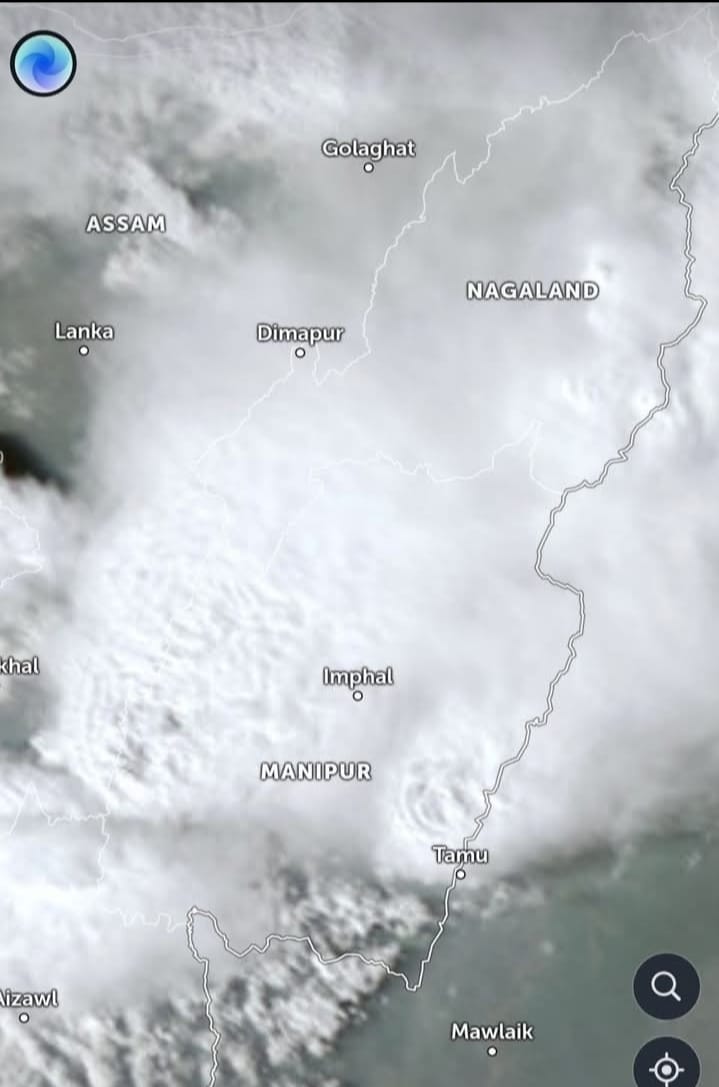
ICIMOD report links rising disasters to funding gaps as Manipur reels under hailstorms, floods, and landslides. Mountain ecosystems and rural livelihoods at tipping point

By Salam Rajesh
The Hindu Kush Himalaya region faces escalating climate risks, including glacial melt, biodiversity loss, and extreme weather events, posing severe threats to ecosystems, livelihoods, and the well-being of billions dependent on its resources.
This ominous assessment is an emancipation of studies carried out by the Kathmandu-based International Centre for Integrated Mountain Development (ICIMOD), as is presented in its publication ‘Climate Finance Synthesis Report: Needs, Flows and Gaps in the HKH countries (2025)’.
The Hindu Kush Himalaya (HKH) is one of the world’s most climate-vulnerable regions, facing growing threats from extreme weather events like glacial lake outburst floods (GLOFs), landslides, droughts, floods, forest fires, and intense monsoons.
The frequency, intensity, and duration of these events are increasing, exacerbating risks to ecosystems, food security, and livelihoods, particularly in rural and mountainous areas according to the ICIMOD studies.
The report estimates that the Hindu Kush Himalaya region requires approximately USD 12.065 trillion from year 2020 to 2050 for financing climate mitigation and adaptation measures, amounting to an annual average of a staggering USD 768.68 billion.
According to the Climate Risk Index (CRI) 2025 Report, floods, storms, and heat waves has caused significant global fatalities and economic losses, with floods alone affecting half of those impacted and storms accounting for 56% of economic damages to the tune of USD 2.33 trillion.
The ICIMOD report stressed that sectors crucial to the region, such as adaptation, agriculture, water management, and disaster risk reduction, remain significantly underfunded despite their critical importance.
The report assessed that limited private sector engagement, insufficient institutional capacity, fragmented policy landscapes, and weak data infrastructure further compound these challenges.
Several Indian States located within the HKH region had felt the impact of weather and climate extremes in recent years, incurring huge losses and damages to human lives, infrastructures, and to the natural environment.
From the damaging GLOF events in Himachal Pradesh and Uttarakhand to cloud bursts in Sikkim, massive floods in Assam, and devastating hailstorms in Nagaland and Manipur, nature’s fury had not spared anyone as such.
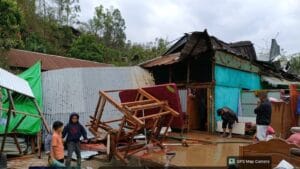
Manipur in recent years is seeing unprecedented scenarios of weather extremes, resulting in bursts of rains in short duration, flash floods, landslides, lightning strikes, and the damaging hailstorms.
Homes, agricultural fields and crops have not been spared, rendering tremendous economic losses for many who are in the marginalized sectors – peasants and agricultural farmers.
On Sunday (15 March) many parts of the State – Senapati, Imphal West, Kakching, Bishnupur, Tengnoupal – were hit by a fierce hailstorm ferried by a strong wind that blew off roofs and flatten houses.
Quite recently, farmers in Bishnupur District were left thunderstruck when a fierce hailstorm wreak havoc with their vegetable crops, totally flatten and battered beyond redemption, while tin roofing were punctured with multiple holes as if strapped by machine gun fire.
To address some of these pressing issues, the ICIMOD report recommended enhancing regional and global advocacy for HKH-specific climate funding, strengthening national and regional climate finance strategies, improving policy coherence, and developing robust financial mechanisms and innovative market-based instruments.
The report suggests that this could be achieved by building strong national institutional capacities and governance frameworks to manage and mobilize climate finance effectively.
It suggests leveraging innovative financial instruments, such as green and blue bonds, debt-for-climate swaps, and voluntary carbon markets, tailored specifically for mountain economies, to achieve the stated goals.
While suggesting urgent collective action and targeted financial investment as critical for building climate resilience, safeguarding ecosystems, and supporting sustainable development for current and future generations in the HKH region, the report emphasized that improving data infrastructure, climate risk assessments, and reporting systems to attract investments and enhance accountability require priority.
Without mincing words, the report points out that the challenges faced by the mountain regions, such as climate vulnerability, environmental degradation, and socio-economic disparities, are often overlooked in national, regional and global planning.
At the same time, the report fairly warns that with global warming projected to exceed the 1.5 degrees Celsius threshold by the year 2027 (WMO, 2025) – hardly a year from now – there is a pressing need for urgent climate action efforts to address key risks in mountain regions, with several structural challenges, such as lack of climate financing, hindering such efforts from attaining the requisite scope and scale.
Describing mountains as hotspots of climate change, the report extols that as in all other mountain regions of the world, in the HKH region too, the observed changes are increasing temperatures, changing seasonal weather patterns, reductions in snow persistence at low elevations, loss of glacier mass, increased permafrost thaw and incidence of glacial lake disasters.
Even as wars (Ukraine-Russia/Iran-Israel) escalates deaths and destructions, subsequently inflicting huge loss and damage, climate and weather extremes too are causing almost an equal amount of loss and damage as nature unleashes its fury left and right.
The massive wildfires in Australia, Europe and in the United States recently are but the tip of the iceberg in recent climate concerns, only worsening by the year. Glacial retreats and formation of glacial lakes in the HKH mountains are the proverbial warnings before catastrophe.
This is where rational suggestions such as those coming up from ICIMOD is a fair indication that States must come up with climate financing mechanism urgently to avoid climate and weather extreme disasters in the very near future within the HKH region.
Pakistan, India, Nepal, Bhutan and Bangladesh are in the red zones of climate and weather extremes, and hence actions require to be initiated soon enough. Even small nondescript States like Manipur and Nagaland are beginning to reel under unprecedented weather extremes in recent times.
The post Climate Extremes Batter Hindu Kush Himalaya, Northeast Feels the Heat first appeared on The Frontier Manipur.
Read more / Original news source: https://thefrontiermanipur.com/climate-extremes-batter-hindu-kush-himalaya-northeast-feels-the-heat/