

Th. Muivah accused the Government of India (GoI) of “betraying the letter and spirit of the August 3, 2015 Framework Agreement” and “consciously reverting to a military solution.”
By Paudi Renta
Eleven years after the signing of the Framework Agreement on August 3, 2015, the Indo-Naga political dialogue seems to have remained stalled—not for lack of talk, but for lack of trust. And in that vacuum, the contours of Govermnent of India’s strategy appear to be shifting. According to the NSCN (I-M), New Delhi has quietly abandoned the negotiating table in favour of a return to coercive statecraft.
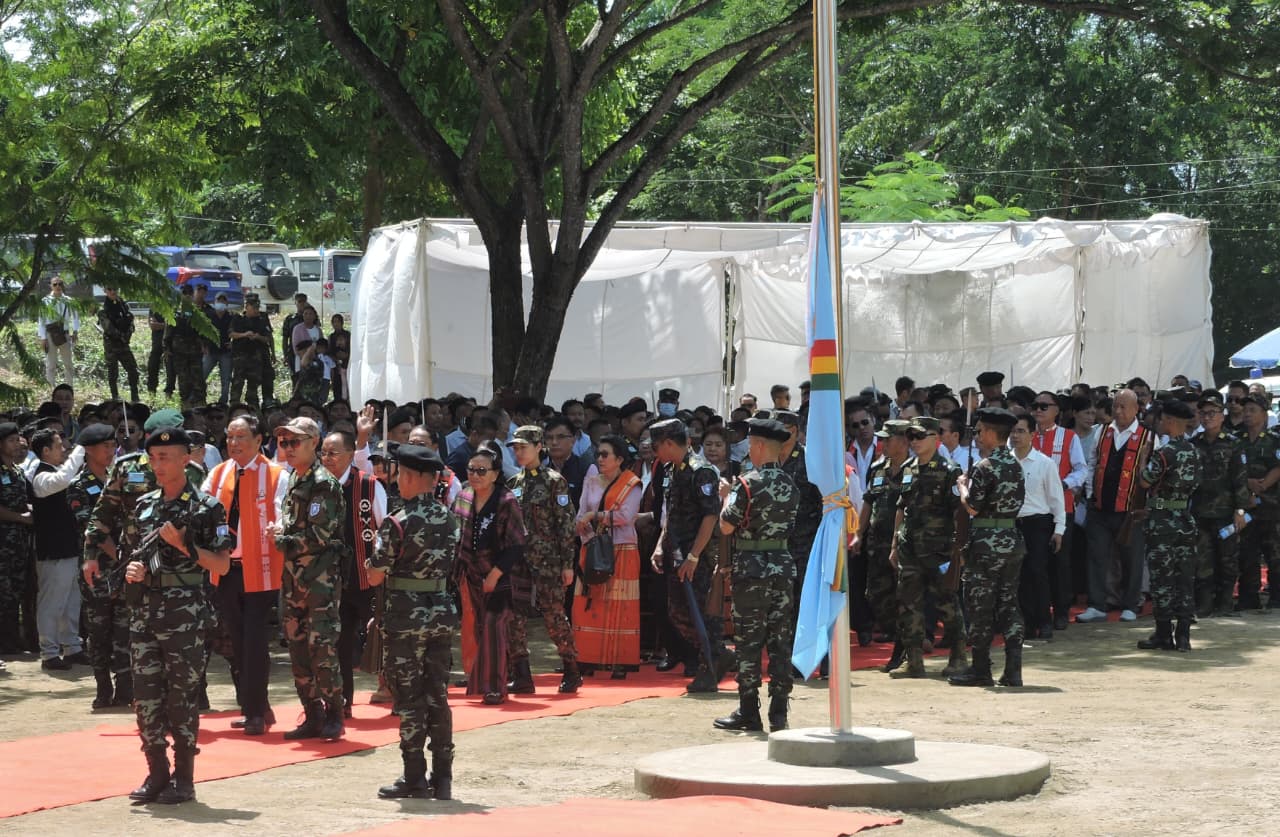
In a sharp address marking the 80th anniversary of the declaration of Naga Independence Day on Augiust 14, NSCN (I-M) General Secretary Th. Muivah accused the Government of India (GoI) of “betraying the letter and spirit of the August 3, 2015 Framework Agreement” and “consciously reverting to a military solution.” The message, read out at the group’s General Headquarters in Hebron, did more than register disappointment—it framed India’s posture as a deliberate strategic pivot.

Muivah’s assertion is not merely rhetorical. It reflects a deeper analytical reading of New Delhi’s actions over the past half-decade: the incremental reinforcement of security forces in Naga-inhabited areas, the lack of substantive movement on the core political demands, and the growing impatience within the Indian establishment toward any framework that acknowledges Naga sovereignty—even symbolically. “We all desire an early, acceptable and honourable political solution,” Muivah said, but cautioned that “the NSCN will not compromise the national sovereignty, flag and constitution on the grounds of political expediency to please India.”
At the heart of the impasse lies a fundamental interpretive clash. For the NSCN (I-M), the 2015 Framework Agreement was never a ceasefire extension—it was a foundational pact between two sovereign entities. Muivah reiterated that the “new relationship” of sharing sovereign power, as envisioned under the July 11, 2002 Amsterdam Joint Communique and the 2015 Framework Agreement, “is between two sovereign entities.” He added: “The final political agreement to be concluded from the ongoing negotiation shall be in accordance with the letter and spirit of the August 3, 2015 Framework Agreement.”
From New Delhi’s perspective, however, the agreement was always a roadmap for greater autonomy within the Indian Union—not a recognition of separate sovereignty. That dissonance has now hardened into mutual disillusionment. Muivah made it clear that the NSCN will not accept an imposed settlement: “We stand for a negotiated political settlement that recognises Nagalim’s sovereignty, national flag and constitution.” He warned that “any political agreement that does not uphold those national principles” would be unacceptable, and that the NSCN would “defend and protect Nagalim’s unique history, sovereignty, territory, flag, and constitution to the last.”
Analysts tracking the conflict note that India’s alleged return to militarised pressure is less about battlefield tactics and more about strategic signalling—a way to force the NSCN into accepting a diluted outcome by making the cost of continued resistance visible. Muivah directly addressed this, stating: “Nagas took up armed struggle in self-defence against the occupational forces of India and Myanmar.” He accused GoI of breaching the peace process “consciously,” suggesting that Delhi has calculated that a “military approach” may yield quicker, if bloodier, results than an elusive political deal.
Yet Muivah also took aim at internal Naga divisions, warning that “factions born of rebellion, mutiny and vested interests have been created and nurtured by adversaries to destroy the Nagas from within.” This reflects a growing anxiety within the NSCN (I-M) that India may be leveraging rival Naga groups and other breakaway factions—to fragment the nationalist movement and weaken its bargaining position. “These anti-nationals and reactionaries cannot claim the moral right to represent the Naga people,” he asserted.
The address also carried a theological and emotional weight, as Muivah paid tribute to former Naga leaders. He also paid tributes to former chairman Late Isak Chishu Swu, former vice chairman Late Khadao Yanthan, Late Brig. Thungbo Pangmi and former vice chairman Late “Gen. (retired)” Kholi Konyak and also acknowledged NNC leaders including AZ Phizo, Imkong Meren, T Sakhrie and others who have consolidated Naga movement. Muivah thanked civil society, churches, and international supporters. But the political message was unmistakable: the NSCN (I-M) seems to be getting close to a renewed prolonged confrontation, whether diplomatic or otherwise. “We will not accept an imposed solution or remain silent to a military solution,” Muivah affirmed. “An acceptable and honourable political agreement shall be according to Nagalim’s unique history, respecting the letter and spirit of the August 3, 2015 Framework Agreement.”
What remains unclear is whether New Delhi views the current stalemate as a failure of negotiation or as the necessary prelude to a different kind of resolution. For now, the rhetoric from Hebron suggests that the NSCN (IM) sees India’s hand not as a negotiator’s, but as a disciplinarian’s. And in that reading, the peace process is no longer about reconciling two histories—it is about which side can outlast the other.
(Paudi Renta is a Dimapur based senior journalist and Chief Contributor for TFM, Nagaland.)
The post Beyond the Table: NSCN (I-M) Feels A Shift from Dialogue to Dominance in Peace Process first appeared on The Frontier Manipur.
Read more / Original news source: https://thefrontiermanipur.com/beyond-the-table-nscn-feels-a-shift-from-dialogue-to-dominance-in-peace-process/