
When Wetlands Beckon

In climate change dialogues, the significance of wetlands as carbon sinks has multiplied manifold, increasingly with new findings on how much of carbon wetlands can sequester, besides the knowledge on green forests serving as important carbon sinks that absorb excess carbon in the atmosphere to help in climate change mitigation. By Salam Rajesh As in […]

The post When Wetlands Beckon first appeared on The Frontier Manipur.

In climate change dialogues, the significance of wetlands as carbon sinks has multiplied manifold, increasingly with new findings on how much of carbon wetlands can sequester, besides the knowledge on green forests serving as important carbon sinks that absorb excess carbon in the atmosphere to help in climate change mitigation.

By Salam Rajesh

As in the preceding years, the world community observed with solemnity the pledges to save, protect and conserve wetlands on the occasion of the annual World Wetlands Day ritual of social and environmental commitments, howsoever the mission appear far more than practicable to put words on ‘wetlands conservation’ in actuality.

The second day of February every year is dedicated to wetlands as a continued process of the global effort in raising awareness and commitments to saving much of the world’s fast disappearing water bodies of value to humans, wildlife and to nature itself.

An assessment by Hu et al. (2017, as quoted in Anisha, N.F., Mauroner, A., Lovett, G., Neher, A., Servos, M., Minayeva, T., Schutten, H. & Minelli, L. (2020). Locking Carbon in Wetlands: Enhancing Climate Action by Including Wetlands in NDCs. Corvallis, Oregon and Wageningen, The Netherlands: Alliance for Global Water Adaptation and Wetlands International) indicated that the area of wetland loss across the seven continents through the year 2009 and up to present times is considerably large.
Asia continent led the world in wetland area loss by a massive size of 2,646,100 sq km, followed by South America at a close second with a loss of 2,521,900 sq km. Europe figured with a considerably large loss of 972,200 sq km while North America lost 457,100 sq km, Africa 453,500 sq km and Oceania 181,600 sq km respectively.

This massive loss when counted in their totality can be seen to influence negative impacts on the living world, where even the IUCN (International Union for Conservation of Nature and Natural Resources) says that currently near around 47,000 species of animals and plants globally are on the verge of extinction from various reasons including negative anthropogenic influences.

Why would then people in general worry for wetlands dying and disappearing ultimately? The reasons are not far to seek, if people do reconsider the numerous ecosystem services rendered by wetlands in their totality.

For instance, wetlands have strong links to ancient traditions, cultures, spiritual values and religious values that establish socio-cultural links of people to their roots, in particular for wetland dependent or wetland-thriving communities. Manipur has a link in the legacy of the Khamba-Thoibi legends.

While it is generally accepted that wetlands supply food through natural resources such as fish and edible aquatic plants and insects, and through agricultural practices in wetland areas, these water bodies play an important role in climate change resilience and carbon storage. They assist in the regulation of greenhouse gases, temperature, precipitation and other climatic processes.

In climate change dialogues, the significance of wetlands as carbon sinks has multiplied manifold, increasingly with new findings on how much of carbon wetlands can sequester, besides the knowledge on green forests serving as important carbon sinks that absorb excess carbon in the atmosphere to help in climate change mitigation.

Compared to tropical rainforests which were thought of to be the best carbon sinks in the natural world, new findings in this aspect throws light on how wetlands can absorb carbon many times more than tropical forests.

For instance, compared to tropical forests storing 200 tons of carbon dioxide per hectare in soil, peatlands can store a massive 4700 tons of carbon dioxide per hectare in soil. That is a difference by a huge margin.

Similarly, mangroves can store up to 2839 tons of carbon dioxide per hectare in soil, seagrass 500 tons of carbon dioxide per hectare in soil, and salt marsh up to 917 tons of carbon dioxide per hectare in soil, which definitely is quite significant in global discussions on carbon sequestration to meet the deadline on limiting global temperature rise to 1.5 degree Celsius by year 2050.

Tropical forests are estimated to store up to 600 tons of carbon dioxide per hectare in their biomass, whereas, in the same measure mangroves are estimated to store as much as 928 tons of carbon dioxide per hectare in their biomass, which accounts for the global thrust on restoring and regenerating mangroves across most coastal belts around the world.

Wetlands play a major role in assisting with the storage and retention of water which helps flow regulation and provides flood and drought protection, and at the same time, wetlands assist in soil formation through sediment retention and accumulation of organic matter.

These, and much more, are the functional properties of wetlands in general, other than these water bodies providing leisure and fun for people seeking respite from the everyday grinding in life.

As in the preceding years, Manipur was not far behind other communities across the globe in observing the day with fervor and solemnity, urging local communities and the State to devout more time and energy in the larger objective of saving whether water bodies of value are left in the wild within the State.

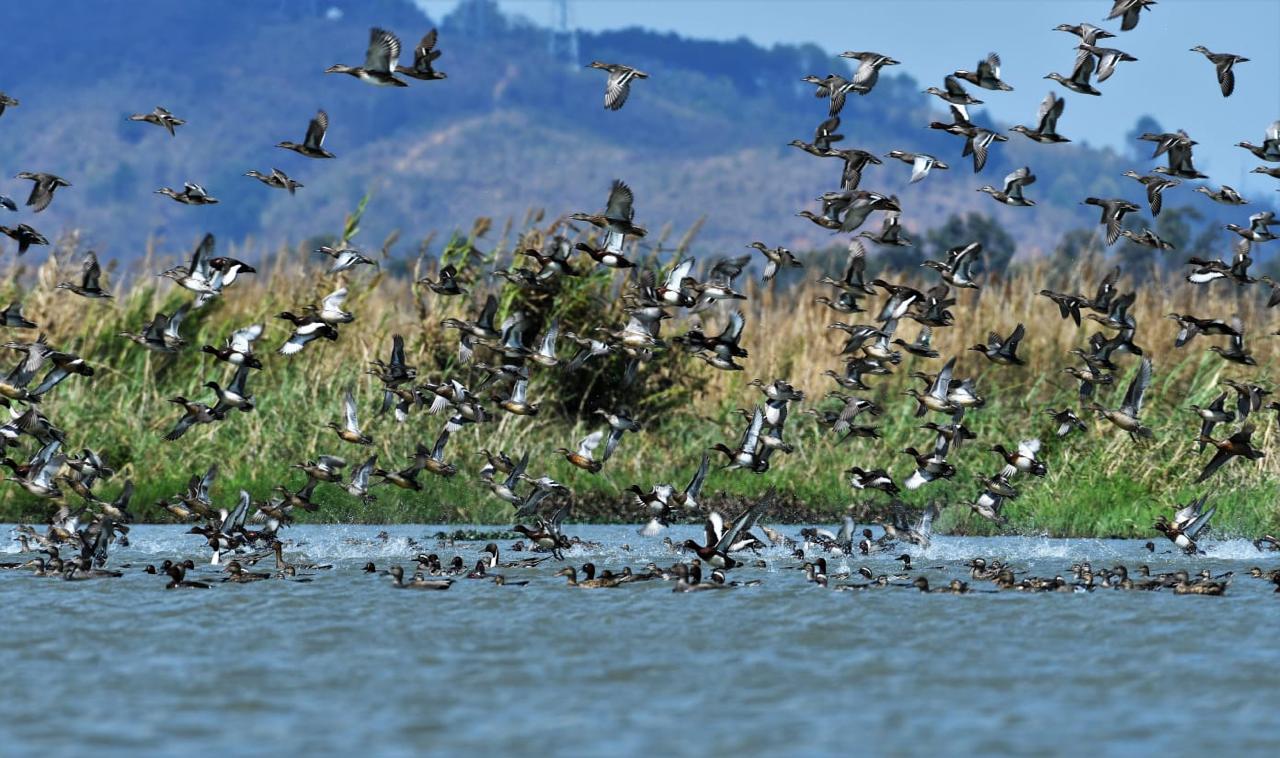
The State’s Directorate of Environment and Climate Change along with other line departments hosted the day at Yaralpat wetland site in Imphal East District, extolling the importance of wetlands to achieve various ecosystem services including groundwater recharge, fisheries and livelihoods, while providing refuge for wildlife such as the wintering migratory water birds.

The day was also observed widely across the State at academic and civil society platforms, individually and with support from the Directorate.

Of significant contribution to the day was the pre-World Wetlands Day 2026 observation on Sunday, 01 February, where the fishing community residing at Champu Khangpok Floating Island Village within Loktak Lake staged a cleanup drive to clear plastics and other domestic wastes along Yangoi Turel Achouba (Nambul River) and its flow up to Birahari Pat within the lake, demonstrating the local community’s responsibility in lake conservation.

Rounding up, it can be well said that a partnership, and workable, model between wetland-dependent local communities and the responsible state agencies can go a long way in shaping the future of wetlands in Manipur, and elsewhere.

The post When Wetlands Beckon first appeared on The Frontier Manipur.

Read more / Original news source: https://thefrontiermanipur.com/when-wetlands-beckon/

Present flood situation in Manipur

Salam Gunakanta Singh (Contd from yesterday) Damage to public infrastructure affects a far greater proportion of the population than those whose homes or businesses are directly inundated by the flood. In particular, flood damage to roads, rail networks and key transport hubs, such as shipping ports, can have significant impacts on regional and national economies. […]

Salam Gunakanta Singh (Contd from yesterday) Damage to public infrastructure affects a far greater proportion of the population than those whose homes or businesses are directly inundated by the flood. In particular, flood damage to roads, rail networks and key transport hubs, such as shipping ports, can have significant impacts on regional and national economies. […]

Read more / Original news source: http://kanglaonline.com/2017/07/present-flood-situation-in-manipur-2/

Chandel rally demands implementation of action plan on Climate Change

IMPHAL, February 11: A mass rally was taken out today at the Chandel district headquarters demanding the immediate implementation of Manipur State Action Plan on Climate Change (MSAPCC). The rally was jointly organised by the Chandel District Farmers’ Union (CDFU), Chakpi River Progressive and Development Society (CRPDS), Maha Area Chief Association Chandel (MACAC), Peoples’ Development

IMPHAL, February 11: A mass rally was taken out today at the Chandel district headquarters demanding the immediate implementation of Manipur State Action Plan on Climate Change (MSAPCC). The rally was jointly organised by the Chandel District Farmers’ Union (CDFU), Chakpi River Progressive and Development Society (CRPDS), Maha Area Chief Association Chandel (MACAC), Peoples’ Development

Read more / Original news source: http://kanglaonline.com/2016/02/chandel-rally-demands-implementation-of-action-plan-on-climate-change/

The making of a global changemaker : Monika Khangembam

var addthis_product=’wpp-252′;var addthis_options=”Google+1″About Monika Khangembam in her words: I am Monika studying in Bangalore. I am currently doing my Masters in Public Relation. Recently I was…

[[ This is a content summary only. Visit my webs…

var addthis_product=’wpp-252′;var addthis_options=”Google+1″About Monika Khangembam in her words: I am Monika studying in Bangalore. I am currently doing my Masters in Public Relation. Recently I was…

[[ This is a content summary only. Visit my website for full links, other content, and more! ]]

Read more / Original news source: http://feedproxy.google.com/~r/Kanglaonline/~3/Birrq9cMq28/

Apocalypse Imagined

The magnitude of a possible disaster as indicated by the periodic flood situation every monsoon can only be described as terrifying. Tuesday night’s unusually heavy torrents literally flooded half of… Read more »

The magnitude of a possible disaster as indicated by the periodic flood situation every monsoon can only be described as terrifying. Tuesday night’s unusually heavy torrents literally flooded half of Imphal, though thankfully the cloudburst did not last too long and the logged water had time to flow away considerably by morning, although not completely.

This is yet another caution as to how vulnerable the Imphal valley is. Just imagine what would have happened if the rains did not stop for another one week, a scenario not altogether impossible, in fact one which should be expected in the near future if the prediction of global warming and climate change by scientists is anything to go by. The floods caused would then be much more extensive. But more than this, in the event of a much larger volume of flood water inundating the valley, the second scenario is even more alarming.

Up to a certain level, the Loktak lake and other still existing natural wetlands can act as the reservoir and absorb flood waters. That is to say, only so long as the flood water volume is within this limit, flood waters would recede soon as the rains stop, and inundated farmlands and residences would be spared total destruction. But just suppose the flood water volume exceeds this limit in any given years. Since there is very little outflow of water away from the valley, the excess waters would have little or no place to drain away into, and farmlands and homesteads would remain inundated until the water evaporates. A glimpse of such a scenario is already available in the current floods. Long after the rains have ceased, many low lying areas as still flooded as the rivers that brought the waters are unable to reabsorb them. If the freak rains persist every year, then even before the previous years flood waters have receded, more would be incrementally added, ultimately water would reclaim much of the low lying areas, in much the same way it probably was in prehistoric and proto-historic times, memories of which are preserved in some of the folklores and legends of the place.

Even as much of the low lying coastal regions of the world, including Bangladesh, Netherlands, Florida etc, are swallowed up by the sea in the event of global warming leading to the melting of the polar ice caps, much of the Imphal valley too then would be an extended lake from permanent flood waters.
The moot point is, what possible remedies can there be? The first thing that most believers in a supernatural order would do is to pray that the unprecedented downpour this year was a freak occurrence and not a portent of things to come. But still, it would be prudent to prepare for the worst, even if one were to continue hoping for the best. The second, but a rather long term strategy would be to join the global effort to arrest climate change. This would entail first and foremost, trying to understand what this is all about. The last proposition that we would like to suggest has to do with the question of preparing for the worst case scenario.

The Imphal valley is at an altitude of over 2000 feet above mean sea level, which means that given the outlet, gravity would ensure that water drains out of the place. This fact itself should be capitalised into devising a way to ensure security of the valley from a future water disaster in the event of climate change. Apart from the river that flow out of the Loktak lake to ultimately join the river system in Myanmar and ultimately the sea, artificial tunnels of the Loktak Hydro Electric Plant use the same principle of gravity to divert water away from the lake to turn generation turbines and ultimately join the Barak River and the sea. Such artificial outlets could be made to have a double purpose – hydro electric generation as well as emergency water drainage. Just as for instance, the elaborate labyrinths of subway train tunnels deep down into the earth in many American and European cities, were also designed during the Cold War to couple up nuclear shelters in the eventuality of a nuclear holocaust which had become a real threat then. The nuclear holocaust did not happen, but the subway systems are not a waste because they are also fundamentally an important city transport infrastructure. Likewise, climate change and a subsequent water disaster may or may not be Imphal valley’s future, but the hydroelectric tunnels would still be performing their fundamental purpose of producing electricity.

Enhanced by Zemanta

Read more / Original news source: http://feedproxy.google.com/~r/Kanglaonline/~3/7zSWRnh62u4/