

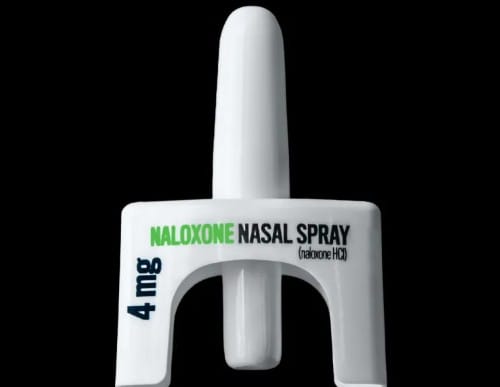
Every Life Matters: Medicine that rapidly reverses effects of opioid overdose

Naloxone can rapidly reverse the effects of an opioid overdose and restore normal breathing, making timely access to the medicine crucial when a person’s life may be hanging in the balance. Its free availability at Government health facilities is expected to strengthen efforts to ensure that life saving assistance reaches those in need without delay. […]

The post Every Life Matters: Medicine that rapidly reverses effects of opioid overdose first appeared on The Frontier Manipur.

Naloxone can rapidly reverse the effects of an opioid overdose and restore normal breathing, making timely access to the medicine crucial when a person’s life may be hanging in the balance. Its free availability at Government health facilities is expected to strengthen efforts to ensure that life saving assistance reaches those in need without delay.

TFM Desk

As the world observes International Overdose Awareness Day (IOAD) on August 31, the Director of Health Services, Government of Manipur, has informed that Naloxone, a life saving medicine used to reverse opioid overdoses, is now available free of cost at all Government health facilities across the State.

This year’s International Overdose Awareness Day is being observed under the theme, “25 Years On. Still Needed,” reminding communities across the world that overdose continues to claim lives and that timely intervention, awareness and access to life saving treatment remain critically important.

The Director of Health Services, Dr. N. Hemantakumar Singh has informed that Naloxone is available at Primary Health Centres (PHCs), Community Health Centres (CHCs), Urban Health Centres (UHCs), District Hospitals and other Government hospitals across Manipur.

Naloxone can rapidly reverse the effects of an opioid overdose and restore normal breathing, making timely access to the medicine crucial when a person’s life may be hanging in the balance. Its free availability at Government health facilities is expected to strengthen efforts to ensure that life saving assistance reaches those in need without delay.

The Director of Health Services has appealed to the public and all concerned to use Naloxone promptly, appropriately and responsibly whenever required. At the same time, he has strongly cautioned against its misuse, misappropriation or malpractice for personal or financial gain. Any person found indulging in such practices may face legal action and punishment under the law.

The Director’s message carries a simple but powerful reminder that Naloxone is not a commodity for personal gain, but a life saving medicine meant to be available when someone is fighting for their life. Its proper and judicious use can prevent a tragedy, save a precious life and spare a family from the pain of losing a loved one.

Every life matters. Let us use this life saving medicine wisely, responsibly and judiciously. When an overdose strikes, timely action can mean the difference between life and death. One dose can save a life, and one life saved can mean everything to a family.

What is Naloxone?

Naloxone is a safe medicine that rapidly reverses an opioid overdose. It can restore normal breathing within minutes. It is an opioid antagonist. It attaches tightly to opioid receptors in the brain and pushes opioids like heroin or fentanyl off those receptors. It blocks the harmful effects and helps the person breathe normally again.
Naloxone is available as an easy-to-use nasal spray or an injection. Can be given safely by family, friends, or bystanders. It works only if opioids are in the body; it does nothing if no opioids are present. Naloxone is non-addictive and cannot be abused. Its effects last for 30 to 90 minutes. The overdose can return when naloxone wears off, one must call emergency services right away.

The post Every Life Matters: Medicine that rapidly reverses effects of opioid overdose first appeared on The Frontier Manipur.

Read more / Original news source: https://thefrontiermanipur.com/every-life-matters-medicine-that-rapidly-reverses-effects-of-opioid-overdose/

Medical profession in Manipur: Humanitarian service or job security?

Sanjoy Akoijam First of all, before I begin this article, I would like to pay my respects to everyone in our State of Manipur who is engaged in the noble profession of Medicine. I thank you for all the countless lives you have saved and for all the smiles that you have brought to the […]

Sanjoy Akoijam First of all, before I begin this article, I would like to pay my respects to everyone in our State of Manipur who is engaged in the noble profession of Medicine. I thank you for all the countless lives you have saved and for all the smiles that you have brought to the […]

Read more / Original news source: http://kanglaonline.com/2017/07/medical-profession-in-manipur-humanitarian-service-or-job-security/

Indian pills fuel drug boom in Myanmar

TAMU (Myanmar) • Five years ago, when cold pills first trickled across Myanmar’s untamed border with India, many local officials were baffled. Where was this medicine going, and why were smugglers so interested in it? Today, the cross-border trickle has become a torrent and everyone knows why the Indian-made pills are so valuable: they are […]

The post Indian pills fuel drug boom in Myanmar appeared first on KanglaOnline.

Read more / Original news source: http://kanglaonline.com/2016/08/indian-pills-fuel-drug-boom-myanmar/

Doctor rounds

By Chitra Ahanthem Once upon a time, a trip to a doctor meant a pretty decent time interval where the doctor would take patient history and then follow it up… Read more »

By Chitra Ahanthem
Once upon a time, a trip to a doctor meant a pretty decent time interval where the doctor would take patient history and then follow it up only with required medication instructions. Looking at those times, it is also a matter of great irony that though there were lesser doctors then and few private clinics, there would never be a rush of people waiting for their turns to be medically examined. But they say changes are the only constant of life and the scene has changed and how! For one, the number of doctors and specialized ones has increased and so has the number of private clinics and hospitals and doctors on private service. But along with the number of doctors increasing (and we are talking mainly of urban centers), there is also an ever growing number of people who are becoming inclined towards seeking health services.

There are interesting insights into the phenomenon of seeking health care. There is of course, the fact that people are becoming more aware about the need to be concerned about their health and to take medical opinion. But on the other end of the spectrum is also the fact that urban life styles have added to new medical ailments. Over and above these areas, there is a disquieting tendency for doctors to treat their patients like money spinning enterprises. There is rarely any doctor (doing private practice) in Imphal or for that matter, in the district headquarters who do not charge a set patient consultation fee. Most of these doctors have a family member or a relative manning a sort of ticket table. They allocate serial numbers and take the consultation charge. The going rate at present is Rs. 200 on the first consultation and Rs. 100 for every follow up medical check up. 99.99 per cent of the time, the doctor will give a list of medicines that you have to buy and the ticket attendant will lead you to the in house pharmacy. Chances are also that you will find free doctor samples of medicines being sold.

This piece today is certainly not a chest beating or vitriolic rant against the medical community in Imphal but a mere mirror image of the practices that has become totally normal. It is certainly not a stand-alone practice for the same situation exists in urban areas and cities. But one wishes that there was a standard set of rules or code of conduct and ethics that the medical fraternity here would stick to. Most private clinics that I have seen functioning outside the state have a social responsibility program where they give subsidized health care to senior citizens and people with poor economic backgrounds. I happened to take my son for a surgery for plugging his leaking tear sac at the Nethralaya Eye Institute and was very impressed by the standard of health care and quality that justified with the amount of money they were charging. They had a patient counseling session where they explained the operation and what would follow later on. But what impressed me most was the fact that they had free surgery and medication policy for senior citizens and people from poor backgrounds. For the later, they checked with BPL cards and when I asked what would happen in cases where people do not come with any official documentation specifying that so and so is poor, I was told that the one thumb rule to check such cases was the desperation of people seeking services and the state of their appearance. I was told that it was as simple as that!

Personally, I have nothing against doctors on private practice so long as they are not shirking their Government work timings. It is I as a consumer, and customer and patient party who is aware that I can also seek his service at a subsidized rate at the government hospital where he/she is practicing. And if this “I” feel that waiting at a hospital is not in the order of things, it is only fair that “I” pay for the time that the doctor has devoted to me. But having said that, there are many areas that need to be considered from the doctor’s viewpoint that justifies the money that is being charged for his consultation. For one, it would do well to have a strict order of who gets in first. Very often, doctors have a set consultation time, which is known or announced. Patients troop in and an attendant, who allocates a serial number, takes down their names. But mostly, the serial numbers do not matter because someone they know or some one in their social circle drops in unannounced for a check up. Also, there are certain doctors who will give first priority towards the patients they have been administering at his/her government hospital set up but who follow up with him later on a private consultation basis. This would mean that they would jump the waiting list and ruffle up a few feathers.

End-point:
They say that an apple a day keeps the doctor away but either, something is wrong with the apples or the doctors have become indispensible for on an average basis, about 4 people out of 10 would most definitely be seeking medical attention or consultation at any given time: if not for his own self, for a family member, for a child etc.

Enhanced by Zemanta

Read more / Original news source: http://kanglaonline.com/2011/08/doctor-rounds/