

Strategic Challenges in India’s Northeast: The Manipur Crisis and Pathways to Sustainable Security and Peace PART 2

By Brojen Thangjam Part II   Manipur: From Complex History to Violent Political Fragmentation Manipur’s present crisis has to be understood against a much longer history of political incorporation, social differentiation and frontier governance. Since its incorporation into the Indian Union in 1949, the state has had to negotiate the coexistence of a distinctive historical and […]

The post Strategic Challenges in India’s Northeast: The Manipur Crisis and Pathways to Sustainable Security and Peace PART 2 first appeared on The Frontier Manipur.

By Brojen Thangjam

Part II


Manipur: From Complex History to Violent Political Fragmentation

Manipur’s present crisis has to be understood against a much longer history of political incorporation, social differentiation and frontier governance. Since its incorporation into the Indian Union in 1949, the state has had to negotiate the coexistence of a distinctive historical and political identity with the institutions and imperatives of the Indian state. Its geography adds another layer of complexity. Located on India’s international frontier with Myanmar, Manipur has long been exposed to cross-border movement, ethnic and familial linkages, demographic pressures and transnational economic and illicit networks. Within the state itself, different communities have developed distinct political aspirations, social institutions and relationships with land, customary authority and the state. These differences have interacted with inherited administrative arrangements, changing forms of political accommodation and a security architecture shaped by the region’s frontier character and successive phases of armed conflict. The result is a political-security environment in which questions of identity, territory, authority, security and political representation have become closely intertwined.

From Political Incorporation to Insurgency

One enduring source of political contestation in Manipur concerns the circumstances and political meaning of its incorporation into the Indian Union. The Merger Agreement was signed on 21 September 1949, and administration was transferred to the Government of India on 15 October 1949. The Government of India’s White Paper on Indian States had described Manipur as a border state of “great strategic importance”, whose security arrangements required special attention. The Agreement transferred “full and exclusive authority, jurisdiction and powers” over the governance of the State to the Dominion Government. These developments marked a decisive change in Manipur’s constitutional and political status, but they did not bring the political questions surrounding that transition to a simple conclusion. (Government of India, 1948)

The significance of this history is also illuminated by the constitutional trajectory that preceded the merger. Manipur adopted its own Constitution in 1947 and held elections on the basis of universal adult franchise in June 1948, establishing a functioning Legislative Assembly. In studies of constitutionalism in the princely states of the Indian subcontinent, Manipur stands out as an important case that complicates the conventional narrative of integration. (De & Shani, 2025, pp. 150–161). They note that the Manipur State Constitution Act, 1947, has remained a site of political contestation, while the subsequent dissolution of the elected institutions following the transfer of administration has become part of a longer political memory concerning constitutional authority, political representation, and the terms of Manipur’s incorporation.

This history should not, however, be treated as a sufficient explanation of the conflicts that followed. Its significance for the present argument lies in the fact that the circumstances of incorporation provided one strand of the political narrative through which questions of sovereignty, political autonomy and historical legitimacy were subsequently articulated. From the 1960s, armed organisations emerged challenging the authority of the Indian state and, in different forms, seeking independence or the restoration of what was regarded as Manipur’s sovereign political status. The question of incorporation thus became one element in the historical and political justification of insurgency, contributing to a prolonged vertical conflict between insurgent organisations and the state.

The Convergence of Vertical and Horizontal Conflict

The present crisis, however, cannot be understood simply as a continuation of the earlier insurgency. The political and security environment has changed substantially. For much of the post-independence period, the dominant conflict was essentially vertical: the principal confrontation was between insurgent organisations and the Indian state. The present crisis has added a powerful horizontal dimension, in which conflict increasingly takes place between communities themselves, with armed organisations, political actors, state institutions and community-based security structures operating within and around these competing relationships. The distinction between vertical and horizontal conflict is useful here because it draws attention not merely to a change in the identity of the actors, but to a change in the social and political location of armed confrontation (Sadokpam, 2026). Sadokpam draws this understanding from Rizal Sukma’s formulation of vertical and horizontal conflict in ethnically volatile Indonesia. (Sukma, 2005) that helped to illuminate this transformation.

This shift was gradual rather than a sudden conversion in 2023. It emerged as political aspirations that had previously been expressed largely through ethnic organisations, constitutional demands and electoral politics became increasingly intertwined with armed organisations and coercive forms of mobilisation. The reconfiguration of insurgent politics in the late 1980s was particularly significant. The formation of the NSCN (IM) in 1988 and the emergence of Kuki armed organisations such as the KNA and KNF in the same year created new organisational vehicles through which claims relating to identity, territory and political authority could be articulated and pursued. The Kuki–Naga conflict of 1992–97 marked a critical stage in this transformation. It demonstrated that armed mobilisation could be directed not only against the state but also towards competing territorial and political claims between communities, producing displacement, deepening mistrust and consolidating armed authority within particular areas. The conflict was therefore no longer simply a contest between the state and insurgents, as territorial and political competition itself became increasingly militarised.

The subsequent peace processes further altered this landscape, although in a paradoxical way. The 1997 ceasefire between the Government of India and the NSCN (IM) substantially reduced direct confrontation between the state and the organisation, while its designated camps, command structure and organisational networks continued to operate within Manipur. The later suspension of operations arrangements with Kuki-Zo armed groups, informally from 2005 and formally from 2008, similarly sought to contain a fragmented armed landscape rather than immediately dismantle it. These arrangements reduced insurgent violence and created channels for political engagement, but they also allowed armed organisations to retain organisational cohesion, territorial influence and political relevance. Over time, armed authority therefore became embedded within parts of the social and political order rather than disappearing from it. The result was a gradual multiplication of centres of authority and a blurring of the boundary between armed mobilisation, community politics and territorial control.

As armed organisations became embedded in particular communities and territories, control over physical and economic space also acquired greater political significance. Territory was no longer simply the ground on which the state sought to deny insurgents freedom of movement; it increasingly became an object of competition in its own right. Control over land, strategic locations, movement corridors, border access, trade and economic networks acquired political and security value. Moreh illustrates this changing environment particularly well. Its location on the Myanmar frontier, its importance for cross-border trade and connectivity, and the presence of competing political and armed interests made it a space where territorial claims, economic interests, community security and challenges to state authority converged. The cumulative effect was a conflict environment in which the older state–insurgent contest increasingly overlapped with struggles over territory, resources, political representation and community security (Nepram, 2004).

This transformation does not mean that the earlier vertical conflict has disappeared. It has not. Rather, the two dimensions now coexist and interact. Armed organisations that once primarily challenged state authority have become embedded, to varying degrees, in community, territorial and political networks, while communities themselves have increasingly come to perceive security through competing claims over territory, identity and political future. By the time the 2023 crisis emerged, armed groups had become enduring political actors with organisational capacity, coercive capability, territorial influence and claims to political representation. The state was therefore no longer dealing only with armed organisations challenging its authority; it was also confronted with communities whose perceptions of security, territory, identity and political future had themselves become mutually contested.

The distinction matters because a state–insurgent conflict and an inter-community conflict pose different political and security problems. In the former, the principal challenge is to restore state authority in relation to an armed organisation. In the latter, the state must simultaneously protect communities from one another, maintain public authority, and create political conditions under which competing communities can continue to inhabit a common political space. This is one of the central reasons why a security architecture developed primarily around counterinsurgency could prove considerably less effective when violence emerged from within the political and social order that decades of conflict management had helped to shape.

The Differentiated Political Geography of Manipur

The transformation described above has unfolded within a political geography that is itself deeply differentiated. Manipur is not simply divided between a valley and the hills. Different communities have developed distinct relationships with land, political authority, customary institutions and the state, shaped by terrain, settlement patterns, historical administrative arrangements and political representation. The valley’s demographic concentration, agricultural and urban economy and political centrality developed alongside hill areas characterised by different land regimes, customary institutions and forms of administration. Geography therefore acquired political meaning: it shaped how communities understood land, representation, authority and security.

The hill–valley distinction is consequently more than a geographical divide. It has acquired political and institutional dimensions, particularly around land, customary authority, representation and autonomy, as well as the relationship between state institutions and community institutions. These differences have also been interpreted and mobilised by political leaders and elites, giving geographical and institutional distinctions a political life of their own. At the same time, the binary should not be overstated. Both the hills and the valley contain multiple communities, interests and political positions. Historical and geographical differences do not inevitably produce conflict; their significance lies in the different political contexts within which grievances, fears and aspirations are understood and mobilised.

An important consequence has been that the state itself is not experienced in the same way across these political spaces. In some communities, state institutions have been perceived as majoritarian, partial or insufficiently protective; in others, they have been viewed as instruments of unequal political accommodation. In parts of the hills, the uneven reach of state institutions has also allowed customary, community and, at times, armed structures to retain significant influence. The result is not the absence of state authority, but its coexistence with other sources of authority and legitimacy. Political order is therefore experienced through multiple institutional relationships rather than through a single, uniformly accepted framework of public authority.

This helps explain why long-standing political differences have proved difficult to contain within conventional political institutions. Questions of identity, land, representation, autonomy and political authority have generated competing aspirations for decades, but the critical issue is not simply the existence of these differences. It is whether institutions are sufficiently legitimate and capable of providing credible means through which such differences can be negotiated. Where political institutions are unable to command confidence across communities, political claims are more readily interpreted through the language of collective security. A dispute over representation can become a question of political survival; a dispute over land can become a question of territorial security; and uncertainty about political arrangements can become a fear about the community’s future.

Hassan (2008) compares experiences of Manipur and Mizoram. In his, Building Legitimacy: Exploring State–Society Relations in Northeast India, Hassan places state-making, institutional legitimacy and state capability at the centre of his analysis of the contrasting trajectories of the two states. His argument is not that conflict disappears when a state becomes more capable, but that the consolidation of legitimate state institutions creates a stronger political framework for managing group contestation. In Mizoram, the process of state-making helped strengthen the legitimacy and authority of state institutions and their capacity to manage competing interests. In Manipur, by contrast, traditional and community-based centres of authority, including tribal and ethnic associations, retained considerable influence, contributing to a more fragmented field of social and political authority.

Hassan’s comparison therefore helps shift the question from why communities have competing claims to why political institutions are unable to mediate those claims effectively. Grievances, competing identities, historical memories and struggles over land and resources may generate political mobilisation. Whether such mobilisation develops into sustained conflict, however, depends also on the capacity and legitimacy of institutions to regulate competition, provide credible avenues for political participation and maintain a political order that communities regard as sufficiently fair. In Manipur, the difficulty has been not simply the presence of competing political aspirations, but the weakness of institutions in providing a sufficiently trusted arena in which those aspirations can be negotiated.

The significance of the present crisis therefore lies in the interaction between a differentiated political geography and uneven political authority. Where communities do not experience the state as equally legitimate or capable, and where alternative sources of authority retain substantial influence, political differences can more readily become security concerns. The crisis is consequently not reducible to the failure to suppress violence. It points to a deeper difficulty in sustaining a political order in which competing communities can pursue their interests, contest one another politically, and still regard the state as a credible common arena for negotiation.

Security Architecture and Managed Instability

This weakness of political mediation has existed alongside a distinctive security architecture that has governed the region for decades. Manipur’s prolonged insurgency produced an extensive security response, including exceptional legislation, counter-insurgency institutions and doctrines, truce-management frameworks and successive peace processes. As Sanjib Baruah argues, however, this was not simply a collection of security measures but part of a wider security order in which a military understanding of political conflict acquired considerable primacy. The persistence of this security orientation shaped how the state understood and responded to political unrest, often privileging the management and containment of violence over the resolution of its underlying political causes (Baruah, 2020).

These measures had significant effects. Over time, levels of insurgent violence declined in important parts of the state, even though the organisations, constituencies and political questions that had sustained armed mobilisation did not disappear. The reduction in violence was therefore real, but it did not necessarily represent the resolution of the conflict’s underlying political drivers. As Ajai Sahni’s analysis of internal security in the Northeast illustrates, declining levels of violence need to be assessed alongside the continuing organisational, political and social conditions that sustain insurgent mobilisation (Sahni, 2023). At the same time, the prolonged security architecture created a difficult legitimacy problem. Where communities experienced security institutions primarily through exceptional laws, military deployment and counter-insurgency operations, trust in the security forces and in the institutions they represented could be weakened. The state could therefore reduce violence while struggling to build the broader legitimacy and confidence necessary for security to become a shared public good.

The distinction is important because containment of violence did not necessarily translate into consolidation of state authority or legitimacy. Ceasefires and negotiated arrangements could reduce armed confrontation while allowing insurgent organisations to preserve their organisational structures, social constituencies and, in some circumstances, economic influence. Political accommodation could therefore coexist with the persistence of alternative centres of authority. The security architecture also remained embedded in a wider political environment in which the state’s coercive capacity was often more visible than its capacity to mediate competing political claims.

This is particularly significant in Manipur because security arrangements developed alongside, rather than fully replacing, other forms of political and social authority. Community organisations, customary institutions and armed organisations continued to exercise influence in different parts of the state, while the state’s capacity to regulate political and security relations remained uneven. The result was a security environment in which violence could be reduced without producing a corresponding consolidation of a common political authority. Moreover, where security forces themselves were viewed with distrust by sections of the population because of the history and operation of the security architecture, the state’s ability to claim legitimacy as an impartial provider of public security was further weakened.

This does not diminish the importance of ceasefires or peace processes. They can be necessary instruments of conflict management and can create conditions for political engagement. The difficulty arises when arrangements intended to create space for political settlement become enduring mechanisms through which armed authority is accommodated without being progressively transformed into accountable political authority. In such circumstances, the reduction of violence may coexist with the persistence of fragmented authority and unresolved political competition.

This produced what may be described as managed instability: violence was sufficiently contained to prevent wider escalation, but the political contradictions, alternative centres of authority and deficits of institutional trust that sustained insecurity remained unresolved. The concept is used here analytically to describe a condition in which conflict is managed sufficiently to maintain a degree of order without producing a sufficiently legitimate and integrated political settlement.

The significance of this distinction becomes clearer after 2023. The question is not simply whether earlier security arrangements reduced violence. It is whether they also created the political and institutional conditions necessary to sustain a common system of public authority and security when the conflict changed form.

Fragmented Authority and Community Security

The events since May 2023 exposed this problem with unusual clarity. The emergence of community-based armed formations, territorial separation, parallel security arrangements and competing claims over political authority made visible a condition in which the state was no longer the sole or universally accepted provider of security.

This can be understood through the idea of fragmented authority. Rather than authority residing exclusively within public institutions, political and security functions become dispersed among state institutions, armed organisations, community-based authorities and other actors. An analysis of the Manipur crisis similarly describes a condition of fragmented sovereignty, in which political authority is dispersed across overlapping institutions, with contested sovereignty and coercive power operating alongside formal state institutions (Thangjam & Laishram, 2026). The important question, therefore, is not simply who controls territory, but who provides protection, who exercises authority and who is perceived as capable of determining political outcomes.

The growth of community-based security is understandable in conditions of fear and uncertainty. When communities believe that public institutions cannot adequately protect them, organising for their own protection becomes a rational response to insecurity. But what may begin as a response to insecurity can itself alter the political order. Where communities increasingly depend upon their own organisations for protection, security becomes a communal rather than a public good. Armed organisations can become embedded within community structures; political representatives can become dependent upon coercive actors; and the state can find itself negotiating not only with political actors but also with actors who possess coercive capacity and claim to speak on behalf of communities.

The events of May 2023 must be distinguished from these longer-term structural conditions. The precise causes and sequence of the initial violence remain subject to competing political and legal interpretations. What is less difficult to observe, however, is the speed and scale with which violence spread across geographically separated locations, the rapid emergence of armed community formations and the subsequent establishment of territorial frontlines. The pattern suggests that the violence did not develop solely through spontaneous local mobilisation; it unfolded in an environment in which pre-existing organisational, political and armed capacities could be rapidly activated.

The concept of an institutionalised riot system provides a useful analytical lens for thinking about this process. Brass cautions against treating large-scale communal violence as simply spontaneous eruptions of accumulated anger. His framework draws attention to the political actors, organisational networks, symbols, narratives and local mechanisms through which violence can be prepared, activated and sustained (Brass, 2003). Applied cautiously to Manipur, the value of the framework is not to establish that the May 2023 violence was a centrally planned riot. Rather, it helps us ask how pre-existing political mobilisation, organisational networks and accumulated insecurity can enable violence to move rapidly from local confrontation to wider communal conflict.

The political crisis and the security crisis therefore began to reinforce one another. Weak political mediation encouraged communities to seek their own security; expanding community security reduced confidence in common public institutions; and fragmented authority made political mediation more difficult. Once security itself becomes organised increasingly along community lines, restoring a common political order becomes considerably harder.

The significance of the post-2023 crisis therefore lies not only in the scale of violence but in what it revealed about the underlying structure of authority in Manipur. The crisis brought into the open a condition in which state institutions, armed organisations and community-based structures could exercise different forms of authority over the same political space. What had previously existed in more dispersed and often less visible forms became an overt feature of the conflict.

Displacement, Trust Deficit and Militarisation

The crisis of political order is also visible in the ways prolonged violence has altered the social and territorial conditions within which that order operates. Displacement, changing patterns of settlement, declining institutional trust and deepening reliance on security structures have become part of the political landscape created by the conflict. These are not simply consequences of violence; they increasingly shape the conditions under which security, political authority and eventual peace will have to be rebuilt.

The scale and duration of displacement illustrate this transformation most clearly. By March 2025, government data submitted to the Supreme Court recorded approximately 57,000 people living in 361 relief camps, from an estimated total displacement of around 60,000 since the outbreak of violence (Human Rights Watch, 2025). These figures do not capture all those living with relatives, in temporary accommodation or outside the state. The significance of displacement therefore lies not only in its humanitarian scale but in the way it has altered the social and territorial geography of the conflict.

Large numbers of people have remained separated from their homes, livelihoods and former neighbourhoods; many homes have been destroyed or occupied; and the physical conditions necessary for return have become inseparable from questions of security and territorial control. Displacement has consequently contributed to a more durable separation of communities and made the restoration of the pre-May 2023 social geography increasingly difficult. Questions of return, property restitution and accountability therefore become part of the larger question of whether public institutions can provide a credible framework for restoring ordinary political life.

The consequences extend to institutional trust. Trust is not simply confidence that an institution can perform a task. It involves an expectation that an authority will act with competence, fairness and a degree of good faith when exercising power. Legitimacy is related but distinct: it concerns whether that authority is regarded as rightful and deserving of acceptance. Research on procedural justice suggests that perceptions of fairness, respectful treatment and voice are central to the willingness of citizens to accept and cooperate with public authority (Tyler, 2003; Fisk & Cherney, 2017). In conflict-affected settings, therefore, the experience of how security is provided can matter as much as the fact of security itself.

This distinction is important in Manipur. Trust in public institutions can be weakened when communities experience the state as absent, partial, discriminatory or unable to protect them. Prolonged exposure to exceptional security measures can add another layer to this problem when security institutions themselves become associated with coercion rather than impartial public protection. Research on military policing in Manipur has documented how prolonged exceptional security measures have affected state–society relations and generated concerns about abuse and accountability (Chopra, 2019). The result can be a trust deficit in which the state retains substantial coercive capacity but struggles to command confidence that its institutions will provide security fairly and consistently. Where confidence is weak, communities are more likely to rely on their own organisations and networks for protection.

These experiences can also become embedded in communal memory. Fear, loss, displacement and perceptions of unequal protection are transmitted through families, community organisations and social networks. Distrust can therefore become self-reinforcing, both within communities and in perceptions of other communities and public institutions. What appears at one level as a problem of inter-community mistrust is consequently also a problem of accumulated institutional experience.

This helps explain the changing significance of militarisation. Manipur has lived for decades with a substantial security presence, exceptional security legislation and institutions shaped by counterinsurgency. In this historical sense, militarisation refers not simply to the presence of armed forces but to the growing influence of security institutions and security logics in political and social life. The post-2023 crisis has added a different dimension: communities have increasingly organised their own forms of protection, including armed community defence, in response to perceptions of vulnerability and the inability of common security arrangements to provide sufficient reassurance.

The two forms should not be equated, but they interact. The historical security architecture established an environment in which security institutions had an unusually prominent role in public life; the post-2023 crisis has extended the logic of security mobilisation into the social organisation of communities themselves. When communities organise for their own protection, this may initially be a rational response to insecurity. But where armed protection becomes embedded in community organisation, security can increasingly become a communal rather than a common public good. Armed organisations may acquire greater social and political influence, while the state faces greater difficulty in restoring a common security framework. Recent analysis of the conflict similarly identifies the emergence of parallel security systems among the principal communities as a consequence of the erosion of common protection. (Kipgen & Ganie, 2025)

A self-reinforcing dynamic can then emerge. Insecurity encourages communities to strengthen their own protection; stronger community-based protection reinforces perceptions of continuing insecurity; and prolonged reliance on separate systems of protection makes the restoration of common public security more difficult. Militarisation therefore becomes not only a consequence of insecurity but also a mechanism through which insecurity can be reproduced.

The immediate eruption of violence in May 2023 must nevertheless be distinguished from these longer-term structural conditions. The precise causes and sequence of the initial violence remain subject to competing political and legal interpretations. What is less difficult to observe is the speed and scale with which violence spread, the emergence of armed community formations and the subsequent establishment of territorial frontlines. The crisis therefore brought together several processes that had developed over time: displacement and territorial separation, weakened confidence in common institutions, and the increasing capacity of communities to organise security for themselves.

These developments also provide a useful way of understanding the official framing of the crisis. Government statements have repeatedly emphasised declining violence, the restoration of normalcy, the resumption of administrative and economic activity, and dialogue with stakeholders as principal indicators and instruments of progress. The Prime Minister has described the conflict as deeply rooted in Manipur’s history and referred to earlier episodes of social conflict, while the Union Home Minister has explicitly characterised the violence as ethnic and emphasised the restoration of peace and normalcy. The latter framing is particularly clear in the Home Minister’s parliamentary statements, where he distinguished the violence from terrorism and other forms of armed conflict and described it as ethnic violence between communities.

This framing is understandable as an immediate approach to stabilisation, but it also has a less visible implication. When a crisis is primarily presented as an historically recurrent or essentially ethnic conflict between communities, the political and institutional dimensions of the crisis can recede from view. The state risks being positioned principally as a manager of violence rather than as an actor responsible for rebuilding a common political order. The emphasis on declining violence and normalisation therefore places immediate weight on preventing renewed escalation and restoring administrative functioning, while the emphasis on dialogue points towards engagement with multiple stakeholders. Yet neither necessarily answers the deeper question of whether the institutions through which security and political authority are exercised have regained sufficient legitimacy and trust.

Framing the immediate objective as “normalisation” therefore leaves a deeper question less visible: what exactly is being normalised? A return to reduced levels of violence and functioning administration is necessary, but it does not by itself restore trust, enable displaced populations to return safely, reverse community militarisation or reconstruct common public authority. If the underlying political and institutional relationships remain substantially unchanged, normalisation may restore order without necessarily producing a sustainable political settlement.

The crisis can consequently be understood as a crisis of political order expressed and reinforced through a crisis of security. Political order depends upon institutions capable of mediating competing claims, while security depends upon the capacity of the state to provide credible, common and legitimate protection. The two are therefore inseparable: where political confidence weakens, communities turn increasingly towards separate forms of protection; where public security becomes fragmented, the space for political mediation contracts. The challenge is therefore not simply to suppress violence, but to reconstruct the political and security relationships through which a common public order can be sustained.

(Brojen Thangjam recently retired from service with the United Nations. He can be reached at brojen2303@gmail.com)

The post Strategic Challenges in India’s Northeast: The Manipur Crisis and Pathways to Sustainable Security and Peace PART 2 first appeared on The Frontier Manipur.

Read more / Original news source: https://thefrontiermanipur.com/strategic-challenges-in-indias-northeast-the-manipur-crisis-and-pathways-to-sustainable-security-and-peace-part-2/
Strategic Challenges in India’s Northeast: The Manipur Crisis and Pathways to Sustainable Security and Peace PART 1

By Brojen Thangjam The continuing crisis in Manipur illustrates how the strategic challenges confronting India’s Northeast are changing in character. The region is simultaneously an international frontier, a conflict-affected political space and an increasingly important gateway for India’s connectivity and engagement with Southeast Asia. The violence that began in May 2023 exposed not only the […]

The post Strategic Challenges in India’s Northeast: The Manipur Crisis and Pathways to Sustainable Security and Peace PART 1 first appeared on The Frontier Manipur.

By Brojen Thangjam

The continuing crisis in Manipur illustrates how the strategic challenges confronting India’s Northeast are changing in character. The region is simultaneously an international frontier, a conflict-affected political space and an increasingly important gateway for India’s connectivity and engagement with Southeast Asia. The violence that began in May 2023 exposed not only the persistence of armed insecurity but also a deeper crisis of political authority, institutional trust and inter-community relations.

The Changing Strategic Challenge

More than three years after the outbreak of violence in May 2023, Manipur remains deeply fractured. Although the intensity of direct violence has fluctuated, the conditions created by the conflict remain unresolved. Large-scale displacement, armed community defence, the circulation of weapons, territorial separation, a vulnerable international frontier and a severe loss of trust in state institutions and between communities have altered the security and political environment.

The significance of Manipur extends beyond the immediate crisis. The state lies at the intersection of India’s internal political order and its strategic engagement with Southeast Asia. It is simultaneously a conflict-affected society, an international frontier, and a critical link in India’s wider connectivity ambitions. The challenge, therefore, is not only how to restore security within Manipur, but how to govern a strategically important frontier while addressing the political and social conditions that have made security itself increasingly contested.

The central argument of this essay is that the strategic challenges in the region are continually evolving as conditions change. The established security framework, in which insurgency and counterinsurgency have been important elements, remains relevant where armed threats persist, but it is no longer sufficient on its own to explain an environment in which ethnic conflict, community-based security, frontier instability, transnational networks and competing political claims increasingly intersect. The conflict has now acquired a powerful horizontal dimension, with communities themselves becoming principal actors in both violence and security. As confidence in common institutions has weakened, communities have increasingly turned towards their own systems of protection, producing a fragmentation of security even while the State retains substantial coercive capacity.

This transformation requires a corresponding change in how sustainable security and peace are understood. The objective cannot simply be the suppression of violence or a return to the conditions that existed before May 2023. It requires restoring legitimate and effective public authority, rebuilding institutional trust, and creating political space for competing aspirations to be pursued without recourse to violence. At the same time, it requires recognising that sustainable peace cannot be secured through state action alone. Political actors and communities must also reconsider the pursuit of maximalist demands through coercion, armed mobilisation and exclusion, while peace processes must find ways of addressing deeply rooted differences without reproducing the conditions for renewed conflict. These are complex political questions that cannot be resolved within the scope of this essay. Its concern is more limited: to examine how these unresolved political and social contradictions have found violent expression, and what this means for the pursuit of sustainable security and peace. In this sense, sustainable security is best understood as a condition in which physical protection, legitimate institutions, political accommodation and relationships between communities reinforce rather than undermine one another.

The essay develops this argument in four parts. Part I locates Manipur within the changing strategic geography of India’s Northeast, examining the region’s transformation from a security-sensitive frontier into a strategic space shaped by security, connectivity, migration, trade and India’s engagement with Southeast Asia. Part II turns to the Manipur crisis itself and examines the transformation from a predominantly vertical conflict between the State and insurgent organisations towards a deeply horizontal conflict between communities and the resulting crisis of political mediation and public authority. Part III asks what sustainable security and peace should mean in these circumstances, drawing on the concepts of conflict transformation, positive peace, sustaining peace and comparative evidence on the prevention and resolution of internal conflict.

Part IV then moves from diagnosis towards pathways for change. It examines five interconnected transitions: from security management towards political settlement; from counterinsurgency towards frontier governance; from community-based protection towards public security; from armed and ceasefire arrangements towards political transformation; and from separation and coexistence towards a shared political community. The final discussion considers a further condition underlying these transitions, namely the need to combine accommodation between communities with greater accountability and participation within them.

The essay concludes by returning to the larger question of what kind of political and security order might allow Manipur’s different communities to share a future without requiring the erasure of their distinct identities. The purpose is not to offer a single formula for resolving the crisis, but to examine the changes in institutions, relationships and forms of authority that would be necessary to move from managed instability towards sustainable peace and shared security.

Part I

Locating the Northeast: From Frontier to Strategic Space

India’s Northeast occupies a paradoxical position. It is at once a frontier to be secured and a gateway to be opened; a region of internal security concern and an important avenue for India’s engagement with Southeast Asia. The same geography that has historically made the Northeast appear distant, vulnerable, and difficult to govern has also made it increasingly important to India’s strategic future. To understand this paradox, it is necessary first to locate the Northeast not simply on the map, but within India’s political and strategic imagination.

The Northeast is often spoken of as though it were a self-evident geographical and political entity. Yet, as Sanjib Baruah demonstrates in In the Name of the Nation: India and Its Northeast, the contemporary idea of “Northeast India” is itself historically constructed (Baruah, 2020). The region, as it is known today, emerged through a series of postcolonial efforts to reorganise and govern a fragmented frontier as part of the national space, shaped by administrative restructuring, political accommodation and security concerns.

The colonial administration had already distinguished the northeastern frontier through special administrative arrangements. After independence, these arrangements evolved alongside the reorganisation of the region and the expansion of state and security institutions. The 1962 war with China reinforced the strategic and security significance of the frontier, while the creation of Nagaland in 1963 marked an early effort to combine political accommodation with the management of insurgency. Manipur and Tripura followed a different trajectory as former princely states that merged with the Indian Union in 1949, retained their distinct administrative identities through the early post-independence period, and became full-fledged states in 1972. Subsequent reorganisations transformed much of the former colonial frontier of Assam into a group of states and Union Territories within the Indian Union.

An enduring tension emerged from this history. The Northeast was being politically integrated through statehood, autonomy and constitutional arrangements, while simultaneously being governed through a security framework that treated the region as an exceptional space. Political accommodation and security governance therefore developed alongside one another rather than one replacing the other. The result was not a transition from a security-centred approach to political integration, but the coexistence of both, often producing tensions between the imperatives of national security and those of democratic accommodation.

This history also cautions against viewing the Northeast simply as a naturally unstable periphery, where geography, ethnicity, underdevelopment and international borders automatically produce conflict. Such a view risks making instability appear intrinsic to the region, rather than directing attention to the political arrangements, institutional choices and forms of governance through which conflict is produced and managed. Yet the security character of the Northeast has not disappeared. Its international borders, ethnic and social linkages across them, history of insurgency, patterns of migration and proximity to an increasingly unstable neighbourhood continue to make it strategically sensitive. At the same time, its strategic significance has expanded beyond the traditional concerns of internal security. The Northeast is increasingly viewed not only as a frontier requiring security and political management, but also as a space through which India seeks connectivity, trade and engagement with its eastern neighbourhood.

The evolution from the Look East to the Act East Policy reflects this changing conception of the Northeast. Connectivity initiatives such as the India–Myanmar–Thailand Trilateral Highway and the Kaladan Multimodal Transit Transport Project illustrate this shift. The same geographical characteristics that once contributed to perceptions of the Northeast as distant and vulnerable, especially its location, international borders and cross-border social linkages now also give it strategic value as a gateway to Southeast Asia. The Northeast is therefore no longer viewed only as a frontier to be secured, but increasingly as a strategic space through which India can pursue connectivity, trade and engagement with its eastern neighbourhood (Saisin, Somboonboorana, Chaisingkananont, & Laishram, 2025).

These objectives, however, do not always sit comfortably together. The borders have to be secured even as legitimate movement, trade and people-to-people interaction are encouraged. Cross-border social and ethnic linkages have to be managed even as the state seeks to consolidate territorial and political authority. Connectivity has to be expanded while also managing the vulnerabilities that greater connectivity can create, including the movement of illicit networks, trafficking, arms and other forms of transnational insecurity. The strategic challenge, therefore, is not simply to connect the Northeast more closely to India and its eastern neighbourhood, but to do so in ways that strengthen security, economic opportunity and political stability rather than creating new vulnerabilities.

The idea of the Northeast as a strategic space, however, should not be mistaken for the idea of a homogeneous region. The eight states differ markedly in their histories, political institutions, ethnic composition, cultures and relationships with the Indian state. Yet national security and development policy increasingly engages the Northeast through common regional institutions and frameworks. The Ministry of Home Affairs has a dedicated North East Division dealing with security, insurgency, political negotiations and border-related issues, while the deployment of the Assam Rifles under its dual-control system, together with the legal and institutional arrangements governing it, gives the region a distinctive security character. Alongside this security architecture, the Ministry of Development of North Eastern Region (DoNER) and the North Eastern Council (NEC) provide an institutional framework through which the Northeast is also conceived and administered as a distinct, interconnected governance space for development, coordination and regional planning. The result is a strategic space that is administratively and strategically connected, but politically and culturally far from uniform.

The Northeast should therefore be understood as more than a conventional border region. It is a historically constructed and differentiated strategic space in which geography, territorial security, political authority, ethnic and social identities, migration, connectivity, trade and transnational activity intersect. Its significance lies not in being a single or homogeneous political space, but in the way these different dimensions are brought together through the ways the Indian state and the wider national imagination have sought to govern, secure, integrate and connect the region. The Northeast is thus simultaneously a frontier to be secured, a political space to be governed, a region of diverse communities and competing aspirations, and a gateway through which India seeks greater connectivity and engagement with its eastern neighbourhood. It is in this broader sense that the term “strategic” is used in this essay.

From Strategic Space to Strategic Challenge

A strategic challenge is not necessarily a military threat. It arises when developments within a particular space affect the state’s ability to pursue important political objectives, when the ways available to pursue those objectives prove inadequate or contested, or when the means available to the state are insufficient or poorly aligned with its ends. A strategic challenge can therefore emerge not only from threats to particular objectives, but also from tensions between ends, ways and means that make those objectives difficult to reconcile or achieve.

Strategy, in its broader sense, concerns the relationship between ends, ways and means. Lykke (1989) provided a useful formulation: ends are the objectives to be achieved; ways are the courses of action through which they are pursued; and means are the resources and capabilities available to pursue them. A strategic challenge can therefore arise when objectives are difficult to reconcile, available courses of action are constrained or produce unintended consequences, or the resources and capabilities available are inadequate to achieve the desired ends. In complex situations, these difficulties can interact, creating tensions or gaps between what the state seeks to achieve, how it seeks to achieve it, and what it has available to do so.

The Northeast illustrates why these relationships matter. India’s objectives in the region extend across several domains: maintaining territorial integrity and internal security, securing its international borders, accommodating political and ethnic diversity, strengthening connectivity and trade, and advancing engagement with its eastern neighbourhood. These objectives are reflected across the Government’s security, border-management and Act East frameworks. The Ministry of Home Affairs, for example, combines security and political management of the Northeast with border-related responsibilities, while the Act East framework places connectivity and engagement with Southeast Asia at the centre of India’s eastern strategy (Ministry of Home Affairs, 2026; Ministry of External Affairs, 2015).

These objectives are not necessarily contradictory, but they do not always point to the same courses of action. Stronger border control may affect established patterns of cross-border movement and social and economic linkages. Connectivity can create economic and strategic opportunities while also creating new vulnerabilities. Political accommodation may reduce conflict in one context while generating new political expectations in another. Security measures may contain immediate violence but, if prolonged or applied unevenly, may also affect perceptions of legitimacy. The strategic challenge, therefore, is not simply that the Northeast contains many problems. It is that the state must pursue several important objectives simultaneously, often through ways and means that advance one objective while constraining or complicating another.

This is why insurgency, ethnic conflict, migration, narcotics trafficking, border insecurity or economic underdevelopment cannot be viewed entirely in isolation. Their significance becomes strategic when they interact with one another and with India’s wider political and security objectives. The implications of any one development may therefore extend beyond the immediate problem or locality in which it occurs, affecting the state’s ability to pursue other objectives or limiting the policy choices available to it.

A conflict that appears local may therefore have implications for border security; instability along the frontier may affect connectivity and relations with neighbouring countries; and developments within the region may constrain India’s strategic choices or influence wider national objectives. It is this interaction among ends, ways, means, actors and levels that can turn developments within a strategic space into strategic challenges. The ends–ways–means relationship provides the organising strategic framework here, while actors and levels help explain how challenges emerge and propagate across the region.

Three Overlapping Strategic Dimensions

For the Northeast, this interaction can be understood through three overlapping strategic dimensions.

The first is the national-strategic dimension. At this level, the Northeast is connected to India’s larger objectives of national security, border management, connectivity, Act East and relations with neighbouring states. Its location places it within the wider strategic environment in which India manages its relations and competition with China, while instability in Myanmar adds uncertainty along the eastern frontier. At the same time, the region is expected to support India’s engagement with Southeast Asia through connectivity, trade and people-to-people links. India’s Act East Policy places ASEAN at its core and treats connectivity in its broadest sense – physical, economic, political and people-to-people – as a central objective (Ministry of External Affairs, 2023). The challenge at this level is therefore one of frontier governance, especially securing the border while allowing legitimate movement, interaction and connectivity to continue. Bertil Lintner’s analysis of the India–Myanmar frontier illustrates how these interests intersect. He identifies India’s eastward engagement, the need to deny insurgent groups cross-border sanctuaries, access to energy resources and the management of China’s influence in Myanmar as interconnected Indian interests (Lintner, 2016). The Northeast is therefore both a security frontier and part of the wider strategic field through which India seeks to protect its interests and expand its engagement eastward.

The second is the frontier-regional dimension. Here, the international boundary is not simply a line to be guarded, but a space where security, migration, ethnic linkages, trade, connectivity and transnational activity intersect. The India–Myanmar frontier illustrates this complexity particularly well. Instability in Myanmar can affect population movements, insurgent networks and cross-border flows of arms, narcotics and other illicit activity, while disrupting established social and economic linkages. At the same time, legitimate movement, trade and connectivity create economic and strategic opportunities but can also introduce new vulnerabilities. India’s border-management arrangements reflect this dual requirement: cooperation with Myanmar includes measures relating to arms smuggling, drug trafficking, transnational crime and immigration, alongside broader efforts to maintain peace and security in border areas (Ministry of Home Affairs, 2015, 2019). The challenge at this level is therefore one of frontier governance especially securing the border while allowing legitimate movement, interaction and connectivity to continue.

The third is the sub-state political-security dimension. This is where national and frontier pressures meet the political realities of individual states and communities. The challenge is not simply whether the state possesses sufficient coercive capacity, but whether it can maintain legitimate political authority and provide credible security in societies whose identities, interests and political aspirations may differ sharply. Internal conflict can acquire wider strategic significance when it weakens state capacity, disrupts connectivity, complicates border management, or creates space for external actors and transnational networks. The experience of the Northeast demonstrates how conflict within individual states can therefore extend beyond the immediate security problem to affect wider internal-security and frontier objectives. India’s own approach reflects this interconnection, combining security measures with political negotiations, autonomy arrangements, rehabilitation and efforts to address the demands of ethnic groups (Ministry of Home Affairs, 2026).

These dimensions are not hierarchical compartments. They overlap and influence one another: a local conflict can acquire frontier implications; frontier instability can acquire national-strategic significance; and national strategic priorities can shape the way the state responds to local political conflict. The strategic challenge lies precisely in managing these interactions rather than addressing each dimension in isolation. This way of looking at the Northeast is consistent with the broader insight of Barry Buzan and Ole Wæver’s Regional Security Complex Theory (RSCT), which draws attention to the interconnectedness of security dynamics within and across regional spaces (Buzan & Wæver, 2003). For the purposes of this essay, however, RSCT is not applied as a formal theoretical framework. Its relevance here is simply as a conceptual reference for recognising that security developments at one level can affect, and be affected by, dynamics at other levels. The three dimensions developed above are therefore used as an analytical lens for locating Manipur within the larger strategic environment of the Northeast.

Manipur at the Strategic Intersection

It is against this background that the particular significance of Manipur becomes clearer. Its location on the India–Myanmar frontier, with Moreh as a major land gateway into Myanmar, gives it a distinctive place in India’s eastern strategy and in the India–Myanmar–Thailand Trilateral Highway linking the Northeast with mainland Southeast Asia. The earlier Look East Policy and subsequently the Act East Policy gave this geography a new strategic meaning, positioning Manipur not only as a security frontier but also as a potential gateway for trade, connectivity and wider engagement with Southeast Asia. At the same time, the same frontier generates significant vulnerabilities: cross-border ethnic and familial linkages, insurgent networks, illicit flows and the effects of instability in Myanmar can complicate border management and expose Manipur to transnational security risks. Recent research on Manipur’s border security similarly highlights the simultaneous expansion of connectivity and persistence of insurgency, irregular migration and transnational crime (Saisin et al., 2025).

These external and regional pressures intersect with Manipur’s internal political and security environment. Conflict and weakened political authority within the state can disrupt connectivity, complicate management of the frontier and diminish confidence in the institutions responsible for security and governance, thereby affecting interests that extend beyond Manipur itself. The significance of Manipur therefore lies in the convergence of the three dimensions identified above: developments within the state can affect the management of the frontier, which in turn can have consequences for India’s wider security, connectivity and strategic engagement with its eastern neighbourhood. It is this convergence that makes Manipur a particularly revealing case through which to examine the changing strategic challenge in the Northeast.

To understand how these vulnerabilities have taken shape, it is necessary to examine the security architecture within which Manipur evolved—how the frontier was governed, how security institutions acquired their role, and how political accommodation and security management developed alongside one another.

(Brojen Thangjam recently retired from service with the United Nations. He can be reached at brojen2303@gmail.com)

The post Strategic Challenges in India’s Northeast: The Manipur Crisis and Pathways to Sustainable Security and Peace PART 1 first appeared on The Frontier Manipur.

Read more / Original news source: https://thefrontiermanipur.com/strategic-challenges-in-indias-northeast-the-manipur-crisis-and-pathways-to-sustainable-security-and-peace-part-1/

Manipur: Nine arrested, weapons and suspected heroin seized in 36-hour operation

Imphal: Security forces arrested nine people and recovered weapons, explosives and suspected narcotics during a 36-hour operation across several districts of Manipur, officials said on Sunday. In Bishnupur district, security forces intercepted a susp…

Manipur security forces arrest nine

Manipur security forces arrest nine

Imphal: Security forces arrested nine people and recovered weapons, explosives and suspected narcotics during a 36-hour operation across several districts of Manipur, officials said on Sunday. In Bishnupur district, security forces intercepted a suspected drug shipment on Saturday at Sericulare Farm under Phougakchao Ithai police station. Two suspected drug peddlers, identified as Md Amir Khan, […]

The post Manipur: Nine arrested, weapons and suspected heroin seized in 36-hour operation appeared first on NorthEast Now.

Read more / Original news source: https://nenow.in/north-east-news/manipur/manipur-nine-arrested-weapons-and-suspected-heroin-seized-in-36-hour-operation.html

A Question of Trust: Time to Redefine the Role of the Gun in Manipur’s Peace Process

By Deben Bachaspatimayum The author as a native peace activist reflects on a landmark Army-University initiative to address Manipur’s “trust deficit,” questioning if the security forces can truly evolve from being part of the problem to becoming facilitators of a multi-layered solution. While celebrating the intent, this article highlights the critical absence of a dedicated […]

The post A Question of Trust: Time to Redefine the Role of the Gun in Manipur’s Peace Process first appeared on The Frontier Manipur.

By Deben Bachaspatimayum

The author as a native peace activist reflects on a landmark Army-University initiative to address Manipur’s “trust deficit,” questioning if the security forces can truly evolve from being part of the problem to becoming facilitators of a multi-layered solution. While celebrating the intent, this article highlights the critical absence of a dedicated peace budget and the dangerous proximity of state and national elections, which risk undermining the very foundations of this fragile process.

Time out before asking what next?

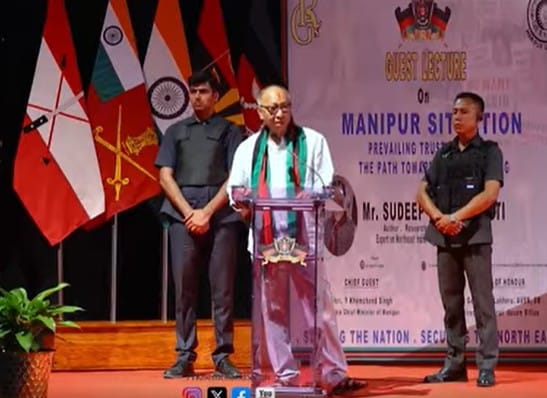
I waited for my turn with my hand raised to ask two simple questions in the Q&A session of A Special Lecture on Manipur Situation: Prevailing Trust Deficit and The Path Towards Trust Building, delivered to celebrate an MoU signed between Manipur University and Army authorities at the MSFDS, Palace Compound, Imphal, on 28th September 2026. However, the last few minutes were given over to an AR Officer to present his views and concerns on the people’s narrative-making, which has negatively affected the images of the forces on the ground. After listening to the concerns for forces on the ground, I also returned happily with clarity on the role of the SF in a straight and blunt answer from Lt. Gen (Retd) Konsam Himalayas, who moderated the panel discussion: The Army should never get into this area outside the mandated duties! I hope this opinion finds resonance with that of the Home Ministry also, but at the same time, I am also against foreclosing the option of playing a facilitating or participant-observer’s role, as was strongly suggested by the panellists, in creating a safe space for multi-stakeholder involvement in the process of addressing the ‘Trust-Deficit’ in all its entirety. I say this because there are demonstrated models of the armed forces facilitating successful conflict transformation processes in the Philippines and elsewhere in other countries experiencing asymmetric intrastate vertical and horizontal armed conflicts.

Trust-deficit to trust-building is a post-war foundation for the conflict resolution process to move on. It is a continuous process of creating reliable relationships by actively involving all parties who have a stake in the conflict. This requires an inclusive and collaborative approach, leaving behind old antagonistic and hostile perceptions about each other with clear communication, consistent actions, setting up a feedback mechanism, and ensuring the accountability of all stakeholders in the process. What is most important in initiating such a path-breaking step is LISTENING with an OPEN HEART and MIND as responsible citizens. And the conflict resolution process in the case of Manipur has to be a multi-stakeholder and multi-layered engagement to arrive at a comprehensive solution acceptable to all parties in the conflict.

I felt honoured to be invited as a native ‘Peace Activist’ to the special lecture, which came up as part of a recently signed MoU between the AR-Army and Manipur University – a new chapter towards a larger conflict resolution programme. This is something I have longed for and made efforts towards for many years with Col (Retd & Late) Jassal and a Rotarian in-charge of the Peacebuilding Fellowship programme while he was alive. The event for me was a very well-thought-out strategic initiative on the part of the Union Government through its Army for a social transformation process in Manipur. I trust that the Government is determined and well-intended, as Yumnam Khemchand, the Hon’ble Chief Minister, who is also currently making peace-making efforts across divides and opening important roads, graced the opening function, promising the Government’s full support and encouragement for the initiative. As a keen observer of the lived-in conflict situation, the context within which the programme is set and a few critical factors that must be considered openly for the public must also be highlighted.

The present context of the programme

The security forces on the ground have been losing their neutrality in the eyes of both the Meetei and Naga communities on one side and the Kuki armed groups under the SoO with the AR-Indian Army. Three communities are locked up in contesting claims and counter-claims over territories and autonomy. The BJP Government is facing an election anytime in 2027. The party has been in recovery mode regarding the lost image and trust of the people. The news about Amit Shah, the Hon’ble Home Minister, visiting the state in the first week of August has been in the air to do something great after three years of the outbreak of violence in the light of the forthcoming election. The ‘Naga community’ is frustrated to the extreme, while the series of uncontrolled and repeatedly targeted brutal killings of 10 Liangmei tribesmen, a minority tribe (6 men on 13 May and 4 on 27 September 2026) by armed Kuki outfits in the immediate neighbourhoods, has created a deep sense of insecurity and trauma in the community without any relief from the security forces on the ground. Liangmei villagers say that they are being targeted to displace them from their ancestral villages, which has become a major hurdle on the ‘tiger road’ – passing through Liangmei territory as the only alternative road connecting Kuki-zo dominated areas; Churachandpur, Tengnoupal, and Chandel districts. While the mutilated bodies of the first six men killed remain unclaimed, demanding justice, another targeted killing of four more Liangmei tribesmen on 27 August has made the situation extremely tense, with Naga bodies calling for a total shutdown. And in the valley and hills, the Naga and Meetei communities are on an intensive campaign: “NRC before CENSUS” against the interests of the Kuki political groups.

The right persons on board

The special lecture: *Prevailing Trust Deficit and The Path Towards Trust Building* was delivered by one of the finest concerned citizens, writers and researchers, Sudeep Chakravarty, a Professor of Practice, Chair and Communication Programme, and the Stepwell Centre for Asian Future, at the University of Ahmedabad, Gujarat, presenting an ‘outsider-insider’, well-studied humane, historical and cultural view. And to complement the outsider-insider view for a comprehensive understanding of the situation in charting out multi-stakeholder and multilayered pathways towards trust-building, the organisers had three of the finest native conscience-keepers of Manipur for their well-informed insiders’ views on the situation: Dr. RK Nimai (Retd IAS), who had a lived-in history of the state and served the state Government in his best capacities; Pradip Phanjoubam, widely read and consulted for his ethical journalism and alternative perspectives on the Manipur situation; and Th. Brojen (Retd IPS), who served in the heart of the security sector and retired as the Chief Security Advisor to the UN Iraq Mission at the UN HQs. The combined views of these three insiders on critical areas of concern – demographic anxiety, socio-economic relations between hills and valley, and security concerns in the state – successfully created a comprehensive cross-sectional picture of the current situation. And Lt Gen (Retd) Konsam Himalaya, the highest-ranking retired army officer from the state who served in some of the most disturbed conditions in India, was the perfect choice to moderate the panel discussion after the special lecture was delivered.

Historical connect to the present initiative and scope

For me, having Professor Sudeep Chakravarty from the University of Ahmedabad, Gujarat, in Manipur at the Palace compound – approximately 3,000 kms away from the west of India – served two purposes: 1) it refreshed the memory of the then highly respected and most powerful Home Minister, Sardar Patel from the same state, ordering the ‘take-over’ of Manipur as the root cause of the original ‘trust-deficit’ and the consequential violence in Manipur in the extreme east; 2) Prof Sudeep, representing a prestigious University in Gujarat, having personally studied Manipur minutely from an outsider-insider perspective, explored path-breaking ideas of addressing the ‘trust-deficit’ in partnership with Manipur University. This is definitely a new chapter in the west and east relation within India after 76 years of human suffering through the deep militarisation of the state. Although the present effort is to address the trust-deficit between ethnic communities, I do hope that in future, the scope of the partnership should also cover the root cause of the Manipur problem. Now, I would make some observations and suggest a few in support of this rare initiative after a lifetime for regional peace, security and development.

Observations

It must be acknowledged that the Assam Rifles-Indian Army, deployed under AFSPA 1958 for counter-insurgency operations, has been a key stakeholder in Manipur’s problem from day one. Therefore, it is also the right institution to be part of the solution for a better democratic nation and state. Whether perceived or actual, the two major communities, Meetei and Nagas, think the security forces have their own stake and perspective on the situation and are hence playing a partisan role with the SoO Kuki armed groups in the ethnic violence in Manipur. Manipur seeks a holistic solution for a critical role in the region’s peace, security and development, based on its rooted history. The security forces can certainly take a new role, as was suggested by Th. Brojen, as a facilitator of resolving the ethnic conflicts while also preparing the ground for resolving Manipur’s political issue. No more denial or narrative-making, especially when an MoU has been signed with Manipur University to chart out a new course, will help.

Lt. Gen. Vikas Lakhera struck the right chord for new things to unfold in his opening speech by stating that although the AR-Indian Army has grown through the worst situation as part and parcel of it, they alone are not capable enough to address the ‘trust deficit’. He expressed the necessity for multi-stakeholder involvement and the Army’s preparedness to shift its role to facilitate a process of peace and reconciliation across the divides. The Special Lecture from Prof Sudeep presented a comprehensive view of Manipur’s problems by focusing on the horizontal conflicts – the local ‘ethnic problems’ of Manipur. The lecture touched upon several nuances and sensitive areas of its composite cultural traditions and heritage – the east-west connection – in his best efforts to give a lived experience and aspirations of Manipur. He raised questions like, would you like to have both Nongpok thong and Nongchup thong opened for Manipur, which is the historical and cultural connection with the native states of the two neighbouring regions; South Asia in the west and Southeast Asia in the east, to reap the fruits of development under the Look East Policy (1993)/ Act East Policy (2024)? This was clearly a forward-looking invitation to leave behind the past and move forward to explore better opportunities. He also suggested important institutional mechanisms like a Manipur Peace Council and reviving the State Human Rights Commission to facilitate a process of trust-building.

Manipur is afflicted with systemic vertical conflict – a divide between royal families contesting the seat of power of the native state – and so this divide continues to inform present electoral politics. The ‘take-over’ or the merger of Manipur in 1949 by the Dominion of India was possible only when the then Indian National Congress colluded with the Manipur State Congress Committee in total rejection of the successful people’s movement that had transformed the erstwhile monarchy into a constitutional monarchy with an elected legislative assembly representing both the Hills and Valley. The resentment and national humiliation experienced by the first elected legislative assembly of Manipur was soon transferred to the politically active generations of educated youth who began demanding the restoration of the internal sovereignty of Manipur from the 1960s. The leaders of the movement, frustrated by the Government, picked up arms like Bhagat Singh by the 1980-90s, when AFSPA 1958 was extended to the entire valley also on request from the then Congress Government headed by a faction of the Royal Class. These internal armed struggles, known as ‘Counter-Insurgency Operations’, have destroyed Manipur badly – giving more reasons for the people to keep up the struggles through generations. Addressing the root cause of the ‘trust deficit’ as part of the original vertical conflict must be included within the scope of the partnership programme.

Before I come to the suggestions, one most critical issue is the total absence of a peacebuilding fund/budget for civil society engagements, except for the SRE budget the Assam Rifles-Indian Army was provided with to spend on maintaining cordial relations with villages and communities. This budget is not accessible to CSOs. Peace is not budgeted, and so there is no fund to implement even some of the most valuable suggestions, such as people-to-people dialogue, setting up a Manipur Peace Council, and a Truth and Justice Commission, etc. Although the Home Ministry and CM have been encouraging dialogue and reconciliation across the conflicting communities, they have not come up with any dedicated budget accessible to civil society groups and religious bodies. All the peace meetings are limited to Government and Army initiatives. This raises serious questions: How serious is the Government for peace among the people? Why are the Army and Government only trusted for addressing the issue of trust-deficit? It also highlights the limitations of a top-down approach to peace without any committed budget to support bottom-up people’s peace and reconciliation processes.

Suggestions

The Army can certainly undertake a path-breaking “Facilitator’s Role” as suggested by Prof Sudeep and Th. Brojen, the security expert and panellist. There are demonstrated models in the Philippines and elsewhere. This requires the Army and Paramilitary forces, who have grown with conflict as part of the problem, to take a paradigm shift to become part of the solution without compromising their mandated duties. This requires training of army officers in conflict analysis so they may shift their targets from ‘anti-nationals’ or ‘insurgents’ to the problems that produced them. I humbly suggest top officers of the 57 Mt Division take an exposure learning trip to the Philippines.

The root cause of this vertical conflict, the original ‘trust-deficit’, is directly connected to the horizontal conflicts in Manipur by default or design. This is much internal to Manipur and also subject to external interference from the Union Government. The original trust-deficit, which is racially and culturally coloured, has actually entrenched over the years. This must be addressed by following appropriate reconciliation processes between the state and the people and among the ethnic communities.

Let me end this article with the two unasked questions: 1) What next? And 2) How prepared, and for how long, are the Assam Rifles-Indian Army (SF) HQs, in charge of the long-drawn counter-insurgency operation, to shift their role in taking forward these path-breaking initiatives to address the critical issue of the ‘trust-deficit’? And has the Union Government committed a special fund for addressing the root causes of the inter-ethnic trust-deficits?

(Deben Bachaspatimayum is Imphal based expert in peace and conflict resolution)

The post A Question of Trust: Time to Redefine the Role of the Gun in Manipur’s Peace Process first appeared on The Frontier Manipur.

Read more / Original news source: https://thefrontiermanipur.com/a-question-of-trust-time-to-redefine-the-role-of-the-gun-in-manipurs-peace-process/

Chilling suitcase murder solved: couple nabbed in Manipur after pan-India hunt – Udayavani

Chilling suitcase murder solved: couple nabbed in Manipur after pan-India hunt  Udayavani

Chilling suitcase murder solved: couple nabbed in Manipur after pan-India hunt  Udayavani

Read more / Original news source: https://news.google.com/rss/articles/CBMiwAFBVV95cUxOUTc3aGpiZlJhUjRsVV9PMFhUYklIaXhONmJhWFZqbGp6YUl6N3RGT0RXWHZxVVM0ZUpEalBwenhYZDNma1Y5ZEFLaE9fN3lwczZxcjlnazc1VU1VV2hkZEJRVFNKcHdHczUxOFBUdlRoVHo3WWtuM3ZsZGVrX094N3ROVmtsVVpWUHhEX0xRZTZLcmlRUGpoMHgzMWtHZWtRRGhvRUVaV2dtVVE3QnptSDJsVDhyeFBBTDBDa2VPUno?oc=5

Suitcase murder: Couple held in Manipur weeks after womans body found on train – The Tribune

Suitcase murder: Couple held in Manipur weeks after womans body found on train  The Tribune

Suitcase murder: Couple held in Manipur weeks after womans body found on train  The Tribune

Read more / Original news source: https://news.google.com/rss/articles/CBMiugFBVV95cUxPbm1IOFVYMVQtNk5FblFzZGxVeDJoRmNLWm5SYzdhUEdvckNpVk1xVkFMZkgxelJ3TURpbDhXNnpIV1FZbjFTZkpUSndvZ0hkdVFwWWpUMGc2NVA4VGhqUHcyTWJyamdTS1A2TUJ0OWhRRlpMa19TUEZweThMbUxweFhrOF9MV2RmZ1ZJa1FyWW8zYkN0VU9pRkpJRmpjWVUwWWtUM1N1b1h3UDBrVjFOdGFPNFVrUnk3NUHSAb4BQVVfeXFMUFdhZzNVYUpoaGlhZTBRUlJRQVVyX19FZzNEempFS3cybWgwOGVZc1FqWFJxQllEb0ZUVHZxdHhDNXlFWS1weW5uek4yN1RjbWNmMkxHbjlUUFRYdWQzU251RktFdldXMXAtejRZSGpfOUQ5T2hRRjZqaTFxRzh3bHMtajhqazNzR1hheFdnNHo2RDdXRlJaSktkZlZvR05hZkI1MWhMbHZfOHpDOUhMTWZhMG53akUtU2dibnItdw?oc=5

Suitcase murder: Couple held in Manipur weeks after womans body found on train – The Tribune

Suitcase murder: Couple held in Manipur weeks after womans body found on train  The Tribune

Suitcase murder: Couple held in Manipur weeks after womans body found on train  The Tribune

Read more / Original news source: https://news.google.com/rss/articles/CBMiugFBVV95cUxPbm1IOFVYMVQtNk5FblFzZGxVeDJoRmNLWm5SYzdhUEdvckNpVk1xVkFMZkgxelJ3TURpbDhXNnpIV1FZbjFTZkpUSndvZ0hkdVFwWWpUMGc2NVA4VGhqUHcyTWJyamdTS1A2TUJ0OWhRRlpMa19TUEZweThMbUxweFhrOF9MV2RmZ1ZJa1FyWW8zYkN0VU9pRkpJRmpjWVUwWWtUM1N1b1h3UDBrVjFOdGFPNFVrUnk3NUHSAb4BQVVfeXFMUFdhZzNVYUpoaGlhZTBRUlJRQVVyX19FZzNEempFS3cybWgwOGVZc1FqWFJxQllEb0ZUVHZxdHhDNXlFWS1weW5uek4yN1RjbWNmMkxHbjlUUFRYdWQzU251RktFdldXMXAtejRZSGpfOUQ5T2hRRjZqaTFxRzh3bHMtajhqazNzR1hheFdnNHo2RDdXRlJaSktkZlZvR05hZkI1MWhMbHZfOHpDOUhMTWZhMG53akUtU2dibnItdw?oc=5

One militant killed in factional gunfight in Manipur’s Noney – The New Indian Express

One militant killed in factional gunfight in Manipur’s Noney  The New Indian Express

One militant killed in factional gunfight in Manipur’s Noney  The New Indian Express

Read more / Original news source: https://news.google.com/rss/articles/CBMirwFBVV95cUxPNFVaRGpxNi1uTE11WlZzR1czNGpkcXRYOW1uSG5HQl9fZ1B0dXBrS2MzMV9ZMENxZFRMWEZMdlZDdWZXWU1wUzNXWENHWGhXZXJmTk4yeFJXVGZjZDRKcTFkSlM1S0FCazI5WkY2aDJCbUdaRi1sbHFMRUd1MDRzdHZRSFdpM1ptZFAtMlpnUnJpckFvOU53c1doUGdtUUttT1N4dEhXdzhkZUJqODlr0gG8AUFVX3lxTE9EM0luS2YxeVg5Z0lkNHJjQnRuTU9nTmlzaXRBd1MtTXBtQU1xRS10Um9mWGRRRFVUb0x4UVNJMUtMZmxtMWlGMnJWdVdZdTQzeThrLXN4c3hoQUZrbWpyT2M4bjdTQVNXMklzQlBMWEd0MGlVVlVyZE0zTU9FcWdjT3dtSXJZV2lKMFg3b1BaRmhNY3BnRmZxbUhueFZzR3RxanBrcWYxY0x5cjNETV9LcDlfNWJCT2RKS1Bq?oc=5

One militant killed in factional gunfight in Manipur’s Noney – The New Indian Express

One militant killed in factional gunfight in Manipur’s Noney  The New Indian Express

One militant killed in factional gunfight in Manipur’s Noney  The New Indian Express

Read more / Original news source: https://news.google.com/rss/articles/CBMirwFBVV95cUxPNFVaRGpxNi1uTE11WlZzR1czNGpkcXRYOW1uSG5HQl9fZ1B0dXBrS2MzMV9ZMENxZFRMWEZMdlZDdWZXWU1wUzNXWENHWGhXZXJmTk4yeFJXVGZjZDRKcTFkSlM1S0FCazI5WkY2aDJCbUdaRi1sbHFMRUd1MDRzdHZRSFdpM1ptZFAtMlpnUnJpckFvOU53c1doUGdtUUttT1N4dEhXdzhkZUJqODlr0gG8AUFVX3lxTE9EM0luS2YxeVg5Z0lkNHJjQnRuTU9nTmlzaXRBd1MtTXBtQU1xRS10Um9mWGRRRFVUb0x4UVNJMUtMZmxtMWlGMnJWdVdZdTQzeThrLXN4c3hoQUZrbWpyT2M4bjdTQVNXMklzQlBMWEd0MGlVVlVyZE0zTU9FcWdjT3dtSXJZV2lKMFg3b1BaRmhNY3BnRmZxbUhueFZzR3RxanBrcWYxY0x5cjNETV9LcDlfNWJCT2RKS1Bq?oc=5

Manipur set to get 5th chief secretary in 3 years as Puneet Goel retires | India News – Hindustan Times

Manipur set to get 5th chief secretary in 3 years as Puneet Goel retires | India News  Hindustan Times

Manipur set to get 5th chief secretary in 3 years as Puneet Goel retires | India News  Hindustan Times

Read more / Original news source: https://news.google.com/rss/articles/CBMi0AFBVV95cUxQYXdJTUoxNXBKTlo5Sm5RR21iWXF1SlhFbGNEeEN3dUJNRzVwRDBIV01uSk5QTFpyUktlUnpBRjFQSUVUcm8zSl9yRGtvVlpYOFJDUHhnVmt6eWIwUzhmRmF1cmQ3cG1FMUxZcVc5SzhoWjViN1BvNkd2R3BuRFBEYU04WHJiZUJrWkJwZEhScEJ2djVxbGxqYUNKTDBBcXo1TlRwMTlHNElPNlJBLUpZSm5mMlJmYWtyRVkxYnoyUnF2UjUtU3pYM1h3Wl9GNkFS0gHWAUFVX3lxTE95dXBPNm1lUnJFaHFUczZYaUdsSFB5di1HSnkzYmczZGV3R3V6U1BZQno2eDdNMHhXbG9LcGpQR21TMS1pYVFGb3dteTFYSl9pb0tXVVpGc2ZCQUdEVTJTWFNOa3U3WE9MTU1MRjdtc0VYSng0QUdEWFZWU2tVdl9abTdLVkRGUkJBR0w2QmpZYXJuVmVlQUh3aGFqLTR6X3NYalVTODI2MW5kUUtGOHQySUo5SzVjU1FRaWIzZ1kzS1JVa3NmNXB6aUh5R2MtWnhTLWRHaVE?oc=5

BJP may gain 13 MLAs as UDP, TMC legislators eye switch in Meghalaya – The Assam Tribune

BJP may gain 13 MLAs as UDP, TMC legislators eye switch in Meghalaya  The Assam Tribune

BJP may gain 13 MLAs as UDP, TMC legislators eye switch in Meghalaya  The Assam Tribune

Read more / Original news source: https://news.google.com/rss/articles/CBMisAFBVV95cUxPWDVJaE93OGlWRmw0ejkxNUJJS1lyZ1oxNzZpOEl0YldqMGdUdmVFZHVyQ05Kb2RTZ1FWVUJCM2h2MFZXV3FVd1lHR0Vxa21xY2loOHp4dzdTOFJNOUpaOG56QzlTOHo2d2I2Z042Qk9VcW9qdWdQY0M3eE9KZmN2dk1FTDkyRVh6UHp2amtZNVNnTG9iUWVLWDlBQTRDZmZpU0otMGYzcWE1WVRRWXNGWdIBtgFBVV95cUxOS1h2V3VnaFlXLV82N0RNY2lIREtJSHJuZnRlVmVLM3cxSV94QkE3MWg1S3JCN1JUVU9fNWtkbVdzYnVmY0RFeWdkMVNIOUdDQUFrdlloREptei1mVnFPRmRpZHZMVERXa1dVamFpS0lWNGJxOGFqMU4wVGN1akRUT1J1YmVDN1FpbTRPdV9RZjdXRTh4TXJkNTJPYk9zVlVrc24xUnNtZW9QWkhaN1YxeXZ3SEZfZw?oc=5